




Abstract
Maya Shavit (1935–2021) was the founder, director, and conductor of the Efroni Girls’ Choir in Emek Hefer, Israel for thirty-three years. Under her guidance, the choir attained success both in Israel and globally, a result of Shavit’s unique interdisciplinary method for teaching music. Indeed, her method and influence changed the musical landscape for choirs in Israel. The current study is a historical account of Shavit’s life focusing on evidence from first-person accounts: testimonies from Shavit herself and from those who worked with or were influenced by her, including this author. Altogether, they reveal Shavit’s background and cultural history and offer insight into her vision, teaching philosophies, methods, and principles for creative work with youth choirs. They also reveal the many innovative projects she established and details of how she raised the quality of Israeli choir directors of youth choirs to international standards.
Keywords
Introduction
Maya Shavit (1935–2021) is recognized in Israel for her profound contributions to youth choirs. Standing out is the Efroni Girls’ Choir, which she founded in 1980, and which rose to international status due to her unique way of teaching choral music. She influenced great numbers of students and teachers throughout her thirty-three years (1980–2013) as director.
This article offers aspects of her biography and teaching approaches for posterity and for the benefit of others similarly involved in choral music. Understanding Shavit’s philosophy and choir-conducting methods can offer an important contribution to other choral music educators globally. This research aims to commemorate her valuable work (Figure 1).
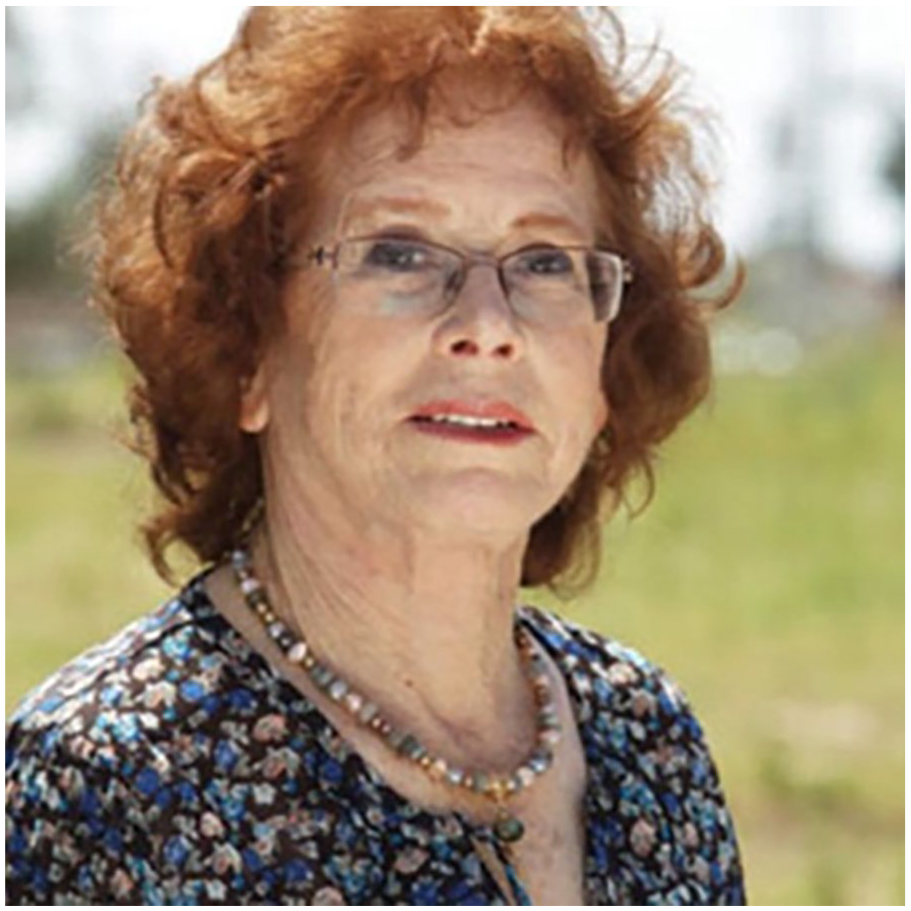
Maya Shavit. Photograph courtesy of the Shavit Family Archives.
History of Youth Choirs in Israel
The field of youth choirs in Israel began to develop in the early twentieth century, during the pre-state period. The Jewish community in the country was exposed to new educational trends from Europe and the United States, brought by waves of immigrants who were involved in education in their countries of origin. This exposure significantly influenced teaching methods and evolving curricula. The most substantial impact on educational and musical activities in the country during those years came from musicians who immigrated from the Soviet Union, including Emanuel Amiran (1909–1993), Shlomo Kaplan (1908–1974), Menashe Rabina (1899–1968), Mordechai Seter (1916–1994), Mattityahu Shalem (1904–1975), and others. These musicians were responsible for creating a significant corpus of Hebrew songs and artistic musical works composed in Israel during the pre-state period, prior to 1948.
Additionally, musicians from Germany and Poland such as Bronislaw Huberman (1882–1974), Leo Kestenberg (1882–1962), Paul Ben-Haim (1897–1984), Yosef Tal (1910–2008), Henry Klausner (1918–2009), Ben-Zion Orgad (1926–2006), and others who arrived during the fifth wave of immigration (1930–1939), played a central role in establishing the Israel Philharmonic Orchestra and other orchestral and choral performing groups, thereby shaping the educational landscape in music teaching in general and in choral activities in particular. 1
The development of youth choirs in Israel manifested in the establishment of choral groups, the organization of conferences, and the creation of an original repertoire of songs in Hebrew. This repertoire served music educators in teaching the language to immigrant students. Prominent figures in Hebrew song composition such as Mordechai Zeira, Sasha Argov, or Naomi Shemer, began writing material specifically for children’s choirs in the 1950. School music educators placed the choir at its center, aiming to provide music teachers with appropriate tools and a repertoire tailored to a diverse student population.
Over the years, many children’s choirs were established across various educational and social contexts, including schools, youth movements, conservatories, boarding schools, and kibbutzim. In 1936, Menashe Rabina initiated the creation of a “Center for Musical Education,” which aimed to formalize the collaborative activities of children’s choirs in schools, support music teachers, and develop curricula that included recommended song lists aligned with the yearly cycle. Within this framework, music teachers from schools in Tel Aviv came together to form the “Council of Singing Teachers.” This council was responsible for establishing teaching methods and a shared repertoire, as well as advising and guiding teachers in the field. As a result, it was determined that all schools in Tel Aviv should include at least four hours of music education: two hours dedicated to general music or singing lessons and an additional two hours for choir rehearsals. 2
From the early years of the State of Israel, during the end of the 1940s and continuing into the 1950s, children’s choirs played a central role in celebrations and ceremonies held in schools, providing artistic expression for the themes associated with holidays, festivals, and significant events in the lives of institutions, communities, and the nation. In this way, the choirs made a significant contribution to shaping school culture. 3
The first gatherings of school choirs in the country took place in 1950, in eight different locations, with the participation of approximately 700 students from across the nation. These events were initiated by the first national supervisor of music education, Emanuel Amiran-Pougatchov, who viewed them as comparative ability test that would serve as motivation to encourage choir directors and choirs to engage in focused and intensive work. His aim was to improve musical performances, enhance the personal skills of the students, and foster cohesion and a sense of belonging among participants—both at the institutional level, within the choir framework, and at the regional or national level, through the artistic connections formed between choirs. 4
Among the prominent artistic children’s choirs and youth choirs were the following: Tzadikov (founded in 1955, conducted by Yitzhak Ziko Graziani and Laszlo Roth), Sharonit (founded in 1960, conducted by Ephraim Markus), and Neve Shir (founded in 1961, conducted by Nathan Margalit). Until the 1980s, children’s choirs in Israel mainly operated within school settings. They primarily performed adapted Hebrew folk songs, with very few original works written specifically for them.
The visits of outstanding choirs from Europe in 1980 and on introduced a new standard of quality for both conductors and singers in Israel. Maya Shavit led this movement, aiming for a dramatic advancement in exposing as many Israeli children as possible to empowering experiences with a fresh, new flavor. As will be elaborated later in the review of Shavit’s contributions, she influenced the establishment of artistic equal-voice choirs during the 1980s.
Purpose and Method of Study
When a musical organization not only continues for thirty-three years under the management of one figure, but also rises to excellence, it raises interest and questions. One, especially, is can this model be reproduced? Is it possible to uncover the “secret” of Shavit’s success to enable future generations to learn from Shavit’s model?
The current study aims to add to the body of knowledge about effective choir conductors by not only detailing Shavit’s background and her fundamental beliefs regarding establishing and operating a choir, but also detailing her teaching principles about how to teach songs in a girls’ choir for equal voices in Israel. It strengthens the meaning of the contribution and enrichment that participating in a youth choir adds to the child’s and the adolescent’s world.
This study presents a narrative oral history of Shavit and her work 5 by gathering personal narratives about Shavit through recorded interviews and personal commentaries of historical significance. The method for conducting oral history is rooted in a deep respect for the richness and complexity of personal narratives, recognizing that oral histories are not just about facts, but about the meanings people attach to their experiences within broader social and historical contexts. So, the story of Maya Shavit emphasizes contextual analysis, which considers the social and historical background in which the case was situated. This includes the relationship between the interviewer and the interviewee, the interview setting, and the cultural or historical events discussed. According to Clandinin and Connelly, the connection between an experience, the narrative, and its meaning is key, implying that the task of the researcher is to collect the narratives of human experiences and interpret them to make sense of them. 6
This historical narrative is based on four sources of evidence.
(1) Fifty-seven recordings of testimonies given by Shavit regarding her musical background, creative work with the Efroni Choir, various choir projects in Israel and abroad, and her methods of teaching canons and songs. These had been already gathered and were supplemented by documents and comments from her family. 7
(2) Semi-structured interviews conducted by the author with fifty-five individuals who had been connected in some way to Shavit or were involved in various projects. This included fifteen Efroni graduates, twelve choir conductors, nine composers, five choir assistants (pianists, managers), four music teachers, four performers and interdisciplinary creators, three family members, two diplomats, and Hayuta Dvir, the anchor and editor of the Kol-Hamusika radio broadcast.
(3) The archives of Kibbutz Ma’abarot (where Shavit grew up).
(4) This author’s personal knowledge of Shavit’s life and work. 8
Interview methods were informed by Creswell and Poth’s approach to narrative inquiry. 9 The interviews with Maya Shavit were conducted between 2018 and 2021. The interviews with other individuals took place from 2023 to 2024 in each of their homes, or by Zoom or by telephone (according to their convenience). The interview questions 10 aimed to reveal both the interviewees’ personal experiences and the Efroni phenomenon. All interviews and archival documents were translated from Hebrew to English for the purposes of this article.
Maya Shavit: A Musical Journey Through History
Early Years
Maya Shavit was born on April 24, 1935, in Kibbutz Ma’abarot in Mandate Palestine. Her father, Abraham (Bumi) Toren (1907–1989), was a great influence on her formation. A natural-sciences teacher at the Kibbutz Ma’abarot high school, he was also a poet, photographer, and writer, and one of the founders of the Society for the Protection of Nature. Bumi instilled in Maya and her two sisters (Tamar and Asia, who are both engaged in art) a love for culture and art. Through his way of thinking and original vision, he taught her from a young age to experience with all her senses.
The Toren’s home was not a musical home; however, there was a lot of music in the cooperative collective space of the kibbutz, and everyone had music and craft lessons from first grade. 11 This collective space supported and helped Shavit’s innate musical talent to develop. Attracted to music in general and to conducting in particular, at the age of ten she was particularly inspired by a production of “Song of Songs” 12 for orchestra, choir, singers, soloists, and dancers that was produced for the kibbutz’s thirtieth anniversary.
At thirteen, she started studying piano, and at sixteen began studying theory, harmony, and solfege. She also participated in a dance troupe, 13 and had a special affection for folk dancing. At seventeen, Shavit participated in a conducting course at the Histadrut Activists’ School where she met conductor and musician Gary Bertini (1927–2005), who was to have a major influence on her approach to music. That same year, she took a course for choir conductors under his guidance, and during her military service, joined his Rinat Choir (founded in 1955 and later named the National Choir of Israel), where she sang for fourteen years.
The Rinat Choir pioneered setting standards in choral activities in Israel. During one interview, Shavit said:
Gary Bertini comes from a European culture . . . singing a-cappella and a completely different repertoire . . . rich Renaissance repertoire that requires the ability to listen. He brought to Rinat the sounds of birds, and the fragrances of spring, but also the pain of love. He painted our singing with a rich palette of colors and the brush of an artist’s hand. Gary educated us in a-cappella singing at its best: on one hand, French, English, and Italian Renaissance continued to be the cornerstone of choral education; on the other, Israeli composers were a fertile ground for creation.
In 1969 (age thirty-four), Shavit traveled to London with her family and studied choral conducting at the Guildhall School of Drama and Music with conductor John Alldis. Between 1970 and 1980, she was engaged in teaching music in schools in Israel. She worked as a vocal instructor at the Inbal Dance Theater, as a music teacher at the educational institution in Gan Shmuel, in the early childhood teaching track at the Levinsky Seminary, and as a conductor of the Emek Hafer Choir. In 1972, Shavit was appointed as a member of the artistic committee of the Zimria, an international choir conference held once every three years at Mount Scopus, where she continued to serve until 2005. Between 1974 and 1976, she taught music and kindergarten at Kibbutzim College. In 1980 she earned her BA in musicology from Tel Aviv university and in 1982, a master’s degree in conducting from Tel Aviv University.
Establishing the Efroni Choir
The year 1980 was a seminal one for Shavit. The Tapiola Choir from Finland visited Israel with conductor Erkki Pohjola. Shavit was very impressed by the choir’s sound and by Pohjola’s collaborations with compatriot composers who wrote for his choir by including its young members in the composition process. 14 Inspired by them, she made it her mission to establish the Efroni Girl’s Choir (a regional choir), which she did the very next year.
Originative Programs
Shavit visited Finland in 1982 as guest of the Tapiola Choir and realized that to effect any change in youth choirs, she needed to encourage Israeli composers to write for youth choirs, and to create a library of international repertoire (then unavailable in Israel).
Composers writing for youth choirs
To encourage Israeli composers, Shavit initiated the Composers Writing for youth Choirs project (starting in 1982 and ending in 1994) during which over forty new works were commissioned from Israeli composers by the music department of the Public Council for Culture and Art. Over the years, many more works have been ordered from well-known Israeli composers.
15
Menachem Weisenberg (professor emeritus at the Jerusalem Academy of Music) recounted:
Composers Writing for Youth Choirs was deeply intertwined with my own development as a composer of concert music. For over three years, I wrote original music and artistic arrangements for youth and mixed choirs, and only then turned to composing instrumental music. I have no doubt that Shavit was the main catalyst to making me a composer [and finding my] own personal creative language.
Composer Sarah Shoham also described how this program became a formative part of the children’s identity: “The children studied a work composed especially for them. They drew new insights about themselves and their environment. Clearly, the learning process was just as important as the concert. The choir becomes a ‘laboratory’ of human relations and life skills.”
Young voices
With respect to international repertoire, at that time music from world cultures beyond Israel and Europe was severely underrepresented and she realized this was partly due to conductors’ fear of foreign languages. To mitigate this, Shavit recruited fifteen publishers from around the world to print editions of songs where the Hebrew translation—suitable for children and with accurate rhyming—appeared below the original (foreign language) text. The result was Young Voices, a series of twenty-six booklets of varying difficulty (simple unison to four equal voices) with translated international choral repertoire, the first of the series published in 1986. Each booklet had four to six songs by composers such as Monteverdi, Brahms, Schumann, Bartók, Kodály, and folk songs from the United States, Russia, and more. These songs generally dealt with content from the child’s world.
Improving and Promoting Choirs in Israel and Abroad
Alongside directing the Efroni Choir from 1985 on, Shavit engaged in teaching the methodology of working with youth choirs and the basics of conducting. This she did at Oranim Academic College (1985–1988), the Academy of Music and Dance in Jerusalem (1985–1993), Levinsky College of Education (1990–2002), and Bar Ilan University (2013–2017).
In 1987, Shavit joined the International Federation of Choral Music 16 and promoted Israeli interests in the international arena. This led to Israel’s admission to Europa Cantat, the prestigious European choir organization. She conveyed a clear message at the Federation’s general assembly: “Music is stronger than politics!” 17 She was applauded for her “dedication, creativity and leadership that raised awareness of choral youth music in Israel and around the world”; 18 for her “commitment to so many projects in which peace, global understanding and international friendship were used as a motto,” and for her “unbelievable positive energy.” 19
In 1988, Shavit co-founded Hallel, the organization of choirs in Israel, through which she initiated various training frameworks for conductors, workshops with guest choirs, and a special seminar for conductors of children’s choirs and youth choirs. 20
Establishing a Choir Culture
Choirs she helped establish
Shavit’s comprehensive, in-depth work also contributed to the world of choirs in Israel in general and youth choirs in particular. Over the course of the years, she helped establish the following youth and girls’ choirs (all are equal voices choirs and currently have female conductors): Herzliya Li-Ron Choir (founded in 1980 by Ronit Shapira), Jerusalem Ankor Choir (1983 by Arnon Meroz and currently conducted by Dafna Ben-Yohanan), Tel Aviv Bat Kol Choir (1984 with Anat Morag), Beit Yitzchak Moran Choir (1986 with Naomi Faran), Karmiel Nufar Choir (1987 by Miri Sade and presently with Rima Preimark), and Petah Tikva Cantabile Choir (1988 by Eva Pitlik followed by Shlomit Madar -Levi).
Collaboration with Arab choirs
Shavit also encouraged the establishment of artistic Arab choirs and in 1996 established a collaboration between the Efroni Choir and the Bethlehem Choir (conducted by Hania Soudah-Sabbara). Despite the explosive security situation at the time (security problems moving from Emek Hefer to Judea and Samaria), 21 the choirs managed to work together (in Bethlehem and at the Rupin regional school). A community artist offered workshops about joint performances in Arabic and Hebrew and they performed together in Sweden in 1997.
Shavit initiated collaboration with additional Israeli Arab conductors, for example with Katy Jarjoura (from Nazareth) and Rahib Haddad (from Shefaram). The latter founded the Sawa Music Center Girls’ Choir. In 2004, the Efroni and Sawa choirs traveled to The Forum Barcelona to perform at an ecological conference that had invited choirs and musical ensembles from places of conflict (Figures 2 and 3).
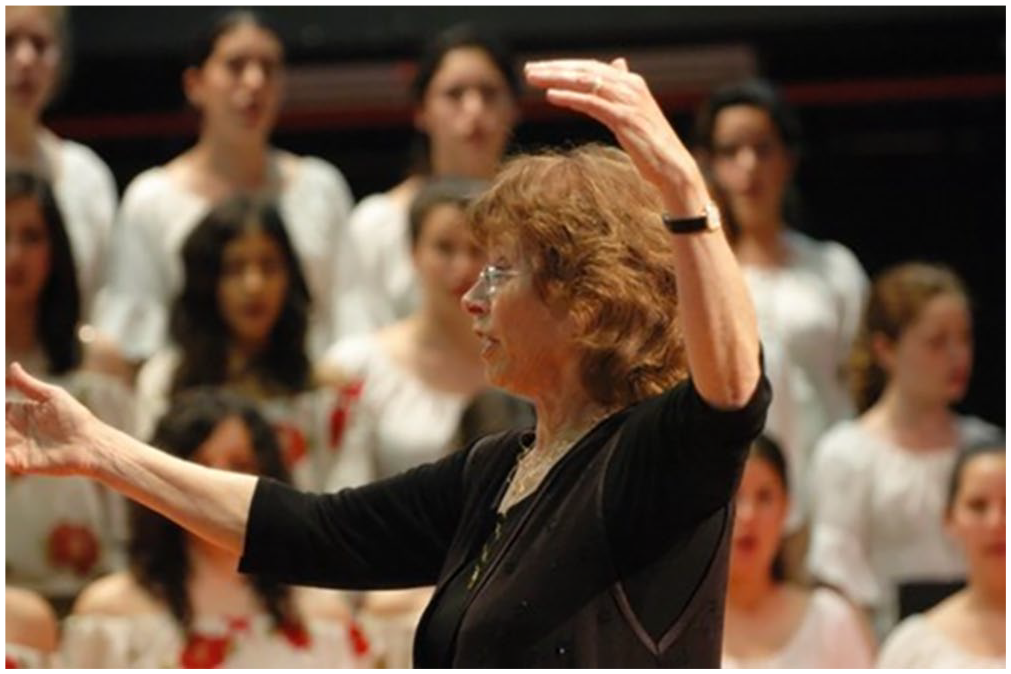
Maya Shavit conducting the Efroni Choir at The Forum Barcelona, 2008. Photograph courtesy of Rahib Hadad.
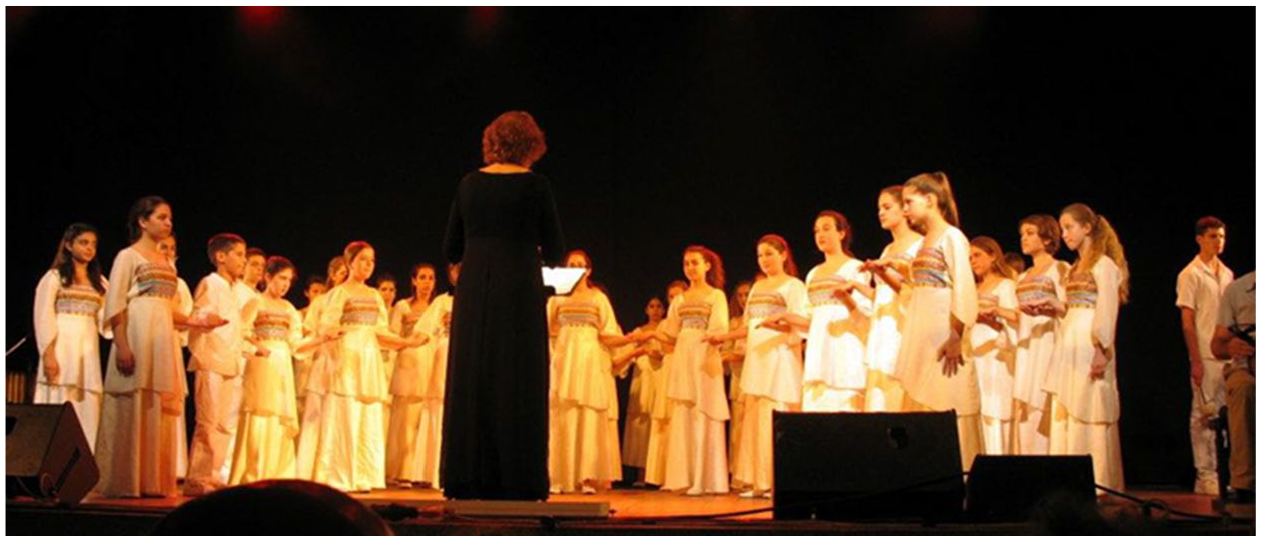
Maya Shavit conducting the Sawa Choir at The Forum Barcelona, 2008. Photograph courtesy of the Shavit Family Archives.
Boys’ choirs
Shavit’s “Finnish” inspiration rooted in the Tapiola Choir also encouraged her to establish several boys’ choirs where the skill and passion of their (male) conductors could serve as models for young boys. She realized that to support boys in their singing, an appropriate framework must be specifically created for them already in the fourth to sixth grades. In 2005, she approached then supervisor of music education, Dr. Yael Shay, who accepted the challenge, resulting in the establishment of several boys’ choirs throughout the country.
A Private Library for the Benefit of Choir Conductors
In 2010, Shavit instituted a consulting library for conductors of youth choirs in her home in Hofit. The library contains a rich and diverse Israeli and international repertoire for equal voices. Conductors at the beginning of their career came to Shavit’s library and selected works that were arranged for equal voices and were written especially for the Efroni Choir. They were assisted by Shavit’s experience, and they expanded their repertoire with new special arrangements and pieces that were performed by the Efroni choir.
In her final years of her life (2020–2021), Shavit developed a project to record the poems and songs by veteran residents of the Emek Hefer community and build a repository of undocumented poems. She was interested in hearing their “home-grown” music, and having it performed by the choir. In this way, she affected the preservation of an important ethnic corpus and melodies that were hitherto passed down only orally.
Awards and Recognition
Given the success of her choir and Shavit’s innovative and dedicated work, it was inevitable that she would receive many awards and accolades. These included the 2003 Frank Peleg Award 22 for high level artistic musical work and the 2012 Landau Performing Arts award. 23 In 2020, she was proclaimed “Darling of the Supervision of Musical Education” for “promoting and enriching Israeli youth choirs.”
The proof that singing continues for generations to come, is that in 2024, there are six Efroni choirs: Little Larks (ages 5–6), Lark Chicks (grades 2–3), Young Efroni (grades 4–6), Efroni Girls Choir (ages 7–18), Efroni Graduate Ensemble, and the Singing Parents’ Choir.
Building, Maintaining, and Directing a Choir
A close analysis of ideas applied by Shavit regarding building, maintaining, and operating a successful choir (given by her and her graduates and co-workers), reveals a total of thirteen specific ones, several of which are typical of many choir directors (i.e., social formation, diverse repertoire, optimal conditions, encouraging excellence in performance, documentation). I therefore chose to highlight eight practices that are unique to Shavit, namely, (1) inspiration, (2) fixed routines, (3) technical-administrative support, (4) avoiding excessive judgment in auditions and having faith in ability, (5) collaboration and cooperative learning, (6) guiding principles, (7) worldwide interaction that cultivates graduates’ personal careers, and (8) intergenerational work.
Shavit believed that a choir conductor has enormous impact both on the way a choir functions in terms of singing and in terms of the relationships between all involved (conductor and members, and between choir members themselves). 24
Inspiration: From vision to reality. Find inspiration in external sources, culture, and musical heritage and understand the desired sound image these references are attempting to express. This may come about by listening to other choirs with a unique sound led by conductors with a musical education agenda (e.g., the Bertini or Tapiola choirs).
Fixed routine. Hold rehearsals in a permanent place and at fixed times. Demand that singers be committed and attend every rehearsal.
Technical-administrative support. Recruit new participants using an ongoing, structured logistical system. Understand that a choir is supported not only by the musical conductor but with the assistance of the rehearsal director, accompanying pianist, administrative manager, etc.
Avoid excessive judgment in auditions and have faith in children’s ability. Ensure that participants feel equal and those less talented are not ignored. As Shavit said:
I truly believe that any child can sing. I learned quickly to welcome anyone who is interested. They will learn along the way. I expressed this insight when I lectured to an audience of 500 choir conductors in China. The choir was behind me, and my lecture was accompanied by demonstrations. I started by saying “Never tell an 8-year-old that they can’t sing in your choir, because they will never sing again in their life.” We have no right to take away from a child the most personal thing close to his heart, the possibility of singing. We must believe in his ability to develop.
5. Collaboration and cooperative learning. Encourage singers to be active in arranging and producing songs and experimenting with other arts. This empowers them. Enhance their sense of personal identity by having them take responsibility and perform additional roles (e.g., experienced members teach new members songs from the repertoire). Collaborative learning in small groups encourages mutual relations, a sense of belonging, interpersonal thinking, and discussion. Involve singers, assign roles, and give musical responsibilities within the creative activity. This will enhance their joy of singing.
Cooperative learning is meaningful and experiential. It builds knowledge and encourages higher-order thinking, in accordance with the constructivist paradigm and socio-cultural approaches to learning. This produces empathy, familiarity, and mutual respect, promoting a sense of meaning. Watching peers’ activity and reciprocal relationships builds knowledge and develops skills. 25
Collaboration also applies to partnerships with other composers, choirs, and orchestras, and with different genres. For example, the Efroni Choir has collaborated with many other choirs, ensembles, and individual artists. 26 The choir has also participated in a wide variety of productions, festivals, and important events in Israel. 27
Composer Sara Shoham explained how Shavit used collaboration to achieve unique, creative work:
In a workshop, Shavit divided the children into small groups. Each group was to improvise on a motif they chose from the piece being studied. Thus, the piece became a part of their lives. The improvisation charged the motif with new meaning, and when all the improvisations were assimilated into the piece, it had a deeper dimension effected by all the members.
6. Guiding principles. Shavit believed that a conductor should use the following three principles to guide their work with a choir.
Pedagogical work. Singing in a youth choir is not merely an artistic goal. It should primarily be an educational approach through which windows are opened into a wide world of culture: literature, dance, theater, plastic arts, poetry, and various aspects of ethnic culture.
The importance of the process. Performing on stage is not the goal. Rather, it should be the result of a process by which the young singers internalize the piece. The process must not be ignored. Time must be allowed so that their involvement increases, enriching the eventual performance. Accelerating the study may shorten the route but does not contribute to internalization and the work is forgotten very quickly.
Decoding the score. Because the musical material is the most important aspect, the conductor must “decode” the score to grasp its salient elements, find the most effective way to work with it, understand the composer’s intentions, and bring the work to both choir and audience in the most fascinating way.
7. Worldwide interaction that cultivates the graduate’s personal career. Shavit took the Efroni Choir on dozens of tours to different countries to meet other cultures. She also encouraged many graduates to pursue a career of their own. Discovering the artistic power of young musicians will inspire many to continue to engage in music. Many Efroni graduates have embarked on international careers as a result of Shavit’s encouragement. 28
8. Intergenerational work. Encourage interaction between different age strata, between graduates and their own children who also join the choir, and between conductor and students, who are potential future choir conductors.
Innovative Teaching Methods
In addition to the principles noted above, a review of Shavit’s working methods identified twenty specific unique techniques for working and teaching three distinct genres of repertoire—canons, songs and liturgical hymns, and interdisciplinary activities—with respect to musical elements such as structure, tonality, text, and interdisciplinary work. 29
Canons
When teaching canons, Shavit employed seven specific methods. These include repeating the melody with clapping; imitating the melodies’ rhythm by marching; and reciting the canon’s words silently (without singing aloud) at the right voice entrances. She also used ostinato (preferably with songs in a small range or with a pentatonic or modal tonality that is not major or minor). For instance, the first group will whisper “Rain come” at regular intervals, and the second will sing the melody and then the two groups change roles.
She often used the text as a starting point: the choir receives the text with an explanation that the song was written as a canon. The choir is divided into groups and each group prepares the canon by speaking according to the song’s rhythm. The groups inevitably create rhythmic canons with different meters, and one group uses variable intonation in two chasing voices. Later, each group is asked to add a third voice at a different tempo, thus augmenting the theme in a rhythm they chose.
Shavit used two methods in which she divided the choir into three voices where each group composes a canon in movement with the song and, in the case where the canon has a complex, variable asymmetric meter, having the singers step the eighths and skip the fourths.
Songs and Liturgical Hymns
With respect to songs and hymns, six methods emerged from the interviews and testimonies of former students, and my observations of her choir directing, each based on a different element (structure, key, musical terms, diversity in performance, text, and liturgical hymns). I will focus on the latter two.
Shavit believed that it is easier to achieve creative freedom by working with language elements than with sounds. Because speech is the property of every child, they can acquire creative skills and enjoy discovering the games inherent in letters, words, and their combinations. Here are three strategies that were mentioned by interviewees: (a) The choir is divided into groups and each group works with part of the text to give it some verbal “musical treatment” (not by singing) using different rhythms, intonations, dynamics, textures, etc. After twenty minutes, each group presents their creation in front of the others; (b) the singers read the poem out loud; (c) the conductor writes each stanza on a separate piece of paper. The singers must arrange the stanzas in the order they feel is most logical. For example, if the song deals with a storm at sea, they might sort the stanzas according to common themes: sea, ship, sailors. They decide where the text’s climax belongs and then recite it, building and lowering tension as required. This allows understanding the language, structure, meter, and other artistic considerations in the musical piece’s structure.
In the context of liturgical hymns, some of the respondents described how the girls in the Efroni Choir did a reading of the seven-verse song “Shir ha’Shirim” (Song of Songs) in the traditional Sephardic form. The main idea was to add persistent sounds (accompanying figures) to enrich the piyut (liturgical poem) without marring the original style by following the following steps: (a) The singers moved around the room freely while singing a rising and falling C-major scale, each at their own pace. (b) They are asked to stop (each independently) on one of the scale’s notes and to hold the note for an extended period. (c) As each girl stops, a cluster is formed that includes all the scale’s notes. The acoustic result is surprising and exciting for the choir. (d) The notes of the piyut’s scale (mode) are located and they sing it together. (e) The choir walks around the room once more, this time singing the piyut’s scale and stopping on notes that seem “right” to them. (f) At the end of each verse, one girl is asked to hold the note until the end. Thus, by the song’s end, a cluster of seven sounds has been formed from the sounds the girls chose. The result is an arrangement of the piyut in which lingering sounds are heard between verses and accumulate toward the song’s end.
Interdisciplinary Teaching
Interdisciplinary work that combines music with other arts enriches and develops the singers’ sensory experiences by exposing the choir members to a wide range of other artistic disciplines that can mutually enhance one another.
The following are six specific examples that illustrate Shavit’s approach to interdisciplinary teaching (according to Shavit herself and her graduates).
(i) Learning texts of Japanese haiku poems (composed by Eran Dinur), while getting to know Japanese culture (e.g., calligraphy, art. dance, Zen theory, haiku).
(ii) Learning “Malagueña” (words by Federico García Lorca, Composer, Einojuhani Rautavaara) and watching a video of flamenco dance. 30
(iii) Introducing Bach’s Cantata No. 4 while listening to two Hallelujah parts and re-composing only those parts by developing, embellishing, or extending the word “Hallelujah.” Playing the outcome to the whole choir can be fascinating; in some cases, it is very close to Bach’s style.
(iv) Sound work inspired by a painting. One example described involves showing the choir a painting [Untitled (Violet, Black, Orange, Yellow on White and Red), 1949] by visual artist Mark Rothko, best known for his color field paintings. They were tasked with turning this Rothko painting into a sound event in space. The singers examined the painting, discussed what they “saw” in it, and then, in groups, interpreted the visual experience with sounds (and perhaps movement). There was no intention of creating something uniform, just an impression. Most groups presented “clouds of sound” (clusters) at different heights and varying density. Some added movement expressing contraction and expansion.
(v) Familiarity with different ethnic groups and their customs (food, culture, clothing, movement, poetry, religious worship). One example was working with dancer and choreographer Leah Avraham (b. 1945) on Yemenite songs. She described the customs and traditions of women’s songs in Yemen and how the Arabic language is interpreted by body language accompanying the songs.
(vi) Finding a common denominator in lullabies from different nations. There is a common modal harmonic structure in lullabies from different countries. The choir created a lullaby that transcends time and place to connect with the universal idea of “lullaby.”
Conclusion
In her life work, Maya Shavit combined her childhood culture of song with her appreciation for girls’ singing. Over 400 Efroni Choir graduates emerged from under her hands during thirty-three years of choir activity some of whom, as mentioned, are at the forefront of the music world in Israel and abroad.
The overarching theme of Shavit’s teaching practice was collaborative learning conducted in small groups and emphasizing cooperativeness and equality (as part of the group) with individuality. Each member was responsible for their own learning goals alongside those of the group, an important component of social, academic, and cognitive development. Each member became part of a significant body of singers.
In the choir setting, the primary connection is between the text and the music, and sensitivity to both must be developed. But the artistic engagement in Shavit’s work with the girls was not limited to music and text. Delving into the origins of musical pieces led the girls to engage in dance, drama, visual arts, and more, thus illustrating abstract concepts and opening new channels for learning and understanding. In addition, relating to the accompanying social and cultural values enabled an open and productive conversation.
From the six different starting platforms for a choral conductor’s career Jansson and Balsnes presented, Shavit defined herself as a music educator. In addition, there is a correlation between Shavit’s emphasis on competence, community, meaning, and identity and Wenger’s notion of communities of practice. Even though the choir is a model of learning, it also has non-democratic characteristics because the individual must ignore the ego to contribute to the many voices. In Shavit’s search for ways of learning that provided an alternative to memorization, she came up with creative solutions that she shaped during her work with the Efroni Choir. In the words of composer Yehezkel Braun (1922–2014):
Efroni is not a bird. [“Efroni” means lark in Hebrew.] Efroni is a chorus that is more like a river. As Heraclitus said: the river you step in today is and isn’t the same river you stepped in yesterday. So is the Efroni choir: . . . Graduates leave, and young girls fill the places. But the uniqueness remains as it was: the special sound, the vitality, the freshness, and the love of music. Similar features can also be found in some other choirs, but what distinguishes Efroni from others is the unique personal stamp left by its conductor, Maya Shavit.
31
Wis, a choir conductor herself, described the leadership elements involved in conducting a choir.
32
In her words she reminds Maya’s personae, “Conductors are leaders—and as leaders, we can move to an entirely new level of effectiveness when we understand our position to influence others for good by who we are, what we say, and what we do.”
33
Also,
As leaders of our ensembles, we need to judge the best ways to engage the ensemble so that our time is still used efficiently toward accomplishing our group goals under a unified vision. If we know what motivates our singers, manage our time well to create momentum, and continually take stock of the balance between process and product, we will maximize our opportunity to influence the learning and artistry of those we lead, becoming an “agent of change” for the better.
34
The following monologues also effectively illustrate and encapsulate Shavit’s multifaceted character. Shira Gefen, today a playwright, actress, and screenwriter, said:
During those critical teenage years, I got to find my voice. When I say “voice,” I don’t mean my singing voice. I mean something much more internal and sweeping. The choir was the first place I felt needed. Although I was one small voice in the alto section, I still felt a part of something bigger and more sublime. Singing in the choir forced me to be supportive, precise, and attentive, and to fully experience the moment. When you sing in a choir you can’t anticipate the future or think about the past. You must concentrate on your role while listening to those around you, who are completely different than you.
Composer Sarah Shoham also describes how participating in the Efroni choir makes a formative contribution to children’s identity:
The girls understood that singing in a choir creates an encounter between the self and the other and forms an important part of one’s identity. You and the person singing alongside you must strive to find a merged vocal connection without losing one’s uniqueness and without getting confused. This is the power of music . . . to learn how to cope with the multiplicity of opposites, like the social entity. To work together while respecting the individual. Singing also releases emotion and sound from within: the hidden soul searching for a light, which becomes a thin flame, which lights another and another . . . Those who retain their voice have less risk of losing their identity; they discover the voice within them that gradually becomes the true resonance of their identity.
Shavit herself described a choir as “togetherness from which magical moments of soul transcendence are created and etched in the heart,” and that “cultural resilience is a value whose importance does not fall from the importance of political resilience and security.”
35
Inbal Hever (Zarachovich) (b. 1977), an Efroni graduate, is a classical trained singer, performer and teacher who divides her time between New York and Berlin. She describes the essence of her experience, especially the joy of singing, and summarizes it as follows:
Every now and then, Maya would ‘come across’ a song she liked—from home, while traveling, or perhaps a song performed by another choir in our presence—and you could instantly see her immense excitement. She would start imagining what kind of ‘delicacies’ she could make of it. I’ll never forget the moment we first heard the Prayer of Saint Francis, sung by a mixed choir from the Philippines at a festival in the U.S. Maya was ecstatic, and immediately, with great urgency rushed to get the sheet music. She would have us sing at every street corner or spontaneous opportunity that seemed right to her, full of enthusiasm, a desire to share, and a deep, genuine love for singing and music.
Inbal continues, much like other alumni, by noting that many of her early musical connections and collaborations were thanks to Maya, and that much of her experience stemmed from her influence:
Maya was the one who prepared my first “gogel mogel” (a traditional vocal remedy). She accompanied me to recording studios and rehearsals. She introduced me to my first vocal coach, and she opened the door to a new and mysterious world when she sent me to a workshop on ancient music at Mishkenot Sha’ananim (The Music Center in Jerusalem). Maya was the responsible adult in my life, offering support and protection beyond the confines of home. She opened many doors for me, both as part of the group and individually, and even after I left the choir, she tried to help me navigate my choices. She became one of the closest people in my life. When she passed away, many alumni shared that same feeling—that she was like a compass or guiding star for them. They always felt a special bond with her and often expressed how profoundly they missed her in their adult lives.
I conclude this article with the memory of Maya’s image as her former student. Her hands, standing in front of us, conducting, are imprinted in my memory—her eyes wide open (whether smiling, worried, disappointed, or grateful), her mouth slightly moving with us to the words, and her whole posture alert and engaged. To stand before a conductor is to learn a unique form of communication and to gain an anchor that is rare to find, and we, all her students, were fortunate to receive both. I found out that the Efroni Choir became a home for the girls—a home that offered structure but was also rewarding. It was a home that required and demanded time, responsibility, learning, the ability to endure pressure, and a great deal of selflessness. In return, they received gifts: making music, singing together, collecting experiences both alone and with others, being part of a community devoted to a shared purpose, performing on stage, traveling in Israel and abroad, learning about new cultures through music (and languages, dances, and costumes), practicing diplomacy through music, and forging lifelong friendships.
In singing together you learn how to commit, how to prioritize. And all of this, together and separately. You learn how to both stand out and blend in. There’s a great power in both giving and receiving. And from that comes the devotion—of the singers and Maya’s. In acquiring this kind of experience in youth, it likely becomes an integral part of the singer’s identity, a lifelong gift that each of them carries wherever they go. 36
Footnotes
Declaration of Conflicting Interests
The author declared no potential conflicts of interest with respect to the research, authorship, and/or publication of this article.
Funding
The author received no financial support for the research, authorship, and/or publication of this article.
