




Abstract
Jane Frazee, an American music educator, administrator, and author has contributed to music education in the United States. This article surveys the impact of her efforts from 1960 to 2015. A pioneer member and past president of the American Orff-Schulwerk Association (AOSA), she taught music to children and adults using the Orff approach and has presented at workshops, clinics, and conferences throughout the United States, as well as internationally. She authored several books and Orff arrangement collections, and her articles have been published in prestigious professional journals and other publications. This paper addresses Frazee’s early life, training, influential individuals, teaching of children and adults, and her work with AOSA. Her roles in the founding and administration of Orff certification and graduate programs in music education in Minnesota are discussed. Lastly, Frazee’s role as an author and the influences of her publications on music educators in the United States were also examined. Although retired from teaching and administration, Frazee continues to publish and inspires current and future generations of music educators.
Keywords
Introduction
Jane Frazee was drawn to Orff Schulwerk shortly after she began teaching elementary music in the early 1960s. Through a series of interrelated events, she met several early Orff pedagogues who introduced her and other American music educators to the Orff process. These experiences included workshops, summer courses, publications, Orff Schulwerk music resources, and early American Orff-Schulwerk Association (AOSA) national conferences. Since 1969, Frazee has been an active participant in teaching and proliferating the Orff approach in the United States, through her roles as a founding state chapter member, workshop clinician, an eight-year member of the AOSA National Board, Professional Development Conference coordinator at the local and national levels, and Past President of AOSA.
Frazee’s interest in Orff Schulwerk was an outgrowth of her desire to teach music to her students in ways that would, not only develop their skills in music appreciation and technical performance, but also their abilities to create music that would be meaningful to them on a personal level. She wanted her music education program to be one that went beyond the singing of songs and listening to music that children could not fully understand. Frazee wanted to develop musical experiences for her students that allowed them to actively participate in the learning process and encouraged them to take ownership of their musical learning. To do so, Frazee began creating new materials that appealed to her students. Throughout her career, she introduced students to the Orff media: speech, song, movement, and playing instruments. 1
Her role as an instructor in summer Orff levels courses afforded her many opportunities to share her knowledge of music teaching, pedagogy, and curriculum with generations of music educators. Through this work, she realized the need for new types of graduate music education programs which would better prepare, stimulate, and challenge practicing music educators. She also created music resources rooted in the spirit of continuous reflection that challenged traditional understandings and applications of Orff Schulwerk in American music classrooms. Each of these examples were influential to Frazee’s teaching. This historical narrative examines Frazee’s three-pronged professional career of teacher, administrator, and author, and explores the significance of her contributions to music education in the United States.
Research Questions
This paper examines the contributions Jane Frazee made to Orff Schulwerk and music education. Excluding her time at the Orff Institute University Mozarteum in Salzburg, Austria from 1981 to 1982, and her participation in conferences and summer training sessions in Canada, this study was limited to the contributions she made in the United States. The following research questions guided this investigation: 1. Which events or experiences helped shape Frazee’s professional career? How did they influence her teaching of children and adults? 2. Which personal encounters with early Orff pedagogues and mentors were the most influential to Frazee’s teaching? 3. How did Frazee’s music teaching approach differ from her contemporaries? 4. What factors were most significant in the foundation of the graduate programs in music education and Orff Schulwerk Certificate program at Hamline University and the University of St. Thomas? How was the program designed? What were the original, short, and long-term goals? 5. How were publications written by Frazee different from other Orff pedagogues? How are they organized? Why are they significant?
Methodology
This historical study was constructed using primary sources including an initial in-person discussion with Frazee in Nashville, Tennessee in November 2014, and email messages. A considerable amount of Frazee’s career involved her roles as a teacher of children and adults and an administrator. Since she has retired from both areas, interviews were conducted with individuals from her first, second, and third generations of American adult students. Her former students shared comprehensive accounts of their experiences with her, and explained how she has influenced each of them, Orff Schulwerk, and music education in the United States. 2 Interviews and email messages with some of Frazee’s former teaching colleagues from Orff Levels courses and the University of St. Thomas also took place. A personal letter written by one of Frazee’s colleagues for her nomination to the Minnesota Music Educators’ Association Hall of Fame was also examined. 3 Her role in the foundation of the graduate programs in music education and the Orff Schulwerk certification program at the University of St. Thomas and her publications are also discussed to provide a clearer understanding of her work and vision as an American Orff teacher. Secondary sources included her biography, published in The Grove Dictionary of American Music, 4 books, journal articles and dissertations connected to the American Orff-Schulwerk Association and Orff Schulwerk educators in the United States. Information pertaining to the University of St. Thomas’s Graduate Programs in Music Education, their Certificate and non-degree programs, and the Jane Frazee Distinguished Scholar-Artist Series were also reviewed. 5
Early Life, Musical Training, and Teaching
Jane Frazee was born on 16 July 1936, in Cumberland, Wisconsin. The eldest of two girls, Jane enjoyed a typical American childhood. She was exposed to music from an early age, and her parents bought a piano, a Baldwin spinet, for their home when she was 5 years old, with the intention of her beginning piano lessons. Frazee was active in music ensembles as a pianist, saxophonist, and vocalist during her primary and secondary school years. 6
Despite a keen interest in music, Frazee enrolled at the University of Wisconsin to pursue a degree in business. After one semester of business courses, she reconsidered her future career path and became a music major.
7
Although she enjoyed teaching and interacting with students in the music classroom, the standard approach to teaching music to young children in the 1950s, primarily singing and learning to appreciate masterworks, concerned Frazee. By my junior year, we were introduced to methods courses with I loathed … I thought I had made the biggest mistake of my life, singing all those horrible songs I was forced to sing as a child in school. Music education in the 1950s was neither very musical nor educationally sound. It was designed to create music consumers, with appreciation of the masterworks a central goal.
8
Despite her initial doubts she later became convinced that she had made the correct decision choosing a career in music education. UW music education senior year students spent a semester teaching at the elementary and junior/senior high school levels. Unexpectedly, this experience turned out to be a genuine epiphany. I loved it! The students made me laugh, and they actually enjoyed my fledgling efforts to bring music into their lives. What I didn’t know was that a revolution in music education was taking place in Germany at the time I was learning to teach the old-fashioned way.
9
In 1958, she graduated from the University of Wisconsin-Madison with a Bachelor of Arts degree in music. 10 She secured her first teaching position in Minnesota and began her professional career as a music teacher. In the fall of 1960, she started teaching music at Northrop Collegiate, a private, college preparatory day school for girls in Minneapolis, Minnesota. 11 During the early years of her teaching career, Frazee continued to expand her knowledge and musical training as a graduate student in music education. Frazee completed her graduate studies at the University of Minnesota and was awarded a Master of Arts degree with a concentration in music education in 1961. 12 Throughout her graduate studies, and later teaching career, she continued learning as much as she could about teaching music more effectively and finding ways to better engage students in learning. 13
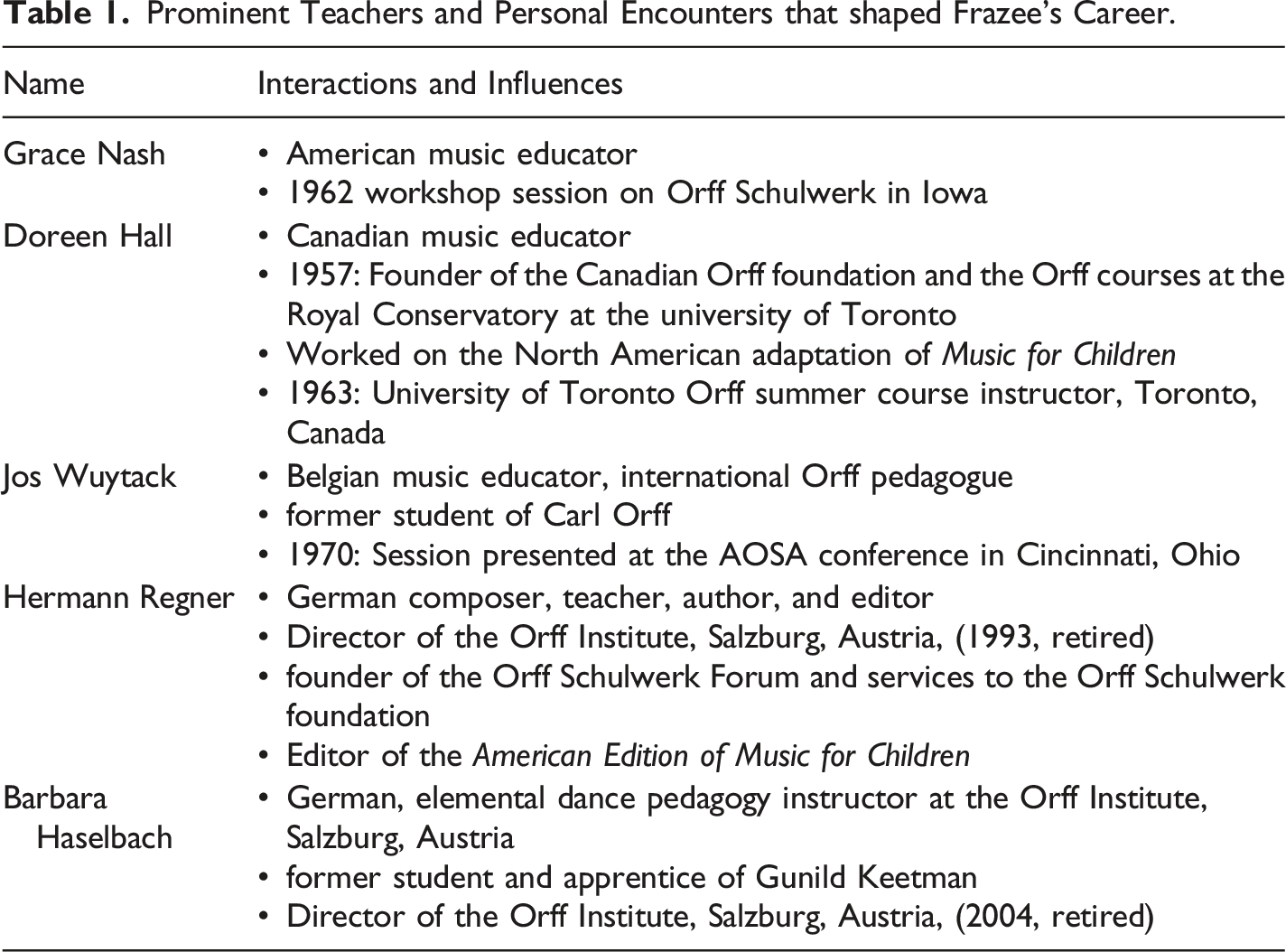
During her second year of teaching, 1961 to 1962, Frazee traveled to Iowa to attend an Independent School conference. At this conference she met American music educator Grace Nash, an influential early advocate of Orff Schulwerk and teaching music to young children. 14 Prior to the Iowa conference Frazee only had a passing acquaintance with Orff Schulwerk, and the Orff volumes. Nash’s workshop was her first official experience with the Orff process. Frazee explained, “Grace Nash unpacked some Orff instrument boxes sent from Germany, we played and sang “Ding Dong Diggy Diggy Dong” and I never looked back.” 15
Fascinated with the child-centered activities and dynamic engagement promoted by the Orff approach, Frazee enrolled in an Orff summer training course at the University of Toronto in 1963 and became one of the first American music teachers to formally study the Schulwerk in North America. Inspired by her studies in Toronto at the Royal Conservatory, she began teaching music to her own students through the Orff process, building on the lessons and activities she had experienced with Doreen Hall and Polyxene Matháy. 16 Hall’s experience as an elementary music educator, when paired with her earlier role in the Canadian adaptation of Music for Children, 17 made her an excellent Orff teacher. Hall provided Frazee with a thorough introduction to existing Orff Schulwerk materials and process teaching. For the next 12 years, the students at Northrop would benefit from Frazee’s natural curiosity, her growing interest in Orff Schulwerk, and her drive to teach music through the Orff process to her students, colleagues, their families, and the community. 18
Influential Teachers and Mentors
Public demonstrations were among the first ways early North American advocates of Orff Schulwerk were introduced to the Orff approach. Significant events from 1955 through 1969 related to the spread of Orff Schulwerk in North America included: the debut of Orff Schulwerk at the Royal Conservatory of Music, University of Toronto (1955), the 1962 summer Orff course at the University of Toronto, and Title III Elementary and Secondary Act projects in the United States. North American Orff training courses were held at the University of Toronto beginning in 1957. First-generation American Orff teachers received training during the summer of 1962, and subsequent summer courses. Special courses at the Orff Institute in Salzburg, Austria were developed later to facilitate more intensive study. The first summer Orff level course in the United States took place at Ball State University in Muncie, Indiana in 1963. The philosophical beliefs held by Carl Orff, Gunild Keetman, and influential North American Orff pioneers, like Nash and Hall, influenced the integration of Orff Schulwerk in American schools. 19
Carl Orff
Carl Orff was a German composer who was intrigued by the combination of elemental music and movement. Through his partnerships, first with Dorothee Günther, and later with Gunild Keetman, Orff was able to advance an innovative approach to music learning and teaching. As a result, Orff Schulwerk, a pedagogical approach which integrates speech, music, movement, singing, instrument playing, and improvisation was created. 20 One of the places where Orff’s wildflower, 21 the Schulwerk has taken root was the United States.
In her 1977 article, “A Visit with Orff”, Frazee recounted her meeting with Orff and Keetman during which he shared with her his views regarding music, nature, pedagogy, and the Schulwerk. 22 Orff claimed, “The Schulwerk was not my discovery. It had been with us—in the air, so to speak—all along.” 23 He went on to explain, “Pedagogy is like a river. As it flows, principles continue to be rediscovered. One can’t interfere with the flow of these ideas or contain them in any way.” 24 Orff believed that a musical education which emphasized a child’s natural instincts, imagination, and creativity was to be encouraged. He explained, “I like to communicate with masses of people, not with their heads, but with their souls. We always must return to the roots for rebirth.” 25 After this interview, Frazee had gained insight into Orff’s mind, and motivations for his approach to music education. She had gotten to know him in a more human way, and not just as an accomplished composer, and creator of Orff Schulwerk. Many of his ideas were also shared by his student and collaborator, Gunild Keetman.
Gunild Keetman
A former student of the Güntherschule and the co-creator of Orff Schulwerk, Gunild Keetman, was a gifted composer, author, and teacher. Her books Music for Children, Elementaria,
26
and others, contain many of her original compositions. In addition, suggestions for teaching music using the Orff approach can also be found in these books.
27
Keetman was influential to the Schulwerk in numerous ways. According to Friedrun Gerheuser, Keetman’s greatest gift as a teacher is to give full value to simple ideas and techniques, and to establish the fundamentals securely before attempting to build on them. Only such an approach can lead on and on over the years in a positive direction. What makes Gunild Keetman so important in the development of the Schulwerk? She herself embodies the main idea of the whole Orff approach, the combination of music and movement. Because she is both a composer and a movement specialist, there has not yet been anyone else so uniquely qualified for leadership in both fields…Without her, the Schulwerk would be unimaginable. Without her, it would not exist at all.
28
Keetman has been a source of inspiration for Orff teachers, including Frazee. Her work has provided a wealth of musical material to be used for teaching students. Nevertheless, her contributions to the Schulwerk go much deeper. Frazee met Keetman again in 1981, while she was a Fulbright lecturer at the Orff Institute. She described a conversation they had on the train ride home from a performance they had attended together, along with Mimi Samuelson.
29
She asked about my work on the train trip. When I told her I was working on a curriculum for Orff teachers (this was to become Discovering Orff), she said she didn’t like to think that way about teaching. Rather, she liked to make lessons inspired by the talents and needs of her students; long-range curriculum planning was not interesting to her. She respected my approach, just made it clear that hers was very different.
30
Although their teaching approaches differed, both respected and supported their colleague’s work. They would maintain a friendly correspondence until Keetman’s death in 1990.
Prominent Teachers and Personal Encounters that shaped Frazee’s Career.
Teaching Children and Adults
Throughout her teaching career, Frazee tried to impart the wisdom she had gained from her studies, and her personal mentors. Frazee aspired to instill a love of music and a thorough understanding of why humans need to make and be involved in music-making activities, and how it has changed through time. She provided a variety of opportunities for her students to experience music through performance, creation, listening, and analysis. 31
Providing her students with sample materials during their music classes, Frazee encouraged them to create their own music based on the models she provided. Students were challenged to study the models and demonstrate their understanding of the concepts while being creative and learning through firsthand activities and play. These activities allowed students to develop a broader appreciation for the flexibility and possibilities of the Orff approach. Frazee clearly understood how children acquired musical knowledge and the ways to stimulate their interests and facilitate musical discovery. Her participation in professional development events related to Orff Schulwerk as a student and teacher helped Frazee understand the need to educate future generations of teachers in the Orff Schulwerk and the pedagogical approach she endorsed.
Classroom lessons and activities were important to Frazee and her students. To provide quality music lessons and meaningful music activities for her students, Frazee carefully selected materials throughout her teaching career. Not only did her students learn songs and dances to entertain them for a limited time, but they also gained a solid foundation on which comprehensive music education could be built. In Judy Bond’s, “Walk in the Wildflowers,” she shared an encounter with Frazee’s teaching. Like many others who have made this discovery, I will never forget my first experience. I had the opportunity to visit Northrup Collegiate School for Girls where Jane Frazee was the music teacher. I watched with amazement as a class of second grade girls sang and played the game “Bluebird, Bluebird Through My Window,” then took places at the barred instruments and sang again, this time playing their own accompaniment while Jane played the recorder. After this they listened and moved with recorded music—a Pavane, for which they would later learn and perform the formal dance patterns. I was inspired and delighted, and eager to learn more about this way of teaching music!
32
Through an examination of the types and variety of materials included in her publications, 33 it is clear to see that Frazee selected high quality rhymes, poems, and songs. Materials that were chosen purely for enjoyment, or non-musical purposes, also possessed an important aesthetic appeal for Frazee, and her students.
Frazee understood her students need to express themselves through music, and she encouraged these behaviors whenever possible. She knew that by using these “teachable moments,” wisely she could also facilitate her students’ social and emotional needs effectively while learning music. Although everything Frazee taught was well planned and always had a specific goal in mind, it was those moments of the “unexpected” that seem to have left some of the most lasting impacts on Frazee’s memories. 34 Also, children often perceive music activities differently than adults, and can use their imaginations in ways adults would not have predicted. Their ability to manipulate and transfer learned skills to new areas demonstrated proficiency in ways that were unique to each student.
Some of Frazee’s more public experiences with her students featured their participation on the radio program A Prairie Home Companion, 35 starring Garrison Keiler, a performance of her Orff ensemble with the St Paul Chamber Orchestra, 36 and a performance by a group of her fifth-grade students at the Canadian National Orff conference in Winnipeg, Canada in 1986. 37 While at this conference, Frazee also presented a workshop session. 38
When instructing adults, Frazee received a great deal of satisfaction working with and learning from different people from around the country and the world. Like Orff, she thrived on the human and personal interactions experienced during music making and learned just as much from her students as they learned from her. She always challenged her adult students to rediscover their childhood freedom. With her adult students, she emphasized that they each possess a thorough understanding of composing and orchestrating for the Orff ensemble in the elemental style preferred by Keetman and Orff. Her knowledge and ability to demonstrate process teaching allowed her to motivate and challenge her in-service music educators to incorporate a wider variety of source materials into their music teaching repertoires. Having benefited from experiencing both the European and North American versions of the Schulwerk in her own studies and teaching, Frazee fully understood Orff pedagogy and was able to make it accessible for music teachers and their students throughout her teaching career.
Frazee’s Teaching Approach
Frazee’s music teaching approach differed from her contemporaries in several ways. She challenged the conventional approaches to music education in the United States since the beginning of her teaching career. She enjoyed trying new things. Frazee wanted the music she taught to present actual musical problems that needed to be solved by her students and enjoyed watching them make discoveries on their own. 39
Although Frazee has been referred to by the music education profession as an Orff teacher, she herself has not limited her thinking about and teaching of music to using only the Orff approach. On the contrary, her interests extend to all music education approaches typically taught in elementary schools, including the Kodály Concept and Dalcroze Eurhythmics. Many of her writings have also emphasized the influential roles Dalcroze, Laban, and other music and movement specialists had on the Schulwerk. 40 Like Orff, Frazee felt strongly that music and movement were inseparable and that both required elements to be developed equally to achieve comprehensive musicianship. Frazee, throughout her career strove to incorporate all areas of music teaching, not because they are recognizable characteristics of the Orff approach, or the Kodály Concept, or Dalcroze Eurhythmics, but because they reflect pedagogically sound music teaching for both children and adults.
As an Orff Levels course instructor and as an administrator of the graduate programs in music education, Frazee has emphasized the need for music educators to engage in both personal and professional reflection activities. One of the most recognizable differences between the music approaches advocated by Frazee and those of her contemporaries is Frazee’s attention to sequence and the systematic presentation of musical skills and elements. Often considered to be more Kodály- or Gordon-oriented strategies, Frazee felt students learning in an Orff-based music classroom also needed this level of sequence in their musical learning. Based on the idea of transferring body percussion to unpitched and then pitched instruments she witnessed in Wuytack’s 1970 AOSA Conference Session, 41 Frazee has expanded this idea of transfer to all areas of music learning. Although she began with a grade-by-grade sequence, Frazee over time realized that music instruction presented in 2 year sequences was a better alternative for both the students and the teacher. Continuing to refine and restructure these ideas, she has maintained that students learn more, and they understand the musical concepts better when presented in an organized and step-by-step format.
Finally, in keeping with Orff and Keetman’s core beliefs that existing rhymes, poems, folk songs, and instrumental pieces should be used as models, Frazee too has based her teaching on these types of materials and resources collected during her professional career. Her books and articles encourage the use of these resources as the foundation of a child’s music learning repertoire. However, the creation of new works in the mode of these models is still a goal for students. Also, rather than seeing sequential teaching as a barrier to creativity, especially regarding improvisation and composition, Frazee’s devotion to order and sequence has enabled teachers to develop rhythm and pitch skills more quickly and reliably with students. 42
Graduate Program in Music Education
The graduate programs in music education at Hamline University and the University of St. Thomas were the result of Frazee’s dedication to making quality music education available for all American students. She felt that one of the best ways to do so was to provide better, more varied, pedagogically based training for the teachers who were employed in P-12 music teaching positions throughout the United States. No such programs existed for graduate music education, so Frazee designed her own programs based on what she and other like-minded music educators believed to be missing As a result, she added preparation, exposure, and guided experiences in all three of the contemporary pedagogical approaches: Orff, Kodály, and Dalcroze for elementary music educators.
Since the first summer Orff Levels courses were held at the University of Minnesota in 1970, 43 music educators have traveled to the Twin Cities in search of a more comprehensive understanding of Orff’s Schulwerk and how to use it in their music classrooms. Frazee was aware of this trend, finding herself right in the middle as an instructor. Following the relocation of the Levels Courses from The University of Minnesota to Hamline University in 1975, 44 Frazee began advocating for the addition of a master’s degree in music education at Hamline. The teachers who were attending the summer courses wanted to pursue graduate studies more aligned with their current teaching situations and felt this was a better option for both their own professional development and the needs of their students. Each summer Frazee observed a similar change in the teachers enrolling in the summer programs from the one she initially felt when she first began to understand Orff Schulwerk. These teachers had more interest in learning about the contemporary pedagogies in music teaching than previous generations. Eventually, the music department and the administration at Hamline University allowed the establishment of the Graduate program in music education in 1984, as designed by Frazee. 45 Over time the program exceeded its capacity at Hamline University, in terms of both student enrollment and staff requirements, and was moved to the University of St. Thomas in 1991, a larger university that could accommodate both the current program’s size as well as future expansions. 46
The graduate programs in music education, and the summer certification programs have continued to grow over the years and have provided quality training to music educators regardless of concentration. 47 Although Frazee retired from her administrative duties in 2001, succeeded by Dr. Jill Trinka, 48 her legacy continues to be remembered by all who worked and studied with her wherever she taught. The programs and courses founded by Frazee continue to operate, thrive, and grow at the University of St Thomas. Dr. Douglas Orzolek is the current director. 49
Teaching Colleagues
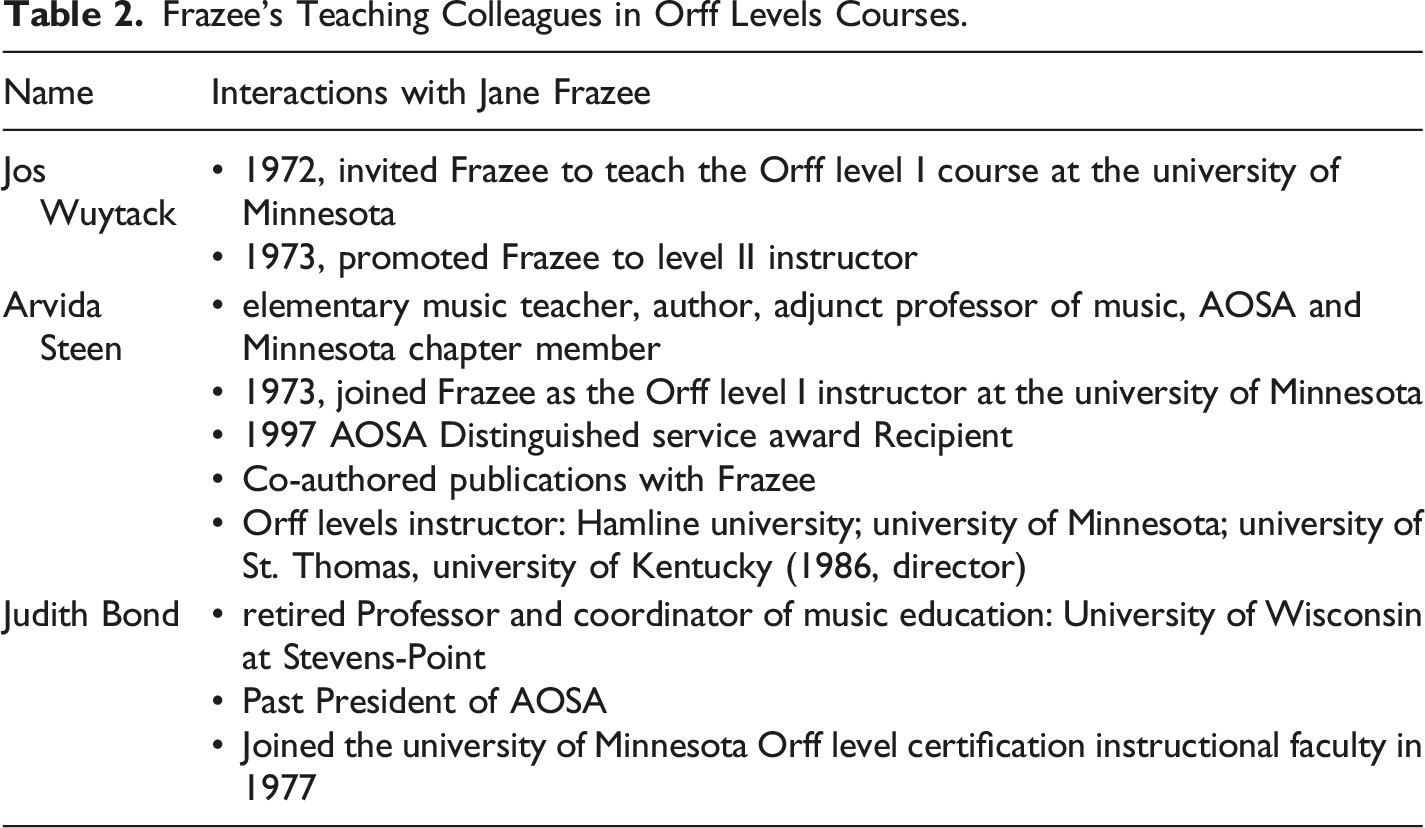
Armed with her Orff-based teaching experiences with children, her training from the University of Toronto, the Orff Institute, and her Orff levels course with Jos Wuytack, Frazee began to share her knowledge and passion for music with practicing music educators. Frazee joined the University of Minnesota summer Orff levels courses staff in 1972. At the same time, she was also a member of the teaching faculty for the Orff certification courses at Hamline University. 50
Orff levels courses were first offered in the United States beginning in 1968 at Ball State University in Muncie, Indiana, beginning as a single-level course. The first three-tiered Orff Levels program was held at Memphis State University in 1970. A year later, the University of Minnesota also began offering the three-level model summer courses. 51
Frazee’s Teaching Colleagues in Orff Levels Courses.
Other Professional Activities
American Orff-Schulwerk Association (AOSA)
Many music educators in the United States first became familiar with Orff Schulwerk and its use in American elementary music classrooms, through the professional development conferences sponsored by AOSA, or as it was known in its formative years, the Orff-Schulwerk Association (OSA). One of the first goals set by the OSA founders was to increase familiarity and interest among music educators regarding the Orff approach. They determined the best course of action to accomplish this goal was to sponsor a professional Orff conference at Ball State University in 1969. 52 Frazee was among the 165 people who attended the 1969 Ball State conference. 53
A member of AOSA since 1969, 54 Frazee has supported its mission through committee service, as well as in other leadership capacities. 55 During her years of service, she has been especially involved in the development of teaching materials for American students. Shortly after she became a member of AOSA, interest the Orff approach began to grow in the state of Minnesota, and Frazee was eager to establish the Minnesota Orff Chapter. 56 She became an Orff Schulwerk leader within her adopted home state, and throughout the Midwest. Frazee’s presence at the National Orff level began to blossom during the 1970s. 57 These events came about largely in response to her attendance at the 1970 Cincinnati Conference. During this conference she was introduced to Wuytack, whose interpretations of the Schulwerk appealed to her personal approach to music teaching.
Strongly influenced by her own attendance at the first two national AOSA conferences, Frazee was inspired to become involved in the planning of future conferences. Her first chance to do so arrived when the decision was made by AOSA to hold the April 1973 conference in Minneapolis, Minnesota. Frazee served as local co-chair with Steen, for the Minneapolis Conference. 58 The conference, which took place April 5 to 8, 1973, included sessions about vocal techniques and improvisation, recorder playing, early vocal music, music for preschool children, and other topics related to Orff Schulwerk. A few early figures associated with the spread of Orff Schulwerk in the United States who presented at this conference were: James and Isabel Carley, Carol King, and Wilma Salzman. 59 The conference was deemed a success and continued to attract new teachers to the Orff Approach.
Following the 1973 Minneapolis conference, Frazee was appointed as the National Conference Chair for the 1975 Detroit conference. 60 She went on to become AOSA president the next year. As president of AOSA from 1976 to 1977, 61 Frazee made significant contributions to the organization. First, she promoted Orff Schulwerk as a useable and beneficial approach to teaching music in the United States through her role and growing recognition as a first-generation American Orff teacher and advocate. Next, Frazee participated in writing the Music for Children Orff Schulwerk American Edition. 62
Due to her studies and interactions with Wuytack, Frazee was one of the 22 American Orff teachers selected to work on the American edition of Music for Children, when he oversaw its publication. 63 According to Frazee, “The artistic members of the team include the project director, Jos Wuytack, and three of his students selected as contributors: Avon Gillespie, Konnie Koonce (Saliba), and me.” 64 Unfortunately, Wuytack, due to a variety of other commitments, would not be able to follow the project through to its conclusion. 65 However, it was completed under the direction of Dr. Hermann Regner. 66
This project was the first resource that contained American made and selected materials for use in music classrooms throughout the United States. It was a monumental undertaking at the time, albeit a necessary one. However, it required a large degree of mailed correspondences and trips to Austria to bring about its completion. As a contributing author, Frazee traveled to Austria and met with Regner in 1977. During this trip she was also afforded the opportunity to meet and discuss the Schulwerk directly with both of its creators, Orff and Keetman.
Through the 1970s and 1980s, Frazee was engaged in AOSA committee work relating to several components of their teacher training program. Frazee was keenly interested in the role of higher education in music teacher training. Her roles in the higher education survey of Fall 1973 and the formation of the AOSA’s Teacher Education Committee, were discussed in Brandon’s dissertation. 67 Frazee served on the committees that established the Level I and Level II Orff course guidelines, accepted by the AOSA Executive Board in 1975 and 1980 respectively. 68 She always supported setting standards for teachers trained in AOSA-endorsed Orff Levels courses and strongly encouraged graduate studies for all music educators.
Orff Institute: Fulbright Lecturer
Frazee was awarded a grant from the Fulbright U.S. Scholars program during the 1981-1982 academic year to teach music and movement at the Mozarteum during the Special Course at the Orff Institute in Salzburg, Austria.” 69 During her time at the Institute, she taught many of the lessons and activities she had created over the years with her students, both children and adults in Minnesota and throughout the Midwest. 70 According to a former student from the Special Course, many of the lessons and activities they learned while in Salzburg were included in Frazee’s Discovering Orff. 71 Students in the special class were provided with opportunities to practice lessons taught by Frazee, and their other instructors at the Institute, and then went out to practice teaching lessons to children attending schools in the surrounding areas.
Frazee instructed a diverse group of international students who had varying levels of English proficiency. She made an impression on all who were present, as recalled through interviews with former students. 72 Upon completion of her year as a Fulbright Lecturer, Frazee continued to serve as an instructor and summer course director at the Orff Institute during the 1980s. She was joined by Steen and Bond, with whom she had previously taught Orff levels courses throughout the United States.
Sessions at the Orff Institute
During the summer of 1983, Frazee returned to the Orff Institute as a music and movement teacher for the Institute’s summer course in English. 73 She was invited back to the Institute 2 years later and became the Co-director of the Summer English Course in 1985. 74 Having had interactions and fulfilling roles at the Orff Institute, Frazee “conducted exams for students who received St. Thomas credit for study at the Orff Institute.” 75 As such, this was her last connection to the Orff Institute. Many of the individuals she taught at the Institute have gone on to become influential teachers and figures in Orff Schulwerk on an international level, as well as in American schools and universities.
Frazee’s Publications
To share her interpretations of Orff Schulwerk and provide teachers with additional insight and models to be used in Orff-based teaching, Frazee has compiled and authored several books. These publications differ from those authored by other Orff pedagogues based on organization, content, and sequence. Frazee stated in an interview with Pam Hetrick, “My work is curriculum,” 76 and later, “A lot of what I’ve done is thinking up ways to get this taught, and things I felt needed to be codified.” 77 Frazee and Kreuter’s Discovering Orff (1987) 78 was Frazee’s first opportunity to expose the music education profession and the American Orff Schulwerk community to her interpretation of the Schulwerk, which had been developing since the 1970s. Organized using a grade-by-grade sequence that focused on the students’ abilities to master a set number of musical goals for each grade, Frazee developed her first music curriculum. Integrating Orff media, pedagogy, and theory, she provided sample lessons that both appealed to students and provided solid musical instruction. Prior to 1987, Orff Schulwerk resources published by European and other North American Orff pedagogues had deliberately avoided any attempt at the structured presentation of learning.
Her new book provided a guide to understanding how to teach and use Keetman’s Spielbooks 79 and other compositions for xylophone in the music classroom. Discovering Keetman (1998), 80 helped to expose American teachers to Keetman’s compositions, and to explain how these could be used as inspiration for student-created compositions. This publication was not intended to teach instrument technique to students. Frazee’s later book Playing Together (2008), 81 was written to satisfy this need. Within this book she presented guidelines to develop playing technique and ensemble skills using Orff instruments. 82 Unlike Frazee’s earlier publication which presented an orderly curriculum, Discovering Keetman and Playing Together fulfill specific needs often faced by Orff teachers.
Finally, Orff Schulwerk Today (2006), 83 and Artful-Playful-Mindful (2012), 84 are Frazee’s return to addressing music curriculum needs in the Orff classroom. As opposed to Discovering Orff (1987), 85 both of her later books make use of a two-grade sequence instead of year-by-year goals. Musical skills and elements were added for each successive grade but could be introduced at a more leisurely pace. Orff Schulwerk Today emphasized activities that were appropriate for discovery and proficiency stages for primary, intermediate, and upper elementary level students. However, lessons were still considered individually, as were musical skills and elements. 86 Artful-Playful-Mindful presented Frazee’s most comprehensive curriculum to date. Despite its structured exterior, the learning that occurs remains free of rigidity or inflexibility. Her “Project Model,” which specifies only rhythmic and pitch elements for each grade, is to be taught over a two-grade sequence. Frazee’s model introduces a limited number of elements for rhythm and pitch in each grade. Due to the limited amount of material, more time could be devoted for creative and in-depth musical study. 87 Each of Frazee’s publications, unique from those of other Orff pedagogues, reflect her personal understandings of child development, musical acquisition stages, curriculum design, and Orff pedagogy. Frazee’s most influential contributions to music education stem from her time teaching music to children and adults. Although she has said she “… feels most proud of the graduate program in music education that she founded, and the books she has written,” 88 her teaching experiences led to her work both as an administrator and author.
Conclusions
And so, as we conclude this investigation of the role of Orff Schulwerk in helping students to comprehend—as well as to perform and create music—we realize the potential of the original idea to propel us into a new world of music making and understanding. Orff Schulwerk has found a home in the world because of its universality of expression and acceptance of the many ways that cultures express themselves in music. This is a timeless idea. But it is an idea with a broader promise—to learn about learning while developing musical skills and understandings. 89
Frazee’s expertise in the Orff Approach, demonstrated through her teaching and her publications, frequently emphasized the vital role of pedagogy within Orff Schulwerk. Frazee never discouraged her students from sharing their knowledge with others. However, she would counsel them to allow themselves adequate time to become familiar with materials and pedagogy before embarking on new projects. An avid supporter of her former colleagues and students, Frazee has continued to provide guidance whenever it has been sought. Although retired, she has remained involved in the musical events of The University of St Thomas.
Frazee has always looked toward the future. Whether she was teaching or publishing, she always focused on preparing the next generation of music educators. Upon first meeting Frazee in November 2014, she stated that her teaching and administrative days had ended. However, writing and publishing were areas she would continue to contribute. 90 She continues to think about teaching, and music education, and demonstrates how all educators should do the same.
For over sixty years, Frazee has been a prominent figure in American music education. An advocate for Orff Schulwerk in the United States, she has worked tirelessly to not only expose educators to the Schulwerk, but to introduce them to a variety of theories, philosophies, and approaches. Each of her career paths, as a teacher, administrator, and author, have been united by one common goal, to share her love and understanding of music with others. Her founding of the graduate programs in music education and Orff certification programs at the University of St. Thomas in St. Paul, Minnesota has ensured that her values and vision will be shared with future music educators. Frazee’s methods and philosophical legacy live on through her publications, the work of her former colleagues and students, and the music educators who continue to benefit from the graduate music education studies at the University of St. Thomas.
Frazee exerted the most professional influence through her written publications. Her sequential presentation of musical skills that blend with the Orff approach altered the perceptions of music educators regarding the use of Orff Schulwerk in American music classrooms. Frazee’s integration of the Dalcroze, Kodály, and Orff approaches positively impacted teaching and learning in music classrooms. Finally, her attention to developing children’s improvisation skills further connects her interpretation of Orff Schulwerk to its original creators, Orff and Keetman. Generations of students and educators are grateful for Frazee’s work and the ways that she continues to inspire and energize the music education profession.
Footnotes
Declaration of Conflicting Interests
The author(s) declared no potential conflicts of interest with respect to the research, authorship, and/or publication of this article.
Funding
The author(s) received no financial support for the research, authorship, and/or publication of this article.
