




Abstract
Studio music teachers have always been constant in Australian society, rarely recognised beyond their immediate surrounds. Building a ‘connection’ of students required advertising, primarily by word-of-mouth or via local press announcements. Few teachers placed individual advertisements in local papers. This changed in 1911 with the establishment of monthly The Australian Musical News, intended to report and support musicians and music teachers. In its first edition, four studio music teachers placed advertisements, first to use this new opportunity. We unfold the stories of Mrs. Arthur Royce, Herr Franz O. Schieblich, James Ure, and J. Alfred Johnstone. By happenstance, their diverse careers capture the different ways of being a studio teacher in contemporary Australia. We note the unchanging nature of studio music teaching and suggest that, with the exception of technologies, the activities of these four teachers resonate with modern practice.
Keywords
Introduction
By the last decades of the 19th century, the State of Victoria and in particular its capital city Melbourne had become a “complex and sophisticated British community” 1 with a rich in musical life. In the 19th and early 20th century, studio music teachers were a constant in Australian society and a “piano in the front parlour” was a familiar trope. As long as people have wanted to learn a musical instrument, there would have been an instrumental music teacher to teach them, but the life of the studio music teacher was often unheralded and unremarked. In the late 19th century, it was asserted that there were plenty of musical performances and “[a]lmost every working-man has his girls taught to strum the piano,” 2 implying that there were plenty of teachers available. For example, the musical world of Melbourne “flourished in a period when ability to play an instrument and to take parts in singing was a normal accomplishment amongst the well-educated.” 3 Despite their certain presence, rarely were studio music teachers recognised by name beyond their immediate community. Over four decades ago, Doreen Bridges asserted that studio music teachers are “the backbone of music education in Australia” 4 but little has changed since 2006 when Holmes noted that despite “the fact that studio music teachers have existed in musically significant numbers for the last two centuries research attention has not been significantly focused in this direction either in Australia or elsewhere.” 5
To build a viable practice of students, studio teachers had few options available to them. Many studio music teachers were women for whom the profession offered an income and social respectability. It was incumbent on them to tread a fine line between self-promotion and the modest behavior expected of women at that time. There was no advertising for such teachers in the way that we know it today although self-promotion was possible to some degree. For example, success at the external instrumental music examinations offered by the Associated Board of the Royal Schools of Music and Trinity College London was reported in the local press. 6 The name of a successful student and the grades they obtained were listed and accompanied by the name of the teacher, unless that teacher was a nun when only the name of their convent was listed. More successful studio teachers often had end-of-year concerts by their pupils which was also reported in the local paper. A parent looking for a studio music teacher for their child might read the paper and see that this teacher had many successful candidates completing their examinations or was holding an end-of-year concert of the pupils. Based on such information and local word-of-mouth, a parent might decide that a particular teacher would suit their child. Studio music teachers span a continuum from expert performers to “backyard” teachers. 7
Very few teachers took out individual advertisements in the local or state papers. 8 Most mentions of teachers in the press were in reporting of success at examinations or performances by students and ensembles. Such reports were effectively de facto advertising. This changed in 1911 when The Australian Musical News was established. This monthly newspaper supported the music and music education trade and was also available to the wider public who wished to be informed about musical matters. In the first edition of the paper, four studio music teachers placed advertisements. These four intrepid teachers were the first to take advantage of this new opportunity. In this article, we introduce these four teachers whose diverse careers capture different ways in which a studio teacher’s life and work might progress. Not all studio teachers were the same then (as now). Independent music teachers across the globe are an under-researched cohort in music education. 9 We gleaned our initial data from their occasional mentions in the local and state newspapers. We pursued them through the pages of The Australian Musical News and secondary sources, although in the latter we found scant evidence of their existence. 10 From the stories that we unfold, we build a picture of four examples of the work of studio music teachers in Victoria (Australia) in the late 19th and early 20th centuries.
Historians of the commonplace and frequently unremarked are well aware that the “influence of fortuitous elements on individual pieces of work seem[s] almost self-evident.” 11 As Australian historians, we are not alone in recognising the happenstance of our work and we warn the reader that we have “tangled stories to weave, intriguing digressions to pursue, … and obscure volumes to shift. But this history is what history is, the dirt roads and singing by-ways often having more to interest us than the straight, black highway.” 12 For us, serendipity played a part in our study as we sought forgotten names who rarely entered the public domain. We pieced together glimpses of individuals from scant and scattered mentions in the popular press across different States. We were lucky in that events occurred in the lives of our four teachers that were noteworthy. We build these into narratives to explore the different ways of being a studio music teacher in Australia. As narrative historians, we built the evidence to support our chronicles and our interpretations. Marienne Uzler points out that writing about studio music teachers “is like trying to assemble a puzzle that has many missing pieces and for which there is no model picture.” 13 We argue that there are several models of how people become studio music teachers, offering four examples from a music trade journal in Australia in 1911.
The Australian Musical News
The Australian Musical News (AMN) (1911–1963) was a monthly magazine published by the music firm Allans, Melbourne, as a news-pictorial digest for Australian musicians and music lovers. There was an emphasis on the state capital of Victoria, Melbourne as this was the location of the parent company but the coverage in the magazine was national. In the first edition, it was stated that the aim of the magazine was to “consolidate the musical fraternity, and uphold the dignity of another profession, to extend helping hand to the student, and widen the artistic vision of the musical enthusiast, besides appealing to the general public.” 14 From the outset the magazine included reports of the activities of international musicians and important concerts, descriptions of companies and artists touring Australia, local professional, semi-professional and amateur music making, advice to students, occasional sheet music, advertising for concerts printed music Instruments, and so forth. An example of the general advice for students was a short article entitled ‘The Choice of Teacher’ which began by stating that what might be considered obvious, that “[i]n learning to sing, it is quite necessary to have a teacher.” 15
On the final page, there were advertisements. It was announced that, “[p]rofessional advertisements will be accepted from members of the Musical Profession, and others for insertion each month. Rates on application to Manager ‘Australian Musical News,’ 276 Collins Street, Melbourne.”
16
Four teachers advertised in the first edition: Mrs. Arthur Royce, Herr Franz O. Schieblich, Mr. James Ure, and Mr. J. Alfred Johnstone. All of these studio music teachers were well established but their paths to their current situations were varied. Between them, these four teachers illustrate the different ways in which individuals could be studio teachers within the social constraints of their time. Their advertisements were succinct and abbreviated, understandable as they were probably paying by the word or the line. The advertisements stated: 1. Mrs. Arthur Royce, Teacher of singing and voice production. Allan’s, Collins Street. 2. Herr Franz O. Schieblich Prof of the Violin. Received Pupils for the Study of the Theory and Practice of the Violin. Pupils Prepared for Solos, Orchestral Playing and Examinations. Orchestral Class held once a week, advanced pupils are allowed to become members. Studio: 108 Elizabeth St, Melbourne. Brash’s piano warehouse. 3. Mr. James Ure, A.L.C.M. Professor of Music, Singing and Correct Voice Production. Pianoforte, Organ, Violin and Harmony. 117 Collins St, East Melbourne. Pupils Specially Prepared for Examinations, State and Platform. 4. Mr. J. Alfred Johnstone Teacher of Pianoforte Playing, The Athenaeum, Collins St, Melbourne. Special Lessons to Teachers on How to Teach Effectively, upon the principles laid down in his Text-book “The Art of Teaching Piano-forte-playing” (Reeves, London). May be consulted by letter on all matters Concerning Examinations in Music by teachers throughout Australasia, on the principles set forth in his handbook “How to Succeed at Musical Examinations” (Glen, Melbourne). ’Phone, 121 Canterbury Exchange.
17
The Cachet of Address
By the 1880s, Melbourne was a grand city, the seventh largest city in the British Empire which exuded optimism, prosperity and faith in future progress. 18 The four teachers who advertised in 1911 taught from different locations but all their addresses were intended to instill confidence in prospective students and their parents. Three of the four teachers had teaching rooms in Collins Street, the most prestigious address in Melbourne. 19 In 1862, an English woman visiting Australia explained that, “Collins Street is to Melbourne what Regent Street is to London.” 20 Royce taught at Allans (number 15), Johnstone at The Athenaeum Club (number 188), and Ure at number 117. Allans, a long-established well-reputed Melbourne institution, began in 1850 as a music warehouse, soon became the largest such institution in the southern hemisphere. In 1900, it was celebrated as “magnificent [with a] constant stream of people passing in and out.” 21 The four-story building contained showrooms for music and musical instruments, a theatrical booking agency, and, on the top floor, “18 teaching rooms opening off a wide corridor … [with] special padding to soundproof them and were used by the 60 teachers providing tuition at Allans at that time.” 22 This was still the case in 1911. Established in 1862, Brash’s was in central Melbourne, close to the premises of Allans. Until 1927, the firm concentrated on selling musical instruments, gramophones and records, but evidently also had teaching rooms for rent. 23 Number 117 Collins Street is between Russell and Exhibition Streets, an area where doctors, dentists, and city clubs had rooms. 24 The Melbourne Athenaeum was founded in 1839 and is one of the oldest public institutions in Melbourne. It housed a lending library, theatre, gallery, and the Mechanics Institute. Schieblich taught in Elizabeth Street which intersected with Collins and also at his home (“Dresden”) in the desirable suburb of Armadale. 25 Johnstone gave his home telephone number via the suburban Canterbury exchange. Canterbury, one of the most exclusive suburbs of Melbourne, was settled by well-to-do and prominent citizens in the first years of the 20th century. Having an address in Canterbury implied success and considerable prestige. 26
We offer the stories of these four individuals as best we can glean from their public presence. Their careers capture who these studio teachers were and the ways in which they plied their craft in contemporary Australian society.
Mrs. Arthur Royce (nee Alice Horsley) (ca. 1862–1943)
Royce’s advertisement suggests mature confidence in her ability as a teacher of singing. This is emphasised by the simple statement of her address at Allan’s music, a firm synonymous with music in Victoria situated in fashionable Collins Street. By announcing herself as ‘Mrs.’ Royce confirmed her social respectability. Mrs. Royce first appears in Victorian newspapers in 1883 as Alice Horsley a mezzosoprano vocal soloist at the annual demonstration by the students of the Lydiard Street Wesleyan School in Ballarat. 27 As the daughter of a middle-class family her education included music. 28 Two years later, Alice was still regularly performing as a creditable and appreciated singer in concerts in Ballarat. 29 On April 28, 1886 Alice Horsley (the second daughter of William Horsley, Ballarat 30 ) married Thomas William Arthur Royce, second son of Reverend J. S. H. Royce of Sale. 31 Arthur Royce studied mathematics at the University of Melbourne. 32 The young couple took up residence in Geelong. 33 Arthur was a teacher at Geelong Scotch College, and then became the principal of Geelong Ladies College. 34 Mrs. A. Royce soon began to appear in local concerts 35 and was a teacher of singing and music at Geelong Ladies College. 36 In 1893 Arthur Royce drowned at Cape Schank aged 30 years. 37 Alice Royce was left with five children, the youngest being an infant. 38
In the 19th and 20th centuries, women who became widows (particularly those with children) often found themselves in need of an income but their choices were limited in their contemporary conservative, patriarchal society. 39 Teaching private piano and voice students was a “frequently pursued vocation for women” 40 as it was considered to be a respectable and comparatively reliable way to earn money. 41 American concert pianist, Amy Fay (1844–1928) explained the position at that time; women who “do not teach in schools or conservatories, they must depend upon their own magnetic qualities to attract pupils. It is a precarious means of support. … So long as one sex monopolizes the musical culture of the world, just so long will women music teachers find it hard to make a living.” 42 Mrs. Royce was presumably in this position but was able to continue her work as a music teacher although her public activities had to be negotiated with regard to social parameters. For a widow with young children to support, few occupations were available, but Royce could build on her already established reputation as a music teacher. By titling herself as Mrs. Arthur Royce, she maintained the respectability bestowed on a married woman. Others who followed her example and advertised in the journal may not have adopted this practice, but Mrs. Royce was of an older generation, being about 50 years of age in 1911. Ostensibly, self-promotion for women was not encouraged, but advertising for music students was acceptable.
In February 1893, Mrs. Royce was advertising herself as a teacher of singing and piano at her residence in the local press. 43 By the end of the year she was again singing in charitable concerts, 44 a practice she continued to frequent acclaim. At the beginning of January 1895 Mrs. Royce was advertising herself as a teacher of music and singing who would resume tuition at “Clinton”, Yarra Street, Geelong. In May her pupils gave a concert 45 and in June 1895 it was announced that there would be a complimentary benefit concert tendered to Mrs Arthur Royce on June 21st 46 Following the concert, the Mayor of Geelong presented Royce with a cheque for £50 as a practical way of exhibiting their “deep sympathy … in the sad bereavement she had sustained by the death of her husband.” 47
Royce continued teaching and performing. Reports of her activities appeared sporadically in the press, generally as accounts of concerts by her students or herself. Many of these public events were in support of charities, confirming the respectability of all concerned. For example, in August 1895 there was a report in the local press of the annual demonstration of the Town Mission and Female Refuge attended by a large audience including representatives from several different churches and their charitable organisations at which Royce sang. 48 Five years later Royce’s pupils were assisted by metropolitan artists demonstrating teaching expertise and musical entrepreneurship. 49 Royce presented her musical abilities to attract students and further invitations to perform. These activities continued before and after her advertisement in the first edition of the Australian Musical News. 50 It is evident that Royce was a well-established and respected teacher and performer as her photograph appeared three times in the journal. In 1914, a head shot of Royce shows a middle-aged woman gazing confidently at the camera; 51 in 1918 she is captured by a photographer on the streets of Melbourne, a full length image of a well-dressed mature woman, captioned “A momentary pause in a busy day;” 52 and in 1923, another head shot of an older Royce with white hair accompanying an advertisement for pupils. 53 The last public reporting of Royce is in 1932, when she attended a meeting of the Association of Music Teachers of Victoria (founded in 1928) describing her as an early member. 54 Royce died in 1943.
Herr Franz Ottomar Schieblich (1872–1962)
In the 19th that German music and music education there was a widely held agreement was superior to that of other western countries. 55 Aspiring performers such as Amy Fay would travel to Germany to learn from the masters, returning to their home in the USA with the cachet of German superiority. 56 Contemporary with the advertisements in the AMN, Mrs Arthur Sidgwick wrote of music in Germany that “we all know and admit that it reaches heights there no other nation can approach.” 57 Prior to the vicissitudes of World War I, having a German family name was prestigious for a musician and music teacher. In his advertisement in the AMN Schieblich prefaced his name with ‘Herr’ evoking his association with German excellence. He also named himself ‘Prof’ – a term often used interchangeably with ‘Teacher’ at that time, but suggesting a certain eminence, experience and expertise but not necessarily implying higher academic achievement. Contemporary Melbourne had a strong German presence, with German newspapers available and Liedertafel choirs popular. 58 The text of the advertisement is polite, pupils are ‘received,’ and advanced pupils could join the Orchestral Class.
Schieblich was born in Dresden, Germany in 1872, but the family emigrated to New Zealand when he was an infant. His grandfather had been a Kapellmeister and his uncle was violinist to the King of Saxony. 59 In 1885 Alma Boll-Schieblich (1840–1910) 60 and Ernest Schieblich moved their family to Melbourne when Franz was 13. 61 In 1899 he married Adelaide Irene Windsor. 62 Their first child, a son (Frank) was born in 1903. 63 Three more children followed. By 1904 he was listed in the Post Office Directory as an established teacher with a studio listed in ‘The Block’, Melbourne’s most fashionable and luxurious shopping arcade. His performances were regularly reported in the local press. Occasionally Schieblich joined his elder brother Ernest 64 who was teaching music in the regional town of Benalla (212 km northeast of Melbourne). 65 At that time, Schieblich was head master of the Working Men’s College in Melbourne. The presence of two Herr Schieblich’s in one state makes tracking difficult. Later, the elder brother also Herr Schieblich moved to Toowoomba in Queensland.
By 1894 Schieblich was leading the orchestra in concerts and from that time his violin performances were regularly noted in the press. 66 He taught in many of the large independent schools and had a long association as conductor St Joseph’s Church, Malvern and with the Victorian Railway Institute Orchestra. 67 At the time of his advertisement in the AMN, Schieblich was a well-established, successful and respected violin teacher and performer, teaching in the city and in his home. Soon after this, his marriage soured, leading to an acrimonious and quite public divorce. 68 In the rancorous interchange of accusations, the husband and wife accused each other of various infidelities and at one point, Adelaide threatened to have him interned as having German sympathies. The counsel for his wife referred to Schieblich as “you German people” to which Schieblich replied “I know nothing of German customs. I have never lived in that country.” 69 In Australia, World War I (1914–1918) was difficult for people with German family names who were automatically suspected of disloyalty. A month after the rather public divorce, Schieblich was named as a “native of Germany” and referred to as one of “these aliens of enemy birth” in a sabre-rattling piece in Graphic of Australia, a short-lived sensationalist paper published in 1916-1918. 70 Schieblich’s reply the next week in the same journal was published under the title “Franz Ottomar Schieblich Protests That He is Loyal.” Schieblich found it necessary to explain that he was born in Dresden, Saxony and that his father was a Russian, originally named Schieblinski but the name was shortened. He again avowed that since coming to New Zealand as an infant he had “never been out of Australasia. I have never even written a letter to Germany, as I know no one there – all my relatives are in Australia. I look on myself as an Australian, and a Briton.” 71 Similarly, the contemporary popular German Liedertafel choirs were assailed by the anti-German feelings at that time. Many changed their names to something less ‘German.’ 72 After the war and the subsequent pandemic, Melbourne society gradually returned. Schieblich continued to teach and performed regularly. His son Frank and daughter Gretchen joined him in the Schieblich Quartet, performing in 1927 works by Vitali, Franck, Beethoven and Strauss. 73 In 1930 Schieblich returned from a European tour and was appointed a teacher of violin at the Conservatorium of Music, Melbourne University. 74 He remained in that position until 1959. 75
Mr. James Ure (1855–1917)
Although born in Alloa, near Glasgow, Scotland, Mr. Ure “claims to be an Australian in everything except birth … arriving in the colonies before he was 3 years old.” 76 He received his initial music education from his father, a schoolteacher and musician. He received tuition from two well-regarded teachers and at the age of 16 he was the deputy organist to the Melbourne Philharmonic Society and appointed organist at the suburban Union Church, Caulfield. He was organist and choir master at various suburban churches. 77 As a young man, he was employed at the Warehouse of the well-established firm of L. Stevenson and Son in Flinders Lane, Melbourne, traders in soft goods (textiles, generally clothing and bedding). He worked there for 6 years before becoming a professional musician. Amongst his musical engagements, he was employed as an orchestral violinist. He was a church organist and involved in professional popular music local and touring performances. In 1880, a public benefit was afforded him in recognition of his work. In 1881 he returned to Melbourne and resumed teaching. He was concert master to visiting opera companies. In 1883 he took charge of the Toorak Harmonic Society and the Essendon Choral Society. He taught vocal students. 78 Ure remained active in his profession, attending a meeting of the Musical Society of Victoria in 1908. 79
Mr. John Alfred Johnstone (1861–1941)
Johnstone was a well-regarded Irish piano teacher and writer 80 who lived in Melbourne for many years and influenced many Australian pianists and teachers both directly and through his many publications. Johnstone was described as cultured and possessing a “forceful personality and fine culture”. Johnstone arrived in Australia in 1882. It is not clear if he came with introductions or connections. In 1896 Johnstone married Emma Cusack Russell Beamish (1861–1942), daughter of the Rev. Peter Teulon Beamish (1824–1914) who was born in County Cork, Ireland.
Johnstone appears infrequently in the contemporary Australian popular press. The earliest mention appears in 1894 when Johnstone, as the organist of St George’s Church, Geelong, arranged a successful sacred concert. 81 The next year, Johnstone was the organist of St Paul’s Anglican Church, Geelong where he directed a concert in which two of his students performed (piano and voice). 82 In 1898, Johnstone was one of several teachers advertising his music teaching, announcing that “[n]o other teacher of the pianoforte in all Victoria has been so successful.” 83 In 1899, Johnstone again advertised for pupils in “Pianoforte playing, Voice production, Singing, Harmony, etc. Elementary and Advanced pupils receive equal attention.” The studio (Killinear Cottage, 84 Latrobe Terrace, Geelong) was evidently well established as Johnstone announced the pending arrival of the examiners from the Associated Board of the Royal Schools of Music. 85 The examination successes of his pupils were reported for several years; for example, in 1902 Johnstone was the teacher of the professional grade and the higher candidates. 86 Reports of Trinity College Examination results indicate that Johnstone was teaching in Launceston, Tasmania in1905 87 and 1906. 88 Johnstone was a Fellow of Trinity College London. After this time, no reports of his pupils undertaking examinations were located.
By 1903, Johnstone and his wife Emma were living in the prestigious Melbourne suburb of Camberwell. 89 His parents-in-law were living with them, both passing in 1913–1914. Little is known of his private life and he evidently had no children. In 1910 he was injured in a car accident – his arm was fractured, and his wife was badly injured. 90 They left Australia in the early years of World War I (1914–1918), returning to England where he continued teaching and publishing. 91 They retired to Sidmouth, Devon. In Johnstone’s obituary, it is stated that, “His character was reflected in his books and treatises on music teaching, some of which were published in Melbourne by Allan and Co. He interested himself in every form of art and held that no one could become a great musician without first attaining a wide education and experience in letters and arts of all descriptions.” 92 Johnstone epitomised this, published collections of original poems such as “Port after stormie seas” (1916) 93 which concerned motherland, war and spirituality, and “Little Lyrics of Life” (1922) 94 where he mentioned the pleasures of returning to England.
Johnstone’s books about music teaching and learning were his main contribution to the profession. He was sought after for opinions, supporting by acknowledged expertise as a teacher. In 1908 he was interviewed, described as well known in Melbourne’s musical circles. Johnstone opined that piano playing and music making had advanced remarkably, from the “haphazard” and “superficial”. This was the result of the work of the examining authorities such as Trinity College of Music, London and the Associated Board of the Royal Schools of Music who had fostered systematic teaching and imposed consistent standards of excellence. 95 Johnstone explained that in his youth he had found books on practical musical subjects wanting so had “found it necessary … to write books upon every aspect of my particular branch of teaching … pianoforte playing. I have had to write a tutor, a scale manual, two or three books on technique, a manual of broken chord exercises, books on ear tests, interpretation, piano teaching, piano touch and sight reading.” 96 He was pleased to note their adoption by teachers throughout Great Britain and the United States. As well as advertising in the first edition of the AMN there was a short article entitled “Muscular Strength and Muscular Relaxation” by J. Alfred Johnstone, which identified him as the author of The Art of Piano Playing. 97
Contextualising Survey of Advertising in The Australian Musical News 1911-1916
Numbers and Percentages of Women and Men Advertising.
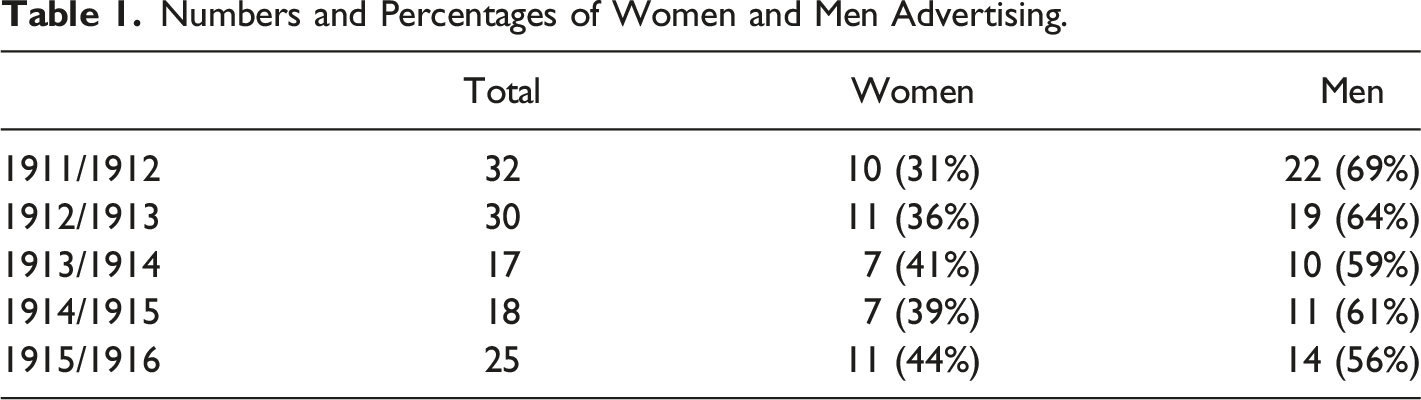
In 1911 the population of the State of Victoria, Australia was 1,315,551 of which 50% were women. 99 In comparison, the percentages of women advertising in AMN was less, ranging from 31% to 44%. The onset of World War I does not seem to have been particularly relevant with numbers increasing during the war.
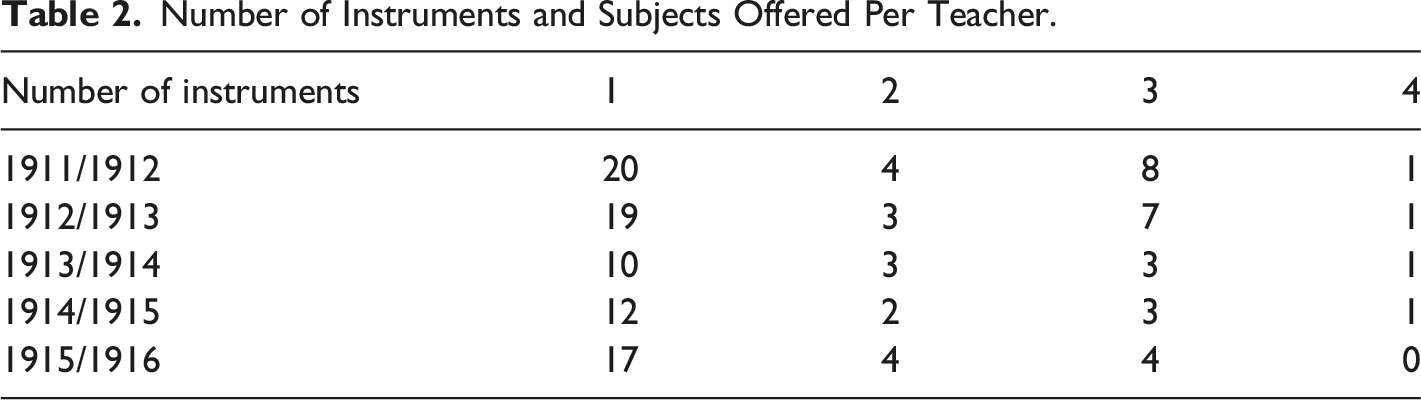
Number of Instruments and Subjects Offered Per Teacher.
Instruments and subjects offered by teachers.
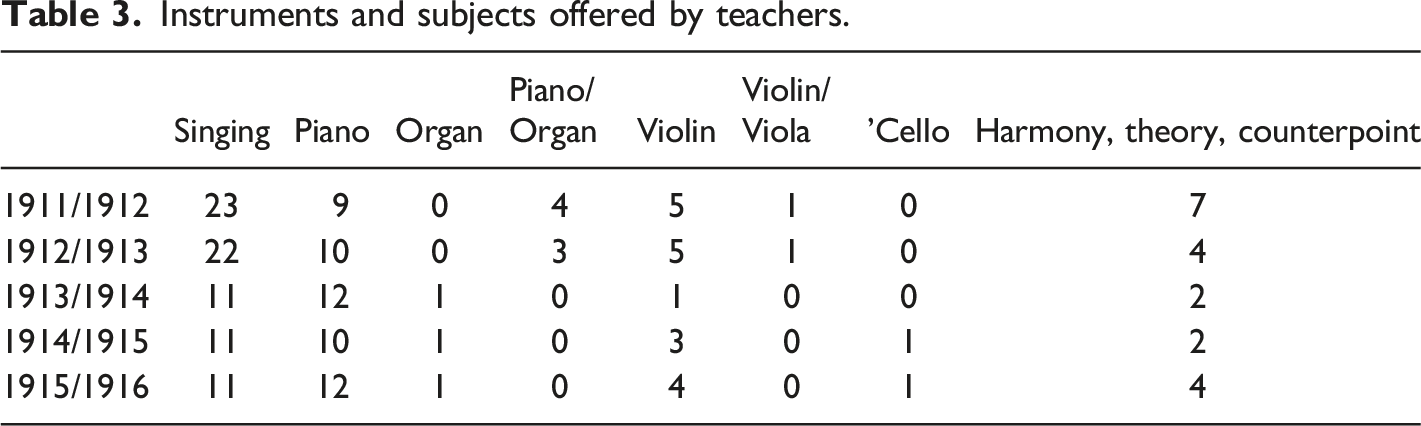
Of the four teachers that are the focus of this article. Royce advertised in every issue of the first volume and in September of the second. Shieblich advertised in issues 1-11 1911/1912, and issue 1 1914/1915. Ure advertised in every issue of the first volume and in July of the second. Johnstone advertised in issues 1-9 1911/1912. No further advertisements by these four were located. It may be that their advertisements had been effective or, as in the case of Johnstone, their interests were increasingly elsewhere. As stated, he left Australia in 1914.
Discussion
By happenstance, the four teachers who advertised in the first edition of The Australian Musical News captured the different ways that people became and continued to be studio teachers. One was a widow forced by circumstance to make her way in the world, another a European migrant who created a career, yet another first worked in a mercantile warehouse before making the leap to professional, and the last became a consultant to other teachers who published texts on how to teach. Studio (private) music teaching appears a conservative profession. With the exception of technologies, the activities of Royce, Johnstone, Ure, and Schieblich captured here appear very similar to practices today. 100
Then, as now, members of the musical profession (artists and teachers) in any locale were acquainted with each other. These four teachers would have known or known of each other. For example, in 1908 at a meeting of the Musical Society of Victoria, members of the musical profession organised to protest the perceived predations of the University Conservatory attempting to gain a monopoly over the recognition and registration of the qualifications of studio music teachers. Johnstone moved the motion to petition Parliament on behalf of the assembled teachers. After discussion, Ure moved that the motion be put. Both men were appointed to the committee to attend to the matter. 101 Registration never occurred, and this perennial question remains current. 102 Our subjects would have attended concerts and heard each other perform. For example, in 1905 the Musical Society of Victoria had established its own strong quartet and one of the players was Schieblich. 103 Johnstone, a long-time member of the Society, would have probably attended the quartet’s performances. The Society held a library of music and at that time live performances would have been invaluable.
By chronicling the careers of Royce, Johnstone, Ure and Schieblich, we recognize their individual contributions to their profession and the musical life of their society. It seems that the majority of studio music teachers remain unsung outside their spheres of influence. We also underscore the truism that, plus ça change, plus c’est la même chose. 104
Footnotes
Declaration of Conflicting Interests
The author(s) declared no potential conflicts of interest with respect to the research, authorship, and/or publication of this article.
Funding
The author(s) received no financial support for the research, authorship, and/or publication of this article.
