




Abstract

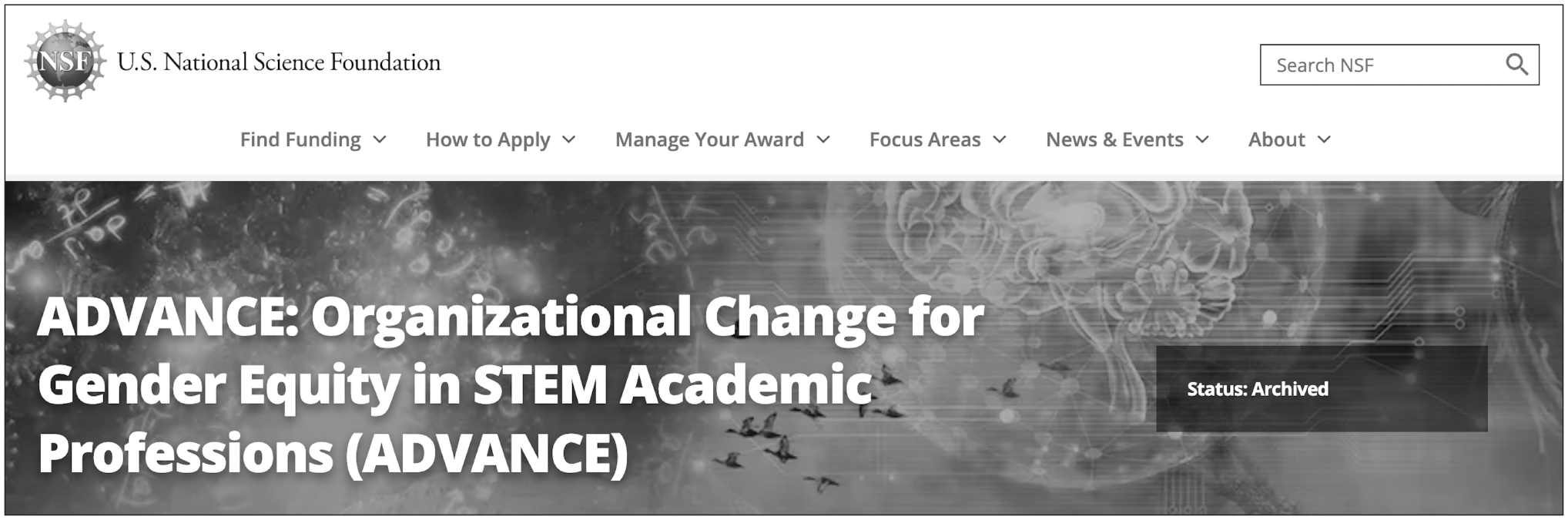
In January 2025, the National Science Foundation (NSF) quietly archived the ADVANCE program, a 24-year initiative aimed at increasing gender equity in academic STEM (Science, Technology, Engineering, and Math). Its shuttering comes at a moment when “DEI” has become a cultural flashpoint—mischaracterized as a zero-sum game of identity politics rather than structural interventions that address systemic barriers. DEI programs like ADVANCE are not just about increasing representation. They are designed to transform the systems that shape scientific discovery and education, making them more innovative, responsive, and robust for everyone.
Universities, like all institutions, are constantly changing. While institutions exist to fulfill core missions—whether educating students, delivering healthcare, or ensuring criminal justice—the world around them evolves. If institutions fail to adapt, they risk becoming ineffective or even harmful, no longer serving the very purpose for which they were created. Institutional change is necessary, then, but it is also difficult, because institutions are what sociologists call path dependent: past decisions and practices create self-reinforcing patterns, making change tough without deliberate intervention.
When we shut down DEI initiatives, as the NSF has done with ADVANCE, we are not simply rolling back progress toward more effective institutions; we are also dismantling the robust networks, knowledge, and infrastructure that allow institutions to adapt to new challenges.
Screenshot nsf.gov
DEI efforts in universities are a prime example. Universities today look vastly different than they did 100, 50, or even 10 years ago. Early federal DEI efforts, such as the GI Bill, Civil Rights Act, and Higher Education Act of 1965—which ushered in structural changes such as student aid, desegregation, and maternity leave—were responses to national and global events that led to the democratizing of education and debates about the relationship between higher education and society. Then, as now, education leaders were challenged to meet the needs of an increasingly diverse student body and workforce.
For institutions like universities, the loss of DEI initiatives is not just ideological—it is structural and practical.
Programs like ADVANCE represent a new generation of institutional reforms that position universities to meet the changing demands of research and education.
In line with the NSF’s mandate to ensure a robust national STEM workforce, the 2001 launch of the ADVANCE program marked a shift in the NSF’s approach to advancing equity among professors, from supporting individual women in STEM (through, for example, targeted grants) to addressing the cultures and institutional structures that perpetuate gender inequality. ADVANCE teams helped universities establish clear hiring and promotion criteria and mentoring programs, make transparent ways to access internal resources, and address unequal workloads and work-family conflicts. This approach is aligned with a sociological understanding of inequality, where structures—not individuals—drive social disparities and thus should be the object of change.
In short, DEI programs like ADVANCE seek to transform how academic science operates. To understand how, we focus here on a narrow question: how NSF’s deliberate structuring of the program shaped the scientific work and institutional efficacy of those involved. By tracking the full career trajectories and scholarly output of more than 1,500 ADVANCE team members at over 200 institutions—before, during, and after their engagement in the program—our analyses found that, in addition to targeting gender equity, the program also promoted scientific practices widely seen as essential to scientific progress.
advancing knowledge production
While ADVANCE focused on transforming institutions, the program also generated interdisciplinary knowledge about how institutional change happens. As participants tested new equity strategies, they documented their experiences—both successes and setbacks—thus contributing to a growing body of scholarship on gender, science, and organizational change in academia.
Our analysis of over 800 publications linked to ADVANCE awards from 2001 to 2019, compared with data from Microsoft Academic Graph—a large, scientific bibliographic database— showed that ADVANCE-related publications were significantly more interdisciplinary than comparable scientific output. In this work, published with Alexander J. Gates in Social Science Quarterly in 2024, we showed that universities increasingly recognize that tackling the most pressing challenges—such as climate change, public health, and technological innovation—requires interdisciplinary collaboration, yet often struggle to nurture it. But ADVANCE delivered, spurring work that spanned fields like organizational science, psychology, sociology, and STEM disciplines. This was no accident. ADVANCE required teams to draw on social science expertise and fostered collaboration through national meetings and dissemination networks. The result was a knowledge community that moved beyond narrow disciplinary boundaries.
This was also reflected in the reference lists in these ADVANCE publications, which were notably merit- rather than status-driven. Usually, science is driven by what sociologists call “the Matthew effect”: high-status scientists are often cited more, not because their work is better, but because it’s more visible. That’s a problem: when science is driven by status and not the content of the ideas, it leads to worse scientific output. Not only did ADVANCE promote interdisciplinary collaborations, it successfully cultivated a knowledge field where intellectual diversity deepened scientific inquiry, moving beyond status-driven metrics to advance research.
And ADVANCE awardees did all of this—carried out the time-intensive work to propose and implement structural change in their institutions and published interdisciplinary work—without sacrificing their core scientific output. Research-active ADVANCE faculty published more in their own core areas of research in the four years following their awards than did colleagues at similar stages in their careers (see Gates and colleagues’ 2025 Socius paper).
This finding was surprising yet revealing. We know that when faculty spend time on projects outside of their core academic work, it reduces the time spent on their own research. If faculty efforts toward equity in science hinders their scholarly productivity, it risks reinforcing the very inequalities they were aiming to combat. Instead, the way NSF designed ADVANCE allowed for faculty to promote gender equity in their institutions while also enhancing their own core scientific work.
responding to crises
Some societal changes emerge gradually—like diversifying student populations or responding to climate change—while others arrive abruptly, demanding swift institutional responses. The COVID-19 pandemic was one such crisis.
Our interviews with over 50 ADVANCE team members before and after the onset of the pandemic indicated that ADVANCE’s networks and infrastructure proved vital during this period of intense uncertainty. The national program had established networks to enable knowledge sharing across institutions, while programs within universities had established trust with faculty and top-level administrators, collected timely faculty data, and cultivated cross-campus relationships. As the pandemic disrupted university life, ADVANCE teams were ready. They provided campus leadership with real-time insights into faculty needs, helping shape institutional responses—things like designing COVID impact statements for faculty evaluations, pausing tenure clocks, and providing resources for online teaching—and then sharing response strategies across institutions.
As one interviewee told us: “We were well-established and viewed as very credible in terms of... faculty trusting us with information. The leadership was listening to us, and we were trusted to present things confidentially. ‘This is what we’re hearing from faculty; we need this now.’”
In short, ADVANCE didn’t just help universities promote equity—it helped them weather global crisis. This DEI program’s embedded infrastructure became an institutional asset during one of higher education’s most turbulent times.
steering institutional change
Large institutions like universities need dedicated people and groups working deliberately and knowledgeably to ensure they adapt in ways that help fulfill their core public missions. The challenge is not whether to change, but how to steer change so that institutions remain capable of advancing knowledge, educating all students, and contributing to the broader public good. ADVANCE is one such initiative—an example of how deliberate, long-term efforts can build the internal capacity universities need to meet their public missions. Successful initiatives like this are difficult and time consuming to build, yet dismantling them is easy—just eliminate funding, fire staff, and disband programs.
When we shut down DEI initiatives, we are not simply rolling back progress toward more effective institutions; we are also dismantling the robust networks, knowledge, and infrastructure that allow institutions to adapt to new challenges. The loss is not just ideological—it is structural and practical. Rebuilding is possible, but it will take years. In the meantime, institutions will be less resilient and less prepared to help shape the future we all depend on.