



Abstract
Sharla Berry on refusing to play a zero-sum game.
Quitting jobs is not new. However, in the wake of the Great Resignation, the mass exodus of workers from their jobs in the early 2020s, Black women are using YouTube to publicly share their journeys toward quitting. Different content creators are using the platform to discuss how stress, burnout, and grind culture have caused them to quit their jobs and prioritize their health and well-being. More interestingly, some are sharing information not just about how they quit specific jobs, but about why they are leaving work behind altogether.
Screenshot jobdetox.myshopify.com
On Stephanie Perry’s YouTube channel and in her forthcoming book, Job Detox, she argues that work is a zero-sum game—one that Black women workers, in particular, can’t win and should quit playing.
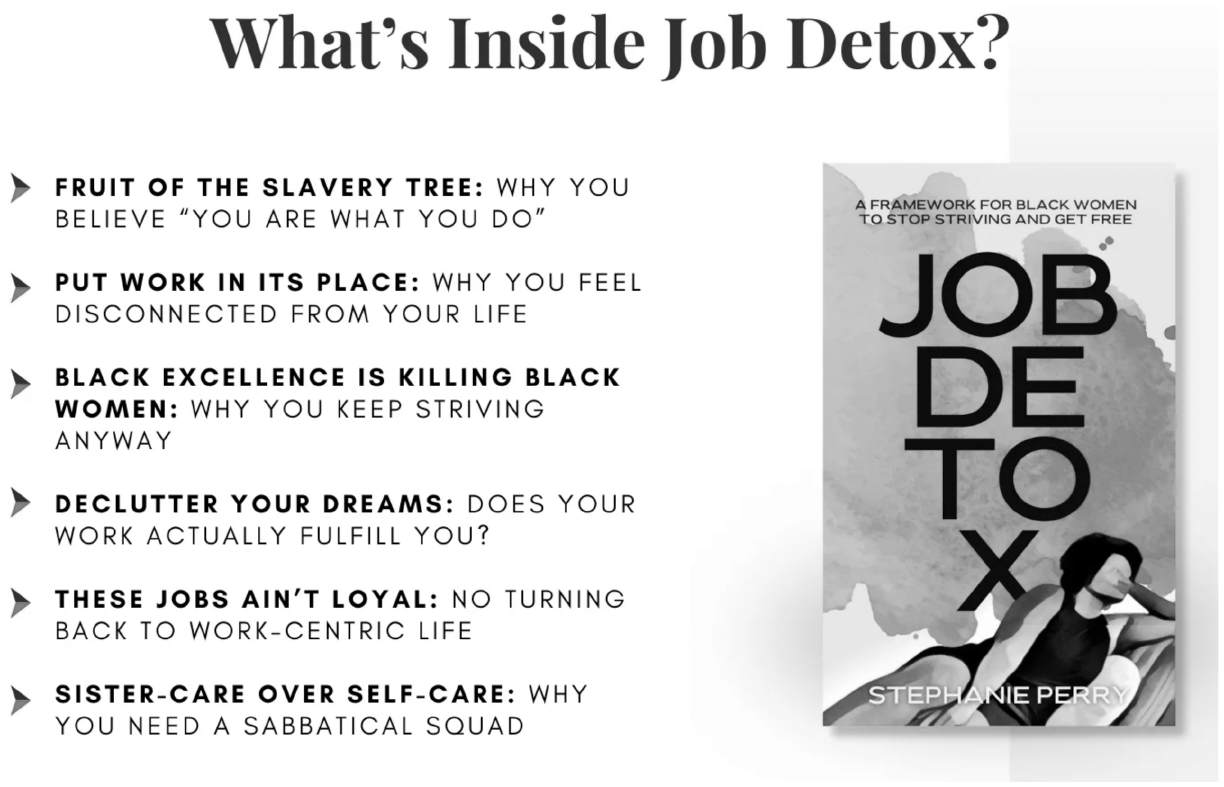
One of the most prolific and consistent creators on this topic is Stephanie Perry. Perry has been on YouTube since 2016, and her channel has 190,000 subscribers. Perry hosts weekly livestreams where she encourages Black women to take career sabbaticals, or extended periods away from work. To reduce the challenges associated with meeting basic needs while unemployed, Perry urges her followers to move abroad. Her page is filled with videos like “Job Liberation for Black Women: Building Your Exit Plan” and “Is it Time for Black Women to Leave America?” In these, she shares insights from her lifestyle as a digital nomad and features the testimonies of other Black women on similar journeys.
Other Black women YouTubers have followed Perry’s format of weaving personal narrative with step-by-step guidance about how to quit. Rashida Dowe, Perry’s friend and collaborator, has her own You-Tube channel with 44,000 subscribers. On it, she chronicles her experience of quitting her job as a lawyer and becoming an expat. According to the channel’s tagline, Dowe teaches viewers how to design “career breaks, sabbaticals, grown-up gap years and early retirement.” Adalia Aborisade, whose Picky Girl Travels the World YouTube channel has 29,000 subscribers, delves into similar themes. Her content focuses on how Black women can develop the financial education needed to work less and live abroad.
With each video, Perry, Dowe, and others are coming directly at the Protestant work ethic, hustle culture, and other key features of capitalism. Many of the videos suggest that Black women should resist working because it is inherently harmful to their well-being. In a video entitled “Reject Black Excellence,” Perry explains: “The promises of ‘Black excellence’ are not there. And Black women, in particular, are the ones who have to do all of the work and all of the striving and all of the achieving and there’s no payback but an early grave. There’s no payback but student loan debt. There’s no payment except crushing mortgage. There’s no payback except expecting more work, more doing.”
Perry argues that work is a zero-sum game, especially for Black women workers. The only way to win, therefore, is to not play. While the message may sound extreme, it is one that is rooted in data. In 2019, the World Health Organization noted that burnout, or chronic, unresolved stress, is an occupational phenomenon that is growing among all workers. According to the American Psychological Association’s 2023 Work in America Survey, 57% of workers were experiencing workplace stressors associated with burnout. These stressors are brought on by a range of factors, including lack of support from managers, lack of role clarity, unreasonable expectations, and unmanageable workloads. The pain of burnout can be deadly. Work-related stress can cause feelings of physical and emotional exhaustion and is associated with physical and psychological illness, including depression, insomnia, and heart disease.
Burnout discourse focuses on work stress broadly, yet it often fails to take into account the unique stressors that Black women face in the workplace. Code-switching, or adjusting one’s hair, appearance, and speech to fit in with White norms, can be a source of stress for Black women workers. Being underpaid, encountering microaggressions, and experiencing racialized and gendered discrimination and harassment all add additional, unique layers of work-related stress for Black women.
Perry and other Black women content creators are arguing that burnout is structural. Rather than viewing it as a strictly individual and psychological experience, they present burnout as an organizational experience—and insist that you cannot self-care your way out of it. Instead, you must adopt a longterm mitigation strategy. If burnout is organizational, and organizations tend to be racist and sexist, it makes sense that Black women are asserting that the best way to avoid burnout due to misogynoir is to avoid work.
creating an anti-work community online
What Perry, Dowe, and others offer viewers is a way to collectively address what sociologists have called the problem of work. Their videos represent more than just a new kind of content creation, they reflect a new type of community forming online. Perry’s livestreams, for example, are highly interactive. She addresses her viewers and followers by name and invites them to join her private Facebook group where they can have in-depth conversations about quitting jobs and expatriation. YouTube subscribers note in the comments that the Facebook group and YouTube community have helped them find support, assistance, and even friendship in their journeys away from work. Perry also frequently uses You-Tube’s SuperChat function to fundraise for Black women in need of career breaks.
selling anti-work
A close observer will note that this type of content is accompanied by advertisements for digital products for sale on the creator’s website. Perry and Dowe co-founded the ExodUS Summit, a virtual conference in which Black women can learn about how to quit their jobs, find remote opportunities, and move abroad. Ticket prices start at $109, and the conference involves several days of workshops. Conference speakers are often subject matter experts who are active in the content creation space, and many sell their own digital products like workbooks, courses, and coaching sessions.
Of course, there is a subtle irony in selling anti-work products. Digital products cost money, and most people acquire money through work. This irony, however, is to be expected, as both the creator and the consumer must still survive under capitalism. Thus, rather than view this form of content creation as anti-capitalist grift, I argue it is better understood as just one part of a long history of Black entrepreneurship.
Black workers, discriminated against in the marketplace, often turn to self-employment. Black entrepreneurship is about survival, with Black workers starting their own businesses to create a reprieve from work-related stress and economic instability. Currently, according to Harvard’s 2021 Global Entrepreneurship Monitor survey, Black women pursue entrepreneurship at rates that surpass all groups, including White men. Seventeen percent of Black women are in the process of starting a new business. For Black women, entrepreneurship offers an opportunity for creativity and autonomy, as well as an escape from being overlooked, ignored, or micromanaged at work—all factors associated with burnout. Additionally, entrepreneurship offers Black women a pathway to supplement their income, which is critically important given that Black women earn 70% of what White men make in the workplace.
What these Black women content creators are selling is what they are living: the possibility of gaining control over when and how they labor. While Perry, Dowe, Aborisade, and others may not have solved the problem of work altogether, they are offering a model of how Black women might exercise greater agency relative to work.
who gets to be anti-work?
The growing public discourse around quitting work and moving abroad represents a shift in how Black women are viewing their relationship to labor. Black women are using spaces like YouTube to explore new possibilities for work, including taking short- or long-term breaks from the labor market, starting their own businesses, or withdrawing from work completely. While similar conversations have been happening in different demographic groups across the United States for many decades (see Tim Ferriss’s The Four-Hour Workweek), such discussions among more marginalized people are relatively new.
Crucially, though, these pathways are not available to all Black workers. Currently, this lifestyle seems most accessible to white-collar workers, or those engaged in administrative, managerial, or other professional work. While this type of work might lend itself to remote options and flexible work arrangements, those engaged in pink-collar work, like education and childcare, or “essential work,” like healthcare and custodial work, might find it difficult, if not impossible, to find labor flexibility. Black women workers in these fields, which tend to be poorly compensated, might also find it difficult to amass the wealth required to take a break from work or to move abroad.
black women and the postwork future
In Zora Neale Hurston’s book Their Eyes Were Watching God, main character Janie declares that the Black woman is “the mule of the world.” Indeed, as far back as the founding of America, Black women in the United States have been looked at as superhuman laborers, individuals born to suffer and endure.
Black women are increasingly using YouTube to make public declarations asserting their right to rest and to resist systems of labor that are physically and psychologically extractive. While these declarations often come in the form of individuals sharing personal journeys and trying to inspire others to take similar steps, this material, both in form and content, could give insight into what Black workers’ collective resistance will look like in the coming years.
As Black workers grapple with burnout, race-related stress, a growing cultural awareness around mental health, and an economic and political context in which key diversity, equity, and inclusion (DEI) policies are being repealed, it is likely that more Black workers will engage in a politics of refusal. Here, in these videos and in the arguments they are making, Black women are already creating space for anti-capitalist dreaming and post-work world-building. They are inviting—and addressing—questions like: What might a collective movement around Black women’s workplace refusal look like? What types of structures and networks are needed to help Black women move away from work? What is the role of mutual aid and collective care within the emerging anti-work movement? And how might technology facilitate such a movement?
The revolution will probably not be livestreamed, but YouTube has proven itself a vital space for Black women workers’ resistance.