



Abstract
Hashtag feminism responds to White western women’s binds and the limits of "having it all" but overlooks the global, utopic feminist visions that might help struggling women everywhere forge paths toward liberatory futures.
In 2024, Sophia Amaruso declared that she wanted to retire the term “girlboss,” a craze she invented. When she published the inspiring book of her own gritty rags-to-riches story in 2014, she never expected that its title, inspired loosely by a Japanese action trope, would take off. The book become a New York Times bestseller and a popular Netflix series, and the hashtag girlboss racked up more than 27 million counts on Instagram alone. Why retire it? Today, Gen Z-ers have rejected what they see as the toxic hypocrisies of feminism, summed up in the alliterative trifecta gaslight, gatekeep, girlboss.
But while Gen Z-ers were busy dismantling the girlboss trope, itself an underdog response to business leader Sheryl Sandberg’s call to “lean in,” another social media trope that seems to come straight out of the past started trending: #tradwife. The term was coined in 2019 and refers to women who reject working outside the home for pay in favor of devoting their lives to their husbands and children. Tradwives promote their lives on TikTok especially, earning revenue from their gauzy, calming representations of an ordered home life that re-enchants the family and is full of aprons, 1950s dresses, and made-from-scratch recipes.
Is the shift from #girlboss to #tradwife a step backward for feminism? Or are both these myths simply features of our stalled feminist imaginations? If we reject these representations, what are we left with?
Women’s empowerment has been the cornerstone of popular understandings of women’s uplift since the 1970s. But what we mean by empowerment is narrowly distilled into women working for pay outside the home. Thus, a country is said to have empowered women when it appears that its women can make choices and express themselves, especially through entrepreneurship. By the 1980s, women in the United States were being told we could have it all: children, a loving spouse, and a fulfilling, lucrative career. “All” referred to wellpaid work outside the home and a heteronormative, nuclear family, without consideration of community, civic responsibility, leisure, joy, or pleasure, since these were assumed to be included in the two spheres.
There was just one catch: In order to have it all, women had to do it all. This is because expectations for women had changed dramatically, but the expectations for men had largely remained the same. Women continued to do the lion’s share of the work at home, even when they were also doing paid work outside the home. This dilemma led to a whole generation of scholarly and popular discourse about “work-family balance.” Women were left to make smart, individual choices to figure out how to create that elusive “balance” through personal grit and creativity. Most found that even if this was achievable, it was impossible to sustain over time.
Today, as Gen Z-ers reject the norms of heteronormativity, overwork, and hierarchy, the moment has come to ask ourselves what possibilities exist outside of having it all and doing it all? To imagine a world where people of all genders can be fully human, with an active intellectual life and fulfilling social connections, we need to understand how women can do less as individuals while still receiving support to realize our full humanity. We must reclaim and center joy rather than work or family. But reclaiming joy, we argue, requires a recovery of forgotten feminist histories. It means asking what presumptions underpin our current feminist mythologies and how we might recover and retool alternative feminist visions of the past as starting points for imagining a fairer future for all.
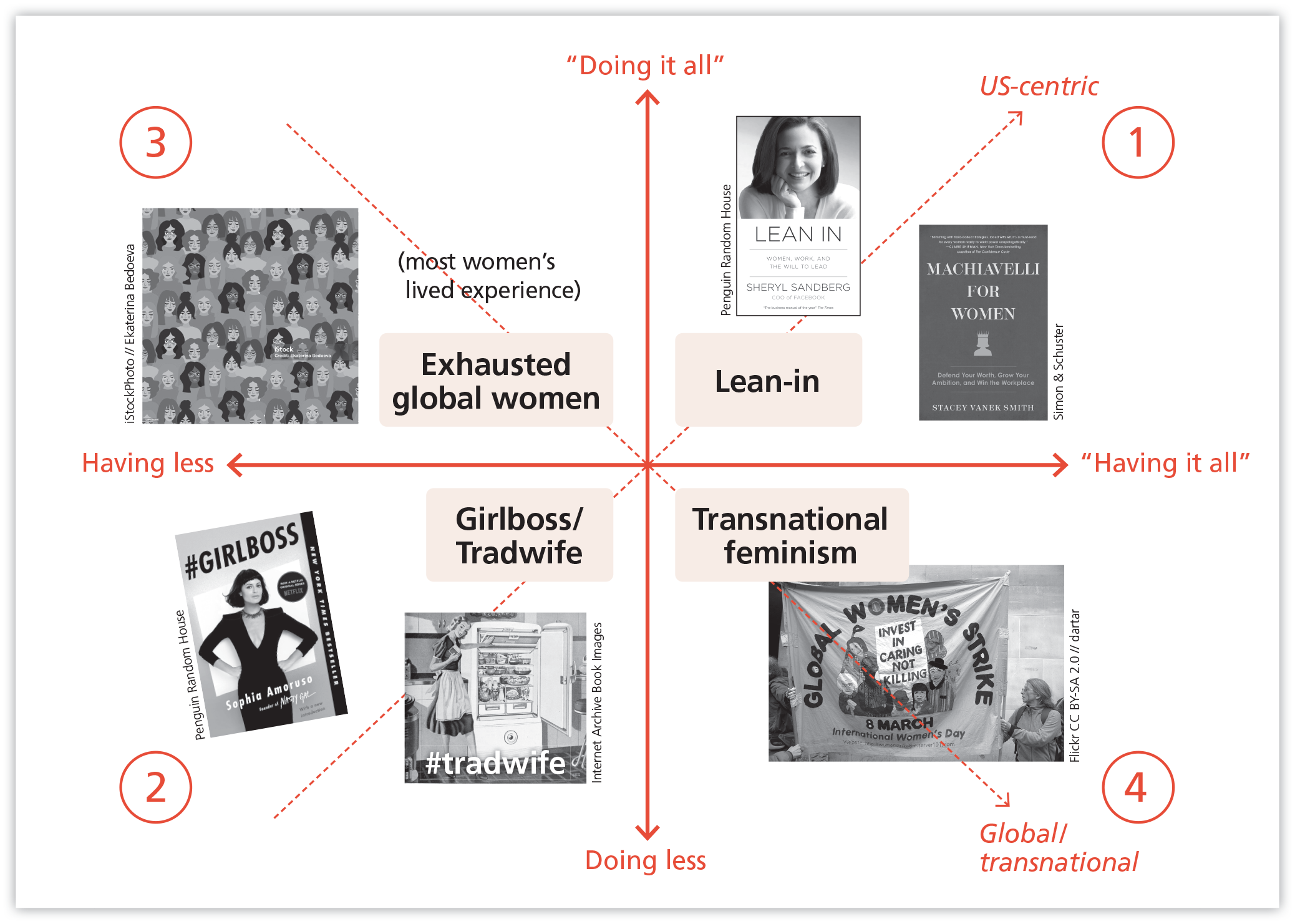
Let’s start by plotting our contemporary feminist mythologies of empowerment. We can put “have it all” on the horizontal axis of our feminist imagination. Those on the right of the axis have both fulfilling careers and families, while those on the left choose one or the other. The vertical axis is the “do it all” dimension. Those on top are doing both work and family, and those in the bottom half are doing less, prioritizing either family or work (or other things entirely). We will work through these axes to identify a new global feminist imaginary, a world where women and nonbinary folks can have it all while doing less as individuals, and where they can reclaim joy and full humanity in the process.
iStockPhoto // SouthWorks
Collective, utopic thinking about women’s empowerment has a long global history. Forgetting that history has impoverished feminist imaginations.
lean-in feminism: to have it all, we must do it all
Sheryl Sandberg’s 2013 book Lean in: Women, Work, and the Will To Lead suggested that women could choose both family and career. Sandberg lamented that women already had the tools for having it all, but men still held the majority of leadership positions in government and industry. Why? Because women were “unintentionally holding themselves back” in their careers. She spoke with elite women in various countries and concluded that all of them would benefit from her advice for how women could “empower themselves” to ask for promotions, negotiate harder, take more risks, and utilize those evening hours after children go to bed to get more career work done. In the United States, White, college-educated women joined lean-in “circles” to learn leadership skills and how to overcome the lack of confidence that prevented them from reaching their career goals. The women in quadrant 1 of Figure 1 can have it all, but only if they do it all.
For lean-in feminists, that means melding successful careers with heteronormative nuclear families. Yet the lean-in feminist myth is made possible by an army of browner, poorer, largely immigrant women from the global South. Located in quadrant 3, these women find themselves doing everything but still having less. These global women may find that their best choice, constrained as they are by class, race, and geography, is to leave their children behind to migrate to the United States. There, such enterprising women provide services as nannies, house cleaners, and family managers while mothering transnationally. Their undervalued work bolsters American lean-in feminist mythology.
#girlboss and #tradwife: do less, even if we get less
The women in quadrant 2 suggest that perhaps having less, but also doing less, is the better strategy. In #GIRLBOSS, the aforementioned Sophia Amoruso wrote that if women “trusted their instincts” and “knew which rules to break,” we could all become CEOs. Today, rather than children, Sophia notes on her website that she is “landlord to three poodles.” The working motherhood of lean-in feminism is exhausting! Thus, in the girlboss imaginary, the biggest rule to break is the rule that all women must be mothers. Stacey Vanek Smith’s 2021 book, Machiavelli for Women: Defend Your Worth, Grow Your Ambition, and Win the Workplace, offers an updated version of the girlboss myth in which women can use the power-plays of Renaissance politics to shatter the glass ceiling and “win” once and for all. Smith acknowledges that some women who read her book will have missed the girlboss memo and already have children, so she offers advice on getting out of the “parent trap” and the “Mommy Hotbox” (though with the caveat that she does not have kids and thus cannot imagine how overwhelming mothering must be). “The research shows,” she explains after noting “how inhumane” the advice is, “working until you drop is one way out of the Mommy Hotbox.”
Girlbosses reject the harried working-mother lives of lean-in feminists. Girlbosses choose not to have children, so they have more time to do what they want. They “invest” in themselves and focus on being badass entrepreneurs. However, girlboss is not the only way to reject the overwork and burnout of lean-in feminism.
Women can cut our work in half another way: by reinventing traditional roles at home. Surprisingly, we find the most recent trend of #tradwife, although seemingly backward-looking, is, like #girlboss, a modern reaction to the unattainability of the lean-in version of women’s empowerment. Tradwives articulate what girlbosses hesitantly intuit: Having it all is a sham, because doing it all runs women ragged. Following the tenets of women’s empowerment, tradwives make choices and assert themselves as entrepreneurs. They choose family over career, but they also sell tradlife on social media as humane for women and supportive for men. Tradwives aim to produce a lifestyle that makes room for leisure for both men and women. Tradwives opt out of careers so they have time to do more of what they want, which includes elaborate makeup and dressing rituals that help make their homes sanctuaries for their husbands. Tradwife influencer Estee Williams, for example, lauds the benefits of having clear rules and roles in her marriage, all the while emphasizing that she has made these choices—and looks sexy making them.
Both girlbosses and tradwives seek to avoid a harried life by rejecting the demands of leaning in and having to create work-family balance. Instead, they choose either work or family. Of course, all three of these tropes (lean in, girlboss, tradwife) are U.S.-centric imaginings of women’s empowerment and are largely created by and for White, class-privileged cis-women. When we move to our other quadrants, we open it up to a global feminist imaginary.
exhausted global women: do it all, but still have less
In quadrant 3, we have the vast majority of the world’s women, who are doing all they can to survive by advancing both work and family lives but have little to show for it in terms of prosperity, support, quality of life, or prospects for the future. The women here are hustling and embracing various iterations of being entrepreneurial. They appear to have lots of choices, but those choices are all pretty terrible.
youtube.com/watch?v=U7S-ip6vb8o
Tradwife influencer Estee Williams in her March 2024 YouTube video “Why Is Tradwife Content Going VIral?”

One of the most compelling myths of global development discourse is that of the microentrepreneur, an impoverished Black or Brown woman who takes a small loan in a group and uses the loan to start up a tailor shop, a small grocery store, or a dairy stall. Those earnings then lift her family out of poverty. But most of the world’s women microfinance clients also end up in quadrant 3, trapped in low-wage work with no chance of upward mobility and burdened with the full-time work of cooking, cleaning, and raising children, often in contexts with poor healthcare systems and few social entitlements. Feminists do not mythologize this quadrant because it is all too real. Instead of aspirational how-to books, here we turn to ethnographies to understand the real lives of the exhausted global women who are living in this quadrant.
Smitha Radhakrishnan’s book, Appropriately Indian, showed that marriage, but especially motherhood, presented major challenges to professional women’s career progression in the Indian IT sector, both at home and in the workplace. Despite attempts by Indian tech corporations to create a gender-sensitive work environment, official policies seldom translated into everyday interactions. Women were consistently expected to do less at work once they became mothers. Most mothers moved from high-intensity technical work to less strenuous, less valued positions if they did not quit the industry altogether. That downgrade almost always cost them long-term career mobility and trapped them in lower-status work. While some women accepted this reset as a given, others tried to fight it by hiring full-time domestic workers and nannies and doubling down on their commitment to work after having a child. A few women told Radhakrishnan they felt they had achieved what they hoped for; most, however, ended up with much less than they planned and continued to do the bulk of the underpaid work both at home and at work. The narratives of these Indian IT workers are surprisingly similar to those of the working mothers interviewed in Caitlyn Collins’s 2019 book, Making Motherhood Work, and in Aliya Rao’s 2020 book, Crunch Time. Without supportive state policies, women in a variety of global contexts end up doing it all but having less. Tapped out by work and home life and robbed of joy, social connections, and intellectual renewal, the women of quadrant 3—most of us—would like to imagine a way out, but we are limited by our social locations.
How might we get to the quadrant most of us would like to live in: having it all while doing less?
iStockPhoto // Likoper
By the 1980s, women in the United States were being told they could “have it all.” The catch? To have it all, women had to do it all.

In many parts of the world, especially in the global South and the former Soviet Union, women may have the chance to migrate to another country to earn higher wages, an opportunity that sounds empowering. Yet, across numerous studies, scholars have found that when women migrate for a better life, the majority must migrate either to marry or to do domestic work. Those who migrate to do domestic work make it possible for class-privileged women to work toward lean-in dreams. In Cinzia D. Solari’s book, On the Shoulders of Grandmothers, she finds that post-Soviet states like Ukraine concluded that Soviet-era state services such as universal childcare and communal dining halls are too costly when that same labor in capitalist countries is called “housework” and thus performed by women for free. The wages that Ukrainian domestic worker grandmothers earned through their domestic labor abroad also made it possible for their daughters back in Ukraine, squeezed out of the new capitalist labor market and with limited access to childcare, to stay home with their children and create traditional families inadvertently reminiscent of #tradlife. Still others, such as the middle-class Vietnamese women Hung Thai interviewed in his book For Better or Worse, committed to marrying working-class Vietnamese men living in the United States, expecting egalitarian American marriages that would support their girlboss dreams. However, after migrating, they instead experienced economic downward mobility and even more restrictive gender expectations, as their husbands wanted them to be traditional, submissive wives.
transnational solidarity: have it all while doing less
We have shown how the women in quadrant 1 aspire to lean in but find the road they are on does not lead to the corner office, while those in quadrant 2 aspire to be girlbosses or tradwives, only to find themselves debunking the myths they once embraced. And those in quadrant 3, the global majority, are exhausted. What feminist imaginary of hopeful change can we offer from here? How might we get to the quadrant most of us would like to live in: having it all while doing less?
Imagine a life where women can have families and jobs in which our labor is valued, and where the labor of cooking, cleaning, and sustaining a family, as well as the jobs at the bottom and the top of labor market hierarchies, can be fairly shared with men. Imagine a world where women’s lives are not only to be valued in terms of “work” and “family,” but also in a way that values community, joy, pleasure, and leisure, all essential for human flourishing. Imagine a world where folks of all genders and sexual identities can have true choices, and need not be forced to be entrepreneurs. Imagine a world where everyone has what they need such that abundance leads to freedom, joy, and sexual and racial equality. Sound utopic? Impossible? If we do not imagine it, we will never get there. As Naomi Klein explained during the 2020 coronavirus pandemic lockdown, history gets made with the ideas lying around. If we do not ensure that there are utopic feminist ideas lying around, all we may be left with is violent inequality, an excessive quantity of mass-produced consumer goods, and a climate crisis.
In our research, we found no inspirational feminist bestsellers that chart a pathway toward that life. We did, however, find some contemporary manifestos that refuse the oppressive conditions under which most women live. For example, Cinzia Aruzza, Tithi Bhattacharya, and Nancy Fraser’s Feminism for the 99%, (2019) envisions a feminism that begins with the needs of the global majority, prioritizing access to housing, healthcare, clean air, and healthy food. And Kristen R. Ghodee’s Everyday Utopia (2023) tells us that resistance movements have, for millennia, led to important experimentations with social life that deserve revisiting.
Indeed, collective, utopic thinking about women’s empowerment has a long global history that we have largely forgotten. Our feminist imaginations have become impoverished as a result. We cannot build a more equitable world without imagining what that world might look like. We must excavate and recover the various strands of utopic thinking of the past to be used not as an endpoint but as a starting point for new beginnings.
In the early part of the 20th century, after the Russian Revolution, feminists from Moscow to Delhi, from Accra to Buenos Aires, increasingly came into conversation with one another through transnational feminist networks. These interconnections were made even more robust after the end of World War II, with the formation of the United Nations (UN). The UN recognized the important role women played in post-conflict and post-colonial societies and created space for women to connect and share their experiences across international boundaries. In the historical work for our 2023 book, The Gender Order of Neoliberalism, we found that by the 1970s, the majority of the world, including a powerful coalition of 134 countries called the G-77 and what was then the Soviet Union, together called for universal education and universal women’s rights. This call included attention to reproductive justice, economic justice, and fair political representation. Fearing the global ascent of communist ideology at the height of the Cold War, U.S. representatives in transnational spaces opposed these goals, even though they aligned closely with the goals of feminists of color within the United States.
In 1991, the Soviet Union collapsed, and with that, the Cold War ended. U.S.-style capitalism claimed victory. The United States seized power within transnational institutions and maneuvered transnational feminist conversations by co-opting the radical language of empowerment that had percolated throughout the United Nations for at least three decades. We found that U.S. representatives transplanted the debate around women’s uplift to the World Bank, where the United States had more power, and codified a narrow, individualistic definition of women’s empowerment. Within a generation, the rich, transnational, feminist imaginings of empowerment had been all but erased.
We are in a moment when we can recapture energy around those transnational feminist projects and strive for a world in which women and gender nonconforming people can expect fairness and thriving, rather than settling for balancing work and family, girlbossing, tradlife, or just barely getting by. This project requires us to recover expansive collective imaginings of empowerment from postcolonial, feminist, Black, and Soviet traditions of feminism and to retool, reconstruct, and extend them for our real and virtual lives. While we might be tempted to dismiss such experiments as passé, all these philosophical traditions sprang up in resistance to dominant projects of colonialism, White supremacy, and other forms of systemic violence, including genocide. In our current moment of competing yet interconnected crises, a feminist imagination that centers the cultivation of joy requires creating space for civic and community life, which offers the social connection eroded by our systems in which women alone shoulder the labor of caring for children, the infirm, and the elderly. By recovering feminist projects of the past and retooling them to ensure that women can reclaim their full humanity by having it all, but doing less as individuals, we can recenter joy and reclaim our shared humanity, providing relief for our exhausted billions.
recommended resources
Kristin R. Ghodsee. 2023. Everyday Utopia: What 2,000 Years of Wild Experiments Can Teach Us About the Good Life. New York: Simon & Schuster. This book explores dozens of global social experiments motivated by a desire for collective justice and gleans lessons we can use to imagine a way forward.
Kim Hong Nguyen. 2024. Mean Girl Feminism: How White Feminists Gaslight, Gatekeep, and Girlboss. Urbana: University of Illinois Press. This sharp media analysis centers the various meanings and iterations of Gen Z’s takedown of girlboss feminism.
Smitha Radhakrishnan and Cinzia D. Solari. 2023. The Gender Order of Neoliberalism. Cambridge, UK: Polity Press. This book explores the prehistories of the feminist mythologies we analyze here, details how the United States hijacked women’s empowerment, and lays out a vision for creating a fairer world in the future.
Catherine Rottenberg. 2020. “Tradwives: The Women Looking for a Simpler Past But Grounded in the Neoliberal Present,” The Conversation, February 7. This blog post argues against the popular media juxtaposition of tradwives vs. feminists to suggest that tradwives are not a backlash to feminism but rather a reaction to the increasing insecurity of our times.
Stef M. Shuster and Laurel Westbrook. 2022. “Reducing the Joy Deficit in Sociology: A Study of Transgender Joy,” Social Problems 71(3). This article argues that sociologists disproportionately focus on narratives of pain and suffering, but telling narratives of joy might be a necessary part of successfully addressing social problems.