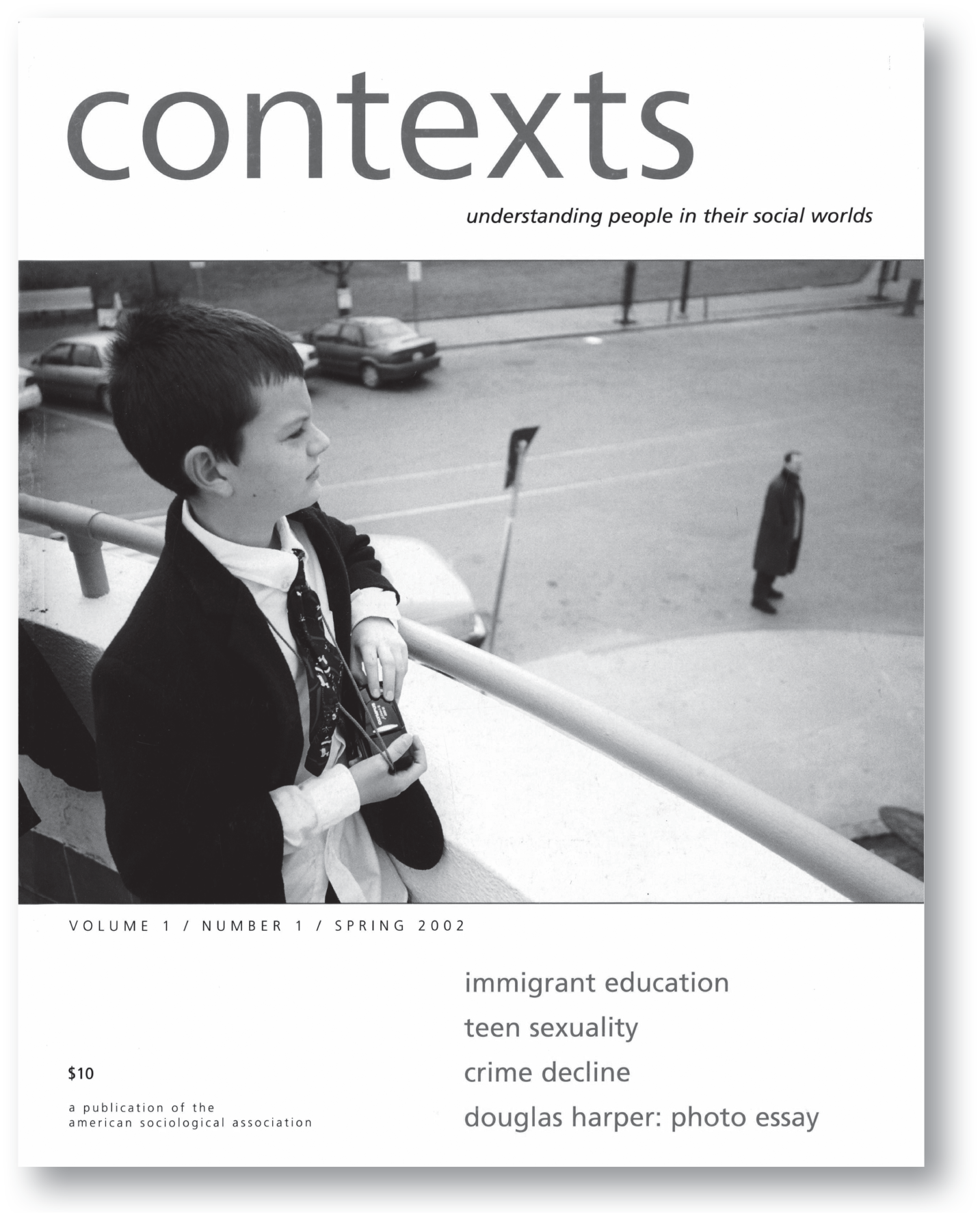
Amin Ghaziani speaks with Claude Fischer, founding editor of Contexts, about his vision for the magazine and the importance of continued investments in public sociology.
“Sociology in America: Discipline and the Public.” That was the title of the presidential address Herbert Gans delivered to the American Sociological Association (ASA) in 1988. In it, Gans suggested “an ASA-run or supervised magazine of high-quality popularized and pop sociology.” After 10 years of advocacy to establish a general interest journal, the executive committee of the ASA issued a call for proposals. Claude Fischer, a sociologist at the University of California–Berkeley, was encouraged to apply. He accepted the invitation and proposed a publication of sociologists writing for lay readers. “This magazine initiates an exciting effort to bring compelling social research to the attention of a wide, new audience,” Fischer would write in his editor’s note for the very first issue of Contexts. From the outset, the magazine was an experiment to test the premise that sociologists know things that are of public interest, that we can write well, and that clear writing would attract a general readership. Amin Ghaziani caught up with Fischer, the inaugural editor of Contexts (2002-2004), to learn about the genealogy of our general-interest magazine. What does it mean to practice public sociology? Why is it important? How did we settle on the name for our one and only public-facing magazine? And, if Fischer could do it all over, what would he change?
AG: You are the first editor of Contexts magazine. Having read some of your earlier writings, I understand that, for you, practicing public sociology means cogently explaining to the public what we have learned from doing robust research. Why is this important?
CF: I think you’ve put it quite well. I think there are a couple of what I call “moral reasons” why. For the most part, what we do is funded by the lay public, directly or indirectly, from their taxes. I think it’s our moral obligation to deliver something useful, accessible, and interesting to that lay public. Also, if we assume that we have some kind of expertise, that we actually know what we’re talking about, then there’s a moral obligation to share that knowledge with the wider public in ways that would affect, and presumably improve public policy. And I think the third motivation is more self-interested, which is to the extent to which the lay public appreciates the work sociologists do, there’s more support for doing sociology.
AG: I noticed in your proposal that you recommended a magazine of sociologists writing for lay readers. But the ASA stated that the principal audience would be other sociologists. Why does that difference matter?
CF: I made it very clear [in my proposal] that I wasn’t interested in writing for sociologists, that the only way I would undertake this work would be if I could write for the lay public. And writing for the lay public is a wholly different kind of animal than writing for sociologists. It has to do with addressing what the wider audience is interested in, addressing the topics they care about in a language that they can understand, providing explanations that they can understand, addressing any assumptions they have, which can be very different than the assumptions sociologists operate on in our conversations. Writing for sociology as a professional discipline, with professionals interested in what other professionals are doing, is a very different animal. And that’s why I designed Contexts to be a magazine. It looks like a magazine, and inside, it’s formatted like a magazine. It’s got photo essays, it has book review sections, it has little bits and pieces that you might find in a general magazine. When I say “general magazine,” I mean a magazine of public science or popular science magazines, like a miniature version of The National Geographic or Scientific American. We also ran it as a magazine. We brainstormed topics. We approached scholars. We asked them to write about this or that or the other thing, and then we edited the hell out of what they wrote. I have to say, I probably alienated quite a number of my colleagues by heavy editing, and the editing went through two or three hands, always. I think that if we’re going to reach the lay public, this is one way to do it. At the time I was putting it together, very late ‘90s, early 2000s, the magazine format seemed to be the way to do it.
AG: How did you come up with the sections of the magazine?
CF: The idea is that this would be engaging, and some people might be engaged by the photos, some people might be engaged by the opinion column, some people might be engaged just by the layout, the look of the magazine. I hired a half-time managing editor with a journalism background and a journalist-turned-grad student as a part-time research assistant on the magazine, and I kept asking them for advice about how to make this an engaging journalistic enterprise. One of the things I imagined was if this magazine could be sitting on tables in doctors’ waiting rooms. People would pick it up, thumb through it, and say, “Hey, that’s interesting stuff. I never knew that. I learned something.” And then become a subscriber. That was the image I had.
AG: You’re also the individual responsible for the name. Can you tell our readers why you chose Contexts?
CF: If we’re trying to bridge the gap between what sociologists do and what they know with the lay public, I think the biggest chasm that has to be crossed, especially when you talk about the American public, is the tendency for what we call reductionism, individual reductionism: Everything is explained on the basis of personal character, personal will, personal goals, personal effort, and so forth—versus what sociology fundamentally tries to do, [which] is say that individual behavior is contextual. It has to do with the position in social structure, position in cultural systems. And I thought the word “context” is what we were going to do issue after issue after issue. Basically, whatever the specific topic was, one of the messages was going to be that contexts matter—people’s structural positions, people’s position in culture matters. That was the idea.
AG: What about the original subtitle: “understanding people in their social worlds”?
CF: We wanted to demystify the oneword title. I think the subtitle is also an effort to suggest to readers that what we’re doing is trying to place people in their environments and understand them that way. I think the word “understanding” hints to, points to, verstehen. And that’s certainly what we’re trying to do: appreciate how people, each in their own social worlds, perceives their situation, perceives the world.
AG: As you reflect on the magazine and your experiences with it, how do you imagine that your term as editor shaped your thinking about public sociology?
CF: I thought the early responses that we got were pretty encouraging. That includes the fact that a major distributor of magazines was carrying Contexts. In the first year, the sort of indirect feedback we got suggested that people who were not academics found the articles somewhat interesting. So, I think, the early signs were that there seemed to be an audience for this—mind you, this was before the old magazine world was totally disrupted by the Internet.
AG: When it began, you considered Contexts an experiment, testing the premises that sociologists knew things of public interest and that we can find a general readership. Let’s talk frankly about that experiment. Do you think Contexts has been successful, or has it struggled?
CF: In terms of what I was trying to do with Contexts, I would say I failed. I gave you that image earlier, that this would be the kind of magazine that would be in waiting rooms, that a notable number of people with no background in the social sciences, presumably college educated but no academic inclinations, would want to subscribe to. That didn’t happen.
The magazine responded more to its use as a device for teaching. I had heard from people in those first years that there were professors out there who were, in fact, assigning Contexts articles as the crux of their syllabi. Because they were short, they were easy to understand. They covered a wide range of topics. So, in that sense, it succeeded. I think one of the things that struck me during those early years—I’ll give you more of the backstage—is the subscription. Among sociologists, Contexts was very strong. My colleagues would come up to me, let’s say at the ASA meetings, and say, “Oh, I really love Contexts. I’m subscribing to it instead of the ASR.” And I would say, “Whoa, that’s not the idea.” That was not the idea. You should not stop subscribing to the ASR.
“ In terms of what I was trying to do with Contexts, I would say I failed.
So, you know, people found it useful, but it wasn’t what I was hoping for. Maybe the material is still too academic, as much as I tried to clean up all the academic jargon.
AG: I appreciate the notion to not stop subscribing to the ASR because you see it and Contexts as distinct modes of communication.
CF: Absolutely. I mean, if I got a paper to review from a journal, and it was filled with references to Contexts articles, if basically I got the sense the person knew the field that he or she was writing about based on Contexts, I would think, “This is not sufficient.” I mean, we were writing for the lay public. We would include at the end of every article references for further reading. But I was a little taken aback by the thought that some of my colleagues would consider Contexts a substitute for the ASR. That’s not the way I thought about it.
AG: I’m also reflecting on your notion that people started using the magazine as a teaching resource. Are students an audience?
CF: When that started to happen, people would tell me, “Oh, I’ve got this syllabus. I’m using mainly articles in Contexts.” I thought of that as a positive, especially if you’re talking about a class like Introduction to Sociology, in which people come in naïve. When we edited the articles, we certainly did not think they were graduate school level. Not that they were bad, but that they were not deep enough, complex enough, rich enough for graduate school. When I was teaching, I could see assigning a Contexts article as an example. One of the courses I used to teach was an intro methods course. I could see assigning a Contexts article as an example of ethnographic fieldwork.
So, your question is, are students an audience? Yes, they’re an audience, but they are being educated or trained to be proto-sociologists. And so, I would think we would expect more of them, demand more.
AG: If you returned as editor, what would you do differently?
CF: I would have to educate myself a lot more in the Internet world. This is where you capture attention. The other thing about the 2025 environment, besides the critical thing that it’s all now webdriven, is that there has been a growth of alternative ways of introducing social science. We have serious people who may not have PhDs in sociology, but who are able to explain empirical materials in a rich way. We have a lot more than we did in 2000. We have a lot more people who can write and do write for the wider public. There are a lot of people out there now who write for major outlets or have Substack newsletters who are finding ways to speak to the wider public.
AG: One final question for you, Claude. Contexts will start its 25th volume as an online-only publication. If you were to offer advice to the ASA, what would you say as we embark on this grand transition?
CF: In the era in which I was operating under a quarter century ago, you had to try hard to get noticed. Every year, there were new magazines coming out. I’m proud that we won a couple of awards as one of the better new magazines coming out from the Library Journal.
But now, it’s an order of magnitude higher, maybe two orders of magnitude higher. And that requires resources. It requires having, for instance, not just an academic sociologist trying to put out a web product but having professionals who know how to do this right and know how to cut through all the clutter. The danger is that our voice on issues, small and large—including our voice in trying to shape this deeper perception of the public, of how we understand the social world—that’s an important role, but it’s a role that we fall behind in trying to achieve to the extent to which we don’t invest time, effort, and resources to do it.
Footnotes
Amin Ghaziani is in the Department of Sociology at the University of British Columbia. He is the co-editor of Contexts and author of Long Live Queer Nightlife.