



Abstract
Myron T. Strong, Jennifer Lê, Kyle Clark Echeverria, Zaynab Daugherty, Ayanna Hasselberger, Francis Phillip, Calise Harper, and Yakhare Gueye on an Afrofuturistic vision of vulnerability and resilience.
Black Panther brought an Afrofuturistic vision to the world that many saw as the answer to the question: “What if Africa had never been colonized?” It’s a question many Africans and their descendants have asked throughout the centuries. This dream was explored in both fantastical and realistic ways in the first film, which spread joy across the African diaspora while critiquing the real effects of colonization.
press.Disney.co.UK
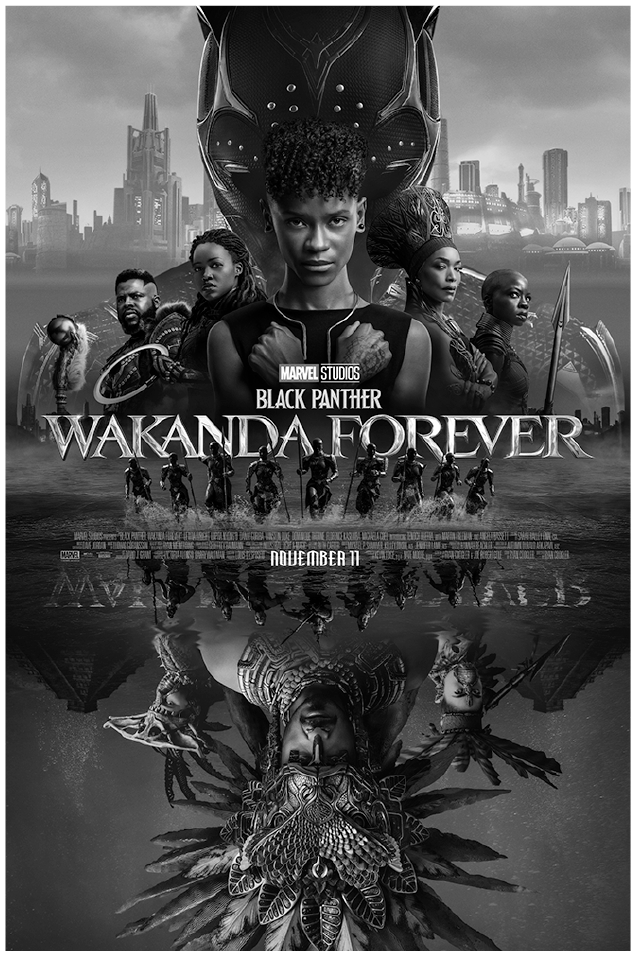
Wakanda Forever adds another layer to the public understanding of Afrofuturism by exploring collective healing and vulnerability. In a broad sense, African societies are complex, with healing, connection to ancestors, and celebration of life rituals forming crucial parts of a culture. Highly varied across regions, nations, ethnic groups, and religions, these aspects of social life serve a vital purpose. For example, the Bapedi culture ritual of Malopo binds people to their ancestors (in the ancestral plane) while providing healing therapy. Throughout Wakanda Forever, loss and healing provide a backbone for the story and main character development. For example, Shuri—T’Challa’s sister and current Black Panther—struggles to accept the loss of her brother and processes her grief through cultural rites. This part of the film symbolizes how the loss of healing rituals in the modern world might be responsible for the dissolution of community bonds, an argument presented in The Healing Wisdom of Africa, by spiritual leader Malidoma Patrice Somé.
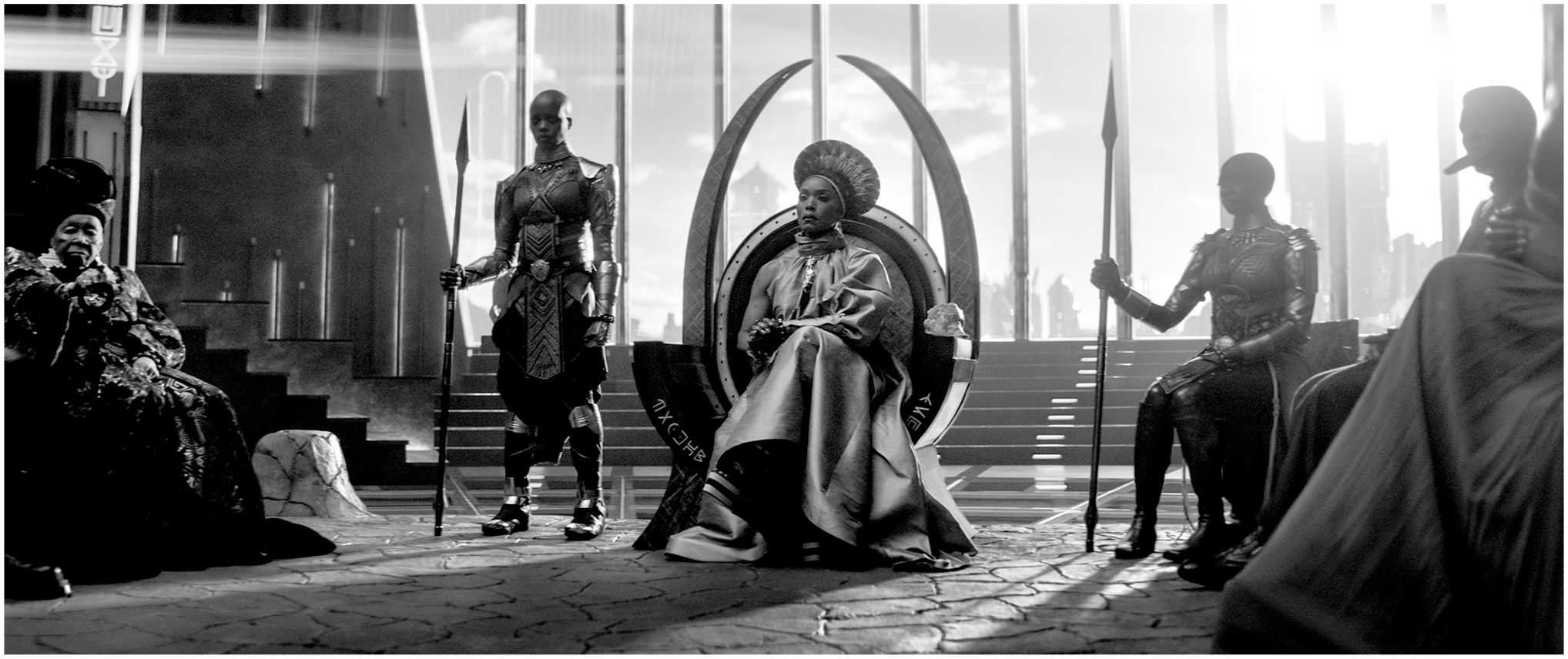
Queen Ramonda, played by Angela Bassett, is the mother of both T’Challa and Shuri.
press.Disney.co.UK
Mourning and healing are front and center in T’Challa’s character—and in the life and death of actor Chadwick Boseman, who starred as the first Black Panther. Foreshadowing an important relationship with death in the character’s debut in Captain America: Civil War, T’Challa says: "In my culture, death is not the end. It’s more of a stepping-off point. You reach out with both hands and Bask and Sekhmet, they lead you into the green veldt where you can run forever." Following Boseman’s death, the film Wakanda Forever functioned as a ritual that allowed for public mourning of the character and actor alike. It set the tone that healing rituals are important when dealing with loss, if one is to truly continue to live and grow.
The Wakandans’ fictional losses and Chadwick Boseman’s real passing make a larger point about adversity, loss, and cultural resilience.
Indeed, in Wakanda Forever, Queen Ramonda shares more of Wakandan culture by explaining to Shuri during a mourning ceremony that death is "the beginning of a new relationship with our loved ones that have passed on." Such messages transcended the movie and gave those watching, many still trying to process the enormous losses attributed to COVID-19, a place to grieve publicly and collectively. In a 2022 episode of their podcast Still Processing, Wesley Morris and Jenna Wortham pointed out the importance of grieving rituals and the role Wakanda Forever played in helping society heal:
"The timing of Chadwick’s passing, which was late August of 2020. And at that moment in time, the losses were just mounting—losses that we weren’t able to properly grieve…. [B]y late summer, as Americans, we were really coming to terms with how impoverished our grieving and mourning rituals are…. Chadwick is also a stand-in for all the losses we’ve suffered, which we’ve never really collectively talked about…. [P]ublic grieving has been privatized, essentially."
As much as the first film presented Wakanda as a social, economic, technological, political, and ideological superpower, the second film contextu-alized Black vulnerability, how people and cultures deal with adversity, and the interconnectedness of Africa with other parts of the world. The filmmakers used the contrast between power and vulnerability to present a more complex view of humanity. The repeated losses, both personal and communal, that the Wakandans suffer in the film are visceral, but those fictional losses and Boseman’s real passing make a larger point dealing with adversity, loss, and cultural resilience.
Wakanda Forever’s exploration of grief, power, and vulnerability are twofold. First and foremost, these themes are told through the experiences of Black women, whose central role in the film challenges Eurocentric notions of a "warrior." The unapologetic centering of Black women throughout the film also pushes back on negative cultural stereotypes of Black women, instead emphasizing their agency and complexity while illuminating their many dimensions.
These themes are told, too, through the experiences of the film’s primary antagonist, the Talokans, a vibranium-fu-eled, technologically advanced society led by Namor, a 500-year-old mutant with winged ankles who is the living representation of the Mayan feather serpent god K’uk’ulkan. Namor’s grief centers on the colonization of the Yucatan and, even though the Talokans were not victims, he keenly feels its impact. Upon meeting Wakanda’s Queen Ramonda, he comments on how great it would be to exist in a place not forced to change. Namor’s grief and the need to protect his people from vibranium-seeking Western powers makes the Talokans vulnerable and serves as the crux of their conflict with the Wakandans.
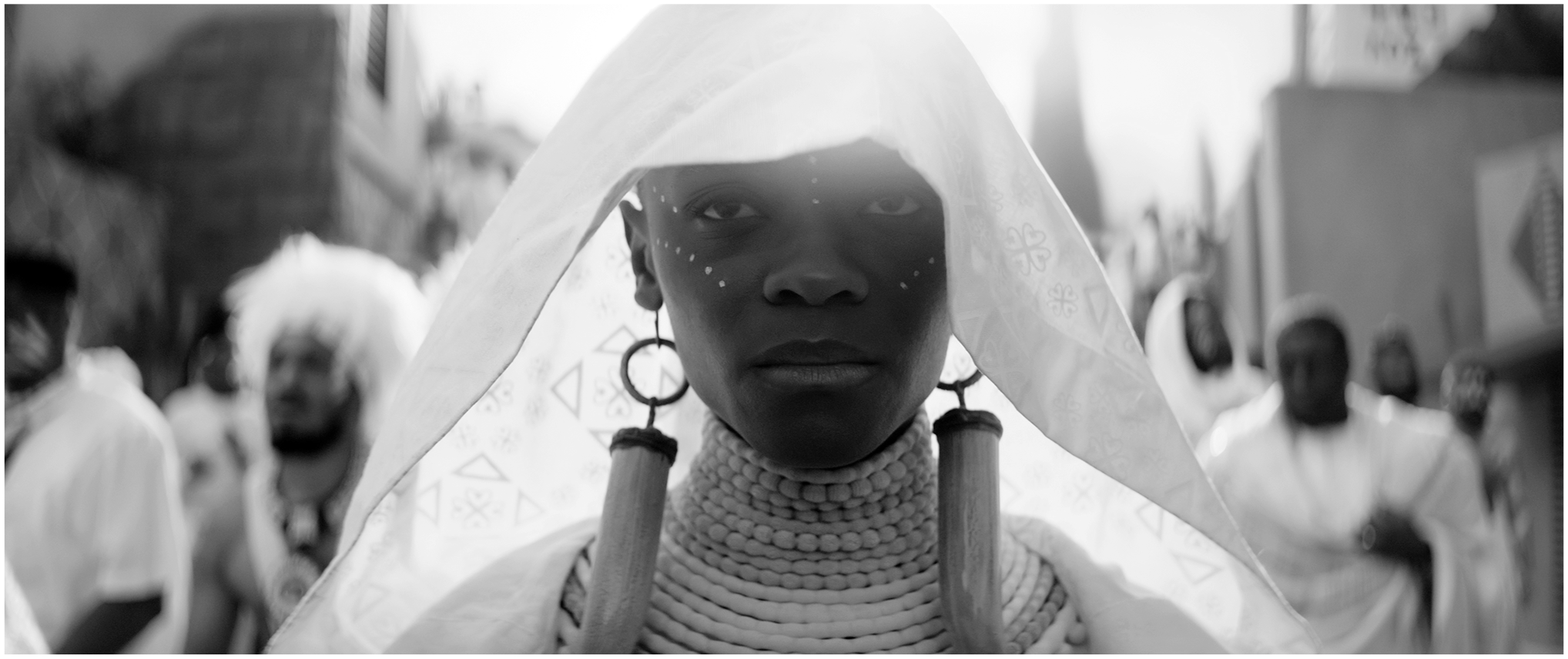
Shuri, played by Letitia Wright, during T’Challa’s homegoing rites.
press.Disney.co.UK
Despite outward displays of power and might, vulnerability plays an important part in framing each of these cultures. Though Wakanda is powerful, it continually loses to the Talokans. Yet the Talokans and their way of life are at risk because the vibranium under their land—no matter how well hidden and technologically advanced—is at risk.
Shuri embodies this dichotomy between power and vulnerability: the most powerful figure in the film, she is still riddled, and initially limited by, anger and grief, having lost both her brother and mother. To lose such large and grounding forces—or as Shuri puts it, the last people in the world who truly knew her—produces profound grief which makes her, and thus Wakanda, vulnerable. This complicates how we see Wakanda and its people. It forces us to look at power not just as brute strength or political might, but also as resilience, coping, and survival—to recognize that strength stems from one’s vulnerabilities. So, too, in Wakanda Forever and Shuri’s healing process, do viewers feel this delicate interplay. As Shuri connects with the ancestral plane in a pivotal moment during her final battle with Namor, she is reminded of the similarities between the two powers, between herself and Namor, and how grief connects them all. Instead of seeking vengeance, Shuri aims to put her people above her own selfish motivations. The fact that Namor also glimpses his mother during this scene highlights how he is choosing—at least in the moment—to put vengeance aside, to find a way for himself and his people to heal. In this way, the theme of restorative justice from the first Black Panther film endures in its sequel.
Both Wakandan and Talokan cultures are linked in multiple ways, and this adds a layer to the understanding of a diaspora. Diasporic identities are created through various factors such as race, culture, colonial history, geography, and involuntary and voluntary movement patterns. Wakanda Forever makes the case that vibranium connects the two focal cultures and has directly affected the social and physiological interactions within, across, and outside each. Vibranium is the literal and figurative lifeblood of each society and, combined with their shared history of resistance to colonization and decisions to hide from the outside world, deepens their bond.
Wakanda Forever illustrates how diasporic communities can regain the roots of belief systems and practices thought to be lost, to come together, and to thrive in times of weakness as well as strength. It mirrors the complexity of the social life of people across the African diaspora, and it leaves audiences with a more in-depth understanding of Afrofuturism: it’s not only about the joy of seeing a prosperous, thriving Africa, but about embracing vulnerability in order to heal both the past and present. To be strong does not mean you are immune to the effects of oppression and toils of daily life. Vunerability allows for a broader connection with communities and emphasizes the Zulu saying Ubuntu, which means "I am because we are" which emphasizes the collective over the individual. These lessons are seen through the experiences of both the Wakandans and the Talokans; ultimately they fuel the cooperation and collaboration essential to ward off neocolonial forces and fight for the future. For Afro-futurism, vulnerability is a powerful tool for building collective consciousness, taking action, and moving forward.