



Abstract
Bandana Purkayastha and Rianka Roy on scarcity and supply in a thirsty world.
Dipti, a domestic worker in her thirties, lives with her husband and two teenage daughters in a city in eastern India (her name, like all others in this article, is a pseudonym). Dipti works in three households. None of her employers has been openly discriminatory toward her. But when she asks them for water, she is given a "separate" bottle. Domestic workers in India traditionally hail from Dalit communities. They are considered "unclean" and hence unworthy of drinking water from the same vessels as their "masters."
At home, Dipti and her family had depended on municipal tap water for several years, since the local tubewells were sealed off (due to the city’s ground water depletion and arsenic poisoning). But two years ago, local political leaders advised residents in Dipti’s neighborhood not to consume the tap water. She continued to use it for cooking, cleaning, and washing until the supply dropped to a trickle. Dipti feels there is nothing to be done about it, because the leaders will not pay heed to poor people’s concerns. A water truck now comes to her neighborhood every evening. Each delivery leads to fights as neighbors jockey for spots in the long line. As a supplement, for the last 2-3 months, Dipti’s husband has been bringing two refilled plastic jars of drinking water twice or thrice a week from a nearby water treatment plant. Each refill costs 10 rupees, which Dipti thinks is an affordable price. The water in plastic jars appears to be a solution to their problem of unequal access.
Water jars stacked in a grocery store in a small town in the northeastern United States, 2023.
Courtesy Rianka Roy
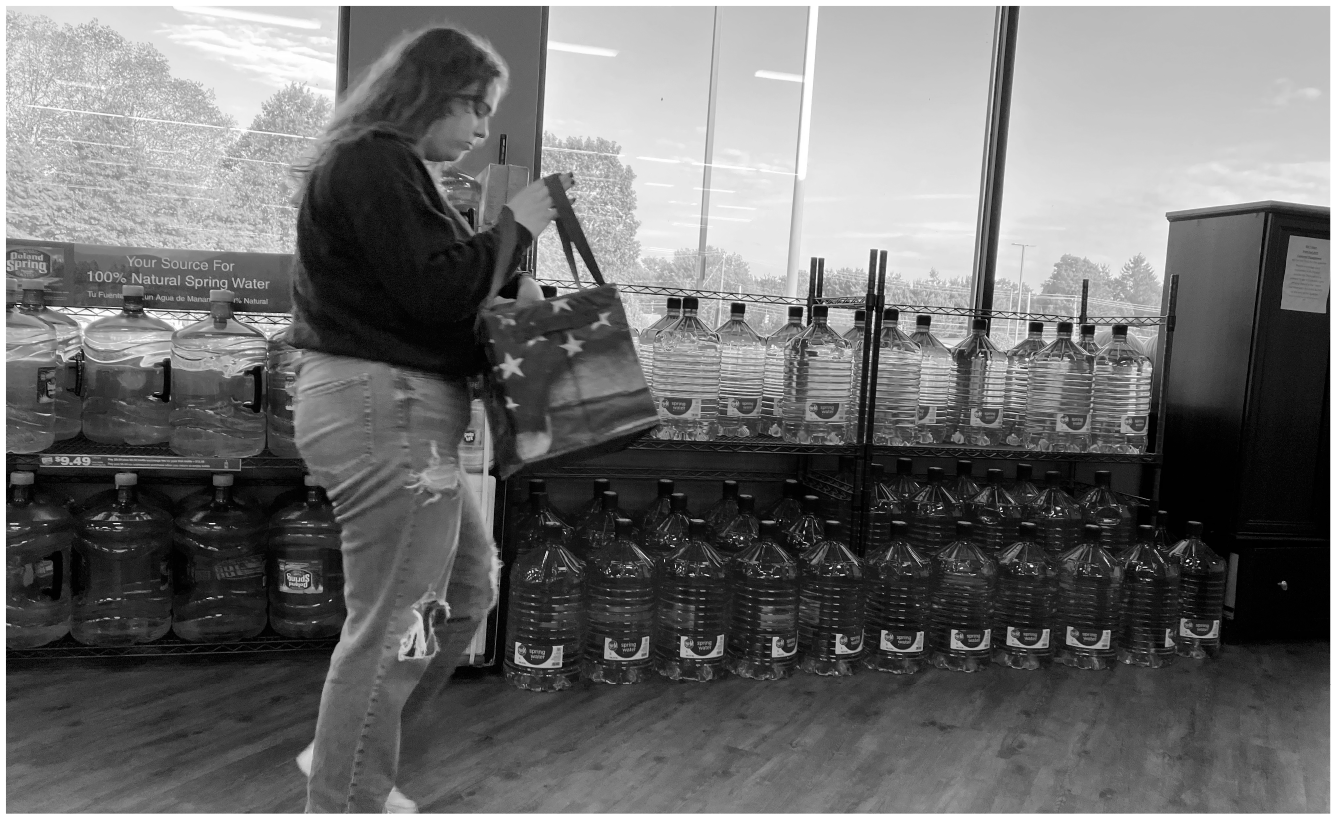
Communities across the United States also encounter arsenic in their water (the Washington Post reported in April 2024 that 7,400 U.S. public utilities do not meet safe drinking water standards), but issues of availability and access exist across the country. Molly, who describes herself as a middle-aged home-maker, lives in a New England town where residents traditionally depended on well water, itself dependent on the state of groundwater. But a nearby university, with its thousands of students and a large body of staff, allegedly started exhausting the local water supply. Molly says, "I know there were a few local issues…. I know they were worried about water issues, and [the university] is using too much, and they were going to build a pipeline, and I believe that got passed in May—to have a pipeline brought there. But at the same time, I know, I remember hearing that [the university] used from [the town’s] little stream, and that it was almost empty or something, and that confused me because, like, we have so much water… So now I’m curious. There are so many bodies of water here, and which ones are actually used for drinking water…" The big institutions in Molly’s area lobbied the state for regional water management and access to water sources from far away, even as local groups protested. Over time, in their quest to earn a "green" designation, the university changed its water management practices and built water stations all over the campus. But the question—where does the water come from?—remains pertinent. Some people get more, others get less and/or worry about future supplies. Despite protests, the needs of those with powerful voices are always met first. Now, people in this town rely on a combination of water in plastic bottles, tap water, and toting bottles from water fountains to fulfill their drinking water needs.
These cases show how, worldwide, access to water is fraught with preexisting social and political inequalities, including local and global racial hierarchies. In India, hidden (and not-so-hidden) barriers related to class, caste, and gender determine who can access water and at what cost. In the United States, it is most often poor and predominantly Black neighborhoods and cities, such as Flint in Michigan and Jackson in Missouri, and Indigenous territories, like the Santee Sioux Nation in Nebraska and the Navajo Nation in Arizona, Utah, and Mexico, that suffer from contaminated or limited water supplies. (More information can be accessed from the National Resources Defense Council, the NAACP, and 2023 National Public Radio reports.)
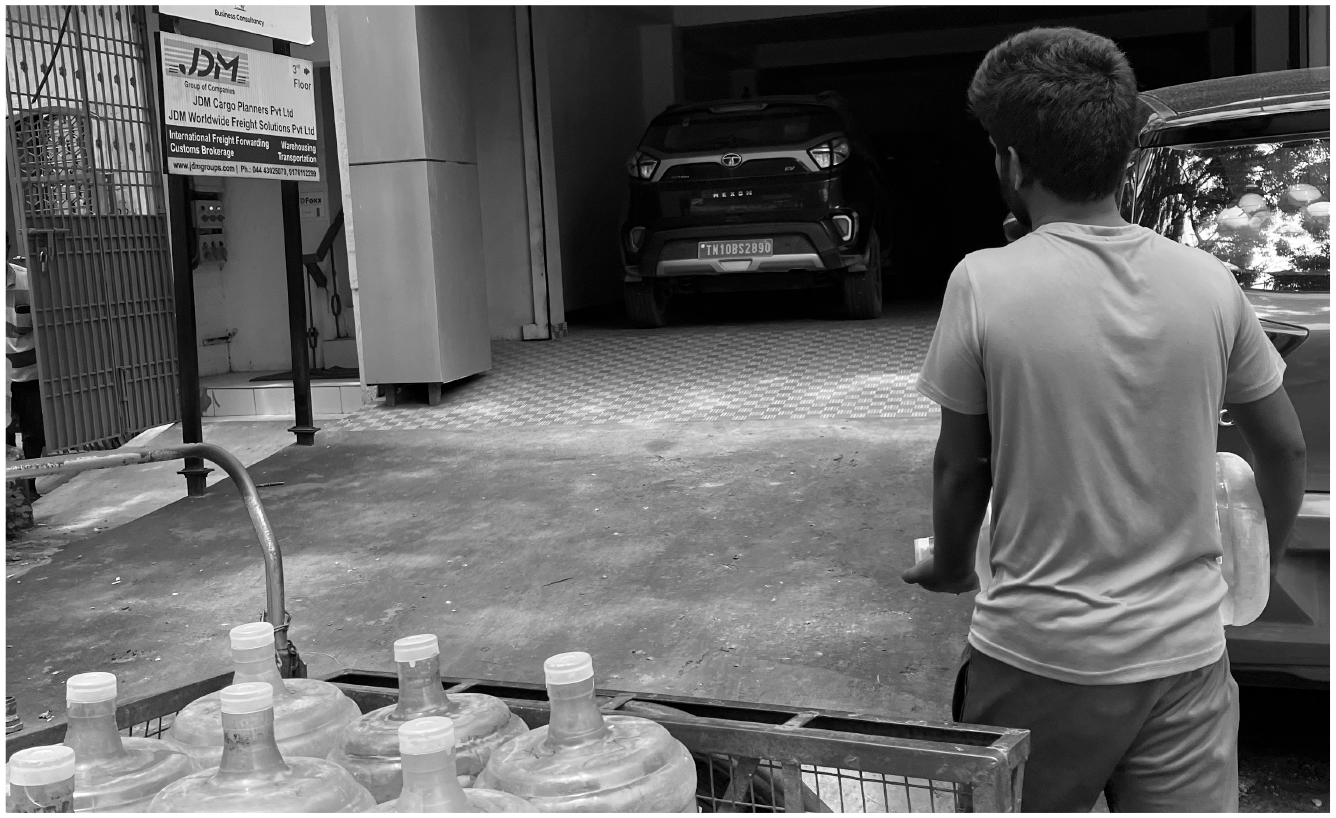
Delivery of refilled water jars in a city in South India, 2023.
Courtesy Rianka Roy
Apparently, there are some available modern solutions to the persistent problems of unequal access. But how sustainable are they?
In recent years, the United Nations has intensified its effort to make water accessible to all, marking it as a Sustainable Development Goal. As we move around public places in the United States, we observe that a large number of companies work to fulfill the demand for clean water. Their brands extol the health and environmental benefits of their "product." Additionally, as the message about the environmental harm of plastic bottles has gained credence within educational institutions, work places, and public places, people are now encouraged to carry personal, refillable water bottles. Water fountains are installed in public places like bus stations, libraries, and airports. Campuses, attempting to go green, often provide free clean water through fill stations. Here, too, a growing industry has responded to the need for drinking water receptacles and to the need to reduce reliance on single-use plastic bottles.
In India, we have observed a patchwork of urban water access schemes and rapid growth in modern approaches to water management. The traditional method is to acquire clean groundwa-ter from ponds, community wells, and deep tubewells, then store it in earthen pots. The other main sources for drinking are municipal pipes and free water stations set up by philanthropic organizations. More recently, as we detail a little later in this essay, water ATMs have appeared, and, for those who can afford it, 2-to-5-gallon plastic bottles for drinking are delivered to households.
Some people believe—or hope— that these modern measures might solve global water access problems, but there are reasons to be skeptical about their sustainability.
First, many vulnerable populations around the world lack access to safe drinking water. For some, water access has been weaponized. Amid ongoing wars in Ukraine and Palestine, as reported by Unicef and NBC News, water scarcity can be characterized as a new humanitarian crisis. In other places, governments have failed to protect land and peoples from predatory industries that contaminate or restrict access to water reserves (for example, consider Coca-Cola’s efforts to extract water from Plachimada, a village in Kerala, south India, and Nestle’s in Maine in the United States, as documented by Vandana Shiva’s Water Wars and 2021 reporting by the Maine Beacon).
Modern solutions, which rely on deliveries, raise additional questions. Whose water is put into the bottles? Who loses as a result? In some places, governments have started to provide plastic containers of water. But in areas like Flint, the question of environmental sus-tainability is rarely discussed. According to the nonprofit organization Earthday, U.S. consumers purchase about 50 billion water bottles per year. In India, the sale of water in plastic bottles has risen more than 40% in the last five years. Both countries are contributing to plastic waste in the name of modern solutions, and we know these bottles are releasing unsafe microplastics that we end up consuming (see, for instance, research from the Environmental Working Group and 2023 reporting from the BBC).
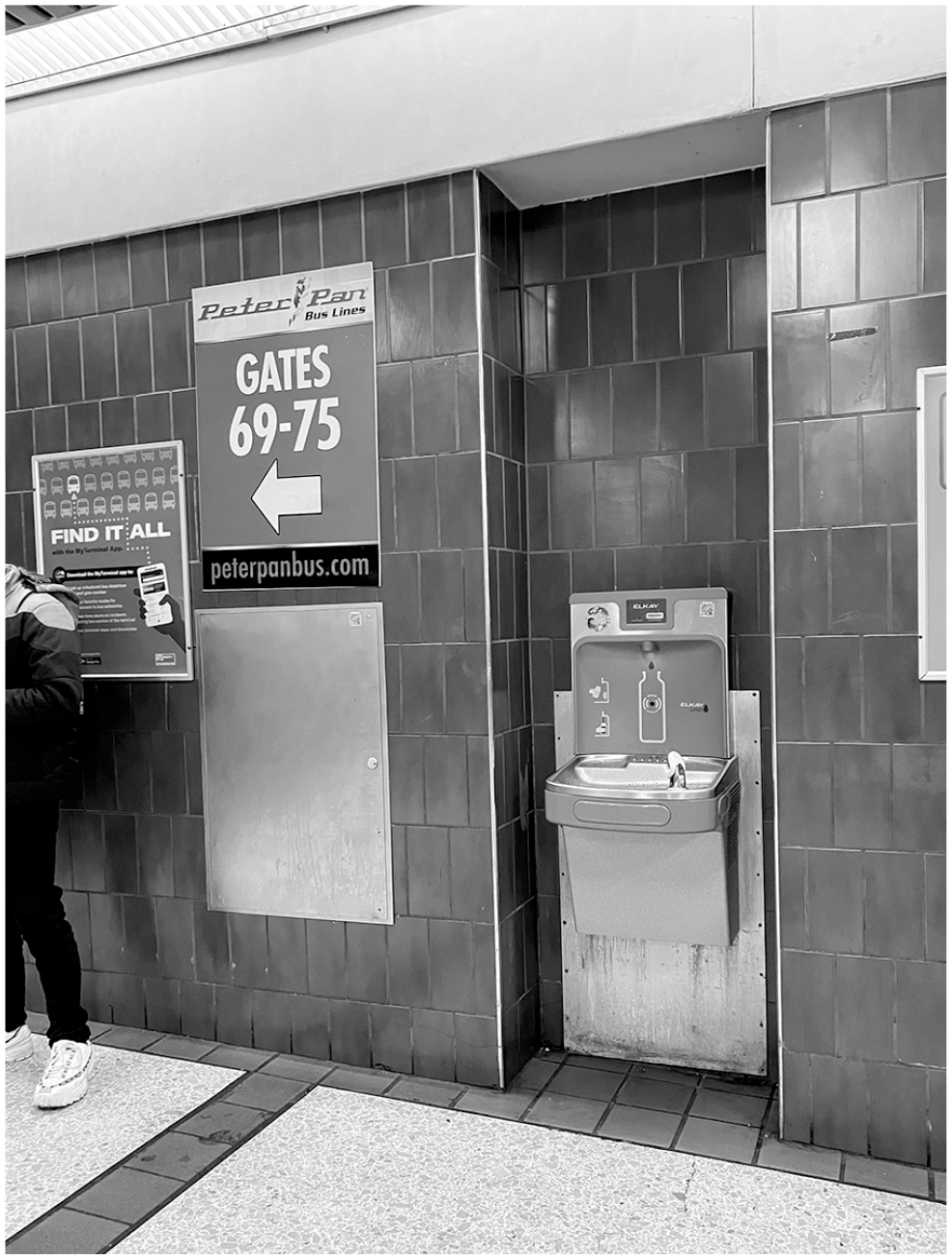
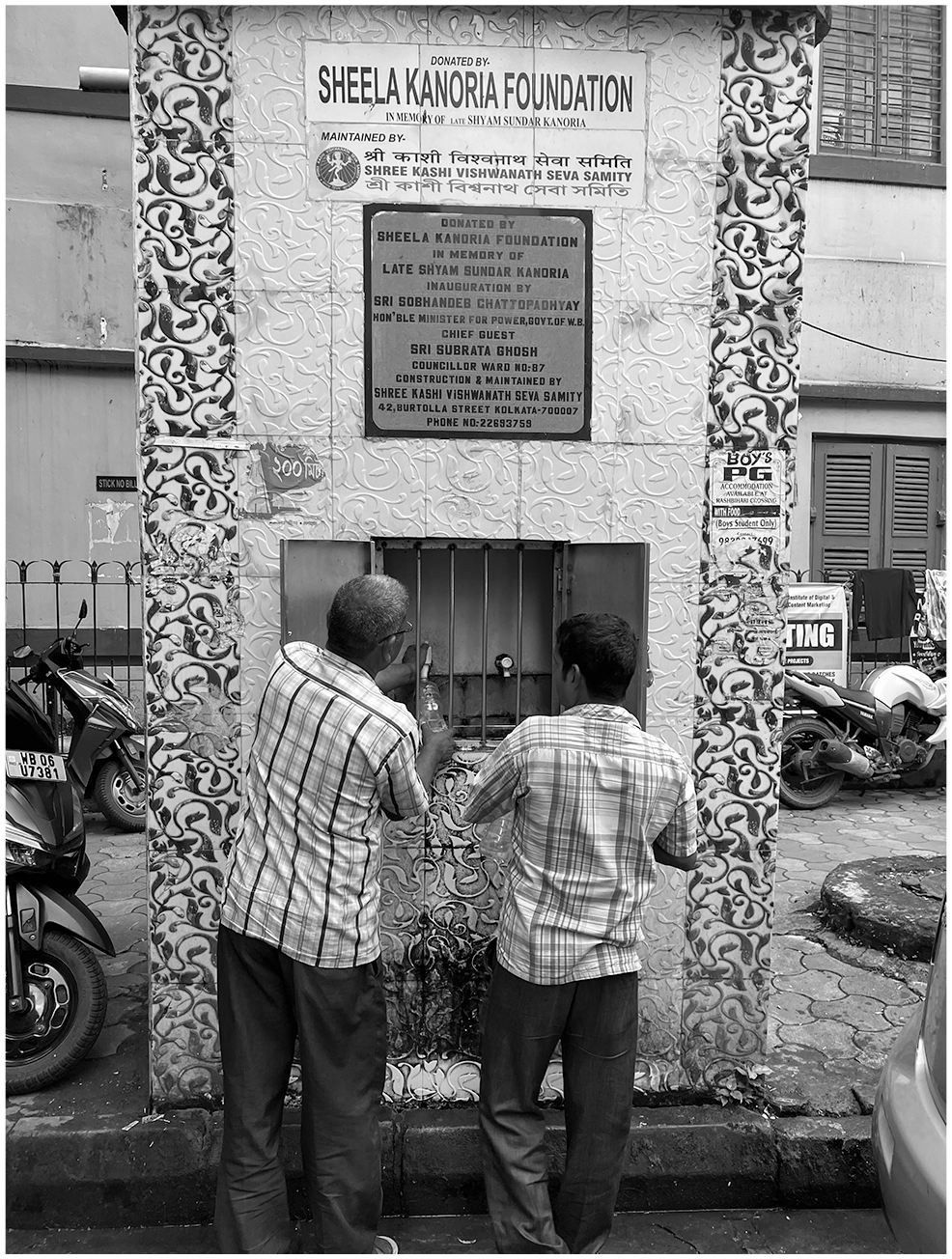
A second reason to be skeptical about these solutions’ sustainability relates to the way water fountains aiming to reduce plastic pollution serve corporate and political purposes over the needs of individuals. For instance, while some water fountains show the number of single-use plastic bottles saved with every refill, according to a 2022 Research and Markets report, these North American water sources contribute to a $30 million market for private corporations. In India, these public fountains and stations also create a fagade of philanthropy while serving the publicity goals of political parties and corporations. Instead of the government ensuring equitable water access across its constituencies, private donors and political parties install these water fountains in those areas most visible to influential consumers, voters, and the media (typically urban and semi-urban neighborhoods).
A water fill station in a northeastern city in the United States provides a count of how many plastic bottles have been saved with refills, 2024.
Courtesy Rianka Roy
In India, water supplied through public fill stations, ostensibly a philanthropic effort, nonetheless facilitates publicity for private businesses and political parties, 2023.
Courtesy Rianka Roy
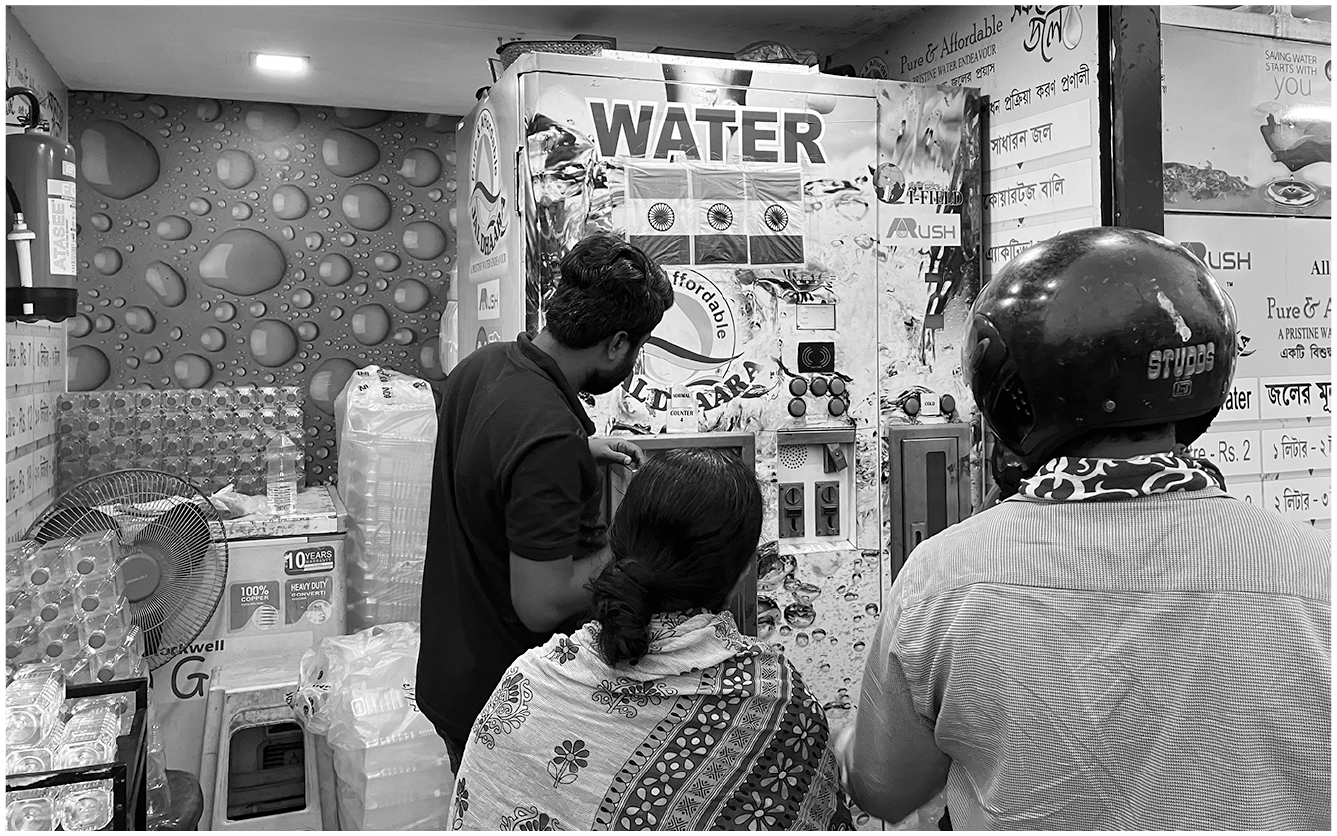
Moreover, in an eastern city in India, we even spotted a water ATM—run by a local municipal representative—where the attendant fills and sells single-use plastic bottles at subsidized rates. The practice completely defeats the purpose of sustainability, and it and other practices point to the complex networks of ownership and profit now scaffolding commodified natural resources.
The third reason we have for skepticism is the replacement of traditional water norms with individualist stances. In India, collectivist norms around sharing water are longstanding; there is a time-honored ritual, for instance, of offering water to household guests as a way of showing respect. Indigenous groups in the United States, too, have long treated water as a community resource (for a deeper look, refer to the websites of the Three Creeks Collective and the Urban Native Collective). But these orientations are being replaced by an overarching focus on commodified water consumption as an individualistic lifestyle choice.
Consider the proliferation of apps like Hydro Coach and iHydrate, which are available to help individuals monitor their water intake. These apps are the luxury of the privileged. Besides, scholars of data colonization (the corporate practice of extracting data from internet users), like Nick Couldry and Ulises Meijas, remind us that the data about water consumption collected by such apps simply gets bought and bundled by industries working to create customized consumer choices—that is, to better advertise to their privileged users. In the meantime, the gap between those who are likely to access the apps and those who are struggling to access sufficient clean water—water that is supposedly a human right—continues to grow.
Global markets have increasingly commodified water and individualized water access while claiming to have addressed the public good, clean water scarcity, and even environmental problems. But this so-called access is only viable in contexts where clean and uncontaminated water supply is guaranteed—and often where the people are privileged. The solutions on offer deepen structural inequalities, distracting us through shallow claims of sustainability, equality, and modernity.
On the other hand, the last few decades have seen social movements demand equitable water access as a human right. People around the world, from Africa’s Maghreb region to the Andes of South America and from South Asia to the Middle East, have been protesting against harmful practices that contaminate water and its large-scale extraction from their regions by a variety of industries. Their struggles honor our collective human rights and can lead most of us toward thoughtful practices around water consumption and conservation.
Some small but firm steps include making demands on governments to prioritize clean water access and resisting the corporate takeovers of rivers, springs, and other community water sources. We can also demand every bottle of water bear a source label, allowing us to see how far the precious liquid has traveled and whether it might be contaminated (in Zurich, Switzerland, for instance, hotels proudly declare that their bottles of water contain municipal water). This would align with the way GMOs and other harmful substances are slowly appearing on food labels. And we can continue to challenge exploitation, extraction, and over-consumption, in part by demanding that our taxes be used to provide safe, local water to all who need it.
A water ATM in eastern India sells water refills at subsidized rates, including in the single-use plastic bottles stacked in the shop, 2024.
Courtesy Rianka Roy
It is imperative that we treat clean water as a limited resource—at risk of depletion in many parts of the world— instead of an unlimited commodity. Through our personal choices and activism, we may yet restore and build more humane cultures of consumption that honor our collective human right to water.