



Abstract
Ellen T. Meiser on a communal concoction's individualization.
I’m Taiwanese-American, and I get invited all the time to eat hotpot. Likely, you do, too. But if you’re unfamiliar with it, hotpot involves a communal pot of simmering broth at the center of a table in which diners cook razor-thin slices of beef and pork, clumps of white enoki mushrooms, crisp leaves of Napa cabbage, fresh fish cakes, and other raw ingredients. Once cooked, they’re dunked into small bowls of personally-concocted sauces—like cilantro and soy mixtures or shacha satay sauce—their steam blown away before being consumed in one dripping bite. Hotpot is fragrant, social, and interactive, and it dates back to China’s Shang Dynasty (1600-1050 BCE).
A server presents their customer with a personalized pot of pumpkin-based broth and a variety of raw ingredients.
Courtesy Ellen T. Meiser
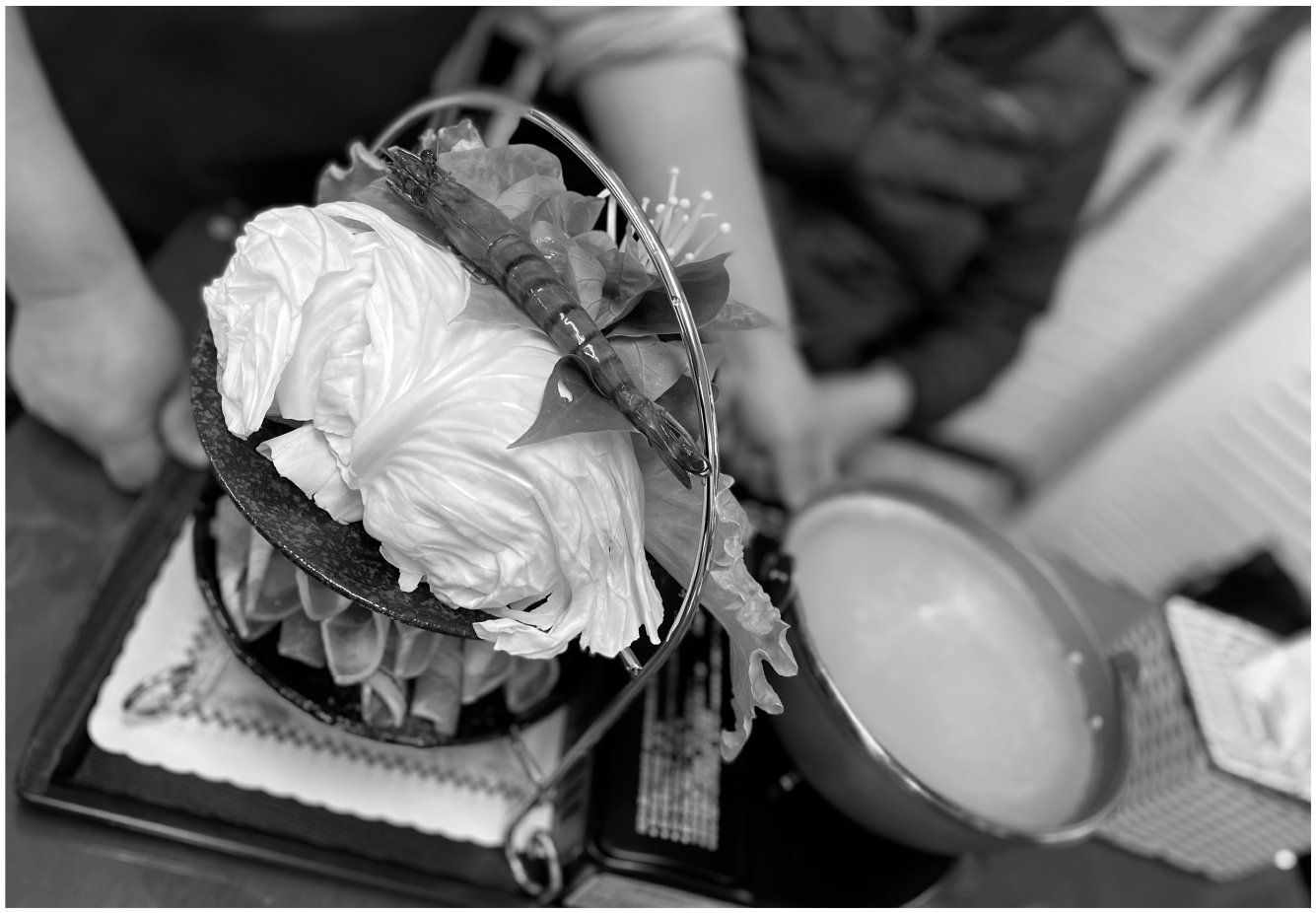
Over the past 10 years or so, I’ve noticed that invitations to eat hotpot have come from a wider range of friends, not just fellow Asians. This tracks with the dish’s growing international popularity since the mid-2000s, due in large part to the globalization of food trends, growing food media, and adventuring foodie-ism.
Diners enjoy single-person huoguo at the basement food court of a busy mall. A cook slices raw beef to order.
Courtesy Ellen T. Meiser
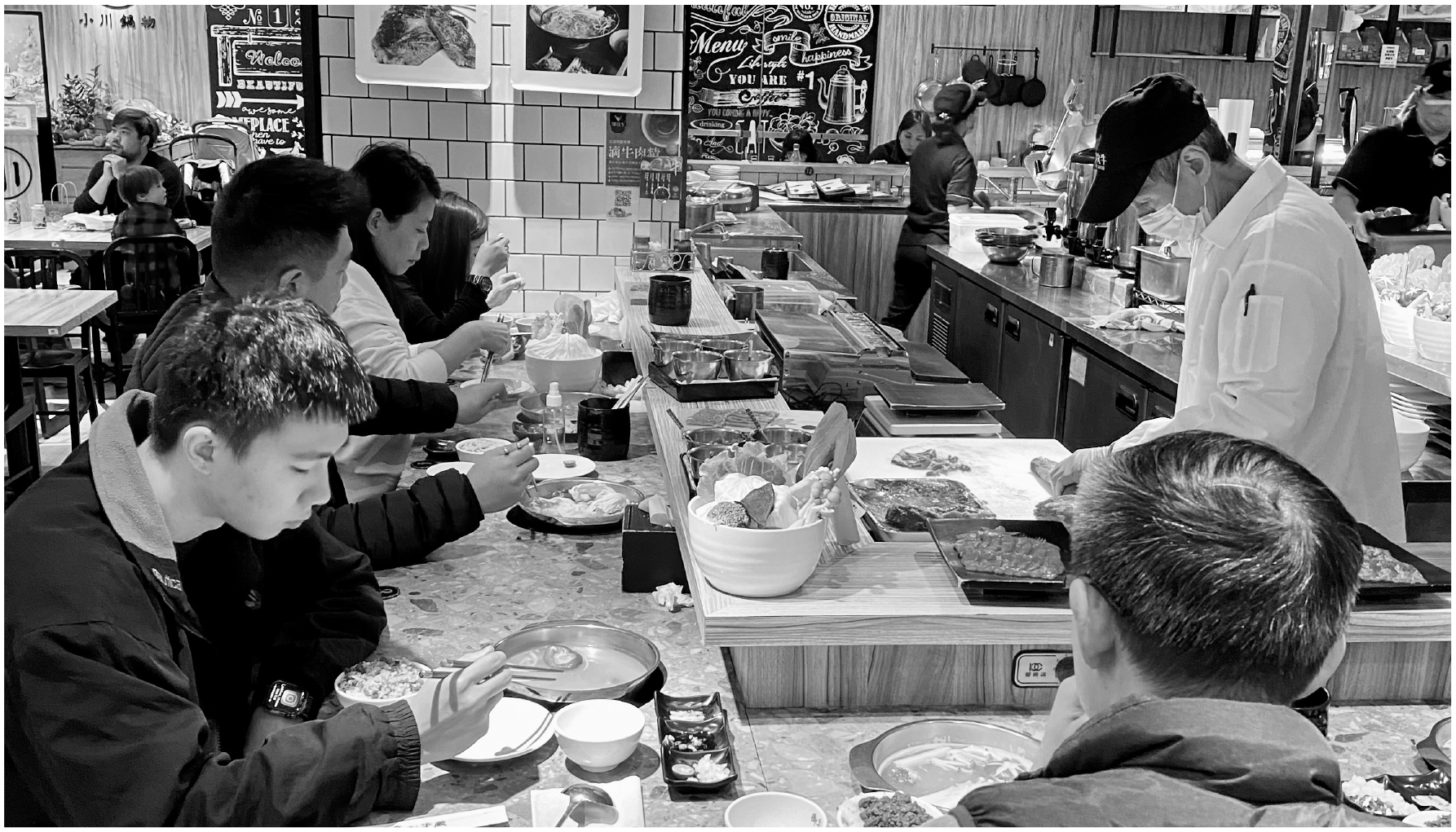
Nowadays, franchises like Happy Lamb Hot Pot (rebranded from Little Sheep Mongolian Hot Pot) speckle Singapore, Australia, the United Kingdom, Sweden, the United States, and more; diners in Frisco, Bellevue, and Chicago can settle into a booth at a Haidilao franchise and fill their bellies; and mom and pop shops are found in most towns and cities. Hotpot is so common that a 2023 study in the Journal of Education, Humanities, and Social Sciences found that about 4% of all restaurants in China serve it solely (about 400,000 stores), and in the United States, rating website Yelp noticed that in dining markets like Utah online interest in hotpot increased a dramatic 27% from 2022 to 2023.
In short, huoguo, as it’s called in Mandarin Chinese, is everywhere.
As it’s spread, hotpot has evolved in some notable ways: broths and sauces have grown in variety, with the spicy and numbing Sichuan mala style coming into vogue. Restaurant brands have begun packaging signature hotpot items and selling them on grocery store shelves. And the cost and quality of ingredients has expanded to net more customers—a diner in Taiwan can spend as little as a few U.S. dollars to $40 or more on a full meal.
But the most interesting change is how hotpot has shifted from a communal activity—one pot with one broth that’s shared with friends and family—to an individualized one. It is increasingly common to find restaurants specializing in personalized pots—called danshen guo—or, at the very least, offering a pot divided like a yin-yang symbol with multiple broths to appease multiple palates.
Curious about these shifts, I set out to interview eight Taiwanese folks about the dish. Outside of my own connection to the country, I selected Taiwan because of its enthusiastic hotpot culture. Commonwealth Magazine journalist Yueh-ju Hsu, for example, described eating huoguo as the country’s “national pastime,” with international tourists specifically seeking out the dish. So, in a variety of locations—cafes, restaurants selling Manchurian-style pickled cabbage hotpot, and echoing karaoke halls—I asked interviewees, “Have you noticed any changes or new trends in how people eat huoguo?” And, from there, the conversations got cooking.
New Trends in Huoguo
“In Taiwan, there’s really a wide variety of huoguo available. Especially those small personal hotpots. Before there weren’t as much,” 30-something Ruth explained, talking over the bumping bass of a nearby karaoke performance. Her friend, Fanfan, quickly chimed in, “It’s a ‘whatever’ dish. You can walk along the street, find a [hotpot] location, and just have a ‘whatever’ dinner. It is more of a crude meal—[it only costs] NTD$100 [USD$3] per person.”
One of the common “whatever” hotpot spots that Fanfan was referring to is the San Ma Chou Chou Guo chain, which has over 300 storefronts in Taiwan and specializes in single-person hotpots. Along with affordability, my interviewees explained that personal hotpots address two major elements of contemporary Taiwanese dining. First, they respond to worries over sanitation spurred by COVID-19 and SARS. A solo vessel of broth and ingredients carries a smaller chance of cross-contamination, after all. And second, it fits with a cultural and demographic shift seen across much of East Asia, one that has reoriented the shape and obligations of households.
Concerns over public health are straightforward, but what do I mean by the latter?
Changing Households and Obligations
Data from the Taiwanese government finds that the nation is amid its lowest dependency rate. Prior to contemporary times, working folks provided financially, emotionally, and socially for a larger number of older and younger family members. Nowadays, there are fewer people who rely on others for support (i.e., who are “dependents”).
This change is credited to some demographic developments:
First, as is seen across the neighboring nations of Japan and South Korea, Taiwanese household sizes are shrinking as fewer people are deciding to marry and have children.
Second, more people live independently, leading to a decline in the number of multigenerational homes. Filial piety used to dictate communal living and care. But in today’s competitive economic market, older folks have grown accustomed to granting more independence to their adult children as they seek out better education and job prospects afar. Solitary living, therefore, has become very common.
Pulling Taiwanese adults further away from family and friends are the country’s typically long working hours. In 2022, for example, Taiwanese spent an average of 2,008 hours at their jobs, while South Koreans logged 1,904 hours and Japanese clocked 1,626 hours. (Singaporeans took the cake with 2,293 hours, while Americans recorded an average of 1,811 hours.)
So, families are shrinking, scattering, and getting busier.
These factors result in some media sources, such as the Taipei Times, calling the island nation a “lonely society.” And loneliness rears its head in the ways Taiwanese eat. As 40-year-old Adri explained, “A lot of people have a hard time coordinating and getting together, [despite] still want[ing] to eat hotpot. [So,] we’re seeing more individual small hotpots.... It’s very convenient. You don’t have to invite a whole group of people. You can just go on your own and still taste a ton of different ingredients.” After a pause, she added, “I think it’s because in Taiwan more people eat on their own or in small groups.”
Shifting Ideologies
The changing ways of eating huoguo correlate, too, with cultural shifts across East Asia. The region has moved from Confucian collectivism to a more capitalistic individualism. Driving this transformation is the rapid economic growth and industrialization of Asian nations since the 1980s, the influence of western culture via globalization, and the decline of traditional social institutions like gender hierarchies and family structures. Hotpot reflects this decline of collectivism, morphing from one pot shared by many to multiple pots eaten alone.
Technology may be a factor as well. For example, 30-something Lan-hsin noted that even in the ways hotpot is ordered there is a growing impersonal bent: “We use less person-to-person ordering. Now, more and more, tablets are used to order hotpot ingredients to your table. It’s ‘do it yourself’—everything is.”
Notably, Lan-hsin was my sole interviewee who discussed the automation of dining. So, while I did notice a few lone diners focused on their smartphones during observations, interview data on this topic is limited. But when I asked her to explain further, Lan-hsin attributed this evolution pragmatically to “stores want[ing] to reduce labor-needs.” This is probably true, though I propose that it can also be seen as a reflection of a growing emphasis on efficiency, convenience, and autonomy—hallmarks of individualism. Through a tablet, customers can exercise greater control over their dining experience, underscoring personal choice and moving further away from relying on interpersonal interactions. There is no need to be deferential to the authority figures of the restaurant, such as the chef. A single word doesn’t even need to be uttered to receive your meal.
Food as a Societal Mirror
Social obligations and cultural shifts clearly contribute to what a person eats and how they eat in everyday life. These factors also explain the ways in which dishes that stretch back thousands of years, like hotpot, are revamped to accommodate modern life. The rise of single-person huoguo and customizable dining experiences—which have been percolating for roughly 20 years now, according to Geeying and Rebecca, two women in their 70s—signify a departure from traditional collectivist practices toward more individualistic ones.
Now, this departure is not merely culinary—it represents a broader transformation in how individuals engage with one another, their communities, and their culture. Food—and how we eat it—mirrors social change. And with hotpot, we see restaurants increasingly catering to solo diners who crave the flavors of this once-communal meal, but who lack the time and company to commune.