



Abstract
Trial by jury remains the symbolic center of the U.S. justice system. Here, readers bear witness to the process of voir dire, or jury questioning, and efforts to identify racial bias. The problem? Racial prejudice itself is taboo: jurors are reluctant to admit it, and judges and attorneys are reluctant to ask about it.
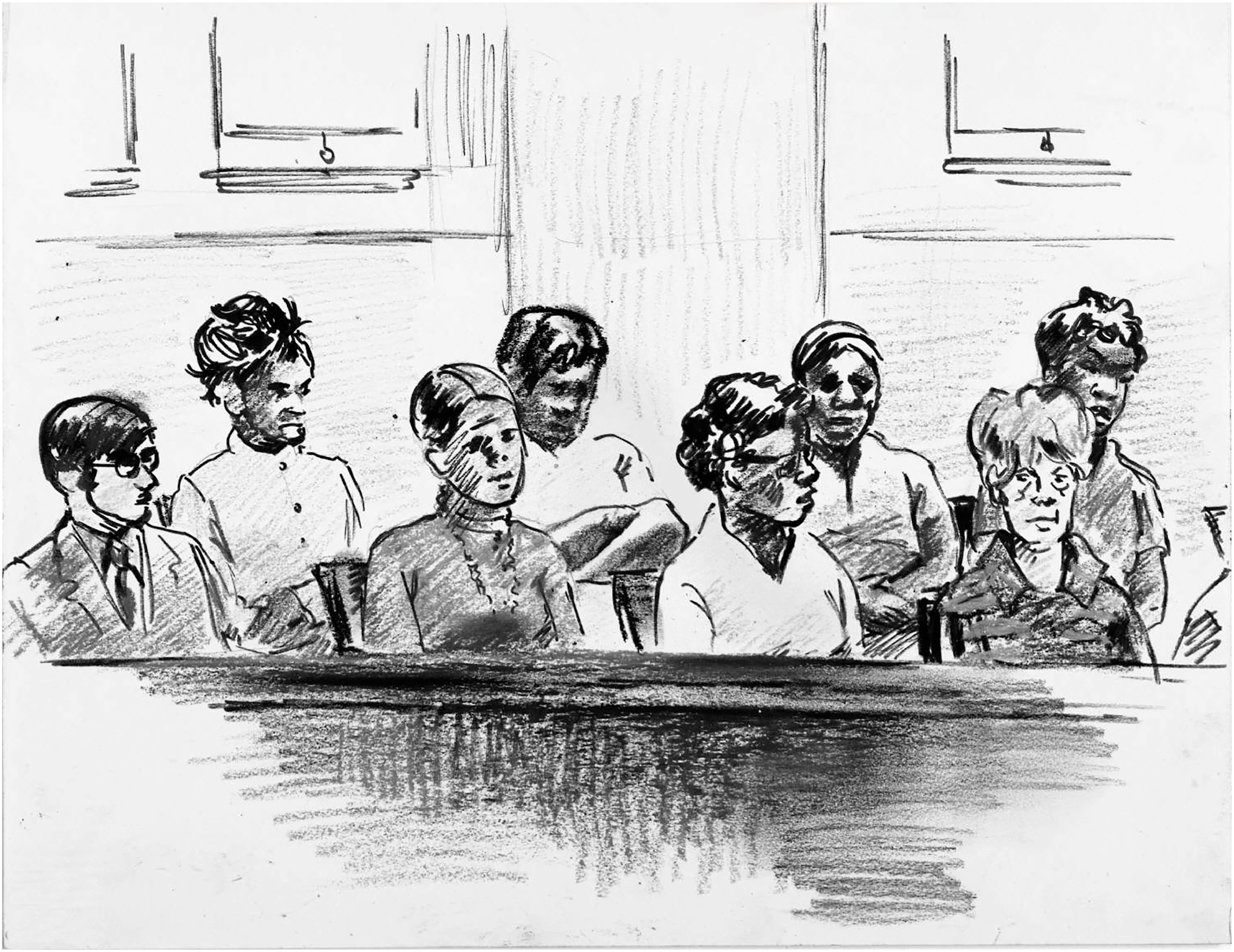
Jurors in the trial of Bobby Seale and Ericka Huggins as sketched by Robert Templeton, 1971.
Beinecke Rare Book & Manuscript Library, Yale University: 2029959
The 2020 protests triggered by the murder of George Floyd spotlighted racial disparities in policing and invited attention to similar disparities elsewhere in the criminal justice system. With racialized outcomes from charging to sentencing and incarceration well-documented and compelling, it’s relevant to take a closer look at the institutional processes that are implicated in them. Trial by jury remains the symbolic center of the U.S. justice system, but procedures bearing on juries have received limited social scientific scrutiny in a context where deliberations are conducted in secret and verdicts are presented without justification.
Given that this key component of the justice system is shielded from public view, the process of assembling juries takes on particular importance. Jurors are selected through an examination process known as voir dire, wherein they are questioned by judges and attorneys to ascertain their suitability for jury service and, in particular, to identify possible sources of bias. Attorneys may request the dismissal of an unlimited number of candidate jurors on this basis, an allowance that underscores the idea that eliminating bias from juries is an officially sanctioned and valued goal. The path toward this goal, however, features an important obstacle: racial prejudice is socially stigmatized, so much so that it amounts to a taboo subject. Not only are jurors reluctant to admit to it, but judges and attorneys are reluctant to ask about it.
Our research addresses the sensitivities surrounding juror questioning and shows how they matter. It is not about the prevalence of bias in jury deliberations and verdicts, so much as the obstacles that hamper efforts to root it out. In this essay, we document the forms of bias that judges and attorneys ask about during voir dire questioning, demonstrating that racial or ethnic bias of any kind is rarely a primary focus of inquiry. We then provide an in-depth analysis of two exchanges in which racial bias (anti-Black in one exchange and anti-Asian in the other) emerges in an indirect way. In the conclusion, we consider what exceptional exchanges and routine practices reveal about efforts to guard against prejudice in the courtroom.
Social Pressures Constrain Investigations of Bias
The main objective of voir dire is to assemble a jury capable of rendering a fair and impartial verdict. Court officials assess the suitability of prospective jurors based upon information disclosed during voir dire questioning, occasionally supplemented by written questionnaires. However, the court’s ability to obtain candid responses is hampered by social desirability pressures arising from the fact that bias is negatively valued while fairness is culturally normative and a justice system ideal. These pressures generate tensions in the examination process. For prospective jurors, the mandate to answer questions truthfully can come into conflict with the pressure to align with the fairness ideal. For court officials, the professional obligation to investigate potential biases can clash with the natural desire to avoid offense. Indeed, our research indicates that court officials probe for bias with considerable caution, relying heavily on indirect and euphemistic ways of broaching the subject. These general difficulties are exacerbated when it comes to racial bias or prejudice, which has an especially fraught history in the United States.
American courts recognize the role that race plays in catalyzing disparate jury participation and outcomes, and they offer mechanisms geared toward rectifying this problem. For example, attorneys can lodge Batson challenges, which require the opposing counsel to provide a race-neutral reason for removing a prospective juror from the panel. The Batson challenge is designed to prevent racial bias from impacting the demographics of jury selection, ensuring that jurors are not eliminated on the basis of their race. But what about prospective jurors’ prejudicial and discriminatory attitudes? How do these get exposed and eliminated from juries?
Legal scholars debate the utility of directly asking candidate jurors about their racial biases. In his 1989 article “The Supreme Court and the Jury,” law professor Albert Alschuler is skeptical, writing that blunt questions (say, Are you a bigot?) are hardly conducive to candid responses. In contrast, law professor Cynthia Lee suggests, in her 2015 article “A New Approach to Voir Dire on Racial Bias,” that while closed-ended questions about racial bias may be unproductive, open-ended questions that ask prospective jurors to reflect upon their implicit feelings surrounding race might encourage more thoughtful introspection and candor. Professor Lee’s approach dovetails with the advice of survey methodologists, who have long advocated circumspection and tact when broaching sensitive and stigmatized subjects. This amounts to reasonable advice for examining jurors, though little is known about whether it is being taken up by court officials or to what extent it is effective.
To understand how social pressures constrain the selection of fair and impartial juries, we must examine those pressures in action—that is, within actual courses of voir dire questioning. First, we assess the extent to which the taboo topic of racial bias is broached in this context, asking how frequent such questions are relative to questions regarding other forms of bias. Going deeper, we look at when and how such questions are introduced. In our data, the first hints of racial bias actually emerge through the initiative of jurors rather than judges or attorneys. Nonetheless, court officials pick up on these often subtle and indirect clues, with further interrogation geared toward exposing bias and eliminating it from the jury. Our findings suggest that tactful probing for racial bias is both underutilized and potentially advantageous.
Fairness/Bias Questions
Our Study
We analyzed voir dire examination processes, focusing primarily on those recorded on video. Such data is quite limited because courts usually do not record jury selection processes. Thus, from this limited data, we selected legal cases with an eye toward maximizing generalizability—routine cases involving ordinary people were prioritized over extraordinary cases involving celebrities or intense media attention. We settled on five routine trials, four criminal and one civil, involving a range of charges and legal issues: armed robbery, drug possession and trafficking, assault with a weapon, and wrongful death. The criminal cases occurred in Arizona state court in the 1990s; the civil trial was a federal case from California in the 2010s. From these five trials, we analyzed every instance (n=107) in which a particular juror was questioned about a possible biasing factor in their background or experience.
iStockPhoto.com // tiero
Topics of Fairness/Bias Questions
Our mixed-methods approach combined context-sensitive case analysis in the conversation analytic tradition with statistical analysis. We first examined each episode of juror questioning, attending to the kind of biasing factor topicalized and the interactive process by which it was introduced and dealt with. We then assessed the frequency of phenomena uncovered through case analyses, while also examining exceptional episodes in more depth. The exceptional episodes are presented here in transcripts with symbols to represent audible details such as silence (numbers in parentheses for silence length in seconds; period in parentheses for a brief untimed silence), simultaneous talk by different speakers (onset marked with square brackets), audible breathing (strings of hhh), emphasis (underlining), and turn-final intonation (period for falling, question mark for rising, and comma for slightly rising).
Asking About Bias
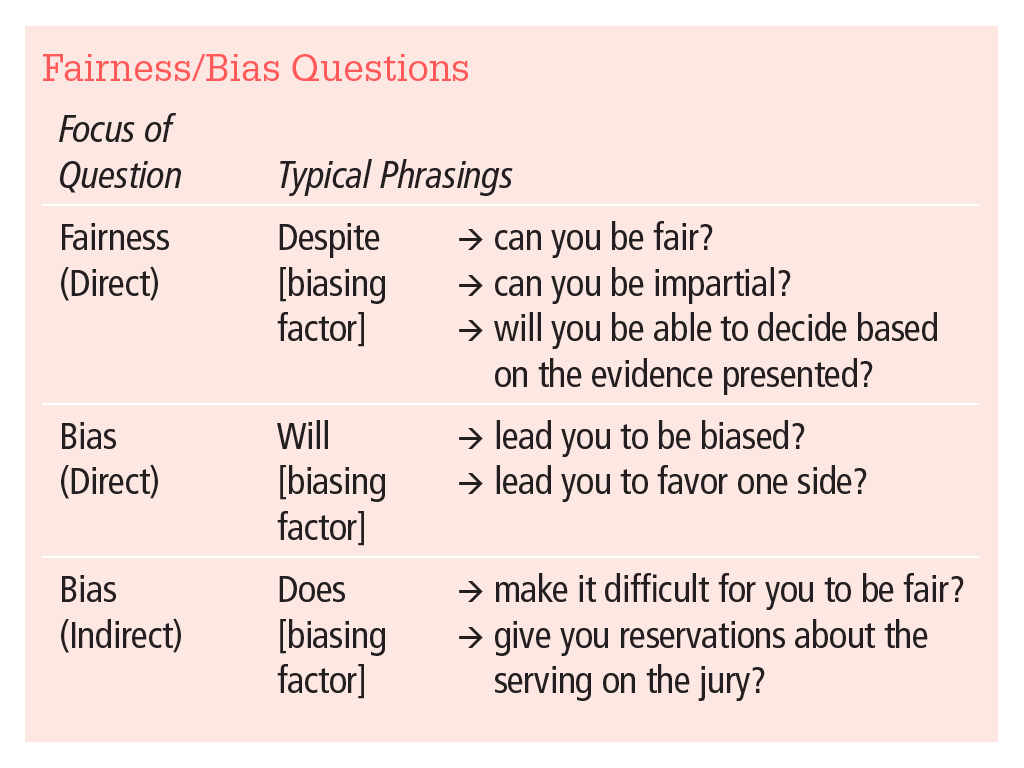
Court officials introduce a succession of possible sources of bias during the examination process, and discussion focuses on whether these might matter for members of the jury pool. Prospective jurors are invited to disclose relevant background and experiences, then asked if these might impact their capacity for fairness or bias in court. We term these inquiries fairness/bias questions. The 107 fairness/bias questions in our data took a variety of forms (see table on p. 26). Court officials sometimes asked directly whether the prospective juror would be fair despite their background and experience or whether they would be biased toward one side. More often, particularly when the question was framed as targeting bias rather than fairness, court officials were markedly indirect, using euphemistic or allusive language such as “difficulty being fair” or “difficulty serving on the jury.” In our data, bias-targeted questions were overwhelmingly indirect rather than direct by almost a 3:1 ratio. This evident cautiousness is one general indication that the social stigma associated with being biased conditions efforts to probe for it.
Episode 1: Lopez Tape 4, 17:31-18:15
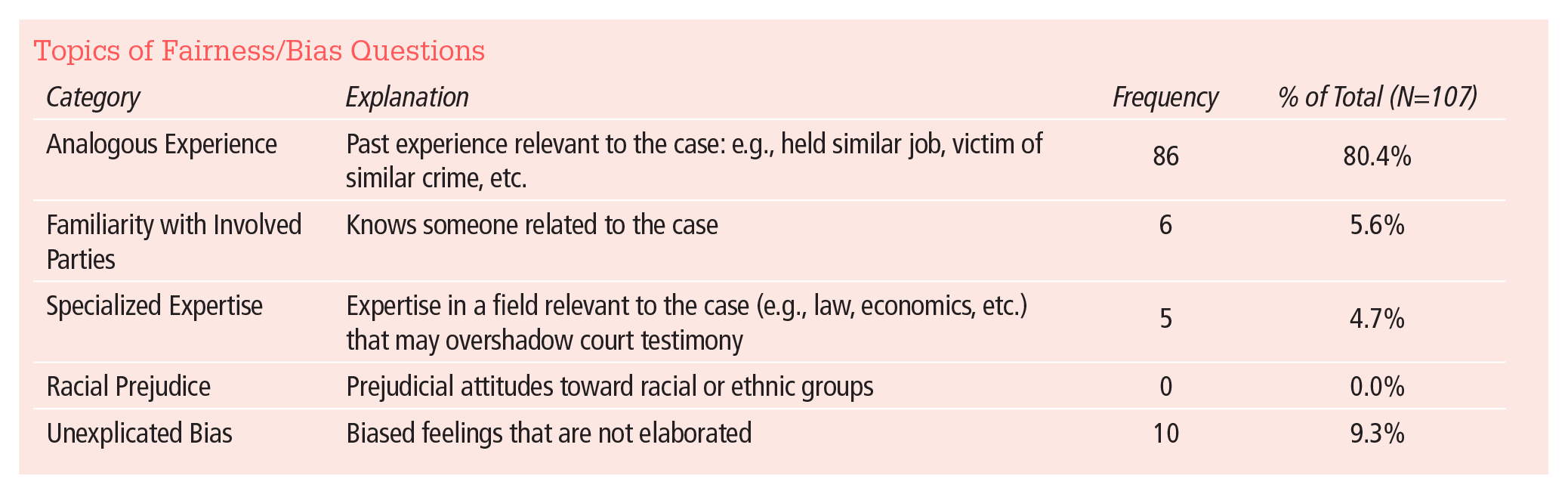
We also coded the fairness/bias questions with respect to the type of biasing factor at issue. As shown in the table on the previous page, most questions (>80%) targeted the recipient’s relevant past experiences (e.g., whether they’d been the victim of a similar crime or worked in a similar job). Less frequently, questions asked about being personally acquainted with someone in the case, having specialized legal or technical expertise that could supersede evidence presented in court, or having some unspecified favoritism toward one side or the other. There were no questions at all targeting racial or ethnic prejudice as a form of bias. The complete absence of such questions suggests that social desirability pressures are particularly acute in this area and, as we shall see, our qualitative analysis of atypical episodes adds further weight and nuance to this insight.
The Circuitous Emergence of Racial Bias
Although court officials did not explicitly make racism a focus of inquiry, it nonetheless emerged twice in our data. In both instances, it was the prospective juror who first hinted at the possibility in a context where some other form of bias was being discussed. And in both instances, the judge (different in each case) subsequently pursued the matter while continuing to avoid the language of bigotry or racism.
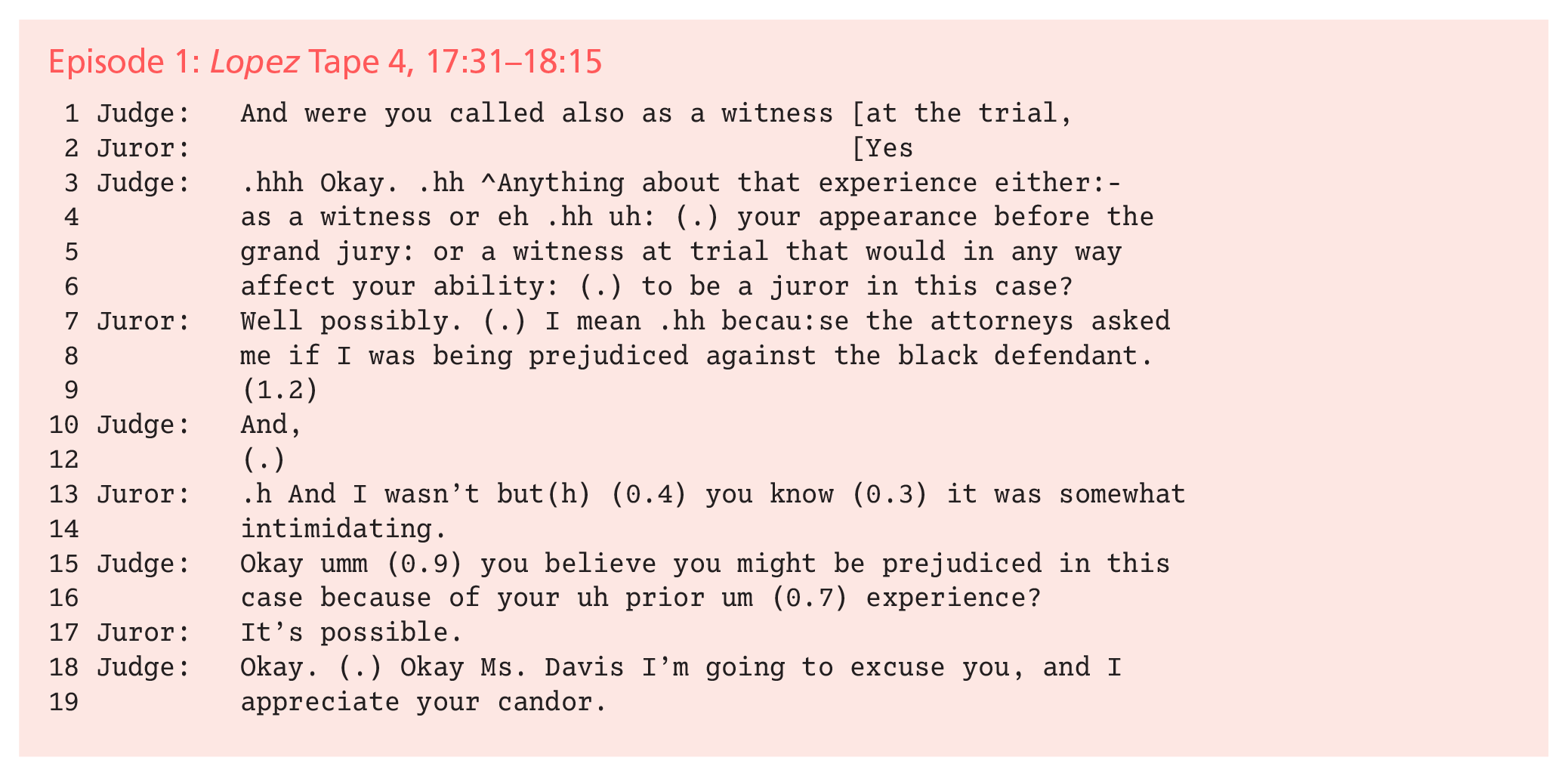
In the first episode (Episode 1, p. 27), which is relatively straightforward, racial bias emerges during inquiry into analogous past experience; the prospective juror had previously witnessed and testified in court regarding a similar type of crime. After that experience is elaborated (ending at lines 1-2), the judge then asks if it would “affect your ability to be a juror in this case” (lines 3-6). The prospective juror admits that this could be a problem (“Well possibly”) and refers obliquely to racial animus (lines 7-8). Though this is hardly a full-fledged admission—it’s put forward as a possibility raised by the defense, but denied by the juror (line 13)—it nonetheless introduces the issue of anti-Black racism.
Episode 2a: York Tape 3, 42:42-44:58
The judge then pursues the matter with sustained circumspection. After allowing space for the juror to elaborate (line 9), he prompts her with just an upwardly intoned “and” (line 10). He then summarizes her remarks (lines 15-16), in the process using the general term “prejudice” and immediately clarifying this with a bland reference to her “prior experience” rather than engrained racial attitudes. The exchange ends (lines 18-19) with the judge briefly thanking and excusing the juror. At no point in the pursuit (line 10), summary formulation (lines 15-16), or dismissal (lines 15-16) is racial bias overtly referenced by the judge. He simply probes the juror’s suggestive comments and acts on them.
iStockPhoto.com // Michael Vi
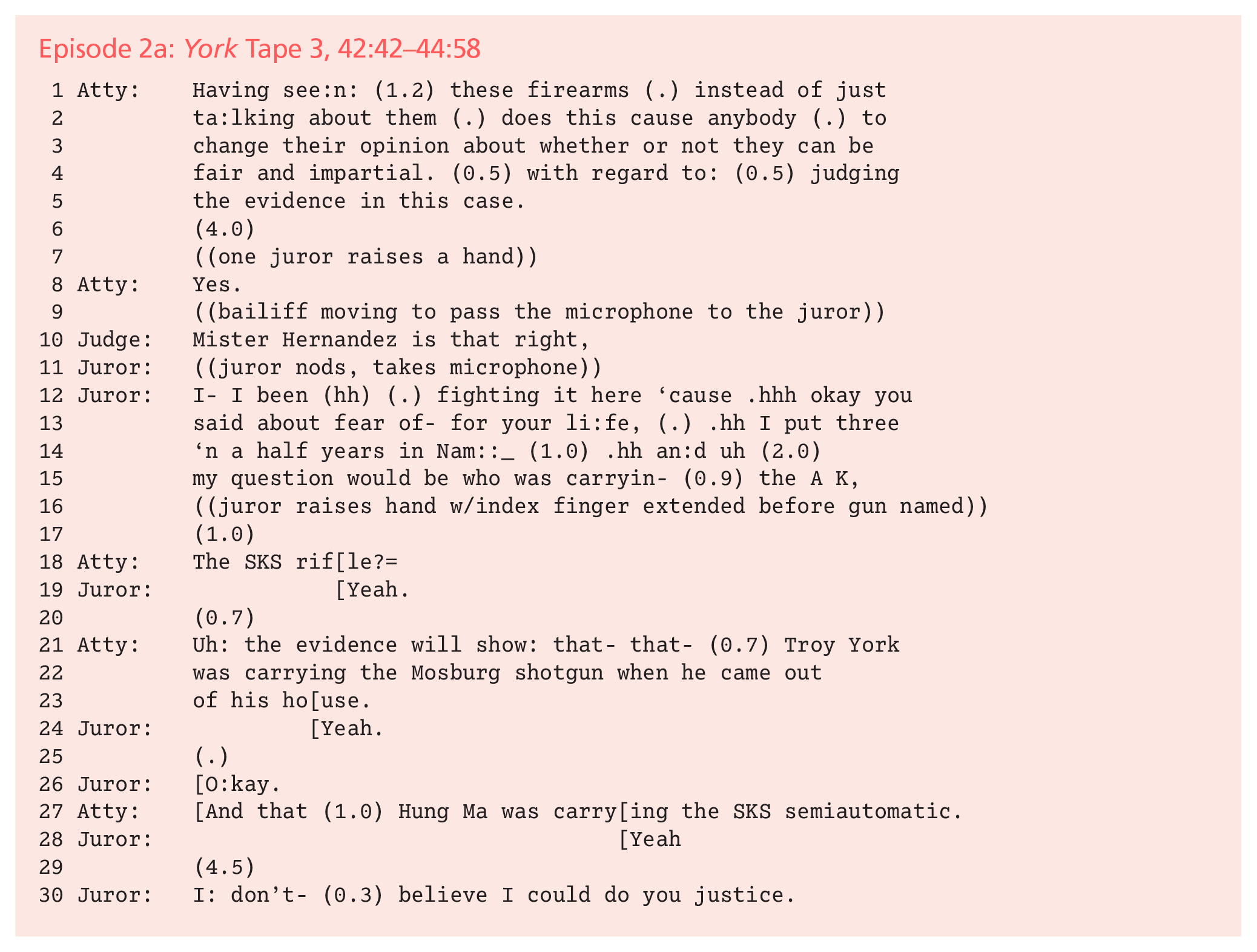
Our second circuitous episode (Episode 2a, beginning p. 28) emerges from a discussion of firearms and strong feelings about them as an obstacle to fairness (the firearms in question figured in an altercation that left one man dead). After the relevant guns are shown to the jury pool, the defense attorney asks if this leads anyone to doubt their capacity for fairness (lines 1-5), and one juror raises his hand (line 7). When given the microphone to elaborate (lines 9-11), the prospective juror presents himself as internally agitated (line 12) before disclosing extended Vietnam War service (lines 13-14) and then asking who was carrying the “AK” (line 15). The attorney explains that the White defendant (“Troy York”) had a shotgun (lines 21-23), while an Asian man (“Hung Ma”) had “the SKS semiautomatic” (lines 27), at which point the juror concludes that he would be unable to “do you justice” (line 30).
Episode 2b: Continued from previous excerpt
iStockPhoto.com // wildpixel
Though the juror offers no explicit account or explanation at this point, his prior disclosure of Vietnam service (lines 13-14) and his query targeting not the gun but the identity of the person carrying it (line 15), who was just revealed to have been an Asian male (line 27), are together suggestive about the juror’s underlying difficulty.
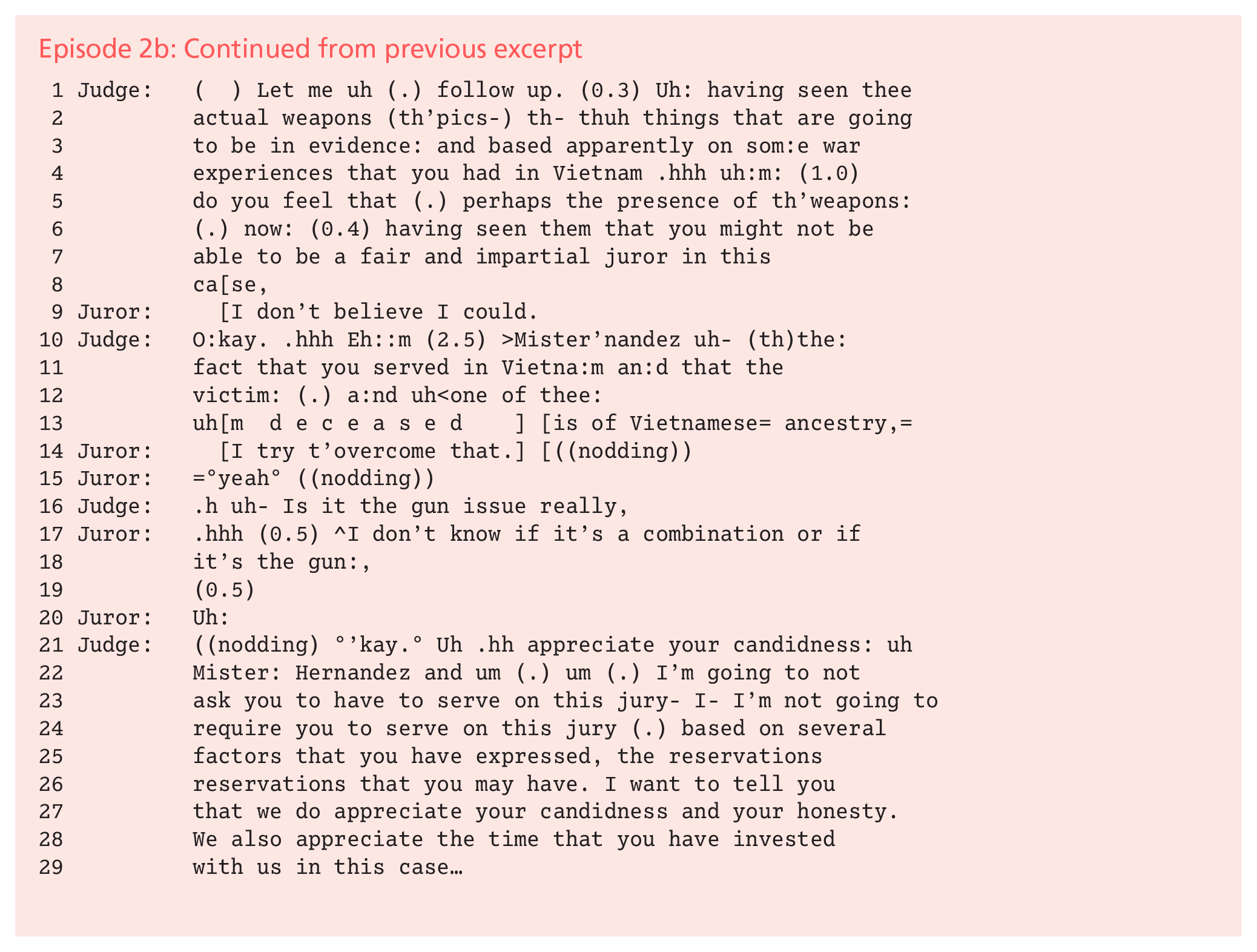
At this point the judge, previously silent, takes over the examination (see Episode 2b, p. 29). He poses a fairness/bias question to the prospective juror, but as in the previous episode, he studiously avoids any explicit reference to racial prejudice (lines 1-8). He frames the question as following from the juror’s prior disclosure, but the question’s preface (lines 1-4) refers only to the matter of firearms and “war experiences that you had in Vietnam.” And the question proper (lines 5-8) returns to the just-seen weapons as it pessimistically anticipates an inability “to be a fair and impartial juror in this case.”
After the juror confirms the pessimism (line 9), the judge pauses at length (line 10) before pursuing the matter of what might be behind the difficulty. He is circumspect while inching closer to the taboo topic of racial animus, leading up to the question (lines 10-13) by juxtaposing two facts: that the juror served in Vietnam, and that one of the parties “is of Vietnamese ancestry.” Then, as an upshot, he poses a question: “Is it the gun issue really” (line 16). The inclusion of “really” gives the question a negative polarization, so that it can be heard to suggest or imply that the gun issue is a facade while the prior racialized juxtaposition captures the “real” stumbling block.
While the judge’s question is unfolding, the prospective juror is nodding along, quietly affirming (“°yeah°”) and claiming an effort “to overcome that” (lines 14-15), all of which tacitly validates the emerging question’s restrained suggestion. But when the juror then responds more fully to the completed question (lines 17-18), he is equivocal about the root cause of his difficulty with being impartial; and like the judge, he sidesteps any language of racial prejudice. The judge then dismisses him from the jury with a bland reference to “several factors” (lines 24-25), before going on to express gratitude for his candor and his time (lines 27-29).
These two instances come from different courts, involve different participants, and concern very different types of cases, but they are nonetheless strikingly similar in the indirect way racial bias emerges, is cautiously but effectively probed, and ultimately eliminated from the jury. And while exceptional in our data, these instances suggest lessons to be learned about how court officials can detect and redress racial animus in the assembly of juries.
Implications
The U.S. criminal justice system is premised on the principle of due process for all. Central to this idea is the Constitution’s Sixth Amendment protection of defendants’ liberties until judgment by an impartial jury of their peers. Yet, it is difficult to assess the degree to which juries are truly fair because their deliberations occur in secret, and final verdicts are recorded without explanation or justification. In contemporary trial procedure, courts’ assessment of prospective jurors’ suitability for service occurs almost entirely during jury selection through an evaluation of self-reported evidence obtained mainly through voir dire. Despite the importance of rooting out racial prejudice, straightforward inquiries bearing on this problem are quite rare.
Legal scholars continue to debate the utility of questioning people about their racial biases. While explicit questions of this sort may not be conducive to candor, more subtle questions that invite open-ended reflections, coupled with a keen sensitivity to what such reflections may portend, can be fruitful. Notwithstanding the deep inhibitions surrounding this issue, we have demonstrated that it’s possible to broach the subject without condescension or confrontation.
The judges that we studied did not directly ask about racism, but it is evident that they were on the lookout for hints and indirect signs of it. When such signs emerged, the judges were probing but tactful, inviting clarification in ways that did not call out or blame the juror. And once these attitudes were confirmed, the judges excused the potential jurors from service with gratitude for their openness and honesty. Such remarks serve dual functions. To the dismissed person, they communicate unqualified appreciation and the message that they fulfilled their civic duty to the court. And to other prospective jurors, who are usually co-present, they confirm that the court values candor above all else. Practices like these, if pursued systematically in conjunction with allied efforts to naturalize bias and invite candid self-reflection, can help reduce the influence of racial prejudice on juries and judicial outcomes.