



Abstract
Though it is vital to attend to oppression and inequality, telling stories about trans joy helps scholars, trans people, and the public understand the full complexity of trans people’s lived experiences. Noticing, nurturing, and celebrating joy is a vital form of resistance for marginalized communities.
Note: To see this article’s images in color, visit ctx.sagepub.com.
Courtesy Mars Wright
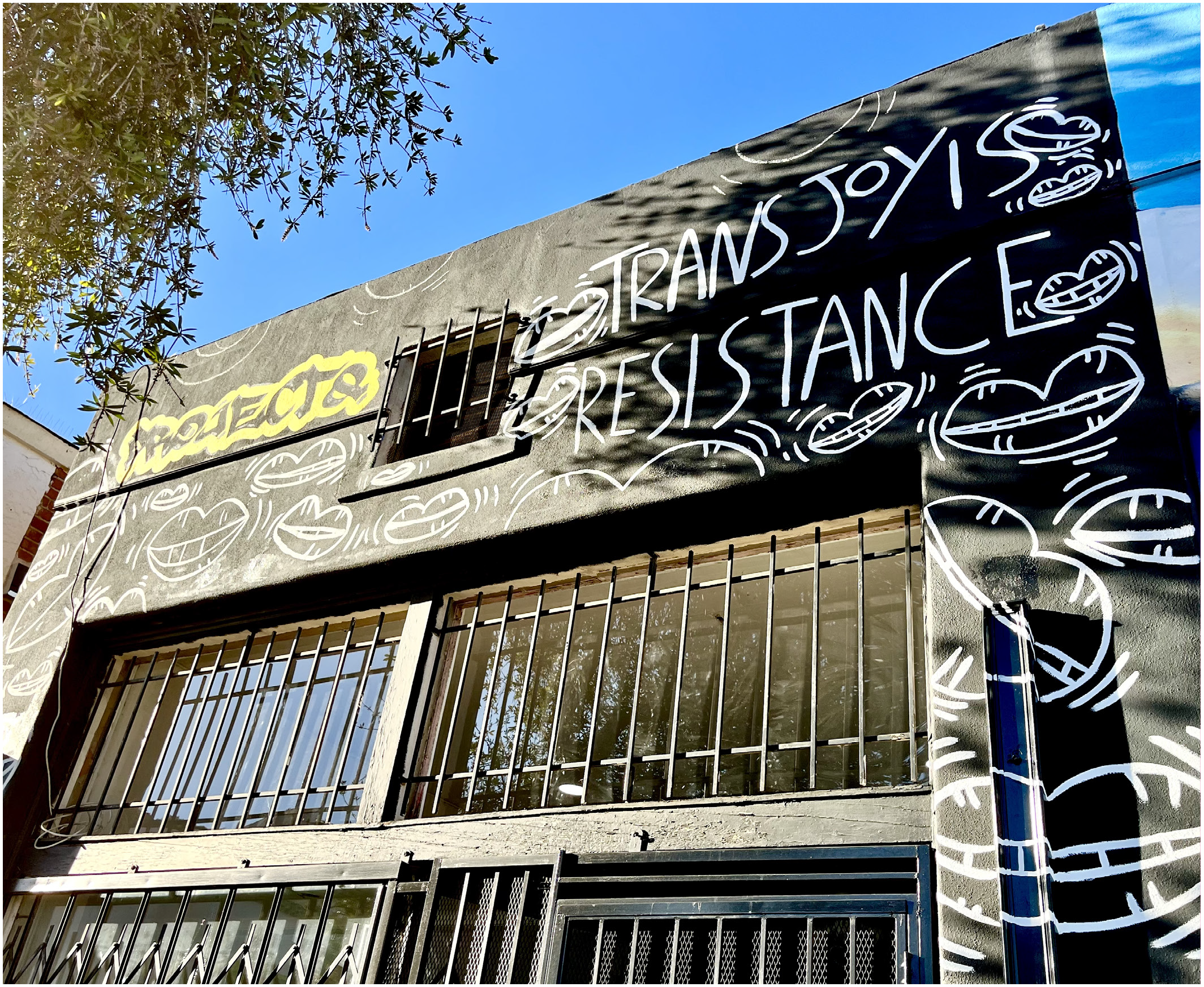
In the face of recent waves of anti-transgender rhetoric, a mural on the ProjectQ Community Center in Los Angeles proclaims “Trans Joy is Resistance.” Reflecting on his piece, artist Mars Wright said, “How do we make trans joy tangible, a lived reality? We put it everywhere, we remind everyone passing by that we are not going anywhere, and our joy is actively resisting the transphobia we experience, the transphobia that tells us we do not belong and we should not have joyous lives as out trans people.” Like Mars Wright, transgender people throughout the United States are increasingly expressing and highlighting trans joy—the joy of being transgender—in its many forms. This movement is in tandem with a number of other efforts focusing on the joy of being a member of marginalized groups, including those celebrating Black joy, queer joy, and disabled joy. Together, these movements show us how joy is a powerful way to temper the onslaught of oppression and discrimination.
Although focusing on joy may seem frivolous to some people, experiencing and speaking about the joy of being a member of a marginalized group resists oppression in a multitude of ways. Highlighting joy helps dismantle the dominant narrative that says members of marginalized groups are miserable and shunned by others. Narratives of joy reduce stigma, discrimination, and violence by showing how marginalized groups are valid, valuable, and worthy of celebration. Moreover, joy fuels activism against oppression by energizing people and offering alternate possibilities for what life can be like as a member of a marginalized group. Our society has long told narratives about suffering, and yet we still have high levels of inequality. What if part of the solution to inequality is to also telling narratives about joy?
The stories that are typically told about transgender people by the mainstream media, academics, and activists are those of suffering, discrimination, and violence. These stories are seen as helping trans people by signal boosting experiences of inequality and garnering more sympathy. Those who repeat these stories are applauded as allies. However, these stories often contribute to transnormativity—the belief that there is one correct way to be transgender—positioning misery and oppression as central to a “true” experience of transness. Rather than helping, spotlighting the negative aspects of the lives of marginalized people causes harm when that becomes the only way we understand those groups.
<< Artist Mars Wright (marswright.com) created his “Trans Joy Is Resistance” mural on the ProjectQ Community Center in Los Angeles in part to counter transphobic rhetoric that insists “we should not have joyous lives as out trans people.”
It is vital to attend to oppression and inequality. But those are not the only experiences that make up the lives of people from marginalized groups. In response to the lack of stories told about trans joy, we asked a diverse group of 40 transgender people: What do you find joyful about being trans? Our interviews revealed three key themes: 1) Transgender people find joy in being members of a marginalized group; 2) Quality of life for transgender people improves after coming out as trans; and 3) Being transgender increases connections with other people. Our findings show how telling stories about trans joy can help scholars, trans people, and the public understand the full complexity of trans people’s lived experiences, including all of the wonderful things about being transgender.
Being from a Marginalized Group is Joyful
One common belief in the United States is that, if given the option, no one would choose to be a member of a marginalized group. For example, this is the origin of the essentialist statement that all LGBTQ people are “born this way.” However, as revealed by our interviewees, there are tremendous joys in being a member of a marginalized group, and many people would not choose to be part of the dominant group if given the option. As Aaron, a 53-year-old white trans man, explained, “I don’t want to ignore the bad things, but I also don’t wish that I was normal.” If he were “normal,” Aaron said, “I wouldn’t ask these hard questions. I wouldn’t have these experiences that I have. I want my life to be a life of experience and a life of joy and affirmation, and I want to help other people feel that freedom to explore themselves and ask as many questions as possible.”
Flipping the script on the dominant belief that marginalization equals misery, Aaron and many other interviewees described to us how being transgender brought them joy because existing outside of the social norm helped them to better know themselves and the world around them. Living in a way that is contrary to dominant gender norms affords people space to explore and decide how to be in a way that will make them happiest.
“Having room to move around and play with gender is really fun. Being able to move around in different presentations and different roles and play with how people perceive you and how you perceive yourself is really joyful.” —Julian
On the joys of being transgender, Julian, a Latinx gender-queer person, stated, “Having room to move around and play with gender is really fun. Being able to move around in different presentations and different roles and play with how people perceive you and how you perceive yourself is really joyful. [I enjoy] being able to move across gender.” Nico, a Black genderqueer person, had a similar experience, saying that being transgender “is a freedom” and that it “shakes up those ideas about gender that even people who strongly identify with their born gender don’t want. It just shakes everything up and that’s exciting.”
Thus, contrary to common assumptions, the trans people we spoke with said that they preferred being transgender because it facilitates experiences and perspectives that they would not have if they were not part of a marginalized group. “I feel like it definitely enriched my life a lot and informed my worldview,” commented Jason, an Asian trans man. To him, being trans means being “able to access things and change my life in whatever way I can.”
Joy is essential to human wellbeing, can sustain people experiencing and mobilizing against discrimination, and helps make life worth living.
iStockPhoto.com // jacoblund

Embracing Marginalized Identities Improves Quality of Life
News headlines and posts on social media often highlight the discrimination and violence that transgender people experience. This can leave the impression that being from a marginalized group means having a lower quality of life than those from a dominant group. However, most of the trans people we spoke with said that their lives improved when they embraced being transgender. Yes, they experienced oppression. But they felt that their lives as trans people were better despite the persecution they endured for living their lives outside the social norm. This was because when they embraced being transgender, they experienced an increase in self-confidence, body positivity, and a sense of peace and connection to the world.
Many interviewees described how their self-confidence increased when they embraced their trans identity. For example, despite having been fired for being transgender, Rachel, a white trans woman, explained how being openly transgender has meant that her “self-esteem has gone way up.” During her sold-out performance art show, she spoke with audiences about her experiences of discrimination and said, “It is really awesome to be able to say, ‘You know, I was fired [for being trans]’ and have an audience of people listening, engaging, and caring.”
Similarly, a number of interviewees discussed how being transgender improved their feelings toward, and connection with, their bodies. Alex, a Latinx genderqueer person, said, “I feel so much more complete. I went on hormones because of the social anxiety of how I was perceived, not being able to find a job, being afraid of not passing, being afraid of being really ambiguous and potentially being a victim of violence. I didn’t really expect to feel more at home in my body. That narrative didn’t really make sense to me. Yet going on hormones definitely moved me into a space of feeling really accepting and empowered about my body and feeling like it really belongs to me in a way, and I take ownership over it in a way that I never have before. And I feel like that also has made me be able to relate to other people’s bodies in a really different way, and that’s been something that’s been really joyful for me.”
Joy fuels activism against oppression by energizing people and offering alternate possibilities for what life can be like as a member of a marginalized group.
© Bernhard Kußmagk, used with permission
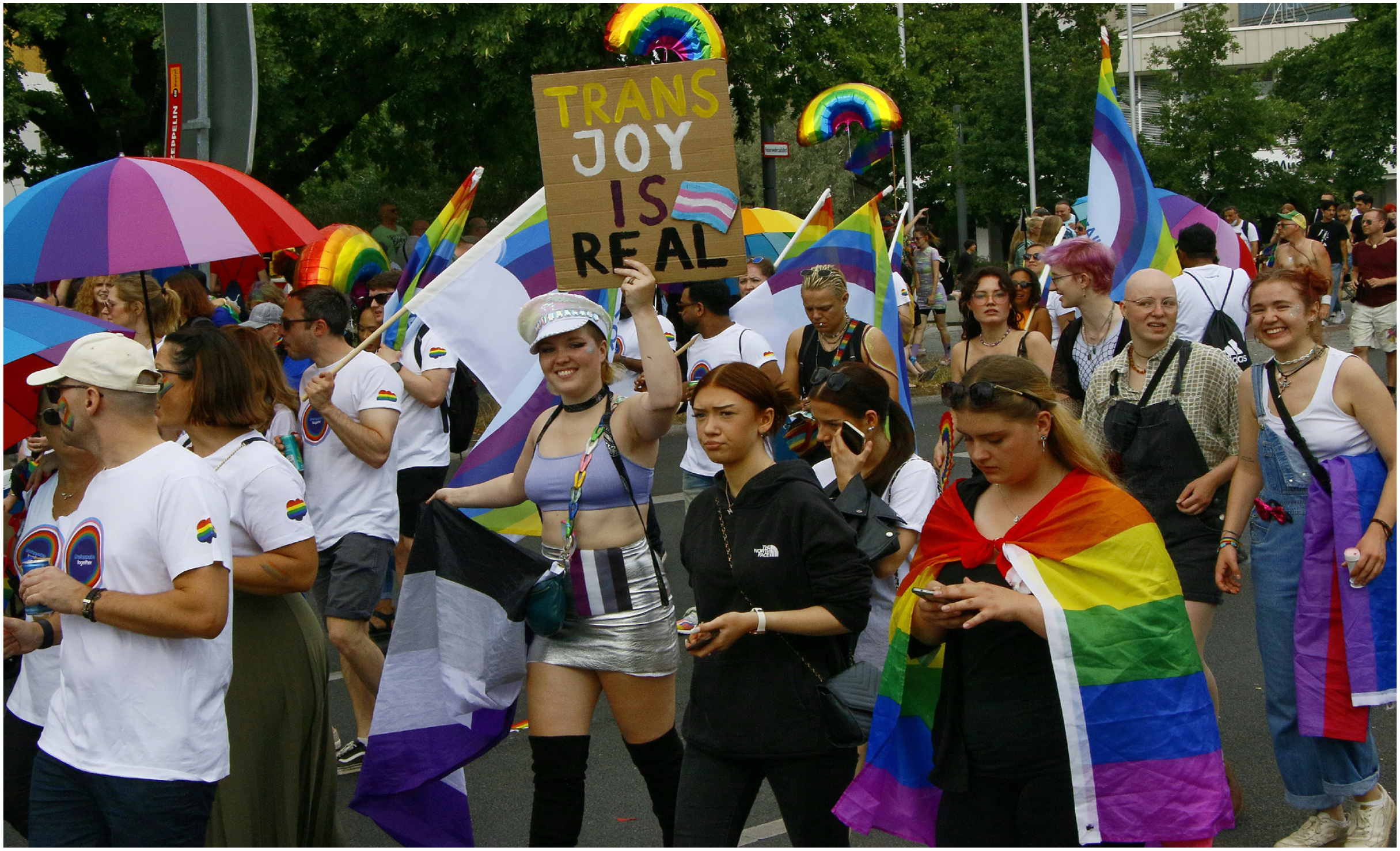
Avery, a white genderqueer person, used similar words: “After I had been out for a while, I just became more in my body. In myself. Like I don’t feel like I have to fight myself all the time. I wish I would have done this sooner. But now I feel good, and that’s awesome.”
Finally, several interviewees detailed how, counter to dominant beliefs, being transgender had helped them become more spiritual and have a greater sense of peace. As Felix, a white genderqueer person, explained: “I feel grateful to constantly be going deeper and really understanding who I am and how I experience the world. And in a roundabout way, it’s also led me down a spiritual path that has significantly changed and improved my life. Which is funny, because I think a lot of people wouldn’t think that would happen. They would see it the other way around.” Felix laughed, “For me it’s totally been the opposite.”
Similarly, Seth, a Latinx genderqueer person, said, “I think some of the joy is that I’ve become more in touch with my spiritual self.…Like, finally getting to a place where I could breathe and just be in myself.”
Although many people may believe that being part of a marginalized group means that one feels shame about their identity, revulsion toward their body, and disconnection from spirituality, the transgender people we spoke with had the opposite experience. Being openly trans increased their feelings of positivity toward themselves and their bodies as well as their connections to spirituality and a sense of peace in the world.
Marginalization Increases Connection with Others
Social isolation is also a feature of typical narratives about what it means to be a member of a marginalized group. The majority of the trans people we spoke with detailed, instead, how being transgender increased connections with other people, including giving them access to trans and queer communities and deepening their emotional connections with family, friends, and romantic partners.
Many interviewees talked about how being transgender helped them be more open to other people, as their experiences of discrimination helped them understand people who were different from them. For example, Grace, a Black trans woman, said that being transgender gave her a “different perspective” and that compassion had become “a core value” for her. With a laugh, she explained, “I wasn’t an asshole before. But I wasn’t exactly the nicest person either. I feel a lot of stigma when I go home. My Black community doesn’t always tend to be open to trans women. It really used to get to me. I used to get happy being able to tell people off. But that never felt right. Eventually I found ways to find compassion. Like, going home now and still hearing comments from people, I can handle it. Sometimes I’ll get into a conversation with them, ask them why they think that way. Some people are raised a certain way. And maybe just knowing people like me will open them up, even a little bit, to not be such assholes the next time they encounter a trans woman. Finding that compassion, that was joyful.”
Living in a way that is contrary to dominant gender norms affords people space to explore and decide how to be in a way that will make them happiest.
iStockPhoto.com // Creative Credit

“I’ve met people I wouldn’t have met [if I wasn’t trans]. I’ve also learned to take people more as they come, you know? Like letting people be and finding joy and beauty in other people.”—L
Julian also found that being a member of a marginalized group helped, rather than hindered, people connecting with them. “Being a genderqueer guy, sometimes, it makes people who would normally see through me, or look past me, or write me off take a second look and be curious and being willing to talk about their own stuff—whether that is stuff around gender, race, or class. There is this way that people are curious, and that curiosity will allow them to share more about themselves. There is a vulnerability in this [in being openly trans] that people sometimes respond to or opens their vulnerability.”
L, a mixed-race genderqueer person, echoed Julian’s comments: “I’ve met people I wouldn’t have met [if I wasn’t trans]. I’ve also learned to take people more as they come, you know? Like letting people be and finding joy and beauty in other people.”
In addition to helping them connect with others in general, the trans people we spoke with said that being transgender helped them find supportive communities that accepted them as they were. Jason counted “the community” among the joys of being trans, saying “I really like being a part of the community.” Similarly, Ben, a white trans man, offered, “I think that my identity [as trans] is crucial to who I have met and who continues to be a part of my life. That is my never-ending source of joy, my awesome friends who I get to hang out with all the time.” Chloe, a white transgender woman, shared how the trans community is “like a kinship and like a family” and how she found the people in her “chosen family” in the trans community.
These feelings of kinship and connection even occurred in some unexpected communities, like religious ones. Callie, a white trans woman, told us, “Religion has always been important in my life, and I grew up in a conservative Baptist home. I thought that being trans meant that I would have to give up religion—that no religious places would want someone like me.” She continued, “But then I found the Unitarian Universalist church, and they had no problems with me. And now I have a church that feels better than any one that I’ve been a part of. The UU helped me understand that religion doesn’t have to be all fear-based, going-to-hell kind of stuff, that there’s room for religion to be a part of one’s life in really healthy ways that are based in compassion and social justice, not fire and brimstone. That’s been a joy.”
Speaking with trans people about what they found joyous about being transgender revealed the myriad and unexpected ways being a member of a marginalized group increased their connections with other people.
Trans Joy is Resistance
Contrary to most narratives that equate being trans with misery, the transgender people we spoke with experienced trans joy in their connections with others, improvement in their lives, and how being outside the social norm helped them see themselves and the world around them in new ways. They also countered the belief that people who regularly experience discrimination would rather be part of a more privileged group. Instead, they argued that, despite high levels of oppression, they preferred being transgender. Indeed, many interviewees talked about how their life became better once they embraced their marginalized identity due to increased self-esteem, body positivity, and a sense of peace. Moreover, most pointed to the connections they were able to make with others because of their transgender identity, including community membership and deeper emotional ties.
Certainly, it is important to shed light on the oppression and discrimination that members of marginalized groups experience. However, exclusively focusing on those aspects of marginalized lives obscures joy. This is dangerous, since it perpetuates the idea that marginalized people are relegated to a life of discrimination, bullying, and violence. Such beliefs can become a self-fulfilling prophecy, further increasing stigma and discrimination against marginalized people and causing members of such groups to only focus on negative experiences and ignore all the wonderful aspects of being a member of their group.
By contrast, experiencing and highlighting the joy of being a member of a marginalized group is a vital form of resistance. Joy is essential to human wellbeing, can sustain people experiencing and mobilizing against discrimination, and helps make life worth living. As such, it fuels and inspires resistance. Moreover, talking about joy resists the dominant narrative of what it means to be a member of a marginalized group, offering people alternate possibilities for how their lives may be and encouraging others to rethink their narrow understandings of the group. The people who shared their stories with us found immense joy in being transgender, and it is imperative that our culture shifts the story about what it means to be trans to include this irrepressible joy. Noticing and nurturing joy are necessary steps to challenging inequality.