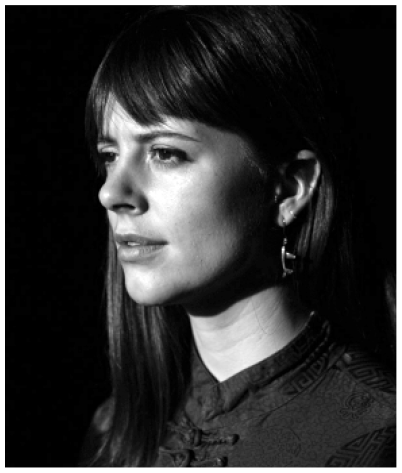
Louise Callaghan is the award-winning Middle East correspondent for The Sunday Times of London and the author of Father of Lions, a nonfiction book about life under Isis in Mosul. She also hosts The Messiah and His Kittens podcast. Since being posted to Istanbul seven years ago, she has reported from across the Middle East, particularly Turkey, Syria, Iraq, and Saudi Arabia. She has covered stories from the attempted coup in Turkey to the refugee crisis and the battle for Mosul. Recently, she has also been covering the war in Ukraine. Across this body of breaking-news and longform stories, her work consistently brings a human element to situations often eclipsed by politics and chaos.
Louis Callaghan
AMIN GHAZIANI: Your writing is so stylish, evocative, and urgent. What advice can you give to authors who want to incorporate captivating storytelling in their writing? I’m especially keen to receive your advice for academics since, let’s face it, the writing can be dry.
LOUIS CALLAGHAN: Yeah, it is often dry. It’s something that really strikes me—and it’s so unnecessary. Sometimes, I’ll be reading an academic study, and I’m nodding off. And then, I’ll notice something really, really amazing inside and just think, “Why is this buried all the way down here?”
The best advice I’ve ever heard about writing is, “Just write it like you’d say it.” If you were talking to someone at a party, and you were describing your research, how would you say it in a few sentences?
Obviously, we’re all in the weeds with what we do, right? You become an expert on something, and you realize all of the nuances and all the multitudes contained within it. But that shouldn’t mean that your work is so complicated it can’t be explained. Nine-year-olds read science books about Einstein’s work. Nothing is so complicated that it’s impossible to explain in an engaging way.
I think that there’s so much possibility and so much opportunity in academic writing, especially in social research, and that a lot of it would be shared a lot wider, and have a lot more impact, if it was written in a more engaging way. And that’s not to say you have to oversimplify it, necessarily. You just have to give it to people straight: “What’s the story really about?”
AG: To make a story more engaging, it helps if we write it like we speak it. That makes sense—but it makes me wonder: do you speak your work aloud as you write it?
LC: If I’m starting to write a piece, I sit there, and I think about all the interviews that I’ve done—and like social researchers, I’ve sometimes done dozens of interviews for an article—and I think, “What’s the one thing that surprised me the most?” Or, “What’s the one thing that I would tell someone?”
One good thing about journalism, as opposed to writing books or academic articles, is that you get very, very good at nailing down the substance of an argument. Your editor in a newsroom is going to ask you, “Come on, what’s the story, what’s the top line?” However many interviews, however complicated it is, whatever your answer is, you have to be able to explain it very, very clearly. I think that’s such an important skill. And it makes our work so much more accessible as well for the people who we want to be reading it.
AG: Speaking of editors, do you need to pitch your stories? If so, do you have any tips for selling big ideas, like the drug industry, elections, political conflicts—the type of work that you do? How do you get others invested in the stories that you want to tell?
LC: You’ve got to keep it really, really short. Get the substance down in two or three sentences, otherwise people are going to start nodding off. What is this about? What is it that you’re telling that’s new? And why is it important?
All good research, and good journalism, answers a question. You can’t just say, “I’m going to study the Captagon trade.” You have to say, “The Captagon trade has turned Syria into a narco-state. There are billions of dollars being earned by the Assad family. This has increased massively in the last year. I am going to show a specific aspect of this for the first time and this is how.”
I think that can be a problem within journalism as well, that people are writing around an issue rather than nailing down what you really want people to find out. All the really great academic studies, all the really great academic nonfiction books that I’ve read, they’ve always managed to zero in: “Okay, here’s a question, here’s how I’m going to answer it.”
AG: It’s clear that social dynamics are important to the reporting that you do. It’s never just about dates and events but, rather, contextualizing world events by peering into logical puzzles, as you’ve recently done with the shipwreck in Greece. Your explorations of that particular issue, as well as the amphetamine epidemic in Syria, stand out to me. Can you tell our readers what role research plays in the reporting that you do?
LC: I do a lot of background reading, as much as I can, when I do longer pieces. I’ll try to go out of my way to read all the academic scholarship on the subject, as far as I can. I’ll also try and get on the phone with a couple of researchers to talk about if they have any ideas on where I could be looking. But I’m also genuinely really interested in their opinions. Often, it’s by talking to researchers and academic experts that I get some of the best ideas on how to form a story. And also, they’re the experts.
I don’t think that, in general, researchers should be afraid of journalists. People are often quite worried, and they say, “Can I answer questions over email?” Sometimes, that’s great. We’re grateful for everyone’s time, always. But sometimes the best conversations and the best ideas come when you have a back and forth, and you can speak to each other. Researchers can always say, “I want to talk on background” or “I don’t want to be quoted.” Some really good stories have come out of speaking to these experts. Their work gives journalists like me a much better contextual understanding of the subject that we’re working on.
AG: I, like you, believe that some of the most important insights we generate come from a back and forth. How would you characterize the magic that develops in the course of a conversation? What is it that happens in conversations that leads to great insights?
LC: We spark off each other. I think researchers, they can often—and I’m the same when I’m deep into a story—you can get so into the weeds of what you’re working on that you stop thinking about how the stuff you’re working on is actually quite interesting, and new, and that other people might not know about it.
The temptation is, if you’re answering questions on email and you’re aware that you’re going to be quoted, it’ll make you quite dry and formulaic. That makes it difficult for me to include it in the article, because it slows down the story. Whereas, if we’re having a back and forth, a conversation where we’re sparking off each other, people often express themselves in a much clearer way, a much more interesting way. They’re more likely to say, “Hang onto that question you asked. I never thought about it that way before, and it reminds me. …”
The quotes are much better if you speak to someone directly, and that means they’re much more likely to be included in the final story. I feel awful when I take up the time of researchers and then can’t quote them or can’t mention their work—because we can’t put dry academic writing in the middle of an article which is otherwise flowing along.
AG: In addition to writing about amphetamine epidemics, you’ve also covered topics such as the war in Sudan and the Russian invasion in Ukraine. How can researchers and journalists collaborate in studying issues as significant as war-torn spaces? What synergies do you see between your work and our work as we both interact with people who’ve been traumatized by geopolitical conflicts?
LC: I think the work we do is really similar. And we can definitely feed off each other more. The way that PR departments at universities reach out to journalists is sometimes not helpful, at all. They tend to do untargeted emails. But if I was contacted directly by a researcher, which I have been before, and they say, “We’re working on similar things. Do you want to talk?” I’d always say yes. Then we share insights, and that can work out really, really well. I would really recommend social researchers, if they come across the work of a journalist that they like or that they think are covering similar subjects, they should definitely email them and reach out.
“Nothing is so complicated that it’s impossible to explain in an engaging way.”
AG: I imagine our readers will appreciate the encouragement to directly contact journalists, so thank you for that. You also mentioned that university PR teams don’t often do a great job trying to connect researchers with journalists. How can we do better?
LC: Be really specific, and don’t do mass emails to a bunch of unrelated people. I get 100 emails a day from people being like—I’m just going to look and see what I got today. Oh, here we go. This is pretty endless. I’ve got something from a British research firm saying, “Given your reporting on consumer affairs, would you like to know about the most popular Christmas gift this year?” It’s a lot of stuff like that. I’ve got one here which says, “Lebanon’s crisis.” That’s the subject line. Of course, I care deeply and desperately about Lebanon’s crisis. This is why I spent years reporting on it, and it affects lots of people I know. But if someone did want to get in contact with me, if they had some information or if they had work that they thought was important that we cover, putting it in a more specific way would really, really help.
AG: There are sociologists working all over the world. Does it matter if, when you are covering a particular topic, the researcher is based in the UK, the United States, Canada, Ukraine, or anywhere else in the world?
LC: I try to contact researchers who live in the countries that they cover. Sometimes, that’s not feasible at all, like in parts of Syria—you can’t work and live, really, as an academic there. So then, I would try and go for people who I can see have done fieldwork in person and in a particular area that they’re writing about, or [who] are from there or have lived there for a significant period of time.
I slightly cringe when I read an article about, I don’t know, Iran, and there’s only non-Iranians and people who have never lived there quoted. You just think, “What are we bringing to the table here?”
AG: Why do you think it’s important for a researcher who is writing about a particular region to have actually been there?
LC: I find that I can’t write well about places that I haven’t been. This is a personal thing—other journalists might disagree—but I don’t feel like I can start to understand or write about a place until I’ve spent time there. But still, I’m not the expert: the people who I speak to for my articles are, so of course I try to quote people who have firsthand experience of whatever it is they’re talking about.
When I’m reading academic articles, I look for evidence that the author has really gone out of their way to speak to people who do live there, that do live a life in the place that they’re forming opinions on. I would never, in my work, presume to write about somewhere without speaking to the people, or with the people who are involved. But a lot of foreign policy writing strikes me as being that: talking about a place, rather than getting in there and speaking to people who this is their entire life.
“I see joy everywhere. People who live in war zones don’t spend their entire lives being terrified: sometimes they’re scared, sometimes they’re angry, and sometimes they’re sad. But they’re often laughing.”
AG: What do those writers miss, the ones who write about a place without ever having been there?
LC: What you miss is nuance, and what’s really important to people. That’s what is very difficult to grasp—what priorities are for people in a place—without going there and speaking to them. …I think it just becomes theoretical, unless you actually speak to people who are affected by whatever it is that’s happening.
AG: One final question, if I may. Our readers, many of them sociologists, are used to looking for, and reading about, social problems. Your work, too, involves telling a lot of tough stories. As much as I’m curious about which story is currently keeping you up at night, I also wonder what story is sustaining your hope and bringing you joy. How do you think about the role of joy in our work as journalists and as researchers?
LC: As depressing as some of the subjects that I work on can seem, the reality is often checkered and mixed. There’s happiness and sadness, and things that are awful and shouldn’t be funny but somehow are, and the little victories that allow people to survive. I think that’s what you see when you do reporting in the field: that varied tapestry of human experience, to use a cliche, but there’s nothing simply sad or simply happy.
I see joy everywhere. People who live in war zones don’t spend their entire lives being terrified: sometimes they’re scared, sometimes they’re angry, and sometimes they’re sad. But they’re often laughing. They have these coping mechanisms to deal with war. Like, they’ll make one of their friends a cup of coffee, or they’ll rescue a cat that they found in a trench. And it’s like, all these details that, for me, make people in these extreme situations so interesting to write about.
Footnotes
Amin Ghaziani is in the Department of Sociology at the University of British Columbia. He is the co-editor of Contexts and author of several books on urban sexualities.