



Abstract
One city, three eras: Touring the monuments of Montgomery reveals ongoing struggles over collective memories of the past and visions of the future.
In the United States, there is arguably no more compelling window onto the dynamics of national memory than the multilayered landsCape of Montgomery, Alabama. OnCe the Capital of the Confederacy, Montgomery later became pivotal in ongoing struggles for racial equality. The city’s seal, which stakes a claim to the dual identities “Cradle of the Confederacy” and “Birthplace of the Civil Rights Movement,” speaks to the underlying tensions that animate both local and national narratives. Here, a nation founded upon the myth of White supremacy reckons with the ongoing struggle for full equality—a struggle that has once again been met with massive white resistance.
As monuments fall across the country, dramatic transformations to the commemorative landscape have demonstrated that the symbolic objects representing our collective past also frame our aspirational futures. The stakes of our decisions about how we adorn our public squares have never seemed higher. Yet we should beware the temptation to see memory only through the prism of its most dramatic turning points—when protesters tug Confederate icons down from their plinths, or when cities conduct surprise monument removals under the cover of darkness. Sudden as they may seem to many observers, the mnemonic dramas that have become so common are part of a continuous struggle over the content and tenor of our broader commemorative landscapes. A closer look at the objects that adorn these landscapes can help us to peel back the layers of such longer-range processes: to understand more clearly how they unfolded, as well as how the decisions we make about public symbols might ramify in the future.
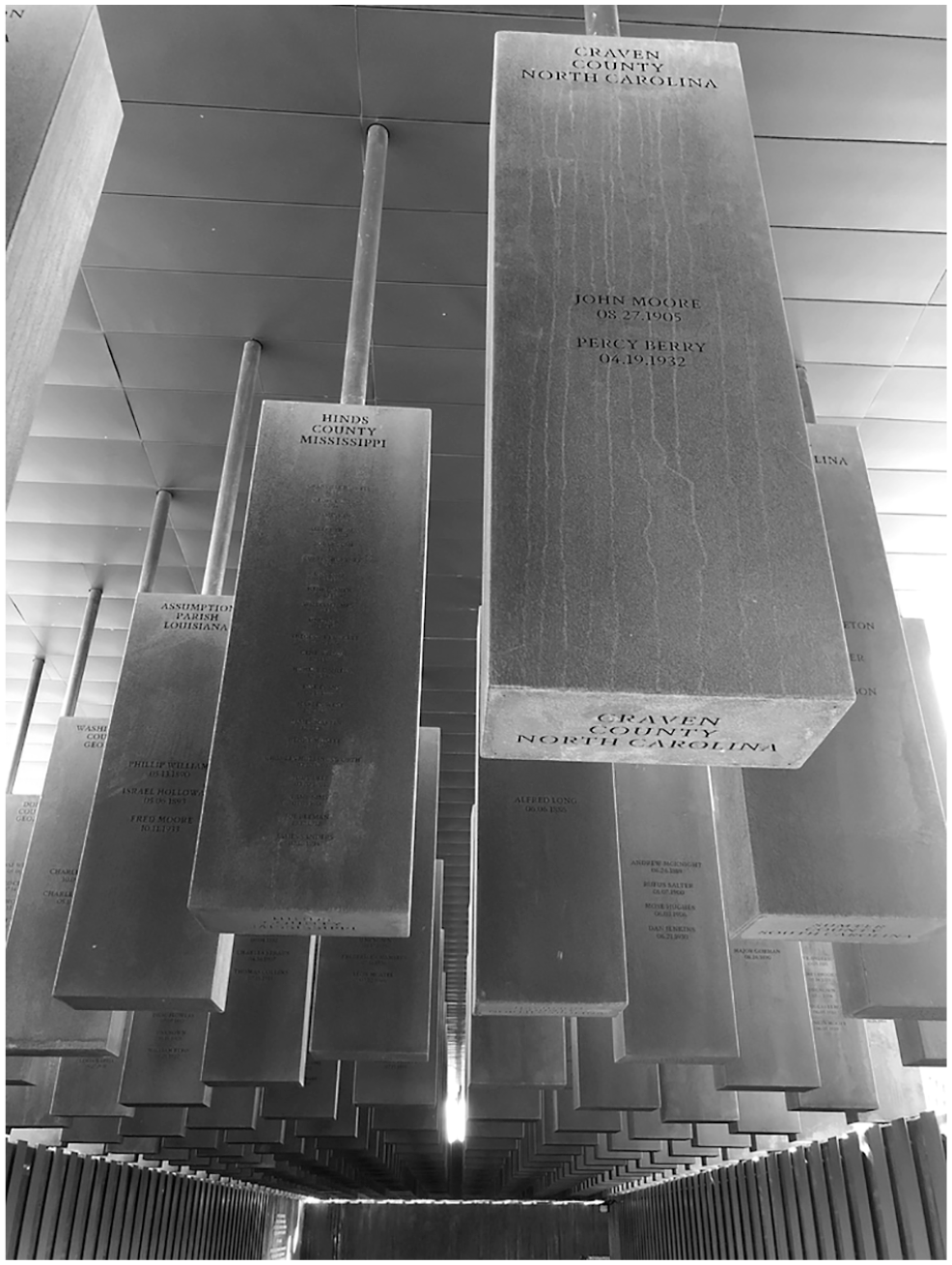
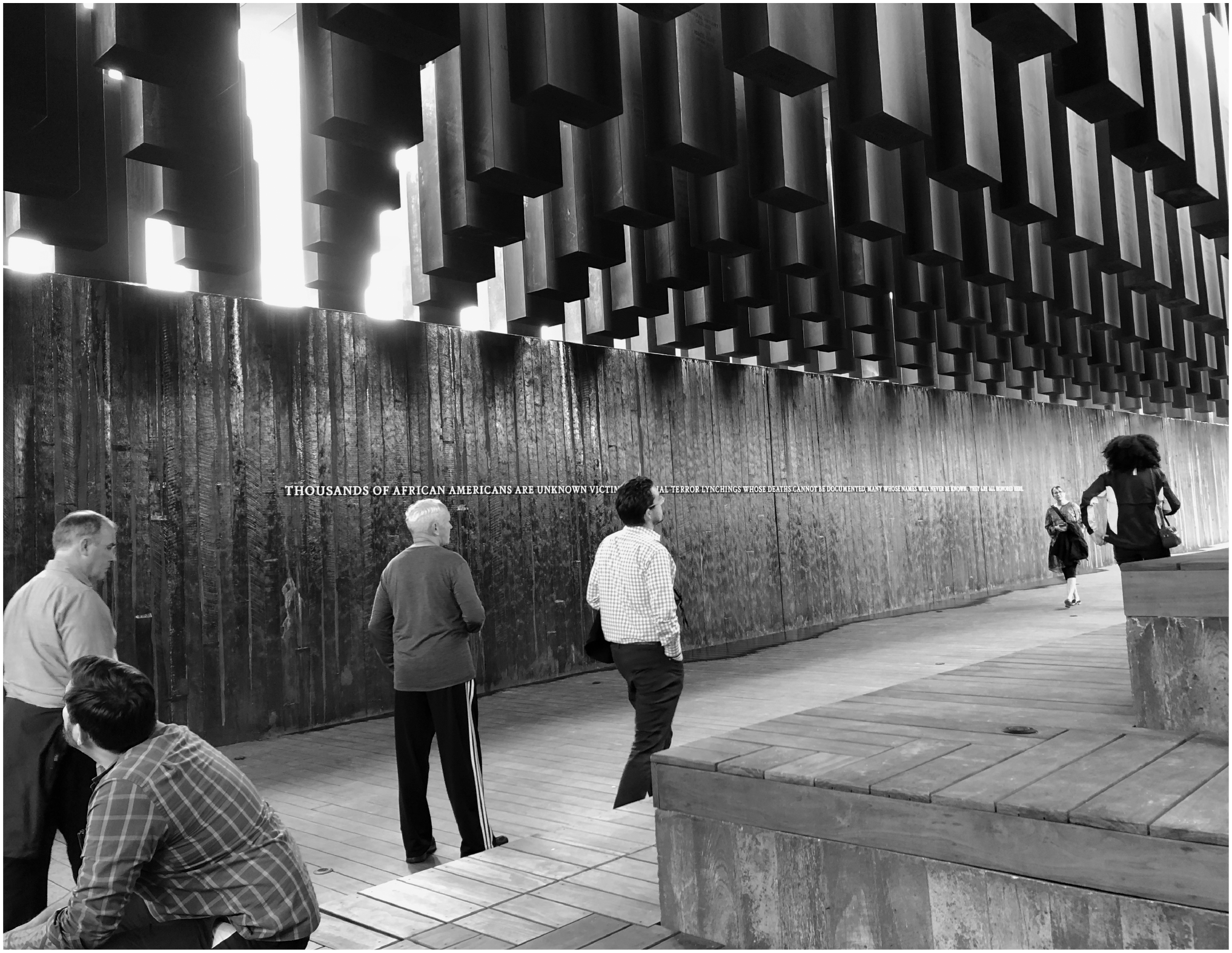
Inside the National Memorial for Peace and Justice, emblematic of the transformative era, memorials to the victims of lynchings rise overhead.
Author courtesy
As a capital city associated both with racialized struggle and governmental power, Montgomery offers a distinctive window into the vectors bearing upon commemorative landscapes. To be sure, the broader reckoning that has, since 2015, effloresced in the wake of fatal racist violence in Charleston, Charlottesville, Minneapolis, Louisville, and so many other communities has motivated—and shaped public interpretations of—transformations to the city’s monumental panorama. But Montgomery also differs from many other state capitals in the South. Unlike Richmond, VA, and Raleigh, NC— with their flashpoint struggles dramatically contesting charged monumental objects—or Jackson, MS, Columbia, SC, and Nashville, TN—where state legislators have doubled down on preservation laws to prevent the removal of historical objects— Montgomery has accommodated, and even encouraged, certain additions and alterations to its commemorative landscape as a driver of heritage tourism and economic development. As a result, the city demonstrates how both reparative and neoliberal forces affect the monumental landscape.
To investigate the complex and at times uneasy arrangements those forces produce, we place the recent installation of the Equal Justice Initiative’s National Memorial for Peace and Justice within the broader cityscape, highlighting Montgomery as home to symbols representing three distinct eras in U.S. collective memory. The era of the Lost Cause glorifies the Confederacy, celebrating the city’s identity as its first capital and raising monuments to the soldiers who fought to maintain a system of enslavement. The additive era features alterations to the commemorative landscape largely in the form of parallel symbols that celebrate the heroes of the Civil Rights Movement. Such symbols do not explicitly challenge the glorification of the Confederate past, but—through their location and content—offer an alternative critical storyline, with its own heroes and martyrs. Most recently, the transformative era has posed a more overt challenge to nostalgic ideas of the Confederate past, interrogating the racial violence that has been a constant in U.S. history while also gesturing toward the future possibility of full equality.
Montgomery’s monumental landscape makes clear that none of these eras is neatly bounded. Instead, they exist alongside, on top of, and in conversation with one another. Within ever-changing surroundings, monuments are anything but immutable; they take on new meanings that often become the basis for renewed struggles over their significance—and its relationship to collective identities. These contested landscapes provide a window into broader reckonings with how race has shaped the city’s past and present, as well as its prospects for future redress.
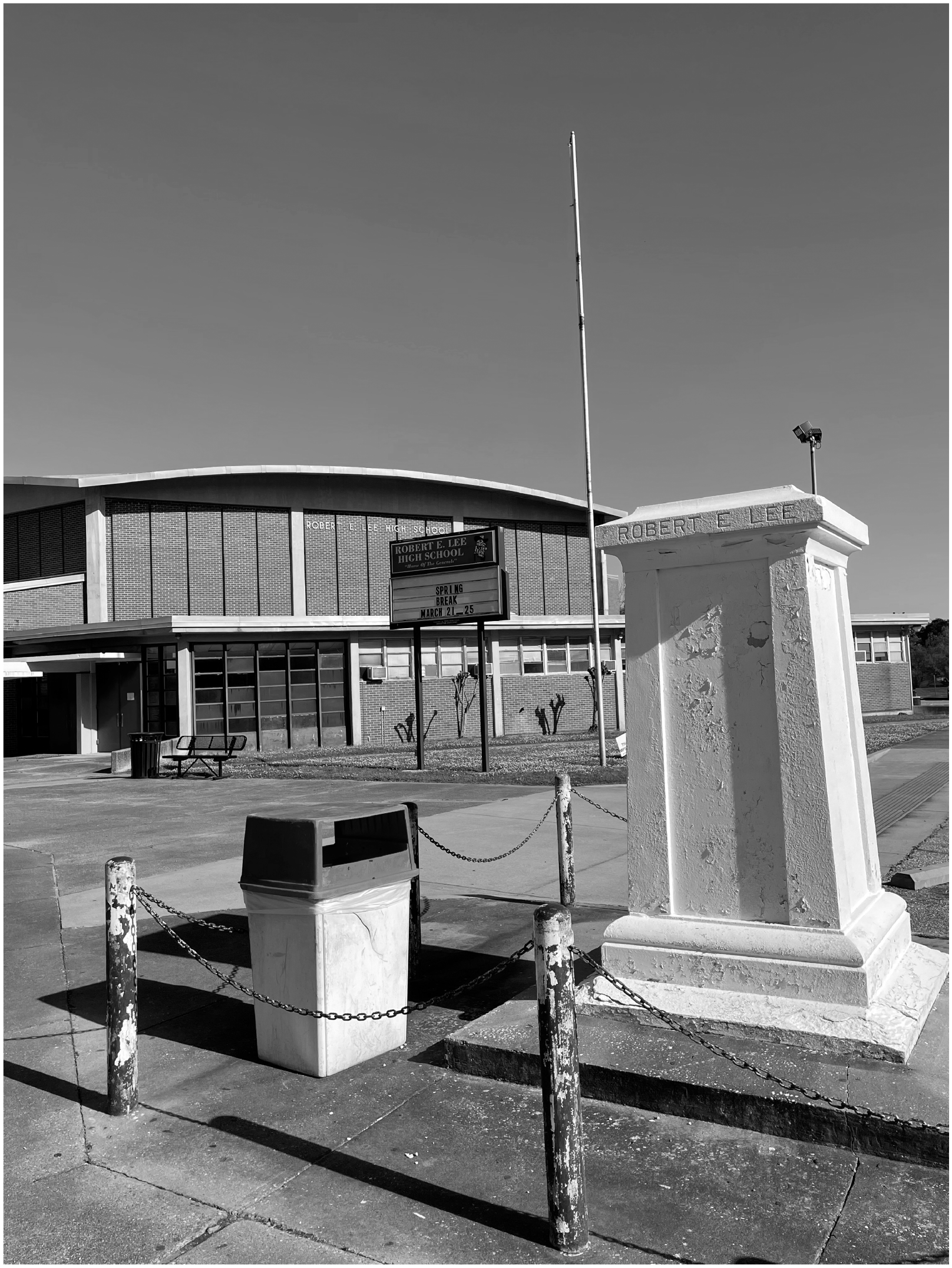
The plinth for a statue of Robert E. Lee stands empty in Montgomery, AL, outside its namesake school, slated to be closed and rebuilt as the renamed Dr. Percy L. Julian High School.
Author courtesy
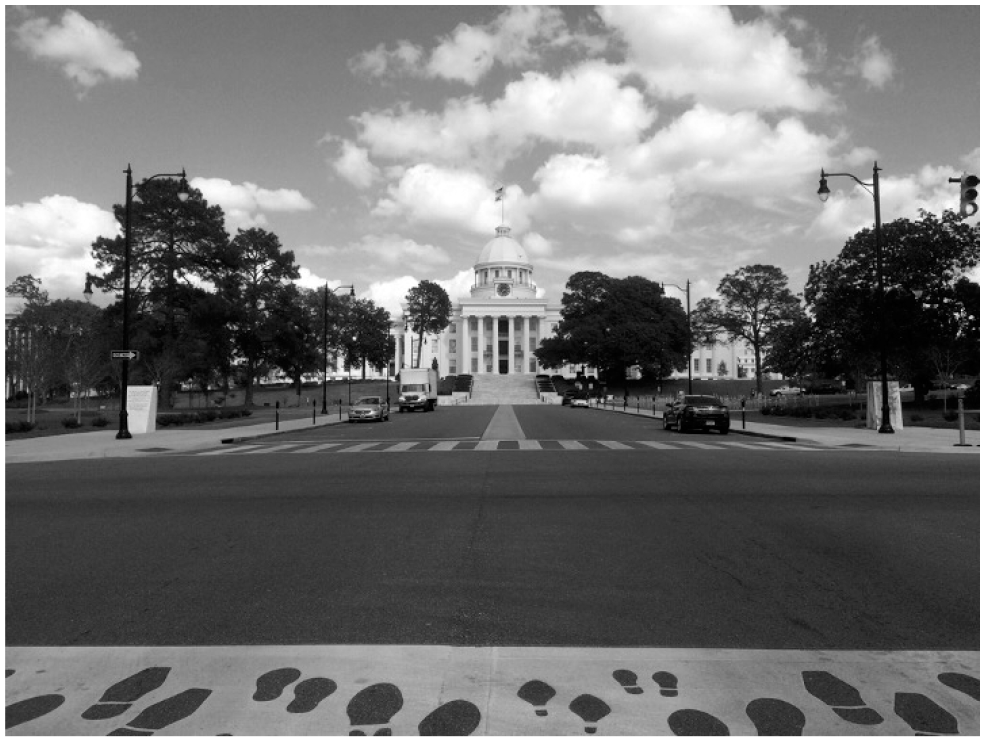
The crosswalk that spans Dexter Avenue in Montgomery, AL, is painted in shoeprints to recall the 1965 Selma-to-Montgomery Voting Rights March.
Author courtesy
The Era of the Lost Cause
Alabama’s Confederate Memorial Monument stands 88 feet tall. Adorning the grounds of the state’s capitol building in downtown Montgomery, it is surely the city’s most grandiose commemoration of the South’s Lost Cause. Perhaps an even more telling symbol, though, is a life-sized statue of Confederate General Robert E. Lee. Created in 1908, the statue served for more than a century as a sort of roving emblem of White supremacy. During its early decades, Lee’s likeness moved among both residential and commercial settings in Montgomery’s downtown, symbolically shoring up the city’s southern identity at a time when regional reconciliation among White Americans undermined Black citizens’ quest for full emancipation.
In 1955, the statue moved two miles east, where it was redeployed in a new era of racial struggle. Installed on a plinth in front of the freshly constructed Robert E. Lee High School, the general stood as a de facto symbol of Montgomery’s defiance of the Brown v. Board school desegregation decision handed down the year prior. Relocating the statue to the high school added a thick veneer of civil rights defiance to an object that had long symbolized more generalized venerations of the Lost Cause narrative.
In front of the freshly constructed Robert E. Lee High School, the general stood as a de facto symbol of Montgomery’s defiance of the Brown v. Board school desegregation decision.
As a resonant symbol of resistance, the statue’s significance evolved in tandem with the school. During its early years, White residents considered Lee High a jewel of Montgomery’s education system. As late as 1968, Black students comprised only 1% of graduating seniors, reinforcing the symbolic power of the school’s sobriquet. The building’s footprint expanded in 1978, as desegregation mandates resulted, finally, in Black students becoming more than a token presence at Lee and the city’s other historically White schools. Such shifts accelerated with pronounced White flight from the district; as of 2020, Black students were 82% of Lee’s population. Every one of those students, when entering the school each day, would have passed Lee’s statue along with a plaque inside its main doors that celebrated the school’s “beloved” namesake by admonishing: “Never by word or deed do anything to discredit the name of this great man.”
But then, in the wake of the 2020 police killing of George Floyd, long-present calls for the school’s renaming intensified. A school board vote resulted in the convening of a committee to solicit nominations for candidates to replace Lee. That process would unspool for nearly three years before the district announced that the existing school would be replaced by a new building and campus, renamed for the pioneering Black chemist Dr. Percy Julian. In the meantime, as administrative inertia left many community members’ frustrations unaddressed, those constituents turned their eyes to the school’s namesake statue. Absent any definitive institutional response to calls for its removal, in June 2020 activists toppled the statue from its perch. The object has since resided in storage, its fate indeterminate, and its absence underscored by the plinth that remains.
During a visit to the school in the spring of 2022, we could not help but be struck by the weight the absent Lee statue exerted upon its surroundings. The simple white plinth, with chipped paint and unadorned by any monumental text beyond the simple identifier “Lee,” stood before the sign that continues to mark the school as “Home of the Generals.” A single-chain barrier had long surrounded the statue site, though its continued presence seemed to invert its original function. Rather than demarcating a site of reverence, the sagging chain instead served to bound an area that intentionally diminished the school’s namesake. A large plastic trash barrel, bedecked in the school’s ubiquitous red-and-white and placed within the chained area, only underscored the negative space. And inside the school’s entrance, the plaque that had for decades trumpeted Lee as a “great man,” was covered by a bulletin board that transmuted the name into a motivational acronym: “Learning while Engaging = Excellence.”
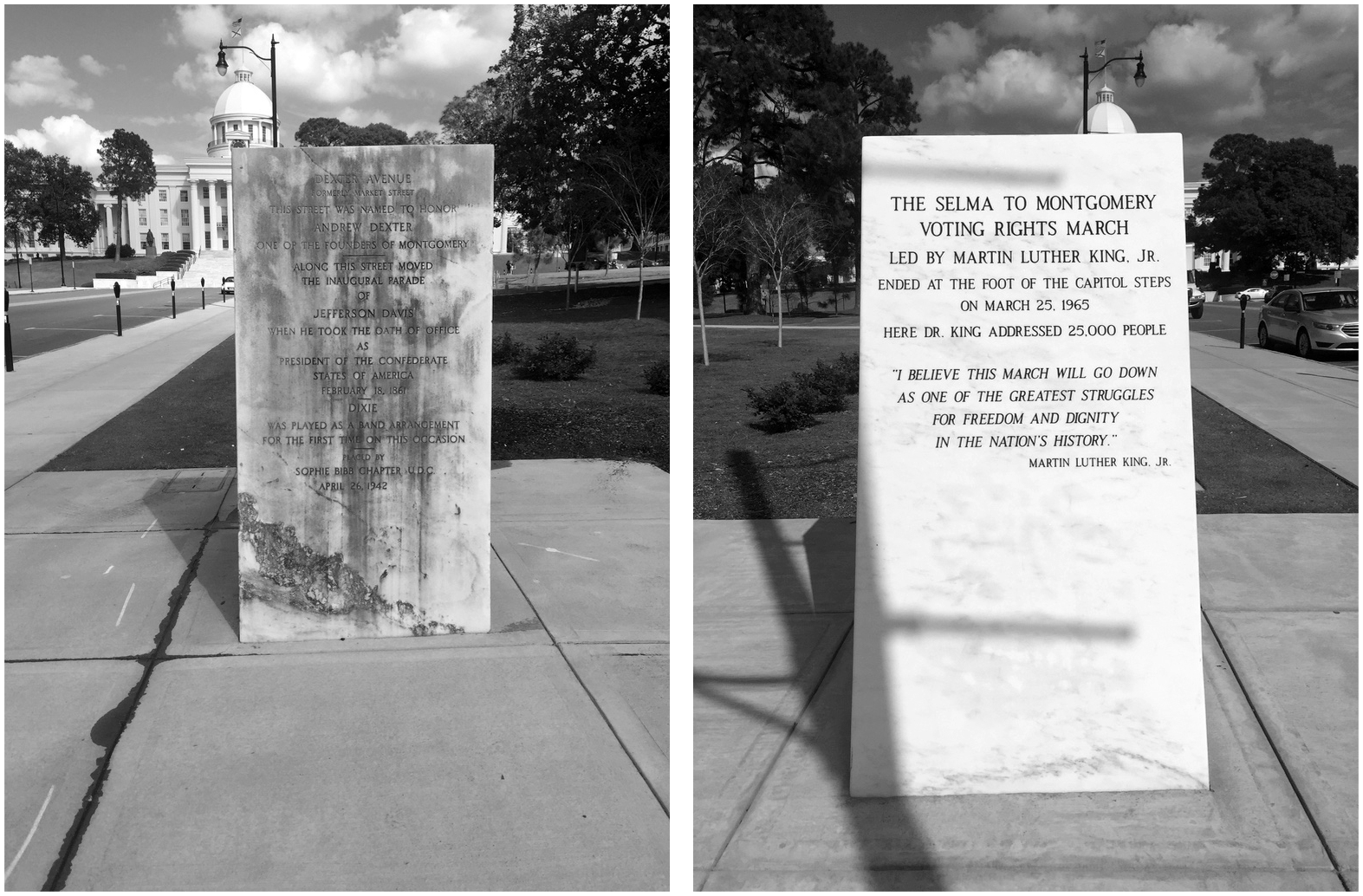
The additive era is captured in the twin monuments at the intersection of Dexter and Decatur Avenues. One commemorates the 1861 inauguration of Jefferson Davis as President of the Confederate States of America, the other the 1965 Selma-to-Montgomery Voting Rights March.
Author courtesy
Designed to shore up a southern identity rooted in White supremacy after the Civil War, the Lee statue was easily redeployed to elevate and protect the racist values epitomized by enforced segregation in the face of legal challenge. In 2020, however, the ground shifted more substantially. Lee High’s namesake General was under siege, his statuary void signaling a hollowing of the forces that had long bolstered his Lost Cause, amidst a setting stubbornly clinging to the vestiges of his labor.
The Additive Era
Few spaces in the United States encapsulate the nation’s racial history as fully as the intersection of Dexter and Decatur Avenues in Montgomery’s downtown. To the east, the grounds of Alabama’s state capitol building still host the 88-foot Confederate Memorial Monument. To the south, Dexter Avenue Baptist Church marks the site where, in the 1950s, Dr. Martin Luther King, Jr., preached and helped to direct the bus boycott in the shadow of the state’s segregationist seat of power.
Additive approaches demand that viewers question the co-presence of objects embodying the forces of oppression and justice.
Approaching the state capitol building today, on the southeastern corner of Dexter and Decatur, one can view yet another canonical Lost Cause monument. This one commemorates Jefferson Davis’s 1861 inauguration as President of the Confederate States of America. Davis’s inaugural parade traveled up Dexter Avenue on the day he was installed in office. The occasion is marked by a five-foot high stone marker, honoring Davis and the fact that “Dixie was played as a band arrangement for the first time” during his inauguration. The marker was installed in 1942 by the United Daughters of the Confederacy, a group whose enduring role has been to advance Lost Cause mythology, largely by placing Confederate monuments across the region (and beyond).
In 2015, however, a quiet process marshaled by the Alabama Tourism Department and the City of Montgomery resulted in the arrival of a second object at the same intersection. Placed on the opposite side of the street, at the same scale and position as the Davis marker and using the same materials, the twin marker commemorates the 1965 Selma-to-Montgomery Voting Rights March. That protest terminated at this very site, with Dr. King and other speakers addressing an estimated 25,000 marchers and supporters assembled in front of the capitol.
In situ, the twinned marker serves not only as an honorific but also as an object of critique. Its presence speaks to the power of a civil rights campaign that served to break down the system of Jim Crow segregation that had for decades disenfranchised the vast majority of African American citizens. In the process, it calls attention to the anti-democratic and oppressive character of the Confederate regime that Jefferson Davis led and represented.
As communities across the region question—and increasingly reject—the very presence of Confederate objects, one might consider how this additive approach to Dexter Avenue inflects the original Davis marker. Today’s visitor still confronts the significance of Davis’s presence, but no longer from a place of uncontested veneration. Instead, the Selma to Montgomery march, and Dr. King’s still-palpable presence in the city, weighs heavily on Davis’s legacy, rejecting and nullifying the celebratory tone that accompanied the marker’s installation in 1942.
Visitors explore the Equal Justice Initiative’s National Memorial for Peace and Justice.
Author courtesy
The danger, however, of addressing an unjust commemorative landscape through adding objects of critique is that, rather than shifting the political and moral valence of historical sites, viewers might interpret the site more neutrally as representing “both sides” of the issue in question. The markers’ symmetry can easily be interpreted as a symbol of moral equality: the commemorative equivalent of “fair and balanced.”
Yet today, the broader context surrounding the twin markers suggests otherwise. The Davis marker is visibly weathered, dull and faded in comparison to the fresher installation commemorating the Selma-to-Montgomery march. Further tipping the interpretative scales, the city of Montgomery replaced the standard lined crosswalk spanning Dexter Avenue with a set of painted shoeprints directed toward the state capitol. Clearly evoking the 1965 march that oriented in that direction, the crosswalk bolsters the memory of the Voting Rights March, detracting from the values associated with Davis’s inauguration and the playing of Dixie. The extra addition creates further dissonance, demanding that viewers question the co-presence of objects embodying the forces of oppression and justice.
The Transformative Era
As these twinned markers demonstrate, an additive approach to commemoration opens new narrative possibilities while also leaving a great deal of interpretive work to individual viewers. Over the past decade, the Montgomery-based Equal Justice Initiative (EJI) has set about transforming the cityscape in more radical ways. Founded in 1989, EJI’s original mandate was to provide legal counsel to anyone facing the death penalty in the state of Alabama. Today, legal advocacy and defense remain the organization’s foundation. Over time, however, EJI’s leadership came to believe that achieving legal justice would require work well beyond the courts, in the form of an effort to transform both local and national narratives. For EJI founder Bryan Stevenson, the pathway to narrative transformation began with dramatic alterations to Montgomery’s physical landscape.
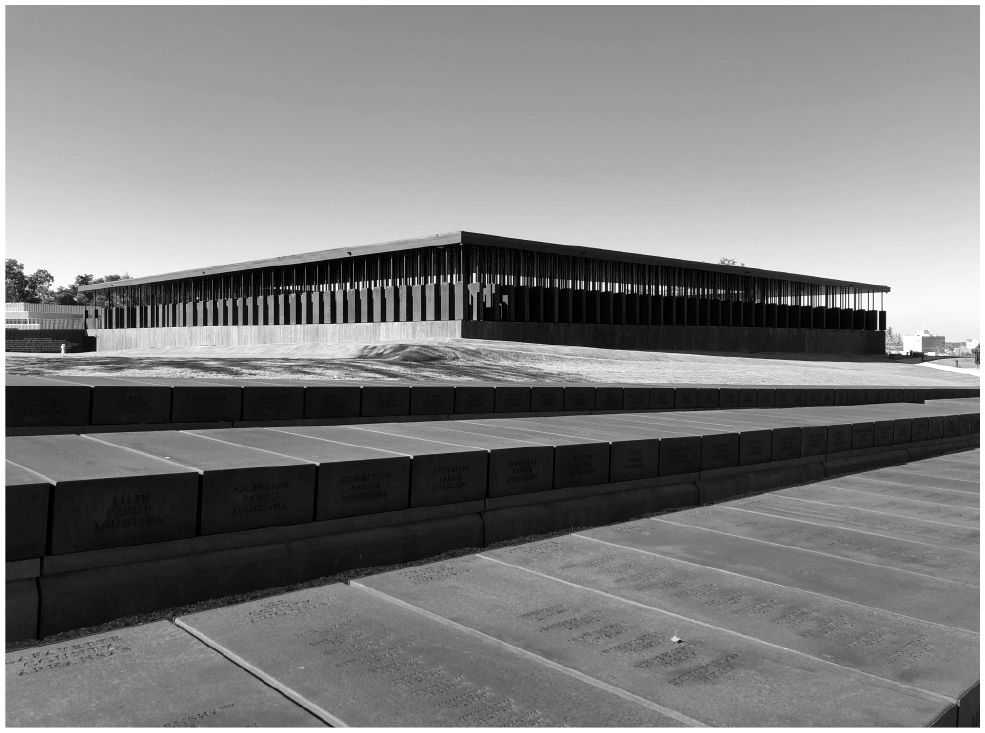
The Equal Justice Initiative’s National Memorial for Peace and Justice from the outside, with the “twin” monuments in the foreground awaiting retrieval for display in communities around the country.
Author courtesy
In 2013, EJI erected historical markers acknowledging Montgomery’s role in the slave trade prior to the Civil War. Although the state of Alabama had installed a marker in 2001, indicating the site of the city’s slave markets, EJI’s signs tell a much more vivid and chilling story of the scenes that once unfolded on the local landscape, where human beings were bought and sold and family ties were irrevocably severed. At the same time, EJI released a detailed report, Slavery in America: The Montgomery Slave Trade, situating the city within its broader national context.
Commemorative objects appear to be oriented toward the past. We struggle over them, though, because they symbolize our aspirations for the future.
EJI was also establishing the groundwork for a larger and more dramatic intervention in local and national memory: the National Memorial for Peace and Justice. Constructed on a hill overlooking downtown Montgomery and opened in 2018, EJI’s memorial centers the history of racial terror lynching: violent extrajudicial killings that served to maintain the system of white supremacy after the Civil War. Often, racial terror lynchings were staged as public spectacles, intended to instill fear in the entire Black community.
In focusing on racial violence, EJI resists not only the Lost Cause narrative, but also sanitized accounts of the Civil Rights Movement that valorize Black heroes without directly addressing the violent White resistance that emerged—let alone the racial violence and inequity that continue today. Instead, EJI inscribes memories of past horrors that continue to haunt Montgomery, the U.S. South, and the nation as a whole. It recalls racial terror and publicly mourns its victims. Its memorials bear witness.
In keeping with this commitment, the heart of the National Memorial for Peace and Justice is a pavilion featuring over 800 mini monuments. Each is inscribed with the name of a U.S. county in which at least one documented lynching occurred. Where possible, the monuments also list the names of the victims, though many are identified as “Unknown.” When visitors initially enter the pavilion, the 6-foot monuments are bolted into the ground, and the names appear at eye level. Gradually, though, the monuments rise up off the floor. Eventually, they loom overhead, evoking the image—and the very real history—of hanging bodies.
Though the pavilion is the memorial’s core, the site enfolds the era of racial terror lynching within the longer story of race relations in the United States. Enslavement, EJI asserts, did not end in 1865. Instead, it evolved into the horrific practice of racial terror lynching; the accompanying violent system of Jim Crow segregation and massive White resistance to the Civil Rights Movement; and, most recently, the contemporary system of mass incarceration. EJI’s Legacy Museum, located in downtown Montgomery and opened concurrently with the memorial, develops a detailed multimedia account of slavery’s evolution from the 1600s to the present.
EJI’s presence on Montgomery’s landscape continues to expand. In addition to the markers, memorial, and newly-expanded museum, EJI opened a Memorial Center for community events and an outdoor Legacy Plaza and associated cafe. There are certainly elements of the additive approach in EJI’s symbolism: both the Legacy Plaza and the National Memorial for Peace and Justice incorporate celebratory images of civil rights icons. But EJI’s dominant tone is somber and mournful, dedicated to showing how past violence haunts the present. Indeed, EJI explicitly criticizes not only the Lost Cause narrative that is still so visible in Montgomery, but also the celebratory narratives of the Civil Rights Movement that define the additive approach.
With new EJI-sponsored symbolism routinely appearing on the landscape, transformation is clearly afoot in Montgomery. The era of the Lost Cause is, of course, still visible: the 88-foot Confederate Memorial Monument stands tall on the capitol grounds. Today, though, the National Memorial for Peace and Justice is the second-most popular tourist destination in Alabama: behind the Space and Rocket Center in Huntsville, but ahead of sites devoted to either the Civil War or the Civil Rights Movement. Visitors thus pour into Montgomery primarily to “reflect soberly”—as EJI founder Bryan Stevenson often encourages—on the role of racial violence in shaping both local and national history.
Memory and the Future
Commemorative objects appear to be oriented toward the past. We struggle over them, though, because in many respects they symbolize our aspirations for the future. What legacies— and whose legacies—are we striving to carry forward? What legacies—and whose legacies—do we seek to disrupt? Even as past violence reverberates powerfully in the present, the EJI memorial suggests it need not determine the course of the city forever. New ways of understanding the past open new horizons of possibility for the future.
Montgomery’s monumental landscape still testifies to the constraints on groups that seek to tell new stories. To be sure, collective memories are malleable. We can, and do, alter our understanding of the past in response to present needs and aspirations. But there are limits. New stories about the past must enter a conversation with earlier narratives. For instance, EJI’s attempt to transform the U.S. national narrative takes shape in a city dominated by Confederate monuments, and in direct dialogue with the White supremacist storylines that they embody. The past can be reconstructed, but never entirely remade.
Still, as symbols from each era of memory in Montgomery layer on top of one another, they visibly alter the imaginable prospects for the city’s—and the nation’s—future. Even when older objects stand unaltered (though weathered, the Jefferson Davis marker on Dexter Avenue is otherwise unchanged since its original installation) their meanings may transform substantially as they are inflected by other changes to the landscape. This is especially so when objects are situated in direct dialogue: the Selma-to-Montgomery marker addresses the earlier celebration of Jefferson Davis, and painted footprints across the roadway stake a clear claim about which legacy ought to take visual, symbolic, and moral precedence.
Even when the dialogue is not so obviously orchestrated, though, new symbols may still act to transform the meanings of the old. For instance, how are we to interpret the Confederate Memorial Monument in light of the National Memorial for Peace and Justice? And did the presence of the latter offer, at last, a frame for understanding the Lee statue as incompatible with a site of public learning? There are perhaps as many answers to these questions as there are observers on the scene. But each symbol’s meaning is invariably altered in response to the other presences—or, as in the case of the Lee statue, new and visible absences—on the landscape.