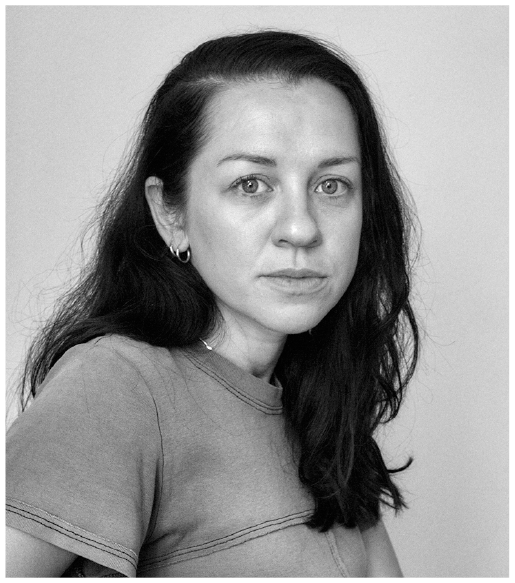
Whether writing for The Guardian or British Vogue—penning pieces for The Monocle, Elle, i-D, and Dazed along the way—journalist Amelia Abraham has her finger on the pulse of the moment—here, there, everywhere around the world. Hosting events at the Tate Modern and Soho House in London, authoring a couple books, and providing inclusion training for Nike, Dr. Martens, Evian, Aesop, Gucci, and Instagram has made Abraham a go-to authority. The New York Times, BBC Radio, and the London Review of Books routinely rely on her expertise. Oh, and did we mention her TED talk? “Why Feminists Should Support Transgender Rights” was packed with people, a standing-room-only event. A prolific voice in the international media, Abraham chats with Amin Ghaziani about why the world needs to pay attention to what moves her most: queer and feminist issues and human rights.
AG: You’ve written for media outlets around the world, and for them, you write consistently about queer and feminist issues and human rights. Why do you prioritize these issues, and how do the social sciences inspire you when you write?
AA: I write about queer and feminist issues because I am a queer woman, so those topics feel close to home for me. And then human rights, because of having the privilege to do so. Growing up in the Western world, it feels important as a queer person, as a woman, to shine a light on what might be going on in other parts of the world. I began writing about those topics just by following my nose about what was going on around me. In one of my first desk jobs, which was as an editor at VICE, I was writing a lot about queer culture in London—for instance, the closure of queer clubs or the commercialization of pride and the legalization of same-sex marriage. These were just topics that were affecting queer communities that I was a part of. Sometimes, the community I write about is a local LGBTQ+ community, and then sometimes, it’s this idea of a larger, global LGBTQ+ community. I’m interested in what it means to talk about “community” because the meaning of that changes over time and with various threats. Those are topics that also interest social scientists.
Right now, it feels like there’s a political imperative to specifically write about LGBTQ+ issues, given the regression of LGBTQ+ rights that we can see happening in both the U.K. and in America at the moment—for instance, in the U.K., the government abandoning plans to reform the Gender Recognition Act, which would make it easier for trans-gender people to legally self-determine their gender. Also, in America, the rolling back of rights to protect trans people (and specifically trans kids) and access to trans healthcare—and also, the level of violence that’s occurring. Hate crime numbers are up here, and in America, there’s been a swath of attacks on drag shows and pride events.
Another link to the social sciences is the idea of norms. Quite a lot of my journalistic writing tackles norms. I just wrote an article about gender reveal parties and how they reiterate gender norms. I think that’s a topic that would also interest a sociologist, for instance, how norms get embedded over time and how they get challenged. I’ve been very influenced by things you’ve written about how sex takes on cultural meaning or how sex is always cultural. And also, this idea of homophily, how likeness finds likeness. I do try and read bits from the social sciences to help me, to help inform my understanding of queer communities, for instance.
AG: I was quite interested in your statement about scaling up the perspective you take in your writings. Can you tell our readers why you decide to take global perspectives?
AA: I’ve written a few stories that pertain to global LGBTQ+ rights. Because of language barriers, I feel like sometimes those stories aren’t told in the U.K. or in the English-language media, so it’s about wanting to give those stories amplification. But I also appreciate that there are sensitivities about writing about communities on a global scale—for instance, imparting a western narrative on LGBTQ+ rights in eastern countries or a Global North perspective on stories in the Global South. The way that I’ve tried to get around that is to make sure that I speak to my interviewees at length about that issue, what they feel the easiest mistakes would be—and to put their voice front and center.
AG: I can’t help but think about positionality here. This is an idea that people think about a lot, especially in the context of sexuality, gender, race, and class. How does your own positionality—and that of your informants—shape the directions you go as a reporter?
AA: I try to hold on to this idea of positionality, remembering how someone’s position might inform what they’re saying and mean, that their viewpoint is very specific and may be limited in its specificity. Something I’ve done before is try and factor in multiple points of view. Both books I’ve published so far hold lots of different points of view. If I’m writing about the tokenization of LGBTQ+ people in the media and in brand and fashion campaigns, I will try to interview a range of people on that, on different subjects, who might be coming from different positions—just to try to get a kaleidoscopic viewpoint on a topic.
In terms of my own positionality, I try to be conscious of it, let my voice fade to a mute when I’m interviewing people, and not over-interpret what they say or import my own knowledge upon it. I think one way to try continuously stay aware of your own positionality is to be reading alongside your own work, whether you’re a journalist or a sociologist. So, if I’m writing about LGBTQ+ communities, I’m constantly trying to read as many books by different people from different backgrounds along the LGBTQ+ spectrum, as well as following them on social media, in order to hold those different perspectives in my mind.
AG: Your work as a reporter is similar to the work of sociologists, especially ethnographers, who engage in participant-observation as data collection and who use interviews and surveys to learn about the social world. How do you decide the key people you need to talk to? And how do you cultivate relationships with them in a way that gives you confidence about the authenticity and accuracy of what they tell you?
AA: It’s a very good question. In journalistic training, you are encouraged to “second-source”; that can lend perspective to the “authenticity and accuracy” of what someone tells you. So, going and talking to someone else about the same topic, as well as fact-checking things people say where necessary, and researching statistics where they exist in order to confirm or deny what they might be saying. But I suppose—I’d be interested to know how this works for sociologists—I often think that what people are saying is their truth, their authentic truth, whether or not it’s the objective truth. These days, we talk a lot about “lived experience,” the validity of that, and we have more countenance of it. I think journalism has moved toward incorporating more of that over time.
“A queer perspective would bring in a multiplicity of different standpoints and try to question the idea that there’s a rigid yes-or-no—that there’s a fact, basically.”
AG: You raise an intriguing distinction between “their truth” or “lived experience” and “objective truth.” These ideas raise questions in my mind about whether there can ever be a single, free-floating truth, or if instead there is what we might call a “social fact”— and what we are doing is collecting a variety of individualist truths. How do you navigate these tensions when you present patterns about the social world or propose policies about it?
AA: That’s what I’m trying to get at, too. It links back to this idea of queerness and challenging norms. A queer perspective would bring in a multiplicity of different standpoints and try and question the idea that there’s a rigid yes-or-no—or that there’s a fact, basically. Queerness is built upon the notion that heterosexuality is a social fact.
AG: It sounds to me like queerness provides a direction for the cultivation of journalistic sources, as well as a methodology for the social sciences. What are the implications for your work?
AA: In my longer-form work, such as the books I’ve published, I tried to embody the idea of queer formalism. I wanted to show that there are many different perspectives to be taken on each topic. [Once] you get to the end, the impression you’re left with is that queer people are not a monolith. There’s so many different perspectives and viewpoints. The second book did that by literally handing over the page to different voices and taking on the anthology format. There are 35 different perspectives from all around the world! So, I think form can be really helpful.
I’ve even found that some forms I can use with mainstream media also embody this idea of questioning facts or even questioning memory. For instance, I wrote an oral history of the first-ever Pride in Britain, in 1972, for The Guardian last year, and I spoke to 10 people who represent different positionalities, who were there at the first pride. It was really interesting to see how some of what they said clashed with one another, how they had different memories. Sometimes, the editor would come back with feedback like, “Well, this conflicts with this! This conflicts with that!” It was difficult to get to “the truth” of what really happened at moments. One thing that we tried to do was leave in a tiny bit of that sense of conflict. Leaving in both perspectives generates a more interesting point than just having one. To come back to our point, I think truths can coexist.
AG: Congratulations, by the way, on the publication of your books Queer Intentions and We Can Do Better. What motivated you to move from the media into longer-form story-telling?
“We’re very lucky to be able to do field research. I see it as a blessing to be able to interact with people face to face, forge connections, and immerse yourself in their worlds, if only temporarily.”
AA: More space for more perspectives, to go deeper into the story and hold more positionality in mind, and to fuse topics from more positions. With the first book, it was connect-the-dots between lots of different stories I had written. In my journalistic writing, the stories I had done were about assimilation politics—the idea that there’s something subversive or alternative to be lost when we become assimilated into mainstream society or mainstream politics, to lose the integrity or originality or community that once existed. How far does this idea of acceptance or mainstreaming actually go? Does it equate to the safety of all types of people? It made sense to write a longer-form piece that brought those different arguments into one place and one cohesive exploration of the topic.
The next book picks up where that first left off. What do we need to do to improve the lives of LGBTQ+ people around the world and across that full spectrum so that nobody gets left behind? And as I said, it’s an anthology format that includes 35 voices, so it needed to be longer-form to give everyone the space they needed to share their perspective.
AG: As I listen to you describe your motivations for moving into longer-form reporting, it makes clear, yet again, that reporters and sociologists have a lot in common. I imagine that your first experiences going out to get the story were as nerve-wracking as some of my first times “in the field,” as we might say. What advice do you have for the possibly-nervous social scientist embarking on a big project, like a book—and those many among us who, like you, seek to impact broader publics?
AA: On a very practical level, I would say double-record all your interviews, and back everything up—or work on Google docs. Try to put a writing structure in place that works for you based on when you’re most productive, that feels sustainable over a long amount of time. Make sure you take time off both to relax but also to think about the project away from the page or the screen. And try to enjoy it! We’re very lucky to be able to do field research as well as desk research—I see it as a blessing to be able to interact with people face to face, forge connections, and immerse yourself in their worlds, if only temporarily.
To achieve maximum impact and engagement with your work, if you can, try to use entertaining or engaging language, and think of your work as storytelling so that you’re taking people on a journey with you. Avoid using too much jargon or academic language. One early piece of advice that someone gave me on my writing was, “Always start a paragraph or a chapter with something that hooks the reader in, and always end a paragraph or a chapter on something that kicks them into the next—or pushes them, or propels them into the next paragraph or chapter.” I use that structural tool to keep the page turning.
And, when I’m getting a bit geeky or niche in terms of what I want to write about, good feedback has been to broaden my thesis or headline, and then you can bring in the specific things you’re interested in—almost like a Trojan Horse technique! Finally, ask the people who are involved in your writing to share it far and wide. This needn’t be self-serving—if the work draws attention to a human rights issue or under-exposed subject matter, it is for everyone’s benefit. Once I have published something, it no longer belongs to me, and that’s a good thing—particularly when the subject matter pertains to feminist and queer representations or progress on human rights.
Footnotes
Amin Ghaziani is in the Sociology Department at the University of British Columbia. He is the co-editor of Contexts and the author of There Goes the Gayborhood and Sex Cultures.Amelia Abraham is an editor, author, and journalist based in London. The author of Queer Intentions and We Can Do Better, she focuses her work LGBTQ+ identity and politics, feminism, and human rights.