



Abstract
Karen Amaka Okigbo on making Black diversity visible.
Scene Setting: At a hospital cafeteria in Detroit, MI, three Black female nurses chat over lunch. Abishola and Kemi are first-generation Nigerian immigrants who are attempting to explain their ranked preferences for a marital partner to their African American colleague, Gloria.
Abishola: If I were to marry again, it would only be to a Nigerian man.
Gloria: Only? That kind of narrows down your options, doesn’t it?
Kemi: Don’t listen to her. She has many options. Top of the list, Nigerian man, same tribe.
Abishola: Yoruba.
Kemi: Mhmm. Then Nigerian man, different tribe.
Abishola: Igbo.
Kemi: Mhmm. Then, other Africans.
Abishola: Except Tunisians and Egyptians.
Kemi: Obviously. Then Caribbean, then White, then African American.
Gloria: Wait! Wait! So, a Black man is last on your list? Below White men?
Kemi: You get it.
Gloria: I get that you’re full of crap. All you Africans think you’re better than us.
Kemi: Well…
Gloria: Well, what?
Kemi: You don’t make it easy for yourselves.
Gloria: What’s that supposed to mean?
Kemi: Oh, come on. Gangbangers, welfare stamps, the baby mamas.
Gloria: You’re just buying into that racist propaganda you see on TV. There are more White people on food stamps and welfare than Black people.
Kemi: That’s not what it says on the Fox News…which is fair and balanced.
Gloria: Okay. I’ll tell you what, next time I get an email from a Nigerian prince do you want me to assume it’s one of you heffas trying to scam me? …You think White folks see a difference between us? To them, we all look the same. You get pulled over by a cop, he’s not gonna see your little ranking system. He’s just gonna see this (points at skin).
Kemi: We wouldn’t get pulled over. We obey the traffic laws.
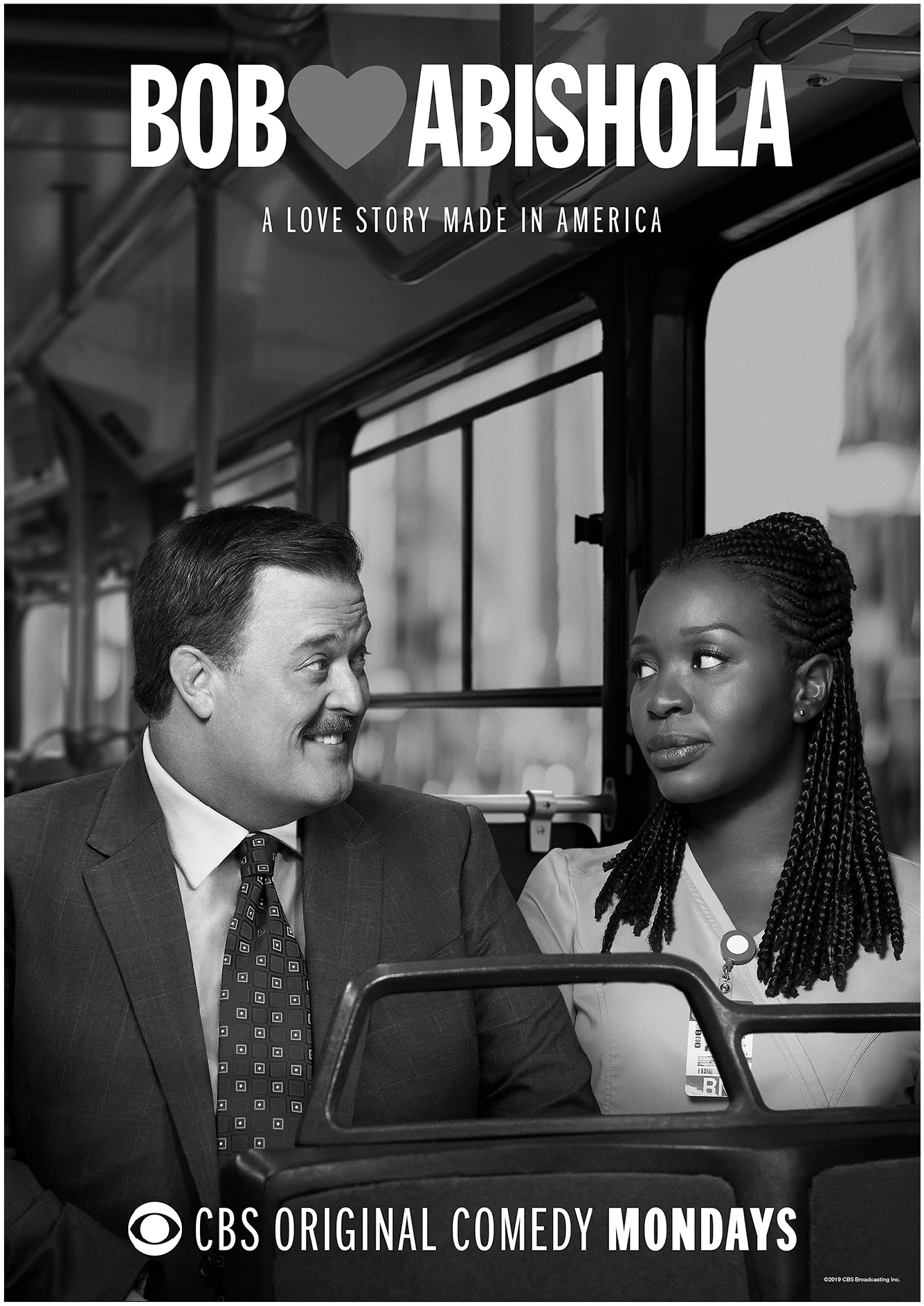
This scene is from Episode 3 of Bob Hearts Abishola, a CBS sitcom that premiered on September 23, 2019 and is now in its fourth season. Set in Detroit, the show stars Billy Gardell (of Mike and Molly fame) and newcomer Folake Olowofoyeku as the titular characters. Gardell plays Bob, a divorced businessman who runs a successful sock company with his mother and two siblings, and Olowofoyeku plays Abishola, a stoic yet compassionate nurse who cares for Bob following a heart attack. The cast is rounded out by a coterie of quirky, lovable characters, notably Abishola’s fellow nurses Kemi and Gloria.
In true romcom fashion, Bob and Abishola are polar opposites—he is the jovial, lighthearted, and monosyllabic foil to her earnest, sincere, and polysyllabic character. He is a White man, and she is a Black, Nigerian immigrant. Ranked the most-watched television network for the past 12 consecutive years, CBS was innovative in choosing to air Bob Hearts Abishola, a show that stars Nigerian characters, features extensive dialogue in the Yoruba language, and addresses controversial topics around race and marriage.
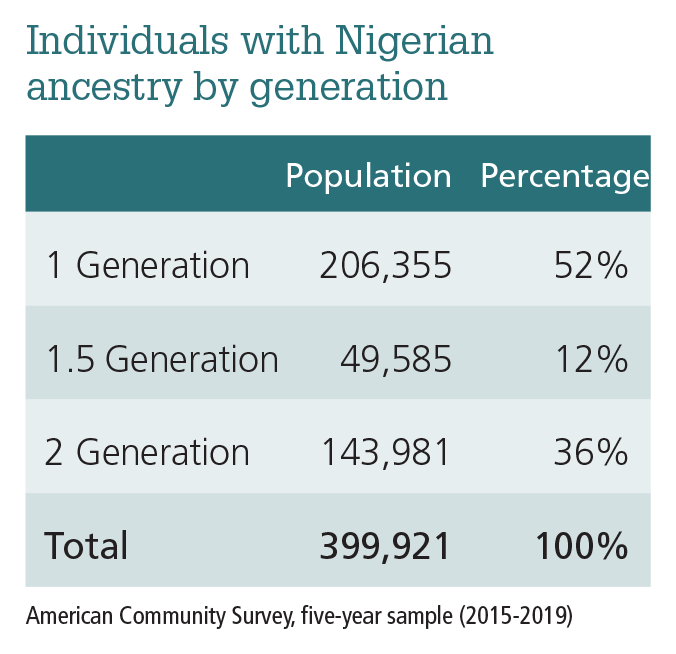
Individuals with Nigerian ancestry by generation
American Community Survey, five-year sample (2015-2019)
The CBS showrunners, as it happens, were on to something. Given the salience of race in the United States, Nigerian Americans’ marital choices present an opportunity to study the integration of African immigrants. The dynamic process of partner selection in the Nigerian American case is significant for a couple reasons. First, Nigeria is the number one source country of African immigrants to the United States. In 2019, there were approximately 400,000 individuals with Nigerian ancestry in the United States, making Nigeria the top birthplace for African immigrants (American Community Survey, 5-year sample 2015-2019). A little over half (52%) of these Nigerians are first-generation immigrants who immigrated after the age of 13, while 36% are U.S.-born second generation Nigerian Americans.
CBS Promotional Image
Another significant aspect of Nigerian American partner selection is the fact that Nigerian Americans are racialized as Black immigrants, yet are ethnically diverse. They come from a country comprising more than 250 ethnic groups. Yet contemporary studies of intermarriage often ignore ethnic differences within racial or national origin groups, especially among people of African descent. Although racialized as Black, ethnicity is very important to Nigerian Americans and it highlights the often-ignored heterogeneity of Black immigrants and Black Americans. Among national origin groups with ethnic and religious diversity, defining intermarriage in terms of both race and ethnicity presents a more nuanced way of thought.
The conversation depicted on Bob Hearts Abishola, as quoted above, touches on both the pervasiveness of racial and ethnic stereotypes and the inherent diversity within the U.S. Black population. Abishola explicitly ranks her ethnoracial hierarchy for a marital partner, placing priority on an endogamous partner of the same ethnicity (i.e., a Yoruba man). Much to Gloria’s bewilderment and annoyance, a White man turns out to be Abishola’s penultimate choice, still preferable to an African American man as husband material. Gloria astutely points out that while Abishola clearly sees a distinction between a Yoruba and African American man, these ethnic differences may not be notable to members of other races. In less than five minutes, this scene drew attention to the recent arrival of Black immigrants, who now represent nearly 10% of all Black people in the United States; to the diversity and heterogeneity within the socially constructed category of Black in this country; and to the nuanced ethnoracial tensions that heterogenous groups experience.
Certainly, sociologists know that the Black population is not a monolith. Especially in light of the large-scale immigration waves of the last 50 years, we know that there is heterogeneity in terms of national origin and ethnicity. However, when stories of intermarriage are told in pop culture, they often obfuscate intra-group differences. That is, they tend to tell a single, unidimensional story of interracial marriage with a White partner. When race is the sole point of analytical interest, it can be conflated with ethnicity, thereby erasing it. Put another way, if race were the sole focus on Bob Hearts Abishola, Abishola’s endogamous preference for a Yoruba partner would go unnoticed, as would the important conversation she has with her friends about pejorative African American stereotypes—in this case, the roundly disproven stereotypes about African American criminality that continue as enduring myths passed on to newly arrived immigrant groups. Therefore, this scene from Bob Hearts Abishola highlights how the Nigerian immigrant case complicates the prevailing U.S. eth-noracial hierarchy by fore-fronting the preference for ethnic endogamy among first-generation Nigerian immigrants.
The advent and growth of the U.S. Black immigrant population is slowly tweaking monolithic conceptions of Blackness.
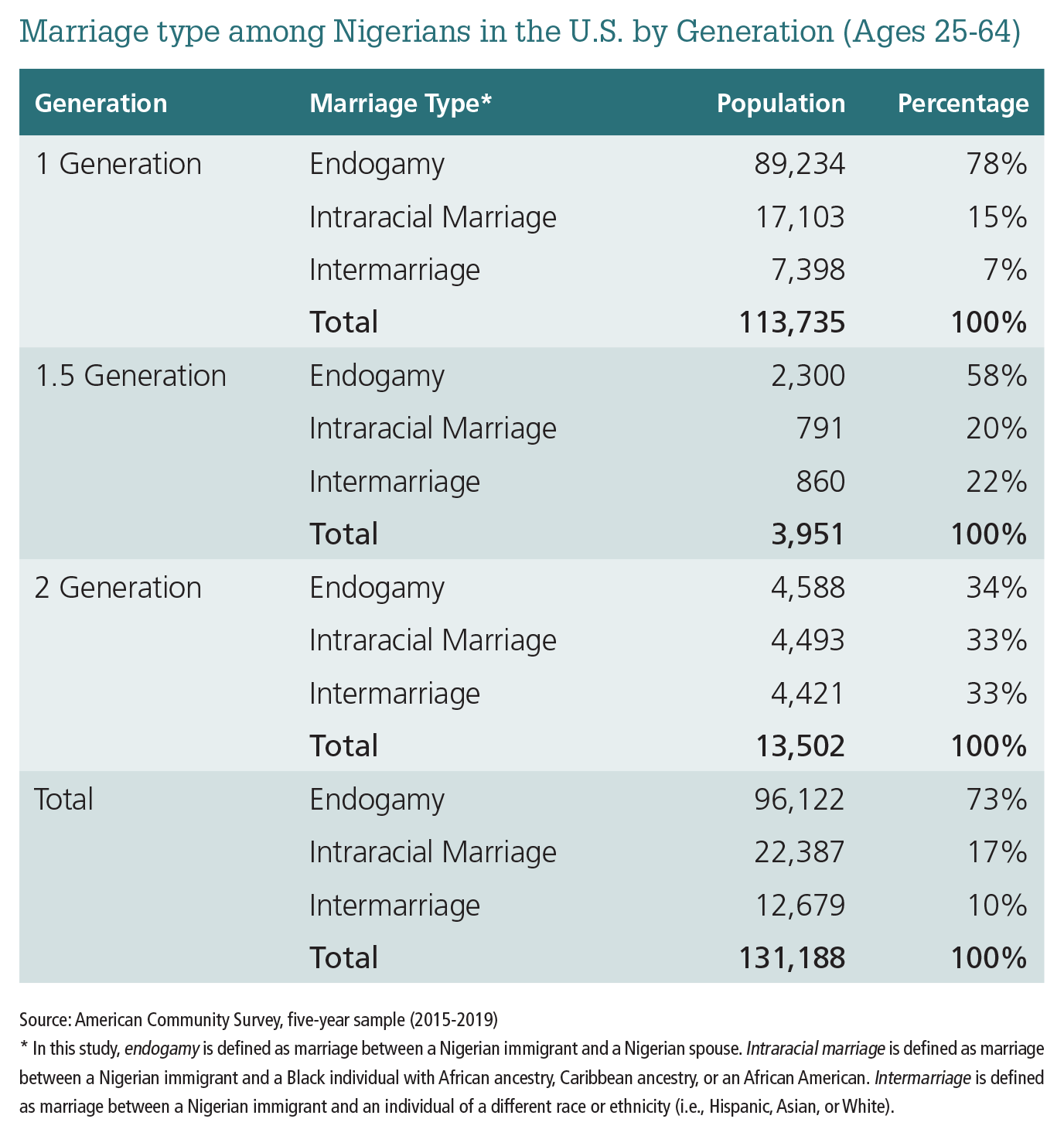
Marriage type among Nigerians in the U.S. by Generation (Ages 25-64)
Source: American Community Survey, five-year sample (2015-2019)
In this study, endogamy is defined as marriage between a Nigerian immigrant and a Nigerian spouse. Intraracial marriageis defined as marriage between a Nigerian immigrant and a Black individual with African ancestry, Caribbean ancestry, or an African American. Intermarriage is defined as marriage between a Nigerian immigrant and an individual of a different race or ethnicity (i.e., Hispanic, Asian, or White).
Abishola and other, real-world first-generation Nigerian immigrants’ preferences for an endogamous partner of the same ethnicity raises interesting questions about whether those trends hold true for second-generation Nigerian Americans, particularly when the definition of intermarriage is extended to incorporate ethnicity and national origin, as well as race. My analysis of the 2019 American Community Survey (ACS) 5-year sample (2015-2019) found that, among first-generation Nigerians, endogamy was the most prevalent marriage type; 78% of married, first-generation Nigerians were married to a Nigerian spouse (see above). For second-generation Nigerian Americans, endogamy (34%) was at parity with intraracial marriage with a Black spouse (33%) and intermarriage with a spouse of a different race/ethnicity (33%). This is key because it shows a one-generation shift away from endogamy and suggests a potential source of inter-generational tension.
My research on Nigerian immigrants shows how just focusing on race among Black immigrants can ignore important intraracial distinctions—obscuring the significance of ethnicity among certain national origin groups and overlooking certain aspects of tensions between immigrants and their proximal hosts. In focusing on marital preferences, one might assume that, given the status of Whites at the top of the U.S. ethnoracial hierarchy, Nigerian immigrants who choose to marry outside their ethnic group would seek out a White partner. This is because privilege is relative, especially when it is based on race. Research shows that people racialized as non-White in the United States may try to access some of the privileges of whiteness by forming relationships with people racialized as White. However, my ethnographic research conducted from 2016-2020 in New York and Washington D.C. suggests this is not true among Nigerian Americans. When it comes to preferences for a partner, my work affirms the ACS data: most first-generation Nigerian immigrants prefer an endogamous partner of the same ethnicity or national origin group, while their second-generation children have preferences based on a more nuanced decision-making process.
These findings indicate that the advent and growth of the U.S. Black immigrant population is slowly tweaking monolithic conceptions of Blackness. Upon arrival, Nigerian immigrants are seen as Black and undergo the racialization process, learning what it means to be Black in the American context. This racialization process is often influenced by interactions with their proximal host group—in this case, African Americans or U.S.-born Blacks. As more attention is paid to the diversity within the Black population, the findings from my research show that stories of marriage choice and intermarriage are not nearly as black and white as previously considered.