




Abstract
This review highlights insights from Rene Almeling’s book, GUYnecology: The Missing Science of Men’s Reproductive Health, regarding the social processes that inform cultural assumptions about the relationships between gender, bodies, health, and reproduction.
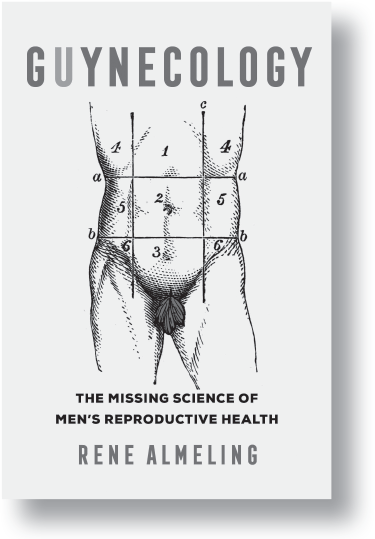
I first read Emily Martin’s 1991 article “The Egg and the Sperm: How Science Has Constructed a Romance Based on Stereotypical Male-Female Roles,” in a sociology graduate course on feminist theories. As one of my initial introductions to feminist science studies, the article captivated me for how it carefully mapped how culture—specifically gender ideology—shapes the production of scientific knowledge and our collective understandings of bodies and reproduction. My exposure to feminist science studies and the sociology of health, medicine, and reproduction ultimately led me to take up a research agenda examining how social processes shape reproduction and what is often referred to as “reproductive health.” Most recently, this work involves a sociological interrogation of the construct of “advanced maternal age” and its social and biomedical implications for cisgender women having first births at age 35 and older in the United States. Not surprisingly, when Rene Almeling’s GUYnecology: The Missing Science of Men’s Reproductive Health was published, I read the book with great interest.
While systematically reviewing the existing biomedical research on advanced maternal age, I discovered the nascent scholarship on “advanced paternal age” and its association with certain adverse pregnancy, birth, and child health outcomes. I was reminded of how only one woman out of 55 participants in the study brought up the issue of men’s influence on reproductive outcomes during her interview. She did so as part of her critique of the framing of pregnancy at advanced maternal age as inherently “high-risk,” noting that her husband was also older, but nobody acknowledged the risk associated with his age. Disgruntled, she said, “It’s all my fault for being older.” Almeling takes up this issue in her book by unraveling the consequences of the arguably obsessive focus within science, medicine, and society on female bodies as the site of reproduction—and by association, reproductive risk. Using a relational approach to gendered analysis, Almeling repeatedly demonstrates that this understanding of cisgender women cannot exist without a corresponding conceptualization of male bodies as ostensibly unrelated to “reproductive health.” By tracing the historical, social, and cultural processes that contributed to what she refers to as the non-knowledge of men’s reproductive health, Almeling challenges readers to question—much like Martin did decades prior—how culture informs the scientific truths we take for granted about the relationships between gender, bodies, health, and reproduction.
Almeling’s Organization of the Book incorporates an analysis of archival documents, scientific and biomedical literature, news media coverage, a public health campaign, and qualitative interviews. Divided into three sections that map onto three related processes, the book emphasizes breadth over depth, resulting in a lengthy, detailed monograph. First, Almeling examines how the lack of biomedical knowledge about men’s reproductive health unfolded in sociohistorical context, using archival research to trace stymied efforts to create a medical specialty devoted to the subject at two junctures in the history of medicine. In the second section, Almel-ing charts how this non-knowledge circulates throughout society, revealing how biomedical research on paternal effects on pregnancy outcomes and child health is (not) disseminated through the press, medical associations, and public health organizations. She then concludes the book by examining how cisgender men and women interpret and make sense of “men’s reproductive health” as a non-topic, highlighting how gender norms fundamentally structure what people find thinkable about reproduction and reproductive health in the absence of contradictory evidence.
The story of the invention of modern medicine and the creation of specific specialties such as obstetrics and gynecology is familiar for sociologists of health, medicine, and reproduction. Almeling briefly recounts this history in the first chapter to demonstrate how women’s bodies and reproduction became conceptually intertwined in ways that rendered efforts to establish a medical specialty similarly focused on men futile. Andrology, as the nascent specialty focused on men was initially called (aptly named using the ancient Greek word for man and positioned as the counterpart to gynecology), was introduced by a small group of male doctors in the 1880s and took as its primary subject the unfortunately labeled “genito-urinary diseases.” Although women were also afflicted by issues pertaining to the genitals and urinary tract, including sexually transmitted infections, Almeling finds gendered beliefs about differences between male and female bodies were ultimately androl-ogy’s undoing during this era. More specifically, the ideological investment in the notion that women’s reproductive organs defined the core of their being was co-constituted with an inverse understanding of men’s bodies as fundamentally unrelated to their “nature.” Indeed, the proposition of a medical specialty focused exclusively on men’s “sexual systems” was regarded as patently absurd by most physicians at the time, and the new andrologists were quickly labeled and dismissed as “quacks.”
When andrology reemerged in the 1960s, Almeling explains its renewed and broadened focus on male reproductive organs, diseases, and infertility as largely unrelated to the initial efforts to establish the field in the 1880s. Instead, she asserts that the new andrology should be understood as a product of the social movements of the era and the corresponding changes to social norms of gender, race, and sexuality. From 1970 to 1990, attention to the scientific study of men and reproduction grew substantively before leveling off. Today, it remains at the margins of medicine, which Almeling attributes to persistent gendered beliefs about female bodies as fundamentally reproductive—and male bodies as “not reproductive” (p. 68). However, a growing interest in paternal effects on pregnancy outcomes and child health has emerged in recent years. Spurred by research on the social determinants of health and fundamental cause theory, the domain of “preconception health” is increasingly attuned to how multi-level dynamics influence men’s health and in turn, reproductive outcomes. While this work, much like research on maternal and child health, tends to overemphasize individual health behaviors to the neglect of upstream social factors, paternal effects constitute a growing area of concern that may finally lead to the integration of men into what Almeling calls “the reproductive equation” (p. 86).
In the final chapters of GUYnecology, Almeling examines the circulation of messages about men’s reproductive health, highlighting what amounts to a lot of silence, with one exception—the March of Dimes health promotion campaign, “Men Have Babies Too,” released in the early 1990s. In seeking to raise awareness about the relationship between sperm quality and pregnancy outcomes, the campaign emphasized a healthy lifestyle and limiting exposure to hazardous chemicals. Almeling then turns her attention to individual men’s and women’s views about men’s involvement in reproduction. While her findings are unsurprising—most rely on standard cultural scripts about sex, sperm, and men’s roles as financial “providers”—the uncertainty and laughter when asked to consider men’s involvement in reproduction contextualize why it remains an elusive topic for most people.
The proposition of a medical specialty focused exclusively on men’s “sexual systems” was regarded as patently absurd.
When Almeling solicits participants’ reactions to an archetypal health promotion leaflet she created, titled “Healthy Sperm,” she finds the tenor of their responses shifts. The pamphlet emphasizes how men’s health risk behaviors can damage their sperm, which can lead to birth defects and childhood illnesses. While many participants expressed a willingness to comply with the directives outlined in the pamphlet, when asked if they thought “the average guy” would be able to do the same, participants expressed deep skepticism, reinforcing the classic fissure between what we say and what we do that continues to frustrate most if not all health promotion efforts.
Almeling concludes the book by asserting that we need to pay more attention to men’s reproductive health. She offers specific strategies, such as producing more biomedical research on men and reproduction, transforming gendered norms and approaches to healthcare, and creating new public health campaigns inclusive of men’s reproductive health. However, it is less clear how best to accomplish this without creating unintended, harmful consequences—a quandary Almeling acknowledges. Beyond the perils of reinforcing individualized health promotion messaging that obscures the outsized influence of upstream social determinants of health exist several areas of mounting concern. These include
increasing restrictions on pregnancy-capable people’s reproductive autonomy, growing social and health inequalities, and the persistence of the ideology of compulsory motherhood—i.e., the belief that women’s primary function is to have and raise children. As we stare down a future without the constitutional right to abortion in the wake of the Supreme Court’s decision to overturn Roe v. Wade and grapple with related attacks on people’s access to healthcare, the vision of structural change about gender, reproduction, and health that Almeling advances feel equal parts ambitious and unachievable.