




Abstract
In many documents left behind by recent white domestic terrorists we see the re-emergence of a national identity that fuses people and land. From Christchurch to El Paso, old articulations "the people" which came to a head most famously in the Nazi sense of the volk and the politics of blood and soil are today resurfacing. This article traces the broad contours of this politics that fuses ethnos and ecos in order to morally justify political exclusion, genocide, and today terrorism via mass shooting.
Keywords
The El Paso Walmart massacre happened in August 2019 during one of the Yale School of the Environment’s first days of a three-week orientation for new Master’s students called “MODs.” I had graduated in May but had been hired to facilitate one of the weeks of MODs out at an old kitschy camp that Yale still maintained deep in the woods of Northwestern Connecticut. This three-week orientation is one of those old Ivy League-type things that are, on one hand, decadent and, on another a ritual that a cultural anthropologist might note binds individuals meaningfully to the group—in this case, to the lineage of elite environmentalism that constitutes the history of the Yale School of Forestry, recently, to symbolically shed its colonial past, renamed the School of the Environment.
And yet I remember that day in early August clearly because of the headlines about the El Paso shooting and about sitting at the old forest camp at my computer and watching all of the new, primarily white, Master’s students mingle and pulling up the shooter’s manifesto and reading things like: “The decimation of the environment is creating a massive burden for future generations. Corporations are heading the destruction of our environment by shamelessly overharvesting resources. This has been a problem for decades. For example, this phenomenon is brilliantly portrayed in the decades-old [Dr. Seuss environmental] classic The Lorax.” Twenty-three dead, another twenty-three injured. The New York Times would call the shooting “The deadliest attack to target Latinos in modern American history.” Meanwhile, there I was, a couple of thousand miles away, welcoming a new cohort of environmentalists into the distinctly white halls of power, into a political and professional identity that, from the best I could tell, now included terrorists and mass murderers from Texas to New Zealand.
A makeshift memorial outside the mosque in Christchurch New Zealand where a self-described “ethnonationalist ecofascist” opened fire on a congregation of worshippers in 2019.
Photo by Elizah Turner, used with permission

It’s hard to know where to start with the ideological tangle between environ-mentalism and racism—it twists our modern political continuum in uncomfortable ways, creates coalitions where they are not wanted, and pollutes and purifies figures from the dregs of history. Many know the old brain busters: Nixon started the EPA, and Hitler was a vegetarian that loved animals. But in the wake of the Christchurch and then El Paso shootings in 2019, there was a briefly heightened popular concern about the specter of ecofascism, and for good reason.
When prompted to describe his political views in his manifesto, The Great Replacement, the Christchurch shooter wrote that he was “an Ethnonationalist ecofascist. Ethnic autonomy for all peoples with a focus on the preservation of nature, and the natural order.” A few months later, the El Paso shooter would open his horrifying manifesto, “An Inconvenient Truth,” a reference to Al Gore’s famous climate change documentary, declaring that “In general, I support the Christchurch shooter and his manifesto. This attack is in response to the Hispanic invasion of Texas.” Although the entanglement of ecos and ethnos in the minds of these high-profile terrorists may seem like a new political imaginary born from our age of self-aware global environmental collapse, it is actually much older. Resurgent? Yes. Novel? Not at all.
Many of us are familiar with the anti-pluralistic ingroup-outgroup political rhetoric of fascism. In Mussolini’s Italy, this political binarizing took place along the lines of political philosophy—the enemy was the communists. In Hitler’s Germany, this binary played out most clearly along techno-eugenic lines—the enemy was any genetic makeup that might pollute the pure Aryan race. But a second dimension was at play, too, namely the quasi-spiritual notion that along with a pure Aryan race must come a pure Aryan land from which those people make their lot. This belief is what would be codified in the Nazi ingroup slogan, blood and soil. But the Third Reich did not invent this entangled vision of people and environment. Instead, as political parties do, they activated a set of beliefs that already laid latent in the German people.
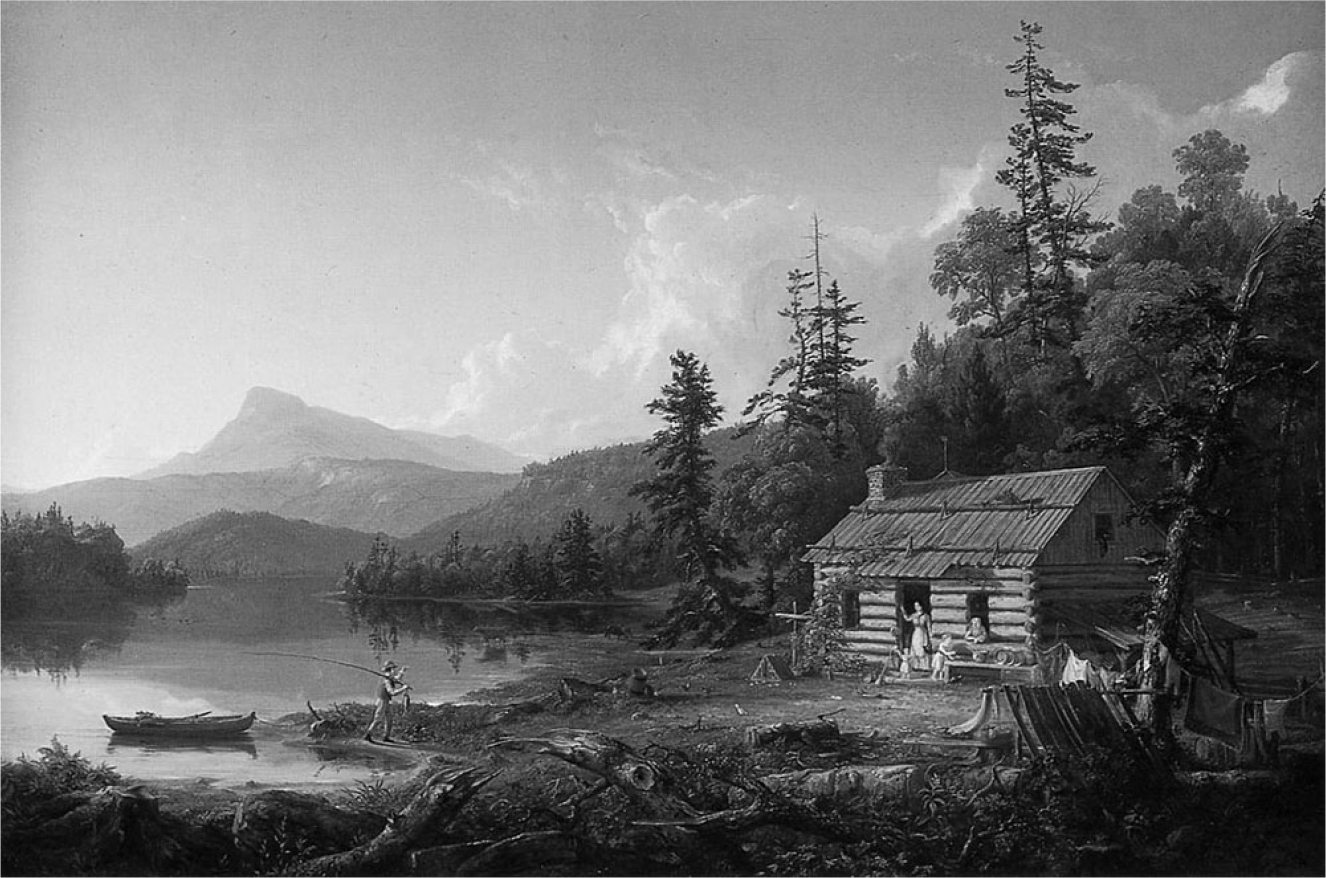
By the mid-19th century, in both Germany and the United States, philosophical movements were underway that were obsessed with the notion of a pure and spiritual nature in revolt against a polluted, dirty, materialistic culture. This purity-oriented spiritual trend was manifest most famously by German Romantic painters like Caspar David Friedrich, by American Hudson River School painters like Thomas Cole, and by the Transcendental writings of Emerson and Thoreau. And it is really in this Romantic naturalistic ideological soil, one built out of a rejection of modernity’s ever-expanding materiality, homogenization, and importantly, multiculturalism, that we might best locate the tangled origins of claims made even today by, say, the Christchurch shooter: “There is no Conservatism without nature, there is no nationalism without environmentalism. The natural environment of our lands shaped us just as we shaped it. We were born from our lands, and our own culture was molded by these same lands. The protection and preservation of these lands is of the same importance as the protection and preservation of our own ideals and beliefs.” Let’s start in Germany and follow this stem as it grows.
The challenge today, presented in a rather oblique way in Bruno Latour’s Down to Earth, is how may we return to the soil without returning to a local racial consciousness? How can we have both human rights and intact ecologies?
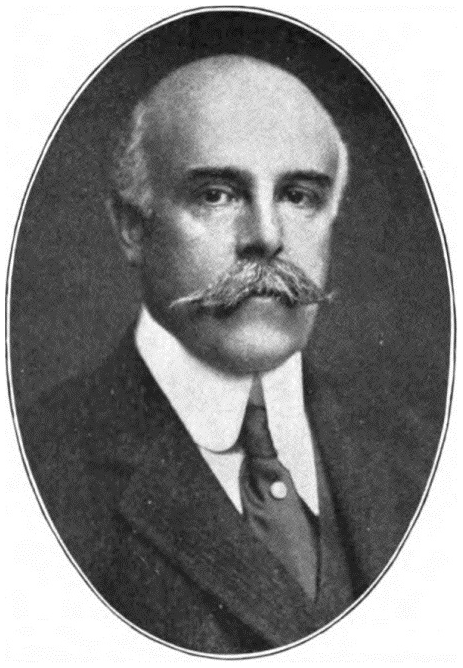
Yale graduate and Progressive Era eugenicist and conservationist Madison Grant authored The Passing of the Great Race, which had a global fanbase and was even embraced by Adolf Hitler.
Public domain, via Wikimedia Commons
The central question in mid-19th century German politics was that of national unification. In 1866, The New York Times printed that “There is…no Germany proper to speak of. There are Kingdoms…inhabited by Germans, and each separately ruled by an independent sovereign with all the machinery of State. Yet there is a natural undercurrent tending to a national feeling and toward a union of the Germans into one great nation.” In the disparate nation states and identities that constituted 1860s Germany, those who were for unification, many of whom caught up in elite Romantic circles, began to articulate a new type of political consciousness they called volkisch.
Starting around the mid-century, the countercultural Volkisch Movement centered itself around the idea of the “volk”—loosely translated as “folk” or “the people”—or that there was some primordial German spirit that linked people to the land and one another. In the volk emerges the idea of volkskörper, the political idea of the “organic, ethnic body,” or an entangled sense of ethnicity that might feel to us today more akin to the concept of a “native species” than to anything else.
And it is in this sense of race that we must understand the Christchurch shooter when he writes, “We were born from our lands, and our own culture was molded by these same lands.” The Volkisch Movement thus was a successful attempt to build a meaningful nationalistic identity that unified “true” Germans with one another and with their soil. By the turn of the century, what had been a type of countercultural eco-ethnonationalist movement had mainstreamed and evolved into the politics of Lebensreform, or “life reform.”
By today’s standards, many of the cultural dimensions of turn of the century Lebensreform Germany would be read today as hallmarks of stereotypical white liberalism. Vegetarianism was common, as was yoga—a practice that connected German Aryans to their Indo-Aryan primordial relatives on the Indian subcontinent. During this period, Rudoph Steiner would promote both biodynamic farming and Waldorf education, while “true Aryans” would retreat in a mass back-to-the-land movement, form nudist colonies, do hallucinogenic drugs, practice naturopathy, and reject the Christianity entirely, only to rediscover the long lost ”pure” Germanic pagan faiths.
Meanwhile, around the turn of the century, the naturalist theories of Volkisch intellectuals began to fuse heavily with Darwinian thought. Quickly the drama of society became framed first and foremost as a race struggle, of which Houston Stewart Chamberlain’s 1899 The Foundations of the Nineteenth Century is but one example: “The races of mankind are markedly different in the nature and also in the extent of their gifts, and the Germanic races belong to the most highly gifted group, the group usually termed Aryan…Physically and mentally, the Aryans are pre-eminent among all peoples; for that reason, they are by right…the lords of the world.” Importantly, in this cultural milieu of eco-spiritual nationalism and pseudoscientific racist intellectual-ism, German fascism would ultimately sow its seeds.
Across the pond in the United States, the entanglement of race and nature was in full swing by the turn of the century, albeit with a less Romantic and more bureaucratic edge. In his shockingly racist, The Passing of the Great Race, Yale graduate and Progressive Era eugenicist and conservationist Madison Grant wrote: “Mistaken regard for what are believed to be divine laws and a sentimental belief in the sanctity of human life tend to prevent both the elimination of defective infants and the sterilization of such adults as are themselves of no value to the community. The laws of nature require the obliteration of the unfit, and human life is valuable only when it is of use to the community or race.” The book had a global impact, with one of his German fans even writing him a letter saying that the work had become “his Bible.” The fan? Adolph Hitler.
In addition to directing the American Eugenics Society, Grant was a devout conservationist. He was instrumental in founding Save the Redwoods League, the Bronx Zoo, the American Bison Society, and both Glacier and Denali National Parks. The basic need for further measurement, rationalization, and improvement of society and nature links the two political notions of conservation and eugenics. And, of course, preserving what is pure. Though he would only ever remain pen pals with Hitler, his close circle included powerful Progressive politicians, including Teddy Roosevelt and the founder of the Yale School of Forestry, Gifford Pinchot, who, in 1900, hosted the first MODs at a chunk of forestland he owned in Pennsylvania.
“A Home in the Woods” painted by Cole Thomas in 1874 depicts the imagery associated with philisophical movements of the time that espoused the virtue of embracing “pure” nature in the world and resisting a polluted, materialistic culture.
Thomas Cole, Public domain, via Wikimedia Commons
Today, in both the United States and worldwide, we are experiencing two trends simultaneously: the resurgence and fascist—often incorrectly labeled “populist”—politics and the ongoing kaleidoscopic suite of crises often bucketed simply as climate change. What this history shows is that these trends are deeply entangled political phenomena. There is no meaningful thing called eco-fascism—it is just fascism. All twentieth-century fascist regimes had distinct myths about race and land. Today, many of the particularly fascist factions in American politics are locked up in a position of climate denial and self-conscious ambivalence toward the environment. And yet, as time moves forward and renders denial more and more untenable, we need to prepare for the refashioning of ecos and ethnos in conservative rhetoric. There is nothing new under the sun.
It’s sunny again in the old forest camp, all the new students are still milling about, and I’m sure the ghost of our eugenicist forefather Gifford Pinchot was somewhere nearby, perhaps disgusted by the School’s recent self-conscious name change to distance itself from this tangled past or by the scant yet improving diversity in the student body and faculty. The challenge today, presented in a rather oblique way in Bruno Latour’s Down to Earth, is how may we return to the soil without returning to a local racial consciousness? How can we have both human rights and intact ecologies?
I look up from my computer and think, “I wonder if when the time comes that we get an openly racist, fascist politician in this country that wants to take urgent action on climate change, who here will jump ship?”