




Abstract
We have recently witnessed the rise of populist leaders across the world. What makes those leaders so successful? We still do not quite know. This article offers an answer. The public and private spheres are typically kept distinct and apart in contemporary societies. Populist leaders, however, behave in the public sphere as if they were in the private sphere: they say and do things that are normally only said and done in private. This unorthodox approach resonates strongly with those who feel like the public sphere has left them behind.
Dr Case, Flickr
Populism has been on the rise. Politicians like Donald Trump in the U.S., Jair Bolsonaro in Brazil, Rodrigo Duterte in the Philippines, and Marine Le Pen in France have won elections and secured the support of millions of citizens. Sociologists and political scientists have accordingly sought to explain both what populism is and why so many populist leaders have gained the loyalty of followers.
On the first question—what populism is—academics have by and large produced a robust and convincing answer. Populism, they argue, is a discursive frame rather than a set of specific policies driven by a political ideology. Specifically, populist leaders depict economic, political, and media elites as corrupt actors undermining the wellbeing of supposedly morally virtuous people. Populist leaders present themselves as “outsiders” seeking to change the system. As they do so, they interact with their followers by bypassing representative democratic institutions and favoring direct means of communication (think Twitter!).
Thus, populist leaders—whether from the left or right—set themselves apart from traditional politicians by claiming to be saviors of the nation and in direct contact with its true citizens. This perspective certainly applies well to many populist leaders— including the four mentioned above but also Narendra Modi in India, Matteo Salvini in Italy, Geert Wilders in the Netherlands, Hugo Chavez in Venezuela, and others.
As to why millions of people have embraced those leaders with such fervor, explanations exist but fall short of being entirely satisfactory. The most common ones stress that populist leaders speak to a segment of the population that feels frustrated by mainstream politics and policies. That sense of frustration has both economic and cultural dimensions. On the economic side, the argument is that scores of people have suffered from the rise of globalization, the concentration of wealth in the hands of ever fewer individuals and organizations, and unscrupulous politicians tied to moneyed interests. Populist leaders promise to fix these problems. On the cultural side, the argument has been that populist leaders wish to return the nation to supposedly forgotten but cherished values—revered traditions, a sense of community, caring for vulnerable citizens, and the like. These explanations certainly have merit.
Yet, is that the full story? Do such basic tactics alone generate the electrifying and palpable energy of Trump rallies? Is this why millions of Venezuelans listened spellbound to Chávez’s often interminable speeches? Is Le Pen’s grip on so many French people solely a reflection of widespread economic and cultural dissatisfaction? It seems that something else—something more emotionally resonant and provocative—is also at work.
Here I offer an additional perspective that recognizes existing accounts of economic and cultural frustrations as correct but builds on them to highlight something hitherto not understood, but fundamental, about populism. The focus is on the propensity of populist leaders to behave in public as if they were in private. Populist leaders breach the divide between the public and private spheres. They subjugate the logic of the former to that of the latter. They delegitimize the former by attacking it with the latter. Their followers love it: feeling betrayed by the public sphere, they finally have someone who, unfiltered, gives them a voice and amplifies their views, frustrations, and aspirations. Populism is about the vindication and liberation of the private self—done in and against, the public sphere.
To explain this idea, this essay is divided into three sections. The first reflects on the separation in contemporary societies between the public and private spheres. The second details, with the help of examples, how populist leaders undermine the public sphere with the logic of the private one. The third articulates why this has proven so compelling across the world.
“I like the fact that he [Trump] is not afraid to say what we are all thinking!” Donald Trump supporter at a 2016 rally
The Public and Private Divide in Contemporary Society
We can start by recognizing that modern society has depended on a clear divide between the private and public spheres. The public sphere may be defined as the place where our political, social, and economic lives unfold supposedly in line with principles such as objectivity, rationality, the respect for human rights, predictability, professionalism, and transparency. It is a theoretically neutral place with clear abstract rules with which our selves selectively interface. Here, a good portion of what we might think, feel, believe, and rather do is not allowed. Those things are irrelevant and in fact potentially harmful.
Capitol insurrectionist Richard Barnett made himself at home in the office of Speaker of the House Nancy Pelosi on January 6, 2021. This is the physical embodiment of the breach of the divide between public and private spheres that has come to characterize modern populist political movements.
Seth Loeb, Getty Images Used with Permission

By contrast, the private sphere may be defined as the space where we are free to feel and express a wide array of emotions, indulge in personal pleasures, entertain ambiguities and even “illegitimate” thoughts, use colorful or profane language, and the like. Our liberties are certainly not unbounded there, but we are nonetheless allowed to think and behave in ways that are quite different from what is expected of us in the public sphere, as sociologists Ervin Goffman and Norbert Elias compellingly argued. In the private sphere, we need to worry less about whether others see us and what they think of us. There is less external judgment and admonition. We have more latitude.
Keeping the two spheres separated is not without its challenges. Often, we make mistakes and breach boundaries. By and large, however, modern society functions with this divide solidly in place. And this is largely because the divide has, as intended, brought about considerable benefits: peace, stability, and wealth. None of these things could have flowed to the same extent from the arbitrariness and ambiguities common in the private sphere. In the public sphere, science has thrived, life has unfolded mostly in an orderly and predictable fashion, investments of all kinds (in education, transportation, technology, finance, biotechnology, high-tech, housing, etc.) have been possible, governments have generally delivered on many public goods (a reliable public administration, for instance, as well as schooling, roads, and defense against enemies), and all types of economic activities have flourished.
To be sure, the divide has not been without its critics. Early on, social scientists felt it generated considerable problems. For Max Weber, for instance, it implied a dulling “disenchantment” with the world and spiritual impoverishment. At the same time, Karl Marx saw the purported neutrality of democracy and legal systems in the public sphere as helping capitalists’ private interests. W. E. B. Du Bois made similar arguments in relation to race, while Sigmund Freud viewed the public sphere’s repression of personal drives and instincts as the root cause of widespread psychological misery. Feminist thinkers like Jane Addams, in turn, saw it as empowering men and not women. Subsequent criticisms have echoed and even amplified some of these concerns—even today with, for instance, the Black Lives Matter or Me Too movements.
Yet, even for some of the fiercest critics, the point has not been to do away with the split between the two spheres. No one has called for a merger of the two. Instead, critics want an improvement of the public sphere so that it serves and benefits everyone fairly and better—so that, in other words, it moves even further away from the drives, inclinations, and possibilities allowed in the private sphere.
Therefore, contemporary societies rely fundamentally on the separation between our private and public spheres. All of our major institutions—from the local elementary school to the World Bank—promote or prepare us for that separation. Significant incentives and rewards are available for the people, organizations, and communities that follow the model. Various kinds of penalties and punishments are in turn imposed on those who challenge it.
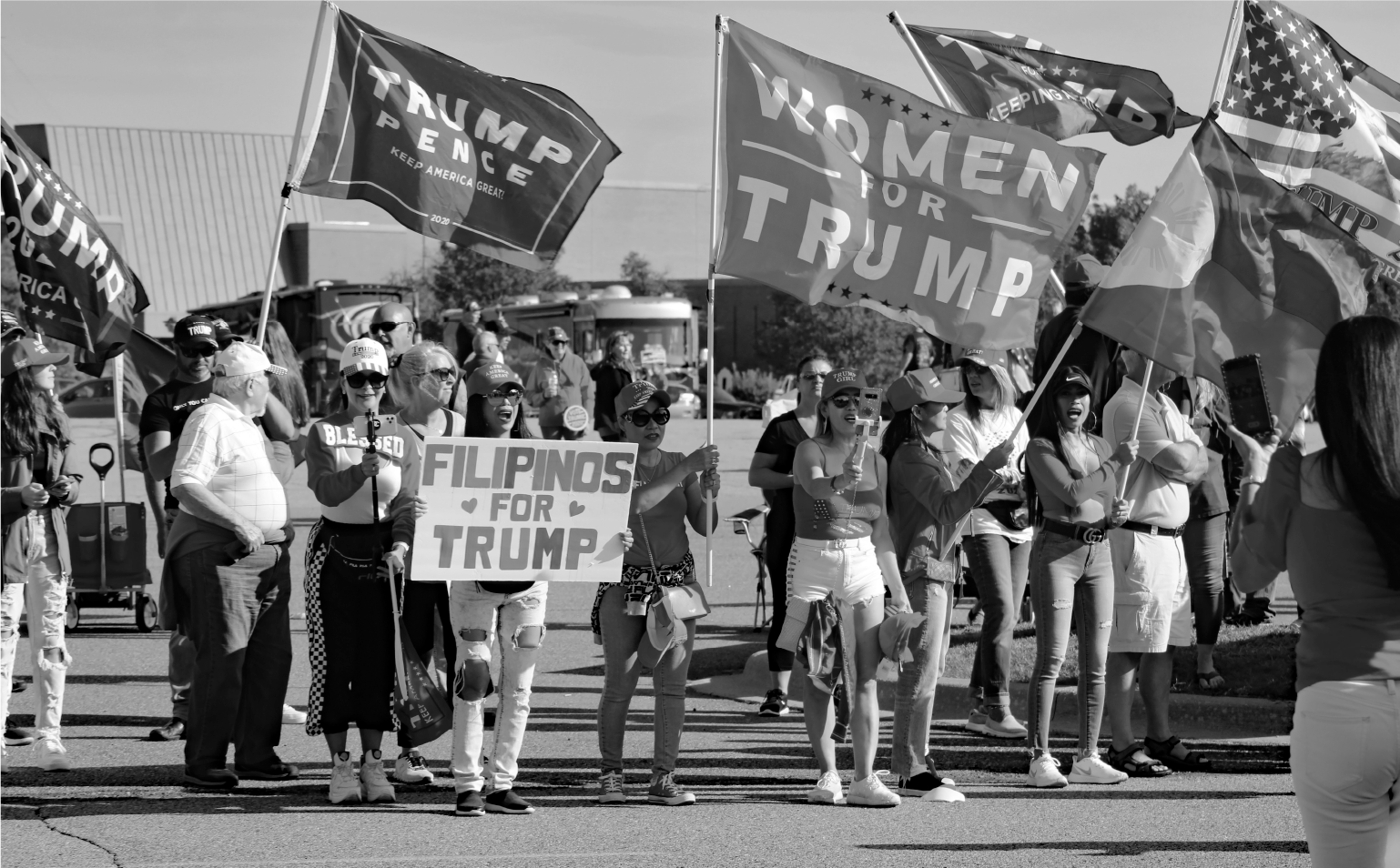
Feeling betrayed by the public sphere, followers of modern populist leaders such as Donald Trump feel like they have a voice through someone who amplifies their views, frustrations, and aspirations.
Michael Anthony, Pexels
The Private Attacks the Public
Populist leaders do something that other types of politicians do not do. They attack the public sphere by breaching it with the logic of the private sphere. In particular, they openly say with conviction things that are only thought or spoken of in the private sphere, and they do so in ways that are typically seen only in the private sphere.
Populism thus entails an affront to the core principles of the public sphere by negating them and asserting instead those found in the private sphere. We will discuss why this has proven so appealing in the next section. In this section, we focus on the nature of the approach itself.
Political sociologists and other scholars have already noted that populist leaders adopt discursive strategies that do not normally “belong” to the public sphere. Populists, they point out, use “rudimentary” moral arguments about good versus evil, appeal excessively to emotions (negative and positive), shun reason, and often employ exceedingly vague and romantic language in their outlooks and promises. They shed tears in public, breach diplomatic protocols, and take unexpected actions without consulting even their closest advisors and allies. The observation that these behaviors are unusual for the public sphere is valid. But closer scrutiny reveals something significant. These behaviors all share one key denominator: they are all typical of how we can, and often do, operate in the private sphere. Thus, when performed by political leaders in the open for everyone to see, they are direct affronts to the foundations of the public sphere.
Examples will be presented shortly, but for now note that this observation holds in terms of both populist content and style. Regarding content, populist leaders favor intuition and instinct over science, espouse conspiracy or fantastical theories to cast doubt on governmental policies and processes, invoke sexual images and language, dispense favors as if they were personal resources, insult opponents by resorting to disparaging attributions, at times mock others for their purported physical or mental limitations, and shun political correctness. All of this is usually acceptable, and at times even encouraged, in the private sphere but not in the public one.
Populism is about the vindication and liberation of the private self—done in and against, the public sphere.
Similarly, legal and judicial requirements are often dismissed as secondary to expediency. Racist and xenophobic perspectives, in turn, might be voiced: one identifies with one’s community, after all, and not with some imaginary sets of human rights or abstract global society. Importantly, though, moving expressions of love, generosity, and other positive sentiments may also be in the cards. Happiness, light, and joy are certainly present— indeed, even more cultivated—in the private sphere. Populist leaders are not afraid to celebrate life, cheer their own people, and express optimism and creativity—in contrast to the dullness and rationality of the public sphere. They also claim to be willing to sacrifice themselves for higher things.
The style of populist leaders complements the content of what they say. It subscribes, after all, to the same logic. The public behavior of normal politicians is measured, planned, detached from personal inclinations or idiosyncrasies. Whether they are talking to a common citizen or the prime minister of another country, their words are carefully chosen and ideally reflective of a pre-established protocol and formula. The typical leader reaches the public through standard and monitored channels of communication.
Populist leaders by contrast say things very differently. They talk as if they are amongst friends and family. They launch into stream of consciousness monologues, raise their voices, speak directly to supporters, and use social media in informal ways. They disregard etiquette in political debates or events by interrupting—as if they were quarreling with a detested relative—or by joking inappropriately. Populist leaders make ample use of hyperbole, folksy language, and false equivalence. They are often unpredictable, sometimes charming, humorous and kind, and other times insulting. Some call them “liberated” and “genuine.” Unshackled from conventional restrains, they appear to be more honest.
Hence, on the whole, populist leaders challenge the legitimacy of the public sphere by “freeing” themselves and their followers from its constraints, and by acting in effect as if they were in the private sphere. In a sense, by challenging the status quo, they remind us of Weber’s definition of charismatic actors, Goffman’s view of the social order as performance and of daring social actors as undermining it by revealing its backstage secrets, and perhaps even of Marx’s famous line that “all that was once solid now melts into the air.” What we have taken for granted about the world is no longer assured. The raison d’etre of the public sphere is suddenly cast into doubt. Is it still useful? Does it really serve its citizens? Does it serve us? Has the time come for radical change?
We can see illustrations of this in all recent cases of populism in North America, Latin America, Asia, and Europe. Trump of course gave us daily examples—from his aggressive, even compulsive, use of Twitter against the core institutions of American democracy and their officials, to his talking about the “beautiful” letters he exchanged with North Korean leader Kim Jong-un and of their “falling in love.” But examples abound no matter whom we consider.
Take, for instance, Chávez in Venezuela and his Aió Presi-dente television show. Broadcast every Sunday at 11 a.m. for many years, it was unscripted, lasted many hours, and involved direct exchanges with audience members and impromptu decisions to help farmers, workers, or whoever else might appear. Informally dressed, Chavez hugged children, broke into song, cried with those who suffered, fired and hired ministers, and staged several episodes not in official buildings but in local villages, farmers’ fields, and the like. Many shows felt like fireside chats. He acted impulsively: after losing patience with a tense diplomatic situation with Colombia, he once suddenly ordered, on the spot, a top general to send 10 battalions to the border and almost started a war.
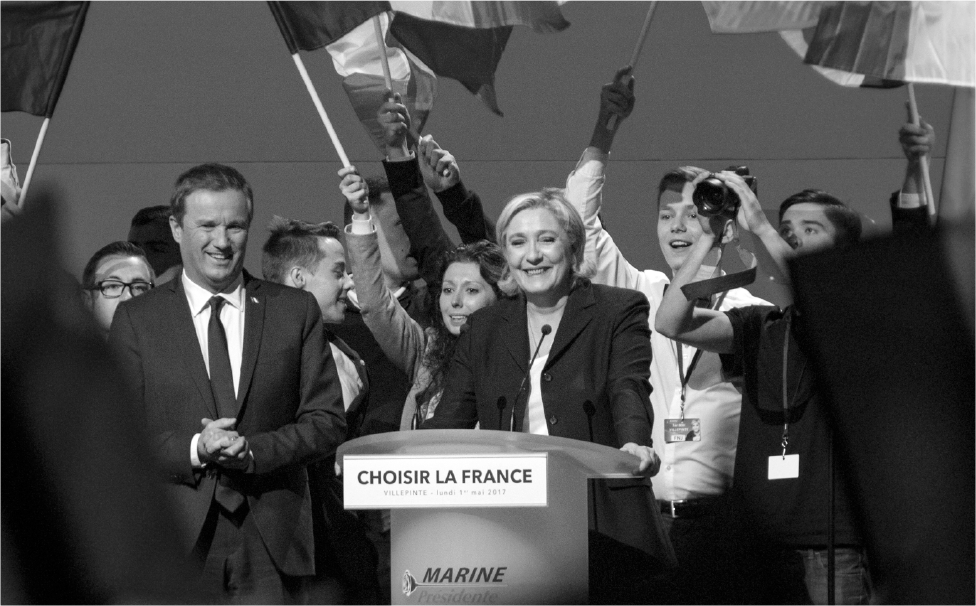
Populist leaders attack the public sphere by breaching it with the logic of the private sphere. Here is Marine Le Pen speaking at a rally in 2017.
Sergio Foo_biker, Flickr
Putin also comes to mind when we glimpse him riding bare-chested astride a horse or following the tradition of submerging himself in icy water to mark the Russian Orthodox Epiphany. Consider Duterte and his pledge to rid the Philippines of the drug trade by executing drug dealers without due process. Why bother to try them in court? President Recep Tayyip Erdoğan’s shedding of tears when hearing old Turkish poems, and Bolso-naro’s offensive denigrations of Brazilian gays and lesbians, offer other illustrative examples. The same may be said of Le Pen’s attacks on Muslim immigrants and her vocal disdain of French legislators, or Wilders’ depiction of Moroccans as “scum” and his condemnation of all Islam as destructive. In all these cases, things traditionally said and done in the private sphere are given expression in the public sphere, with the effect of challenging it head on.
Why It Works So Well
Any explanation of the success of populist leaders must be able to shed light not only on why millions of their followers support them but on why they often do so viscerally and with great intensity. Populist leaders elicit deep, instinctive, and often uncompromising allegiance. Their followers feel recognized, energized, and even personified by those leaders. What can account for this? Should they not be concerned about their leaders’ unorthodox behaviors?
The simple answer is that large segments of many societies, comprising significant percentages of populations and electorates, have felt let down by the public sphere. The public sphere is their problem. They do not believe it has delivered for them. It represents an antagonistic and untrustworthy space in which they cannot win. They see its supposed fairness and objectivity as illusory and even downright harmful. Its bureaucratic and scientific qualities and processes have translated only into obstacles. Willing to work hard, their efforts have yielded little and their earnings have dwindled. Accepting to play by the rules, they have seen others bend them and get ahead. Devoted to their country, they have witnessed politicians and business leaders sell it for personal gain. Their children attend underfunded schools, the elderly and vulnerable in their communities are neglected, and yet migrants are let in and supported. As they suffer, the mainstream media fails to talk about their problems, and in fact belittles them. No one seems to be listening.
Welcome, then, to those courageous and trustworthy leaders who are willing to make a mockery of all that goes on in the public sphere, and of the people who benefit from it. The more daring the politicians’ attacks, the deeper they will resonate among the disaffected. The more unfiltered and offensive the comments, the more gratitude and appreciation those leaders will earn. The more those leaders “sound like them”—the people, with their fears, hopes, and the lexicon they share with friends and family—the more inspiring they will be. At last the people have a voice—their inner voice—in the public arena: a genuine, irreverent, uncompromising representative willing to say and do what hitherto has been ignored, suppressed, and considered taboo. What for so long they have said behind closed doors—about their workplaces, the direction of the country, immigrants, gays and lesbians, China, multinational corporations, politicians, or whatever—can finally be projected outward into the open, ideally with the biggest megaphone available. And if an establishment politician, like Hillary Clinton, calls them “deplorable,” they, for once, will have the final word. The public sphere will be shaken up to reflect who they are and what they need.
It is easy to see how such rhetoric might feel irresistible. It is the foundation of an existential bond. The denigration of the public sphere comes with the recognition of the people’s injured and neglected dignity—their unfiltered and whole selves. Thus, importantly, to those leaders go loyalty, commitment, and, crucially, a willingness to act as instructed, even if that comes with serious risks. This is not a typical sort of political connection, after all.
The events of January 6, 2021 in Washington, D. C., illustrated all of this with tragic clarity. Encouraged directly by then-President Trump, a furious mob stormed nothing less than the United States Capitol. Most people who watched the events unfold felt disbelief and repulsion. But in reality, if properly understood, the actions taken by the mob that day were perfectly coherent and even predictable. The irreverent insurrection—complete with the assaulting of police officers, looting, the placing of feet on elected officials’ desks—summed up best Trump’s appeal: it represented the culmination of his (and now their) assault of the public sphere through the logic of private sentiments and actions. By definition, they could not have achieved their goals in an orderly manner. Instinct, insult, and desecration were the insurrection’s essential ingredients. Aimless roaming, searching, and barging into offices served as the perfect contrasts to the highly regulated and bureaucratic unfolding of life that define that building. Each person felt free to do as they wished: smash windows, take selfies on phones, seize busts, lecterns, and other trappings and symbols of government, or leave threatening notes. Under the weight of the private sphere, the public sphere thus collapsed for several hours.
Populist leaders challenge the legitimacy of the public sphere by “freeing” themselves and their followers from its constraints, and by acting in effect as if they were in the private sphere.
Populism, then, is a unique sort of formula that calls into question and challenges the very foundations of our contemporary world. What this may mean for the future is unclear and beyond the scope of this essay. But those intent on understanding its appeal, and exploring ways to challenge it, will do well to appreciate what lies at its core.