



Abstract
This review is a discussion of Deborah J. Cohan’s book, Welcome to Wherever We Are. The stories presented within may be unforunately familiar to some readers, making this book tough to wade through—not because of the writing, but because of the topic and the precision with which Cohan crafts the lived experiences of abuse throughout her life. She is upfront about this reality, noting that this book is about what it means to caregive for an abuser over the course of her life and most intensely for the eight years at the end of her father’s life. Rightfully, and true to ambiguity, she elaborates throughout the book on the delicate balance of trying to love her father at the same time she is trying to process the abuse and her feelings toward him.
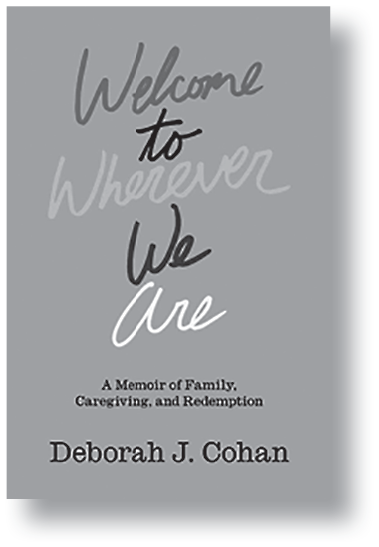
Could you provide help and care for an aging parent who consistently abused you? And how would you navigate that experience? While these are not questions that people may first consider when thinking about family and caregiving later in life, caring for an abuser is an issue that many people may grapple with as their parents age. Deborah Cohan’s book Welcome to Wherever We Are presents answers to the above questions that may surprise many people, a fact she acknowledges early in her sociologically-infused memoir—yes, a person can care for their abuser. Written by a sociologist who focuses on domestic violence, Welcome to Wherever We Are gives personal attention to a social issue that many researchers are concerned about —adult children providing care to their aging parents— but adds an often-understudied layer to the dynamics by focusing specifically on an abusive relationship. Cohan’s father was verbally and psychologically abusive to her throughout her life, but she cared for him until the end. As noted by Cohan, abuse both stunts growth while simultaneously speeding up time, and the book progresses in a similar fashion where we travel back and forth between childhood and later life to understand the complexities of her relationship with her father. Our lived experiences, our memories, are complex and constantly shifting; nothing is fixed.
Scholars who study parent and child relationships over the life course often rely upon a particular theory to situate and understand family dynamics of care and exchange: intergenerational solidarity theory. Developed in the 1970s after a period in U.S. history of protests and conflict between older and younger generations, the inclusion of “solidarity” within the theory’s name implies togetherness or cohesion and gives a sense of positive ties between family members. Although such a “positive” theory suggests an opposite negative side exists, or lack of solidarity, recent iterations have pushed back on the overall nature of the theory to argue that family ties are not so clear cut—family ties can be and are ambiguous. This ambiguity is the framework within which Cohan situates her experiences and perceptions of caring for her abuser. An interesting and unexpected twist to the narrative is that although the main focus of the book is on her father, Cohan weaves in other narratives of solidarity, conflict, and ambiguity in her social ties, mainly with her mother and her partners. This complexity to the narrative makes sense as Cohan provides insights into her personal ties, but also takes a 10,000-foot view of family relationships of all kinds.
The stories presented within Welcome to Wherever We Are may be unfortunately familiar to some readers, making this book tough to wade through—not because of the writing, but because of the topic and the precision with which Cohan crafts the lived experiences of abuse throughout her life. She is upfront about this reality, noting that this book is about what it means to caregive for an abuser over the course of her life and most intensely for the eight years at the end of her father’s life. Rightfully, and true to ambiguity, she elaborates throughout the book on the delicate balance of trying to love her father at the same time she is trying to process the abuse and her feelings toward him. Readers may be surprised by how human and relatable her father is, even when balancing disgust at the verbal venom he spews at Cohan. For instance, she presents a touching narrative of how much her father wanted her to get her doctorate. However, just like the past verbal abuse she experienced, the documentation of the violence is always waiting in the wings—his reactions, the verbal onslaughts—causing her, and the reader, to constantly be on their toes.
While reading the book, I had to take a break after each chapter, as I reflected on the complexity and depth of the family relations so artfully and painfully narrated by Cohan. As a demographer who studies family relationships, I am interested in what family members do for one another and how are they are tied together across the life course, often referred to as “linked lives.” Welcome to Wherever We Are reveals what static or cross-sectional surveys may fail to capture—that these social ties are complex, dynamic, and iterative; our feelings are not always so clear or consistent. Cohan notes that trauma can alter your memory, so she supplements her book with field notes, written letters, and voicemails that she kept of her experiences like the true researcher she is. Cohan further discusses throughout the book that violence creates a distorted reality of not knowing whether the person cares for you or is going to destroy you. For instance, in discussing her abuse, she often emphasizes how the violence is patterned but also unpredictable, making it hard to prepare and causing a person to become hyper vigilant—ironically, skills that are valuable when caring for an aging parent as their decline can be difficult to prepare for and require attentiveness.
Another interesting aspect of the book is that one might expect that Cohan has only had to grapple with the ambiguous ties to her father once he began his later life decline, but it becomes apparent that she has been “linked” together with him throughout their lives together. After her parent’s divorce, as an only child, despite the abuse from her father, she became in charge of helping him create a new life and when he became sick later in life of taking care of him. By weaving in the narratives of other family ties she has, she elaborates on how one person can be viewed so differently by others. For instance, her partner was able to interact with her father in a very relaxed and open way because he “didn’t have the history that I did” (p. 61). These intersecting relationships highlight the complexity of linked lives between two people and others in their networks of family members, friends, and acquaintances; all influencing each other in some way and changing how we understand relationships.
Grief and loss add another deep dimension to the story Cohan provides, as grief can also bring its own ambiguity. Cohan documents the anticipatory grief of knowing her father will die, for instance, as she struggles with signing the hospice paperwork, finding herself wanting to ask her father for advice up until the very end. At the end, her father is left with only a few dollars and a few boxes of possessions to his name, and Cohan wonders, in essence, “is this it?” about all of our lives, but especially about her father’s life. The physical possessions of pens and datebooks also cause her to see how ordinary her father was, adding another layer of complexity and ambiguity toward her father for whom she is also processing anger. Grief gives Cohan a chance to reflect back on it all.
Welcome to Wherever We Are is the perfect illustration of the whole spectrum of intergenerational solidarity, conflict, and ambiguity within family relationships and ties during both life and death.”
Welcome to Wherever We Are is the perfect illustration of the whole spectrum of intergenerational solidarity, conflict, and ambiguity within family relationships and ties during both life and death. The book will be of interest to a wide audience of readers. Adult children who have or are currently grappling with a similar experience of caring for an abusive parent may appreciate reading Cohan’s memoir to help reflect upon their own experiences. Family Scientists, from applied fields in family therapy to researchers in family demography, should pick up the book to gain more nuanced understanding of the dynamics of these kinds of relationships within an aging context. Within the classroom, the book could easily be a main reading in a graduate level course on families, domestic violence, or aging, but parts of the book would also be accessible to undergraduate students during weeks when materials cover family relationships or domestic violence (for instance, Chapter 1, “Phone Calls,” provides enough details to discuss the larger context of the book if time is limited). Overall, readers may be left with many conflicting feelings of their own after reading the book, coming away feeling just as Cohan does: “The murky grayness of ambiguity is the only thing that feels clear to me” (p. 157).
Given this review touches on domestic violence, if you or someone you know may be facing such situation, please consider the following resources:
The National Coalition Against Domestic Violence (https://ncadv.org/resources)
The National Domestic Hotline has 24 hour resources available online at https://www.thehotline.org/ or call 1-800-799-7233 (SAFE).