



Abstract
This essay focuses on the socio-spatial significance of Atlanta’s Caribbean Carnival. I describe how members of the Caribbean diaspora use the annual parade as an assertion of belonging that expands the boundaries for black community life. Based on participant observation and analysis of parade routes over the last decade, I argue that Carnival is an example of creative place-making that reveals how Caribbean residents lay claim to places. In the context of the ongoing displacement of blacks from the City of Atlanta and the spatial re-ordering of the population in the metro area, Carnival affirms new sites of black joy.
Women are the dominant “mas players” at Carnival. It is a space to challenge dominant notions of decency and respectability.
Photo by Alvin J. Wilder, used with permission
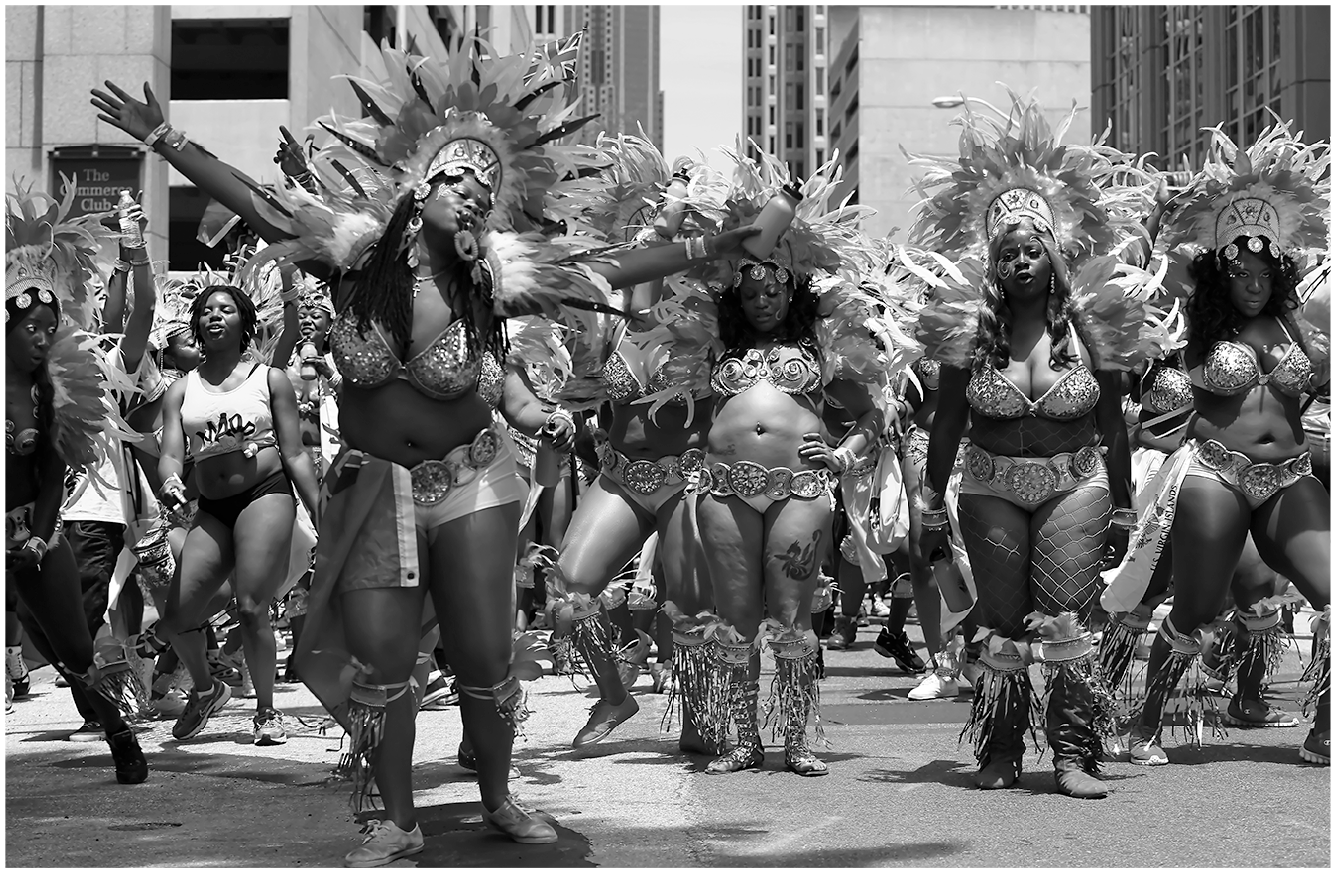
In a shift away from the racialized sites of everyday life in Atlanta where people reside, work, go to school, or worship, this essay focuses on the socio-spatial significance of the metropolitan area’s Caribbean Carnival. I describe how members of the Caribbean diaspora use the Atlanta Carnival as an assertion of belonging. I argue that Carnival is not just an annual cultural event; it is also a spatial practice. The act of taking up space for celebration and disrupting social and spatial norms is a form of place-making or transforming the places we find ourselves into places of meaning. Based on participant observation and analysis of parade routes over the last decade, I show that Carnival says a great deal about how Caribbean residents make and lay claim to places in the context of the ongoing displacement of blacks from the City of Atlanta and the spatial re-ordering of the population in the metro area. I conclude that the uniquely Atlanta practice of staging two Caribbean Carnivals on the same day unsettles traditional geographical boundaries for black community life. While it can be confusing to prospective participants, the contested location of the Atlanta Caribbean Carnival in this racially fragmented landscape illustrates a remapping of black space to include new geographies where black joy and presence are affirmed.
Every Memorial Day weekend in Atlanta, organized groups of parade-goers—called mas bands—representing Jamaica, Haiti, Panama, Costa Rica, the Bahamas, Trinidad and Tobago, the Virgin Islands, Saint Lucia, Guyana, and Brazil dance in the city streets behind live steel drums or tractor-trailers blasting soca, kompa, dancehall, and calypso music. In the Caribbean, Carnival season ends at the beginning of Lent. But the Atlanta event is the official kick-off of the North American carnival season that concludes with the West Indian American Day Parade in Brooklyn, NY on Labor Day. While migration scholars have studied Carnival as an indication of the size and socio-political significance of new black immigrant/ethnic communities, it can also be examined through the lens of place. Grounded in the theoretical framework of black geographies and the sociology of space and place, the case of Atlanta highlights the Caribbean Carnival’s power to appropriate and reconfigure space.
I want to suggest that the Atlanta Caribbean Carnival is an example of black urban placemaking. Sociologists have always paid attention to how places come to be the way they are, and how spatial practices matter for social and historical change. Spaces are safe or dangerous, rich or poor, black or white, beautiful or ugly, welcoming or not, because people ascribe meaning to the material and social stuff gathered there. Marcus Hunter and his colleagues describe urban placemaking as one of the ways that “black Americans create sites of endurance, belonging and resistance” in inhospitable societies. For black communities in the South, sit-ins and marches are well known examples of how embodied acts of taking up space and moving through off-limits city neighborhoods can transform an individual’s relationship to a segregated landscape.
Caribbean Carnival moves to Southeastern Dekalb County, May 2018
Photo by Elizah Turner, used with permission
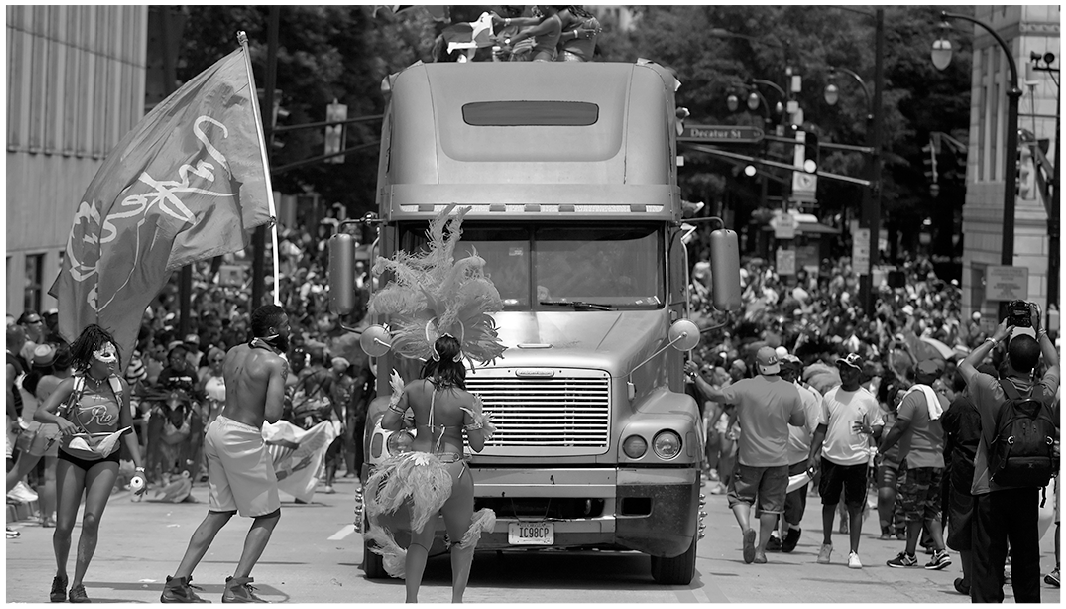
Celebratory black placemaking is an equally powerful spatial practice. Unlike antagonistic modes of claiming space, assertions of joy such as playing/making music outside, dancing provocatively in the street and other public expressive acts signify presence and control over space. As George Lipsitz argues “people who do not control physical places often construct discursive spaces as sites of agency, affiliation, and imagination.” The radical potential of black parading culture as a placemaking project distinguishes Carnival from other meaning-filled assertions of black joy. As a simultaneously transgres-sive practice, challenging the expectations of good and appropriate behavior some places carry with them, it has the capacity to remake both the historic black spaces in the city of Atlanta, as well as those new suburban spaces where Caribbean immigrants have settled since the 1990s.
Focusing attention on the “where” of Carnival makes clear that the interplay between the people and the street is especially important. While there are shared essential features of all the older and better-known Caribbean diaspora carnivals—Notting Hill (in London), Caribana in Toronto, Boston’s Caribbean Carnival, and the Labor Day Carnival in Brooklyn, NY—each illuminates the local setting in distinctive ways. Carnival celebrations erupt in the streets in response to harsh socio-economic conditions, such as overcrowding, unemployment, crime, violence and poverty in a social landscape that constantly connects the car-nivalist to the everyday wor ld. It is a time that allows one to be free. The term “jamette” refers to a kind of urban lower class, comprised of singers, performers, domestics, pimps, and prostitutes, that epitomized the opposite of the upper-class elite and notions of decency and respectability. It is the very interplay between streets of the city and dancing “mas players” that give carnival its force and power. The history of the Atlanta Caribbean Carnival evidences its significance as a space of liberation and creativity, as well as a form of resistance.
History of Atlanta’s Caribbean Carnival
The first carnival was held in 1988 with the modest goal of showcasing Caribbean culture and bringing the small immigrant community together. As the event became more commercialized and Atlanta’s West Indian community grew, a group called the Atlanta Caribbean Carnival Bandleaders Association (ACCBA) formed to represent the interests of the various traveling bands. By the year 2000, the largest concentrations of Caribbean immigrants were settling east of Atlanta in southeastern Dekalb County. The northern portion of the county is home to majority-white communities and commercial areas, while the southern part remains relatively underdeveloped, infra-structurally isolated, and almost exclusively black. A separate Caribbean carnival was organized in Dekalb county, first in unincorporated Decatur in 2015 and later in the new city of Stonecrest as the community quadrupled in size. Locating the Caribbean Carnival in Stonecrest can be interpreted both as a collective assertion of their presence outside the City of Atlanta and as an affirmation of Caribbean culture as part of the black life in Atlanta.
These multiple claims of belonging unfolded as settlement patterns of Atlanta residents shifted dramatically. Over the last 20 years, the metropolitan periphery began to diversify, the proportion of blacks in the city began a steady decline, and some city of Atlanta neighborhoods experienced an influx of whites reversing the pattern of “white flight” exhibited for decades. Data from the 2020 Census suggest that Atlanta is now 47 percent black. Historically concentrated in Fulton and Dekalb counties, the city’s non-Hispanic black population declined by more than 30,000 between 2000 and 2010. By 2010 nearly half of metro Atlanta’s non-Hispanic black population lived outside of the City of Atlanta and outside those historically Black suburban counties adjacent to the city. This demographic shift largely follows the trend in other metropolitan areas. But in Atlanta, where there are currently fewer blacks in the city than any other post-CRM decade, it means that old realities of race and place no longer make sense. The long-held conventional wisdom that people of color were concentrated within the city of Atlanta with whites living “outside the perimeter” began to shift with the elimination of public housing. What has been euphemistically described as the diversification of the suburbs ignores disinvestment in Atlanta’s inner suburbs where blacks who settle outside the perimeter are concentrated in neighborhoods facing the same problems as declining inner-city neighborhoods—high crime, low performing schools, poverty, and low property values.
Parade Geographies
In the early years the parade began in Downtown Atlanta. Mas bands wound their way through the central business district down what was once known as Black Wall Street, the Sweet Auburn neighborhood, the M. L. King Historical District, and ended at Turner Field. The 2008 Carnival was one of the last events before the approval of the Atlanta Beltline project hastened gentrification in in-town neighborhoods. Research has shown that proximity to the Beltline has had a major effect on home prices in the city, where values rose significantly more for homes within a half-mile of the Beltline than for properties located elsewhere in the city.
The 25th staging of the Atlanta Caribbean Carnival in 2013 took participants to the historic West End neighborhood. Hundreds of carnival goers lined the streets around the Atlanta University Center then streamed into Morris Brown Herndon Stadium. Notwithstanding the significance of this new parade route and venue at one of Atlanta’s HBCUs, it also illustrates how official attempts to contain Carnival in a park or stadium space— thereby keeping carnivalists out of the street—limits its power. Notably, some participants commented on social media that the event didn’t quite “feel” the same as the previous Downtown events.
In 2015, while the Atlanta Caribbean Carnival was held at Historic Fourth Ward Park, a second festival advertised as the “Atlanta / Decatur Carnival” paraded through the Dekalb county neighborhood of Avondale Estates (where approximately 83.9% is white and the median household income is $108,299). Commentary from residents and carnival-goers shows that this neighborhood was not “the right fit” for the people it attracted to Avondale. This carnival also represents a turning point in the history of the Atlanta Carnival and the racialized resistance that emerges over geographic claims of belonging. Commentary from residents and carnival-goers shows that this carnival represents a turning point in the history of the Atlanta Carnival and the racial-ized resistance that emerges over geographic claims of belonging. Responding to complaints about trash and noise from Avondale Estates residents Charles Baker, president of Atlanta Carnival Bandleaders Council (ACBC), said: “But we are all stakeholders in the community…We all contribute to the well-being of the community. We work here. We live here. Our kids go to school here…. We are first responders, healthcare givers. In every aspect, we are fully integrated in the community.”
Unaware of the historic dividing line between the unincorporated parts of Decatur and the independent cities to its North, Caribbean blacks reimagined the identity of Avondale Estates as if it was part of unincorporated Decatur while they unsettled the geographical boundaries of black community life.
The 2018 Atlanta/Decatur Caribbean Carnival was moved to the new city of Stonecrest—a symbol of the metro area’s new racial order. In November 2016, the City of Stonecrest was carved out of the middle-class southern corner of unincorporated Dekalb County, adjacent to a black suburb called Lithonia. Stonecrest was the first self-started, majority-black city created in Georgia since Reconstruction. As one carnival-goer put it: “We got the [Stonecrest] mall, then we became a city, and now we’ve got a carnival… So I’m here to support.”
Conclusion
Black geographies scholars argue that Black lives are lived spatially. Like other Atlanta parades and festivals, Caribbean Carnival is more than a celebration of culture. This annual rhythmic event is a socio-spatial practice that utilizes music and dancing, place-making discourses, and the appropriation of space to assert claims of agency and presence within the city. Mapping the Atlanta Caribbean Carnival helps illuminate the diversity of black experiences and spaces, the ongoing geographical displacement of urban blacks, and the significance of creative place-making practices in this rapidly changing metro area. While it is still ordered by race and class, the Atlanta Caribbean Carnival remakes this majority-black city that typically centers on an African American sense of place. The (hyper)visibility and audibility of the Caribbean carnival parade, the influx of carnival-goers and visitors from throughout the diaspora displaying their national flags, the movements of mas bands, and people dancing in the street, transforms the socio-material landscape —if only for a day.