



Abstract
Policy and scholarly debates on gentrification have mainly focused on displacement or improvements to neighborhood amenities. Less attention has been paid to actively worsening conditions for residents who don’t leave and for whom poor housing conditions are a perverse consequence of gentrification. Mapping city data on apartment code violations, we find that substandard housing conditions are surprisingly concentrated in gentrifying areas and not just low-income neighborhoods. Drawing on ethnographic observations our research finds that in gentrification while bringing new amenities to neighborhoods, can also give strong incentives to landlords to mistreat tenants in an attempt to drive them out intentionally.
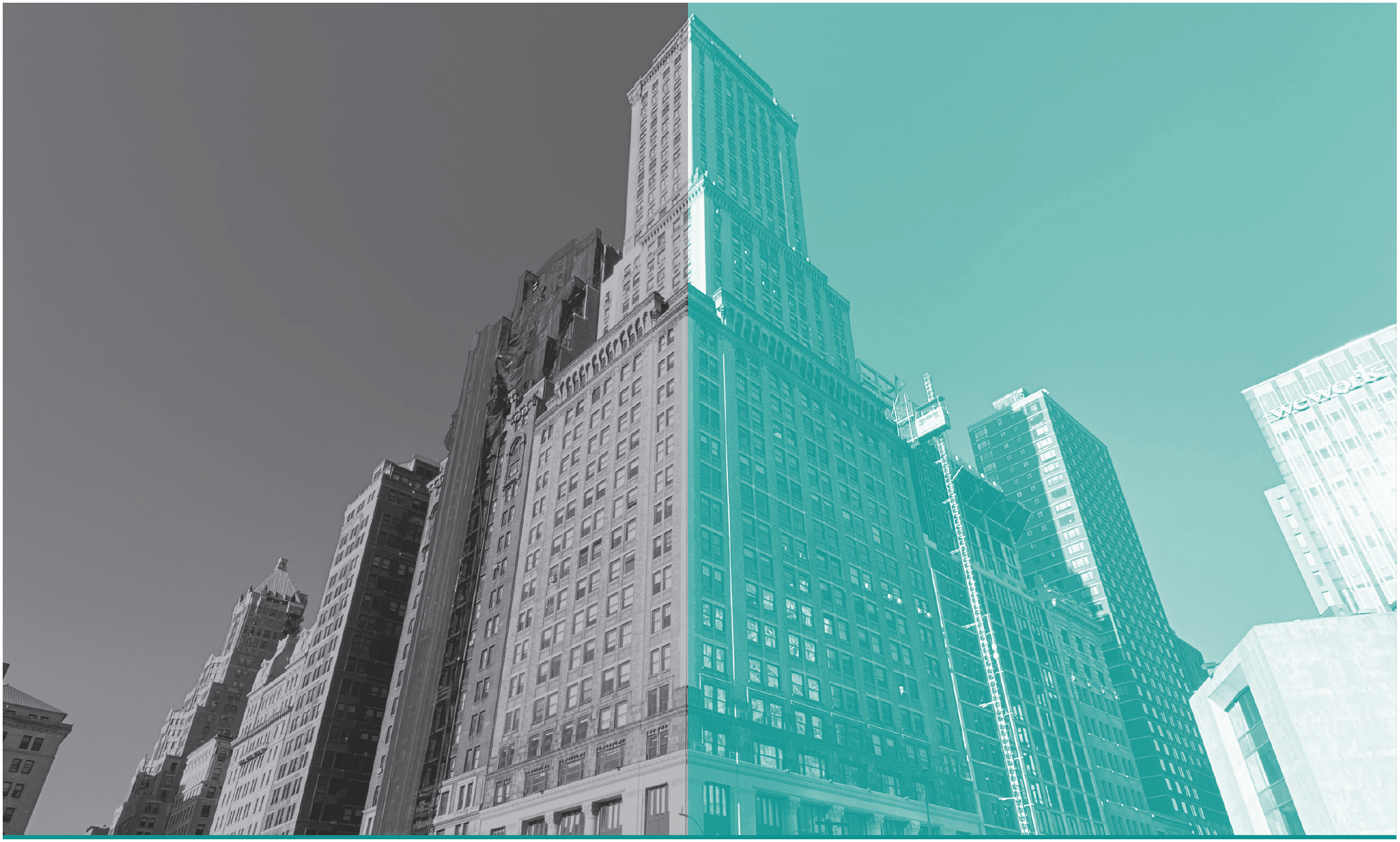
Crown Heights in Brooklyn is today’s Ground Zero for gentrification in New York City. A cultural crossroads in the city, Crown Heights is the traditional home to both the city’s Hasidim, as well as a large West Indian population, living on both sides of Eastern Parkway, a tree-lined Olmsted-era boulevard. An influx of real estate money has been rapidly changing the neighborhood over the past decade. Property prices are up, the price of rentals are through the roof, once-dilapidated rental buildings are getting glossy once-overs, and the community is steadily changing. As is the story in so many other urban centers, long-term Black residents are being replaced by wealthier, white occupants. Walking around any one block of Crown Heights, you will come across trendy coffee shops, bodegas, Section 8 apartments, and increasingly, luxury developments, all often a stone’s throw from each other.
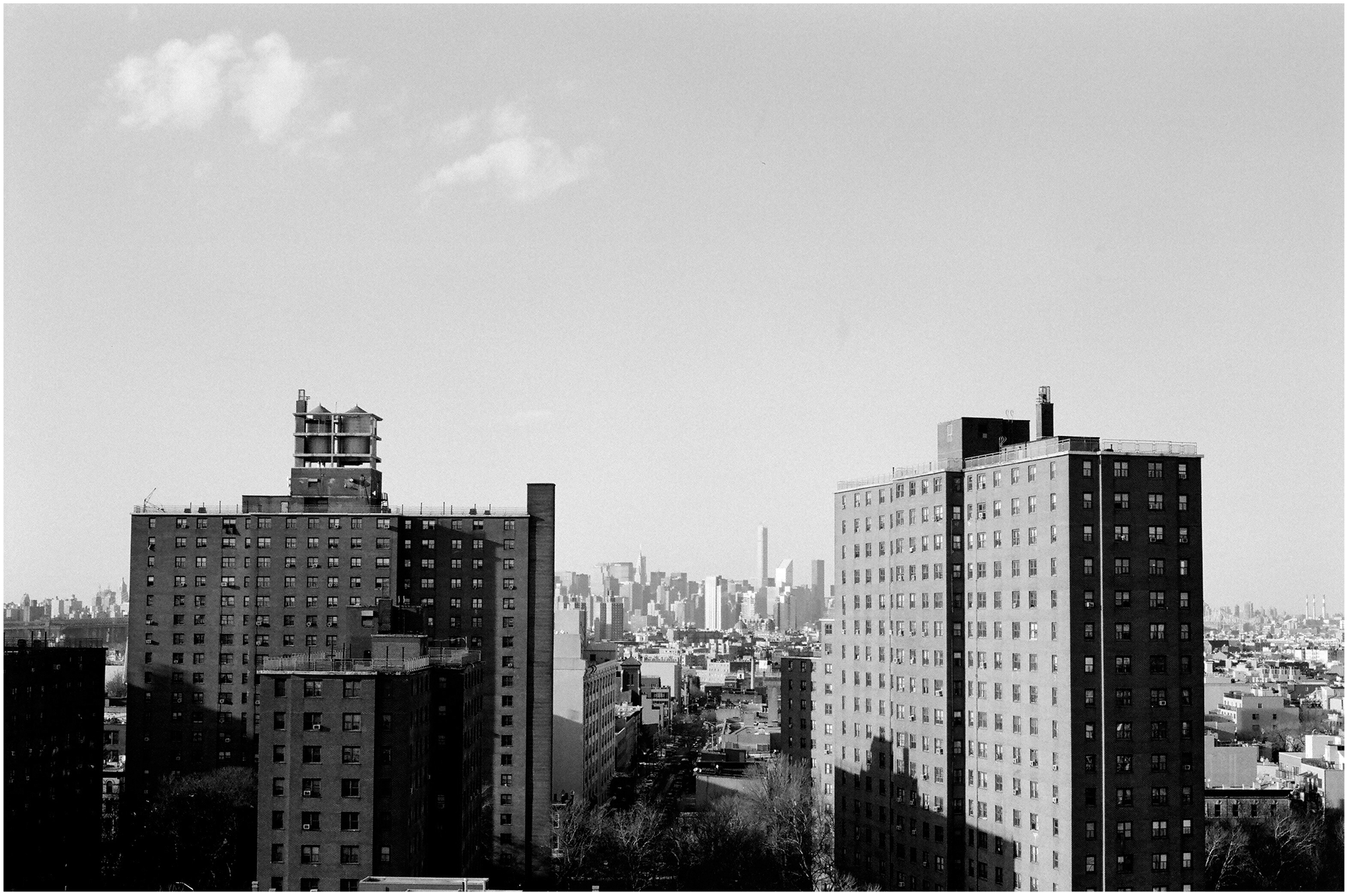
A view of the Manhattan skyline from a Brooklyn apartment.
Brandon Knickerson, Pexels
Less visible on a stroll through the neighborhood are the poor conditions of apartments inside some of those buildings. Neighborhoods in New York City like Crown Heights, Flatbush, the Southern Bronx, and other gentrifying areas with particularly “hot” real estate markets, are hotspots for poor housing conditions today. New York City has an alarmingly high concentration of poor housing conditions: at any one time, there are hundreds of thousands of open “code violations” in the city. The city issues a code violation when apartment conditions do not meet the habitability standards as defined in the municipal code. One apartment can have multiple code violations for each condition, and open code violations are violations that have not been rectified by the landlord. There is, on average, one open violation for every four private apartments.
Mapping city data on apartment code violations, we find that they are, surprisingly, concentrated in gentrifying areas and not just low-income neighborhoods. We usually associate derelict and abandoned neighborhoods with poor housing conditions, not “up-and-coming” ones like Crown Heights with its expensive bike shops. What our research, employing statistical analyses of municipal apartment code violation data and ethnographic observation of tenant struggles, would come to show is that gentrification, while bringing new amenities to neighborhoods, can also give strong incentives to landlords to mistreat tenants in an attempt to drive them out intentionally.
Over the course of a year, we followed tenant associations, neighborhood tenants’ rights organizations, city housing courts, and individual tenants in their struggles over housing conditions. To contextualize these ethnographic observations, we used municipal data on code violations to map geographic patterns of apartment conditions and used statistical analyses to examine the relationship between gentrification and housing conditions at the building level.
In trying to understand how all of this was experienced we came to know Damian, a young father who had grown up in Crown Heights. He was pushed out of his prized rent-stabilized apartment in 2016 by a landlord who used the deliberate lack of maintenance to get him and other rent-stabilized tenants out. Rent-stabilized apartments are a type of rent-regulated apartments in New York City. Unlike for market-rate units, the city decides on annual rent increases for rent stabilized units, and tenants are guaranteed automatic lease renewals for these units. There are over 900,000 such stabilized apartments in the city, making up approximately 45 percent of the total rental housing stock.
For three years, the apartment had a severe lack of heat during the winter’s coldest days and a steady deterioration of maintenance. Despite a series of complaints to the city, a court case, coverage by the media, and mobilization by tenants, conditions only got worse, and Damian moved out because he “couldn’t risk my kid’s life.” The problems were accompanied by not-so-subtle forms of harassment. Another parent of a young child in the building who left shortly after Damian received a text message after a formal complaint that said, “if you feel that you are living in dangerous or inhospitable conditions, you should move out.”
In 2020, the building, once full of working-class Black tenants, was occupied mainly by white, higher-income tenants. We were able to track down two of the available units at a luxury rental website. One of the renovated units was listed for rent at $2,700 a month; pictures show a sunny and beautifully-finished unit with new hardwood floors and top-of-the-line appliances.
This case goes to a central tension about how housing conditions and affordability are linked. In gentrifying neighborhoods, and in rent-stabilized units, in particular, we find that landlords systematically produce poor conditions to push long-term or low-income tenants out of buildings to bring in market-rate tenants or, in some cases, to develop the units into condominiums for sale. Policy and scholarly debates of gentrification have often circled questions of neighborhood improvements and displacement. Less attention has been paid to actively worsening conditions for residents who don’t leave and for whom poor housing conditions are a perverse consequence of gentrification.
Drawing on our ethnographic observations of building-level struggles and tenant organizing, we came to learn that it is not a question of landlords being unable to bear the financial burden of additional investments in rent-stabilized apartments, but that the lack of investment is a strategy integral to gentrification.
Rethinking Gentrification and Housing Conditions
There are two common economic arguments explaining inadequate conditions: (1) they reflect the economics of poverty or (2) they are a profit-maximizing strategy of landlords. The first argument suggests that landlords in low-income areas cannot improve conditions without increasing the costs of housing beyond what the local market can bear. That is, landlords of low-rent buildings operate on razor thin profits, and as such the costs of improvements would be passed onto tenants, likely making the apartments unaffordable. In this argument, inadequate conditions are a consequence of low-income tenants’ market power; they exchange poor conditions for lower rent. The second argument suggests that landlords may withhold maintenance as a way to cut costs for buildings that they hope to sell in the future at a higher price than what the market currently affords. For example, a landlord may withhold maintenance with the expectation that their neighborhood will gentrify, thereby ensuring a high sale price for their building even if it is dilapidated.
Our research seeks to understand to what extent these theories explain the core dynamics of inadequate conditions in New York City. The first argument around costs implies that we would only see a concentration of inadequate conditions in low-income neighborhoods. Still, we find that they are prevalent in gentrifying neighborhoods, mainly targeting tenants of color and those in rent-stabilized apartments, as Damian was in.
Theories about rent-controlled apartments predict that landlords will likely not invest in them because of profit considerations; it is linked to the argument around profit maximization but has a differing causal mechanism. The causal mechanism is that with below “market-rate” rents that are unlikely to increase, landlords cannot either afford to invest or have a lack of interest in investing in rent-controlled apartments due to the lack of rising profits.
Drawing on our ethnographic observations of building level struggles and tenant organizing, we came to learn that it is not a question of landlords being unable to bear the financial burden of additional investments in rent-stabilized apartments, but that the lack of investment is a strategy integral to gentrification. Until June 2019 landlords in New York City could increase the rent by 20 percent for stabilized units each time there was a change in the leaseholder, establishing a strong incentive for turnover in rent-stabilized units. By driving out long-term tenants, landlords could move closer to “market rate.” And as Damian’s case points to, landlords would withdraw services as a way to have long-term tenants move. As an organizer with a community organization working in Brooklyn explained, I did not understand what gentrification looked like on the ground until I started this work. Landlords don’t make repairs, they start noisy construction projects, turn the heat on and off as a way to get tenants out so they can bring apartments up to market rate. It’s rampant.”
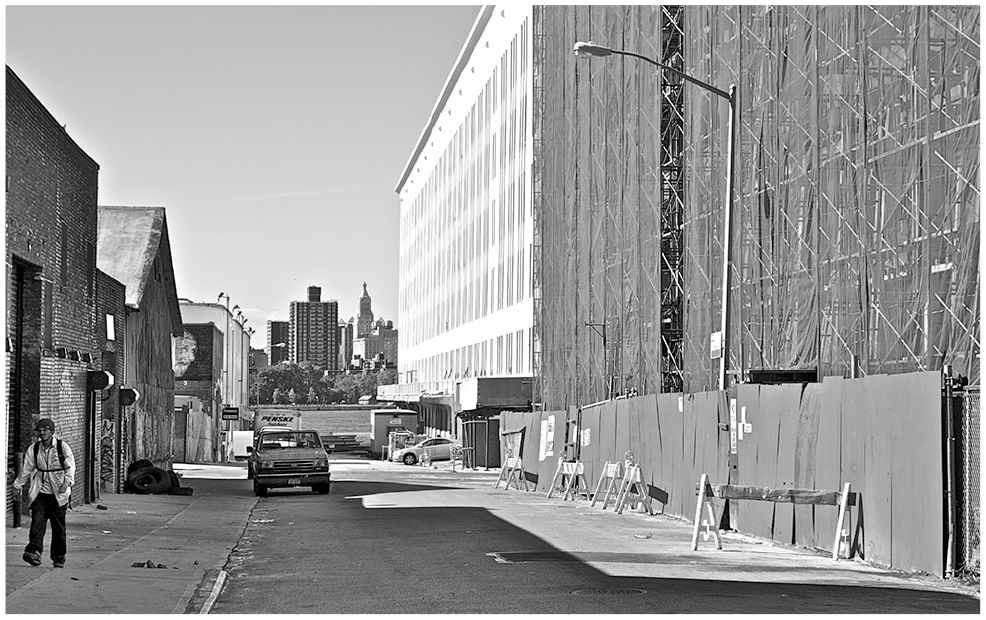
Gentrification in progress in Williamsburg, Brooklyn.
Gregory Donovan, Flickr
Damian’s landlord had effectively engaged in the tactics outlined above to push out three long-term families in the span of two years. Damian’s landlord is, in many respects, a typical slumlord—a relatively small landlord, owning nine buildings in low-income or gentrifying neighborhoods. At the time of this writing, the small, 32-unit building had 114 open violations, 31 of which were categorized as “class C,” meaning those posing an immediate hazard to residents.
This strategy is not just relegated to small-time slumlords—larger corporate landlords are just as guilty; corporate landlords refer to companies that manage multiple rental buildings. Just a few blocks from Damian’s building, Jean and Charles were engaged in a similar fight with their landlord. Jean, a Caribbean-American woman, had lived in her apartment for over 30 years, and Charles, a young white man, had been in the neighborhood for two years. Their landlord—a corporate landlord owning 63 buildings—had overseen the destabilization of over 150 units across their portfolio.
In Jean and Charles’ buildings (two connected buildings), out of the 32 units, only eight housed long-term tenants, and there was a visible disparity in conditions between the two sets of tenants. Longer-term, rent-stabilized tenants like Jean had significant complaints about conditions from ceiling leaks to pest infestations. The open violations in the building, at 126 in 2020, almost all originated from the eight remaining long-term tenants’ units. Newer tenants like Charles (who are more likely to be white) paying almost two or three times as much in rent (often because of illegal overcharges) had newly refurbished apartments. As is the case of these two buildings, tenants who face conditions issues are predominantly tenants of color. An independent report by the City Comptroller in 2014 found that over a third of Black rent-regulated households have substandard housing conditions compared to 16 percent of white rent-regulated households.
Just as jarring is that, as Jean pointed out, conditions for her and her neighbors worsened when her new corporate landlord took over the building. Throughout the 1980s and 1990s, when overall disinvestment by the city and private capital was high in Crown Heights, she had a secure home. And as the neighborhood improved, and conditions improved some in her building, the quality of her housing declined despite having a larger corporate landlord with resources to invest in the building.
What we find is not that rent control or rent stabilization incentivizes disinvestment, as classical economic theory argues. Instead, the tremendous private capital flowing into gentrifying neighborhoods has created profit incentives for landlords (from slumlords to corporate landlords) to disinvest from long-term tenants. This has created neighborhoods where public and private amenities attract well-heeled professionals priced out of Manhattan but still willing to pay high rent, and for whom a million-dollar condo in an “up-and-coming” neighborhood is an attractive option. For other tenants, particularly, long-term tenants of color, conditions have worsened, despite occasional building-level improvements. These dynamics have left the neighborhood dotted with buildings that have industrial chic lobbies and apartments with new stainless appliances as well as many units housing long-term tenants with inadequate heat, peeling paint or even collapsing ceilings.
The Janus-Faced State
These violations of housing conditions and open harassment fly in the face of laws and the apparent intent of local municipal government. New York, like many states, recognizes the implied warranty of habitability, which obliges landlords to provide safe living conditions in exchange for rent. The city of New York maintains what seems to be a proactive posture about tenant’s rights. Subway entrances and bus shelters in Crown Heights have prominent signs informing tenants of their rights. The city also maintains open databases on violations and even collects additional information on conditions that have been published in official reports. There are dedicated staff within the Housing and Preservation Department to investigate and enforce the housing code. Landlords that do not correct their violations, in addition to being fined, can find themselves on the “Worst Landlords” website organized by the City Advocate’s office.
Yet, judging by the aggregate data (and the very fact that there is a website that tracks landlords with literally hundreds of open violations), none of these mechanisms can stem the tide or even prevent landlords from brazenly violating codes. For tenants like Damian, Charles, or Jean, accessing protections around housing quality is at best, a difficult uphill battle. Political sociologists have long insisted that we do not take the state to be a unitary entity with a single underlying “logic.” To understand the impact of the actions of any one part, we need to understand all of its parts.
In New York City, unlike many other U.S. cities, there is a dedicated section of Housing Court where tenants can raise repair issues and sue landlords for violations, the infamous “HP (Housing Part) Court.” There, tenants can take actions individually or collectively against recalcitrant owners. We had heard many complaints about “HP Court”—tenants don’t often have legal representation, have to navigate a cumbersome and opaque process, and usually have to sacrifice wages to appear in court over and over, so in the course of our research, we followed several cases of tenants seeking remedy through legal means.
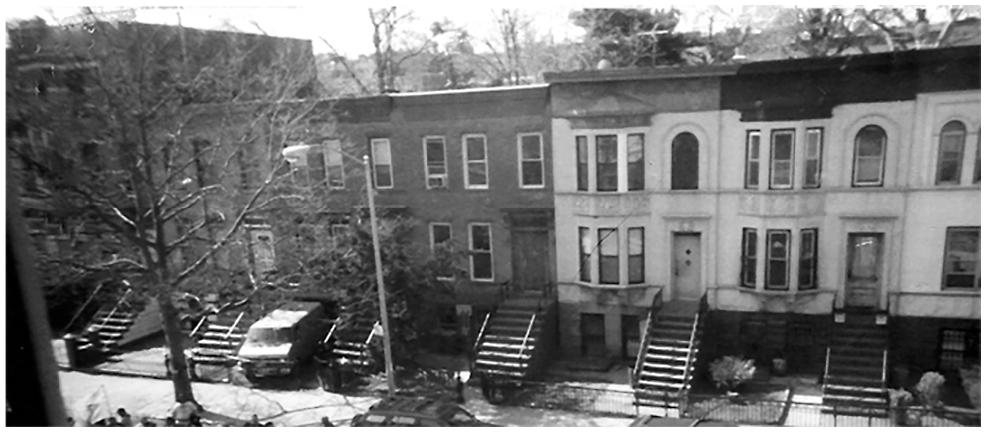
Row homes in Crown Heights, Brooklyn, the neighborhood where the authors conducted their study.
Wikimedia Commons
Rally for stronger tenant laws and repeal of laws favoring landlords and developers.
The All-Nite Images, Wikimedia
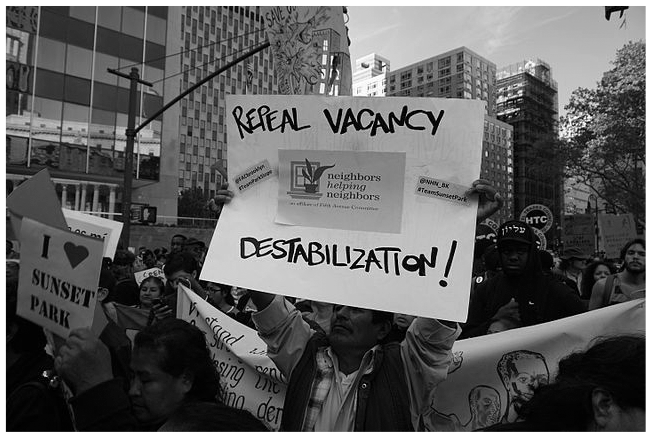
Our observations in Housing Court confirmed all of our worst expectations. In the drab, multistory courthouse in Brooklyn, there is only one small courtroom dedicated to HP actions, and the remaining courtrooms are dedicated to evictions. It was often filled with 40 or so tenants, the vast majority Black or Brown, waiting for three to four hours every morning to pursue repair complaints against their landlords. We often saw tenants waiting a whole morning or afternoon to be heard but having to return another day because of a procedural technicality. As cases were often drawn out by landlords’ lawyers, tenants found themselves at court multiple times to have the same complaint addressed. It was not uncommon for tenants to return to court to ask that a previous judgment be enforced.
As an organizer with a community organization working in Brooklyn explained, “I did not understand what gentrification looked like on the ground until I started this work. Landlords don’t make repairs, they start noisy construction projects, turn the heat on and off as a way to get tenants out so they can bring apartments up to market rate. It’s rampant.”
In Damian’s building, his tenant association had attempted a legal remedy. They successfully started a “group HP action” over the lack of heat a little over six years ago. They were able to secure free legal representation, itself not a trivial matter. They were well-organized, and by pursuing a heating case, they had a relatively straightforward and easy-to-document case.
It still took over a year and a half to litigate, despite having clear, incontrovertible evidence: city inspectors had measured temperatures that were below the legal minimum. The process was nonetheless drawn out. Tenants persisted and returned to court over and over, including over another winter, when the heat was still not turned on regularly. The story was picked up by local TV and print media that ran stories with stories like “Landlord of ‘worst buildings’ in Brooklyn only turns heat on for inspectors.” The case was eventually decided in favor of the tenants—the landlord was ordered to fix the heat, offer each tenant a $250 abatement in compensation for the months without heat, and pay the city a fine of nearly $1 million. Yet, in the five years after winning their court case, tenants have yet to receive the abatement, the landlord has not paid the fine, and tenants continue to have complaints about repair conditions in the building, including lack of heating. And more long-term tenants continue to leave.
Many tenants have complaints about the efficacy of the violations system to change landlord behavior, and numerous studies have outlined the limitations of the legal mechanisms associated with the implied warranty of habitability to change landlord behavior. A New York Times investigation in December of 2018, based on a sample of conditions cases, for example, found that, in more than two-thirds of cases, the city accepted settlements for less than 15 percent of possible penalties, with a median settlement of $4,000. And the actual collection rate on those fines was a small fraction of the settlement. A few thousand dollars’ fine (which may never be collected) pales before the profits to be had by tripling rent on one or a few units, let alone converting it to a luxury condominium for sale.
The Dangers of Market-Based Solutions
The housing crisis has become an unavoidable public issue nearly everywhere in the United States. From tent-cities in the Bay Area to debates about right-to-shelter laws in Los Angeles and ending zoning restrictions in Minneapolis, there is today consensus that the cost of housing, particularly the cost of rental housing for low-income tenants, has become an alarming problem. But prices, evictions, and the failings of public housing, which continue to dominate the headlines, are not the only concern of low-income tenants or housing advocates today. There is the fundamental question of the quality of housing, which has reached crisis proportions in New York City.
The New York City story is one where in the context of skyrocketing rents, a difficult city bureaucracy for tenants, and very few effective sanctions for landlords, the incentives are actually to produce poor conditions. Moreover, the distinction between market and non-market apartments has created perverse incentives to foster declining conditions for rent stabilized tenants. This has important policy implications and forces us to shift our thinking from older ideas that poor conditions result from solely urban blight and poverty. In that view, encouraging growth and investment is the solution to poor conditions. In today’s world, at least in “hot” real estate markets, this is likely to backfire and further incentivize bad behavior. Our research highlights the importance of policies to address the perverse effects of unfettered capital and profit-making in gentrifying neighborhoods.
Looking at it more broadly, responsibility also lies with policies like aggressive up-zoning of the city in recent years, permitting the construction of luxury buildings incentivized with tax abatements for developers, and conversions into condominiums. In this way, too, the push towards market-based solutions to the housing crisis seems dangerous and likely to hurt vulnerable tenants in the short term. Many of these programs operate under the assumption that landlords will hold up their end of the bargain. Today, one fashionable solution in gentrifying neighborhoods is mandatory inclusionary housing (MIH). MIH programs use re-zonings and the development of high-density luxury buildings to promise small set-asides for affordable housing. Opposition to these developments in New York is not from traditional NIMBY proponents but from grassroots tenants’ rights organiza- tions, who worry that MIH developments will continue to place upward pressure on property and rental values and lead to the secondary displacement of long-term tenants through harass- ment and lack of repairs. MIH developments in New York City often advocate for the construction of buildings with both luxury apartments and “affordable” apartments. Our research points to the dynamics of harassment likely awaiting tenants of the “affordable” apartment in such buildings.
Effectively addressing cases of vulnerable tenants, like Damian and countless others will also require concerted effort to increase enforcement agencies’ and court systems’ capacity and funding. These efforts could be improved, too, by the kind of big data monitoring that watchdog organizations like Housing Rights New York have begun to carry out.
But the question of incentives and penalties also needs to be put on the table. We need to consider policies that slow down speculation and reduce incentives for monitoring and enforcement to work. Already, the June 2019 victory by housing advocates de-regulating rent-regulated apartments more difficult in the state of New York was an important one. But it is likely not enough, and other tools will have to be considered, like universal rent control or ending tax-loopholes for real estate profits. An important example is New York State’s proposed Good Cause Eviction bill that protects tenants’ right to remain. As long as incentives are higher than penalties, we will continue to have the particular paradox of increasingly wealthy neighborhoods with deliberately poorly maintained apartments.
Our ethnographic data is not available to third parties, but our data on city-wide complaints and violations is available for sharing.