




Abstract
This book review describes an edited volume co-authored by the late Justice Ruth Bader Ginsburg and her former law clerk, Amanda Tyler.
The news of Justice Ruth Bader Ginsburg’s death on September 18h, 2020, jarred a nation in the throes of a global pandemic, a vitriolic presidential election season, and on the heels of a summer of racial justice protests. The public outpouring of grief was immediate and massive in scale. The same night that the news broke, an impromptu vigil sprung up outside the Supreme Court building in Washington, D.C., as masked mourners lit candles and consoled each other. Anguished posts and grateful tributes flooded social media. In the days that followed, Justice Ginsburg’s former law clerks traveled to Washington, D. C. to hold vigil as she lay in repose below the engraved words “Equal Justice Under Law.” Justice Ginsburg was also the first woman and Jewish person to lay in state at the U.S. Capitol. As thousands of visitors paid their respects, clerks stood in shifts day and night for two days, making a striking tableau of black suits against white marble.
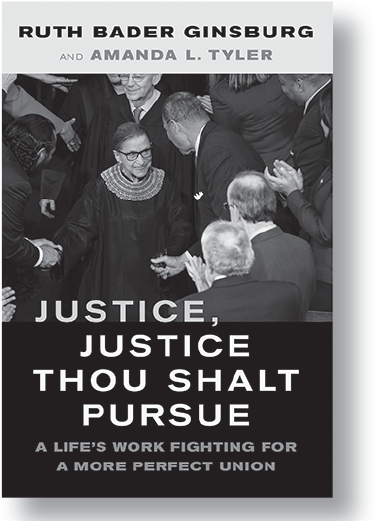
Amanda Tyler was one of those former law clerks. Now a law professor at the University of California-Berkeley, Tyler and Ginsburg had just completed Justice, Justice Thou Shalt Pursue when the justice succumbed to her fifth and final bout with cancer. (We learn that the book’s title is drawn from a Deuteronomy passage that Ginsburg hung on the wall of her Supreme Court chambers.)
Justice, Justice is an accessible collection of Ginsburg’s speeches, briefs, and opinions. It might be best described as a “greatest hits” volume, with some deep cuts back to before she became known as “the notorious RBG.” It also includes a selection of pictures from her life and her death. Probably because one of its authors is a law professor, the book has a more scholarly and measured tone than the fangirl classic Notorious RBG: The Life and Times of Ruth Bader Ginsburg by Irin Carmon and Shana Knizhnik, but it fits squarely alongside Ginsburg’s earlier book, My Own Words, which was a collection of her writings and speeches up to that date.
Justice, Justice is organized into several sections based on her work as a path-breaking attorney and then as a Supreme Court justice, where she served for 27 years. Throughout, we see that Ginsburg, though a trailblazer in her own right, never failed to pay tribute to those whose own trailblazing stories and support had inspired her. One of those individuals is Herma Hill Kay, one of the first women law professors with whom Ginsburg worked to help launch the field of gender discrimination law. (Kay’s testimony at Ginsburg’s Supreme Court confirmation hearing is also included later in the volume) After Kay’s passing, Ginsburg was the inaugural speaker in a lecture series named after her friend, and her speech opens the first section of the book. Ginsburg emphasizes the significance of Kay’s accomplishments in the law and the legal academy and how her family life and interests outside of the law shaped her in important ways. We see this emphasis in the whole person reflected in Tyler’s commentary about Ginsburg throughout Justice, Justice; that is, a person’s legacy is not just their professional accomplishments but also about the relationships that they nurtured and their passions (swimming and gardening for Hill, opera for Ginsburg). In a hard-driving field like law, where it can seem like work consumes every moment, this is an important lesson.
One of the central relationships highlighted throughout the book is Ginsburg’s relationship with her husband, Marty. As Ginsburg notes, “He was the first boy I ever dated who cared that I had a brain” (p. 31). We are given the transcript of Tyler’s interview with Ginsburg as part of the Herma Hill Kay Lecture. This is a must-read for anyone seeking a window into the justice’s formative years balancing child care, a sick partner, and Ivy League law school demands. When asked how to respond to students who ask her about balancing work and family, Ginsburg’s response is “choose a partner in life who thinks that your work is as important as his” (p. 39). We are regaled by touching stories of Marty’s devotion to Ruth and their children—as well as his “legendary” sense of humor.
The next section of the book contains materials that Justice Ginsburg selected to represent her time as an advocate for gender equality—including a legal brief co-authored with her husband (a highly regarded tax attorney) in Moritz v. Commissioner of Internal Revenue. (Readers may recall that this case was the basis of the recent film On the Basis of Sex, with Felicity Jones starring as Ginsburg.) Moritz offers a window into a key legal strategy that Ginsburg successfully used in many cases challenging gender discrimination. Namely, reliance on gender stereotypes was harmful to both men and women. Again and again, we see pushback against state and federal laws based on “overbroad generalizations about the different talents, capacities, or preferences of males and females” (UnitedStates v. Virginia, p. 121). As a woman in a male-dominated field, Ginsburg understood all too well how policies based on stereotypes handicapped those who defied those same stereotypes.
While the written arguments are informative, the transcripts of the Supreme Court oral arguments in Frontiero v. Richardson and Weinberger v. Wiesenfeld are even more illuminating. (Moritz was not heard by the Supreme Court.) Here we can see Ginsburg’s skill at framing the issues in a way that the all-male Supreme Court could understand. Indeed, her success rate in cases she argued—she won 6 out of 7—speaks volumes about her formidable persuasive skills.
The third section of Justice, Justice focuses on her time on the Supreme Court. Only one of these cases was Ginsburg in the majority (US v. Virginia, where she was assigned to write the majority opinion, striking down VMI’s all-male admissions policy). Perhaps in a nod to her reputation as a formidable dissenter (with a collar or two to match), the other three opinions are dissents. Among these, perhaps her dissent in the voting rights case Shelby County v. Holder is the most timely. We are provided both her full dissent and the bench announcement, which she read aloud at the time the decision was announced. For those unfamiliar with Supreme Court procedures, generally only the majority opinion is announced from the bench, with concurring and dissenting opinions published but not read aloud by the authoring justices. Therefore, when a dissenting justice opts to break from tradition and read their dissent from the bench, this signifies that a justice is especially displeased about the outcome of the case.
In Shelby County, Ginsburg writes passionately about the success of the Voting Rights Act (VRA) in combating the continuing problem of racial discrimination in voting. In her bench announcement, she describes the law as a rightful exercise of Congressional power to ensure “a voice to every voter in our democracy undiluted by race” (p. 169). At issue in the case was a provision known as “preclearance,” which required jurisdictions with a history of racial discrimination in voting to subject any voting changes to review by the Department of Justice and the federal courts. (This part of the VRA was struck down by the Court.) In the wake of the 2020 presidential election, where many Republican-controlled state legislatures have acted to restrict voting access, it is instructive to read the examples of similar actions taken by states and localities prior to the VRA’s reauthorization on bipartisan grounds in 2006 (p. 185). Ginsburg warns that “[t]hrowing out preclearance when it has worked and is continuing to work to stop discriminatory changes is like throwing away your umbrella in a rainstorm because you are not getting wet” (p. 6).
The book ends with a touching afterword by Tyler, written a month after Ginsburg’s death. She expresses what so many people felt; namely, that after everything else that Ginsburg had survived (discrimination, her husband’s cancer, her own bouts with cancer, her loss of Marty in 2010), she had expected Ginsburg to survive this last bout with cancer too. “It felt like a gut punch,” Tyler writes. Yet Tyler remains hopeful about the work that Gins-burg started and has inspired others to continue. She closes with a passage from Ginsburg’s Shelby County dissent, which quoted Martin Luther King, Jr: “‘The arc of the moral universe is long,’ he said, but ‘it bends toward justice,’ if there is a steadfast commitment to see the task through to completion.” It is our responsibility, says Tyler, “to take up this charge” (p. 266).
For those who share the late justice’s passion for dismantling inequality, Gins-burg’s life, as described in this volume, shares some important lessons. We see the value of forging strong mentor-mentee relationships, as in Ginsburg’s relationships with Herma Kay Hill and Amanda Tyler. And as Amanda Tyler told Melissa Harris-Perry on The Takeaway in October 2021, one of Ginsburg’s gifts was her ability to think about the long game, partly because of her expertise in legal strategy. Tyler observed that Ginsburg “understood, maybe we will only make progress incrementally. We’re going to have to do a bunch of cases to get where we want to go, but we’ll get there, and we’ll get there one case at a time.” It is instructive to remember that even small victories can help to build the foundation for something transformative. Because of the cumulative nature of legal precedent, those small wins can force the hand of later courts. While this approach requires a measure of patience, it does not mean that the advocate is less fearless in pursuing her radical goals.
Lastly, while Justice Ginsburg is recalled by those who knew her as an incredibly hard worker and a perfectionist, her life also serves as a reminder that we should not be so consumed with our work that we fail to cultivate meaningful relationships and other passions that can sustain us. To wit, Ginsburg’s marriage to Martin Ginsburg was truly a lifelong partnership of equals, and her love of opera was shared with her fellow justice and friend Antonin Scalia. The pursuit of justice can be draining, and we should not be apologetic about making time for joyful endeavors. Amid a pandemic, when work-life boundaries have become more blurred than ever, this lesson is a vital one for the next generations of activists and academics.