




Abstract
In Indigenous communities, knowing a missing or murdered Indigenous person is the norm, not an exception—a consequence of traumatic past and ongoing policies and practices. We summarize the history of North American governments– genocidal policies toward Indigenous Peoples and how these policies created and now perpetuate present-day institutions that exacerbate exposure to violence. We also describe survey data from a longitudinal study called Healing Pathways, arguing that we must create a society in which resilience is not necessary for survival.
Indigenous women are murdered at rates ten times the national average in some parts of the United States. Interior Secretary Deb Haaland has described this violence as an “epidemic.” Indigenous women residing in Canada face similar threats, where a national report concluded that Canada had committed and is continuing to commit genocide against Indigenous Peoples. In 2019, Canada published results of its National Inquiry into Missing and Murdered Indigenous Women and Girls, an endeavor that collected stories and testimonies from survivors and family members over many years.
As of this writing, Canada has not addressed the majority of the report’s findings. In the United States, meanwhile, there are no concrete plans to fully fund an independent national inquiry into the United States’ treatment of Indigenous Peoples.
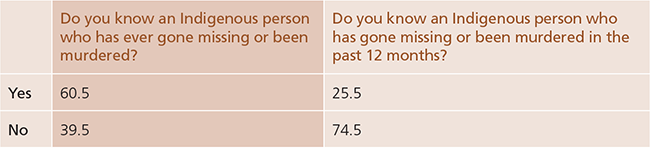
In 2019-2021, we also asked participants if they knew an Indigenous person who had gone missing or been murdered. Three out of five answered yes.
Below, we summarize the history of four examples of North American federal governments’ genocidal policies toward Indigenous Peoples and how these policies created and now perpetuate present-day institutions that exacerbate exposure to violence. Then we describe survey data from a longitudinal study called Healing Pathways that includes data from Indigenous young adults in the northern Midwest United States and Canada. The study focuses on Indigenous pathways of development and includes questions about missing and murdered Indigenous women, girls, trans people, and Two-Spirit people (MMIWGT2S). These narratives emphasize the resilience of Indigenous Peoples. However, we argue that we must move beyond resilience— we must create a society in which resilience is not necessary for survival.
Past Policies Influence Present-Day Exposure to Violence
Jurisdictional Confusion
Past legal decisions have shaped the complex jurisdictional barriers to justice for missing and murdered Indigenous people. In 2018, the National Congress of American Indians published a progress report on the Violence Against Women Act (VAWA) that described the various negative ramifications of legal decisions that VAWA attempted to correct. The 1978 Supreme Court case Oliphant v. Suquamish determined tribal nations could not prosecute non-Indigenous people on their lands. Another example was the enactment in 1953 of Public Law 280 that transferred legal power from federal to state authorities in certain states.
In 2019, Canada published results of its National Inquiry into Missing and Murdered Indigenous Women and Girls, an endeavor that collected stories and testimonies from survivors and family members over many years.
The Mandate of the National Inquiry
Both federal legal decisions limited tribal nations’ sovereignty. The Sovereign Bodies Institute and Brave Heart Society published a report in 2019 showing the likelihood of solving MMIWGT2S cases varies based on jurisdiction: 90 percent of unsolved cases and 92 percent of cases in which an alleged perpetrator was either acquitted or not charged were in non-tribal (federal, state, county, or city) jurisdictions. Non-tribal legal decisions have failed to protect and provide justice for Indigenous Peoples.
The National Congress of American Indians report notes that VAWA attempts to address the injustice through a provision that authorizes tribal courts to prosecute non-Indigenous persons on tribal lands. Unfortunately, the provision is limited in scope and difficult to put into practice.
Ecocide
Attacks on land and environmental sovereignty were core tactics in the brutal colonization of North America. The destruction of ecosystems, such as the hunting of bison to near extinction and the diversion of water away from Indigenous nations, occurred in tandem with the genocide of Indigenous Peoples.
Past legal decisions have shaped the complex jurisdictional barriers to justice for missing and murdered Indigenous people.
Tingey Injury Law Firm, Unsplash
Ecocide continues today via oil pipelines and fracking sites. Recent pipeline construction and fracking sites are disproportionately placed on or near tribal lands. Increased violence and sex trafficking are likely due to the influx of non-Indigenous workers who perpetuate this violence. Research and interviews—such as those by Brandi Morin of Al Jazeera in 2020—document this link between environmental extraction and the MMI-WGT2S epidemic.
In particular, the Sovereign Bodies Institute and Brave Heart Society published a report in 2019 showing an increase in sexual assault, sex trafficking, and violence against Indigenous women and children during the construction of the Keystone XL Pipeline in the Northern Plains region. However, jurisdictional complexity creates barriers for survivors to obtain justice, meaning perpetrators are rarely held accountable for their crimes.
A heartfelt photo that can be found on the Indigenous Kinship Collective’s website homepage.
Indigenous Kinship Collective
Forced and Coerced Sterilization
Government policies not only condoned violations of land and sovereignty but also violation of Indigenous people’s bodies. As Brianna Theobald described in her biography of Susie Walking Bear Yellowtail, government-run reservation hospitals were known for abuse and for not obtaining consent. Language, cultural barriers, and intentional miscommunication assisted doctors in coercing consent for sterilizing procedures. Government physicians challenged Indigenous women’s reproductive autonomy when they performed medical operations and performed sterilizations without obtaining consent. Official reports likely underestimate the number of sterilizations by a significant amount, as some women did not know they had been sterilized. Even so, a landmark review article by Jane Lawrence in 2000 noted that various studies estimated between 25-50 percent of Indigenous women had been sterilized during the 1970s. These experiences left Indigenous women feeling violated, outraged, guilty, and afraid of going back to government-run hospitals.
We call on the U.S. federal government to honor its trust and treaty obligations to the original inhabitants of these lands by allocating funding and other resources to conduct a national inquiry into the MMIWGT2S crisis.
Stereotypes and Racism
Distorted and racist media representation is one facet of the larger hyper-sexualization and dehumanization of Indigenous women for the purpose of colonization. These processes perpetuate negative stereotypes that are used to justify violent acts against Indigenous people.
According to the Reclaiming Native Truth project published in 2018, a barrier to Indigenous wellbeing is discriminatory or non-existent media coverage and invisibility that can affect how law enforcement and government respond to crises. When media does report on cases, it often discriminates against the Indigenous person. The final report of the Canadian National Inquiry described the vilification of victims in the media, and the Urban Indian Health Institute published a 2019 report describing similar media treatment in the United States. The latter report concluded that roughly a third of media coverage used violent language toward MMIWGT2S victims including racial stereotyping, misgendering, victim-blaming, excusing perpetrators, false information, and widespread use of images and/or videos of the victim’s death.
Healing Pathways Study
With these policies and practices in mind, we turn to a discussion of MMI-WGT2S-related findings from the longitudinal Healing Pathways survey study. Healing Pathways (HP) is a community-based participatory research collaboration between eight reservation and reserve communities in the northern Midwest United States and Canada and Johns Hopkins University Center for American Indian Health, Great Lakes Hub.
HP aims to better understand risk and protective factors that influence well-being across generations in Indigenous families by examining health, mental health, and substance use patterns and predictors over the early life course.
These narratives emphasize the resilience of Indigenous Peoples. However, we argue that we must move beyond resilience—we must create a society in which resilience is not necessary for survival.
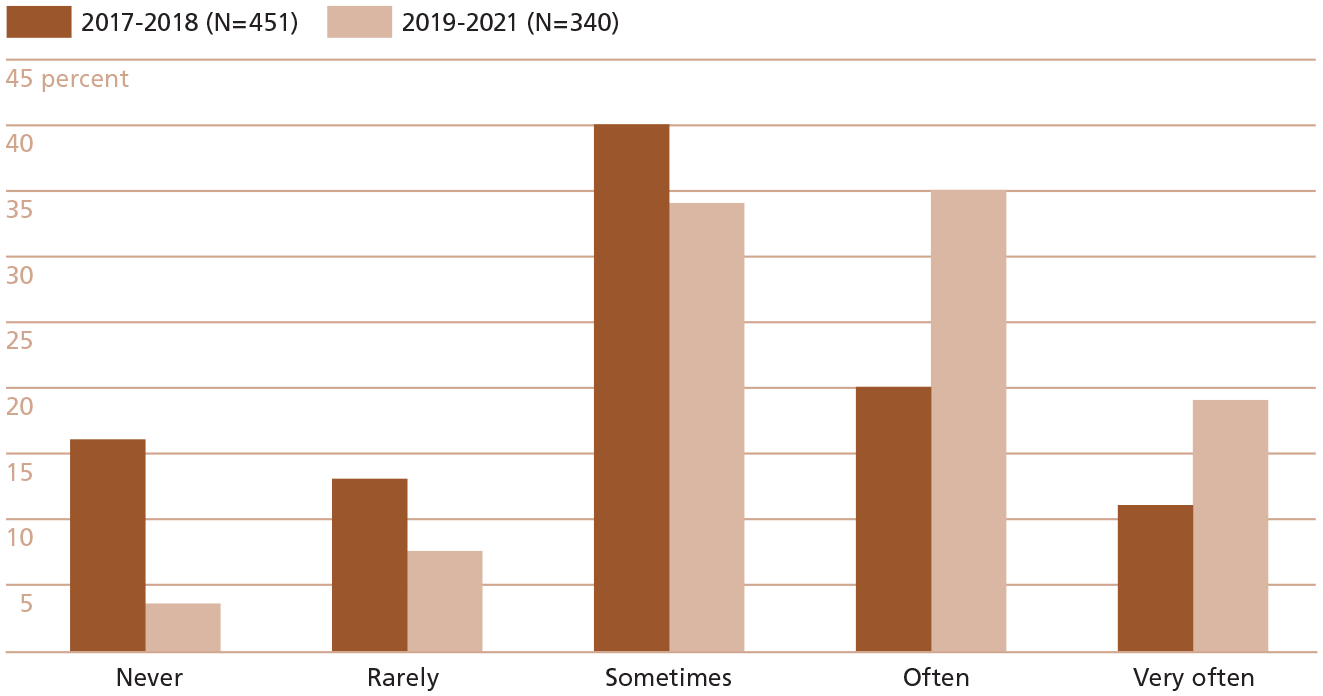
Frequency of worry about missing and murdered Indigenous persons.
Frequency of worry about becoming a missing or murdered Indigenous person.
Percentage of participants (N = 337) in 2019-2021 who reported knowing an Indigenous person who has gone missing or been murdered.
A total of 735 children aged 10-12 years and at least one of their adult caregivers participated in the first round of data collection in 2002. Additional interviews with the participants and their caregivers took place over eight consecutive years. After a several year hiatus, the study re-interviewed the original youth participants, beginning in 2016 and continuing until 2021 (adult caregivers did not participate in surveys after the hiatus). At the request of select tribal communities, the HP team included questions pertaining to the MMIWGT2S crisis in surveys administered in 2017-2018 (wave 9 of data collection) and 20192021 (wave 11).
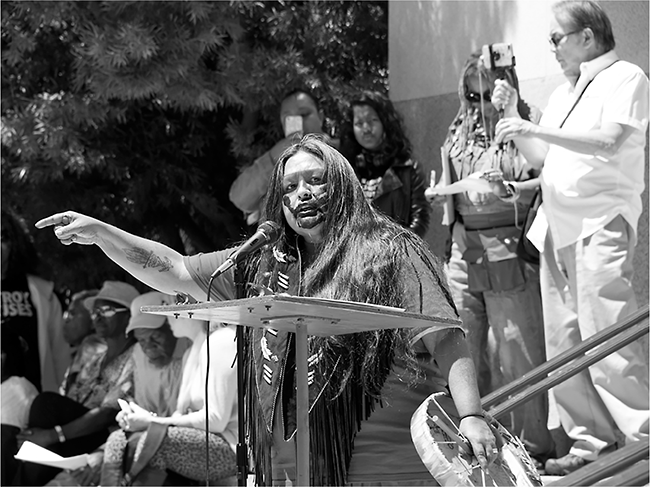
Activist speaking at a No More Stolen Sisters rally in 2018.
Peg Hunter Flickr cc
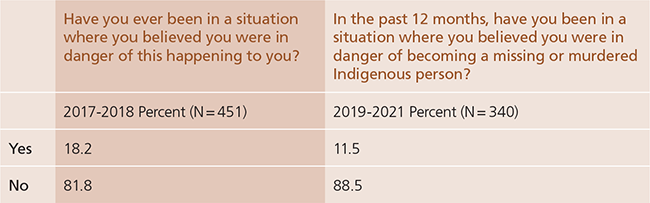
As shown in Figure 1, 70.7 percent of participants in 2017-2018 and 88.8 percent of participants in 2019-2021 worried at least sometimes about Indigenous missing and murdered persons. Notably, the percentage of those who worried “very often” about Indigenous missing and murdered persons nearly doubled from 2017-2018 to 2019-2021, from 10.6 percent to 19.4 percent. And as shown in Table 1, 18.2 percent of participants in 2017-2018 reported being in a situation where they believed they were in danger of becoming missing or murdered in their lifetimes. In 2019-2021, 11.5 percent reported being in that situation during the past 12 months.
In 2019-2021, we also asked participants if they knew an Indigenous person who had gone missing or been murdered. Three out of five answered yes (Table 2). One quarter knew an Indigenous person who had gone missing or been murdered in the past 12 months.
Conclusions
Indigenous Peoples in North America have survived and continue to survive genocide. Data demonstrate that for a sample of Indigenous young adults, the MMIWGT2S crisis is a common source of worry. Knowing a missing or murdered Indigenous person is the norm, not an exception—a consequence of traumatic past and ongoing policies and practices.
A story of resilience emerges by weaving the threads of historical and present-day narratives. But we long for a world in which resilience is not necessary. We long for a world in which we share stories of survivance, a term coined by Anishinaabe scholar Gerald Vizenor to describe a thriving life. We call on the U.S. federal government to honor its trust and treaty obligations to the original inhabitants of these lands by allocating funding and other resources to conduct a national inquiry into the MMIWGT2S crisis.
Such an inquiry is a critical first step in acknowledging, reckoning with, and healing from the nation’s genocidal history.