



Abstract
Articulating the dangers and the possibilities of decolonization, Frantz Fanon’s The Wretched of the Earth, loomed large over African studies in the 1960s and 1970s. With its arousing language, its gripping descriptions, and its compelling argument, it traverses seamlessly between the psychological and the structural, between alienation and domination. Yet, it passes lightly over the connecting tissue, the social processes that are the entry point for ethnography. In this essay, the author sketches Fanon’s theory of decolonization, how it shaped one of his ethnographies of postcolonial Zambia, and ends with reflections on its significance today.
The The Wretched of the Earth by Frantz Fanon Grove Atlantic, 320 pp.
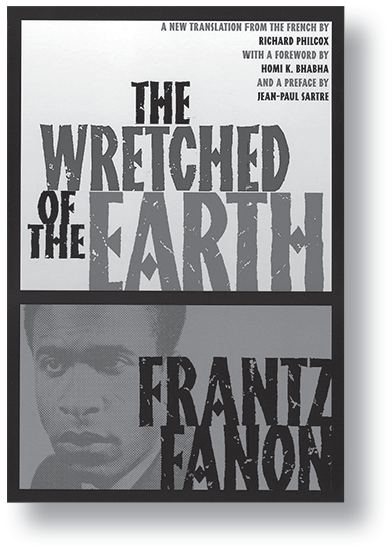
Articulating the dangers and the possibilities of decolonization, Frantz Fanon’s The Wretched of the Earth, loomed large over African studies in the 1960s and 1970s. With its arousing language, its gripping descriptions, and its compelling argument, it traverses seamlessly between the psychological and the structural, between alienation and domination. Yet, it passes lightly over the connecting tissue, the social processes that are the entry point for ethnography. In this essay, I sketch Fanon’s theory of decolonization, how it shaped one of my ethnographies of post-colonial Zambia, and I end with reflections on its significance today
Frantz Fanon was born in 1925 into the aspirant Black middle class of the French Caribbean colony of Martinique; he died in 1961 of leukemia, fighting against French colonialism in Algeria, on the eve of independence. At his lycée Fanon came under the spell of the Martiniquan poet, politician, and philosopher of Negritude, Aime Cesaire. Fleeing the Vichy occupation of Martinique, at the age of 18, Fanon fought in the French Free Army during World War Two. After the war, he returned to Martinique, only to soon leave again for Lyon, where he would acquire a medical degree in psychiatry. In 1953 he transferred to a post at Algeria’s Blida-Joinville Psychiatric Hospital. Appalled by the psychic trauma of colonial violence experienced by his patients—Black and White—he joined the FLN (National Liberation Front) in the struggle for independence. He was expelled from Algeria in 1957 for his political activities, settling in Tunis as FLN’s ambassador in West Africa. He died four years later, but not before completing The Wretched of the Earth, bible of liberation movements not just in Africa but across the world, influencing such notable figures as Ali Shariati in Iran, Steve Biko in South Africa, Paulo Freire in Brazil, Che Guevara in Cuba, and Malcolm X and the Black Panther Party in the United States.
As the revolutionary optimism of the 1960s has given way to varieties of Afro-pessimism, Fanon has become better known for his first book, Black Skin, White Masks (1952), psychoanalytical reflections on Black responses to racial domination in France. Whether by speaking better French or through inter-racial partners—every attempt to escape racial domination condemns one Black immigrant to recapitulate and consolidate racial domination. Blackness is framed by and against whiteness. If Black Skin, Whites Masks posed the problem of transcending racism, The Wretched of the Earth offered a solution: the violent overthrow of colonialism could unleash collective energies for social transformation.
However, The Wretched of the Earth was far more than a revolutionary tract. Written when most of Africa was still under colonial rule, it was a prophetic account of divergent roads out of colonial domination. To that end, it was a class analysis of racial subjugation that stood The Communist Manifesto on its head. Marx and Engels regarded the industrial working class as the revolutionary class while the peasantry, in Marx’s famous words, was a sack of potatoes; in Fanon’s view, it was the reverse—the colonial working class was a relatively privileged class interested at best in reform, while the dispossessed peasantry, unified by its shared relationship to land, was the revolutionary class. They, not the working class, had nothing to lose but their chains.
For Marx and Engels, revolutionary impetus advanced through inclusionary exploitation, while for Fanon it advanced through exclusionary dispossession. Indeed, many Third World Revolutions -China, Vietnam, Cuba—were made by a dispossessed peasantry. While Theda Skocpol’s classic States and Social Revolutions reduced the French, Russian and Chinese revolutions to a single “classical” type in which peasant revolt was essential to each, Fanon insisted on the African Revolution as a distinct product of the colonial context.
He discerned two routes of decolonization: a national bourgeois road (NBR) animated by an emerging Black bourgeoisie (made up of civil servants, teachers, lawyers, small traders) and a national liberation struggle (NLS) driven by a volcanic peasantry becoming organically connected to dissident intellectuals expelled from the towns, who gave programmatic direction to insurgency. If the NBR was concerned with the replacement of White by Black, a reformist road in which the class structure remained unaltered, only changing the color of its incumbents, the NLS led to the overthrow of the colonial class structure and the inauguration of a socialist order. Fanon waxes lyrical about the possibilities of democratic socialism through the inclusive and enthusiastic participation of all.
Although I have found no evidence that Fanon knew of the great Italian Marxist, Antonio Gramsci, nonetheless, The Wretched of the Earth can be read as combining the elements of Gramsci’s theory of revolution. If the overthrow of colonialism required a violent, cathartic, unifying “war of movement”—only such a violent assault against the barricades of colonialism could overcome external as well as internalized oppression—the construction of a postcolonial order called for a “war of position,” a struggle for hegemony between the NBR and the NLS.
The outcome depended on the constellation of class forces among the colonized. Fanon was convinced that the working class would throw its weight behind the emergent Black bourgeoisie forming an urban bloc that would follow the NBR. But where would the vacillating classes stand? The so-called “lumpen-proletariat” (dispossessed of land, finding themselves unemployed or working episodically in the informal sector, living in peri-urban shanty towns) was an uprooted group, easily bribed into supporting one side or the other. The tribal chiefs, responsible for administering colonial indirect rule, were reformist by position if not by nature. However, how could they maintain their legitimacy with their insurgent followers? The struggle for hegemony and thus the direction of the postcolony would be resolved through the political articulation of class forces with limits set by objective economic conditions.
Unlike Gramsci who saw the War of Movement succeeding or preceding the War of Position, Fanon saw them as coinciding: even as the colonial order was being overthrown through violence, the direction of postcolonialism was being shaped by class struggles among the colonized. Still, there were ambiguities here, especially the temporal sequencing of the NBR and NLS. Do they represent a fork in the decolonization road, or does the NLS follow the NBR? Fanon left this question to future theorists and strategists of the African Revolution.
Fanon’s vision of the “necessity” of the NLS followed from his pessimistic diagnosis of the NBR—that it would follow a reactionary trajectory, from initial adoption of liberal democracy, to the development of a one-party state, to a dictatorship. Under the NBR, the postcolonial economy would be unable to extricate itself from a peripheral place in global capitalism. It would not be able to deliver the economic concessions necessary for the survival of liberal democracy. He saw the national bourgeoisie as an appendage of the metropolitan bourgeoisie and the descent toward dictatorship inevitable.
The colonial persists despite appearances to the contrary, it continues to unravel inside the postcolonial.
Fanon’s warning about the dangers of the NBR, made the NLS that much more urgent but not necessarily more feasible. Fanon understood the threat of international capitalism but considered its dependence on African raw materials and consumer markets as giving postcolonial countries the leverage for autonomous development and even reparations. Still, in the final analysis, he argued, the African Revolution would depend upon the Western working class deciding to “wake up, put on their thinking caps, and stop playing the irresponsible game of Sleeping Beauty.” Without support from the Western working class, Fanon’s optimism about the NLS would, therefore, never be seriously put to the test—where it was tried, as in Algeria, the revolutionary road involved violence that did not cease but intensified with independence. Western powers were not tamed; to the contrary, they could be very effective in subverting socialist projects and forcing former colonies into the NBR straight jacket.
Today many reject Fanon’s theses for their utopian/dystopian quality. However, in the early years after independence, the 1960s, when optimism for a new order was high, Fanon’s ideas inspired such prominent Africanist scholars as Immanuel Wallerstein, Giovanni Arrighi, Issa Shivji, John Saul, Walter Rodney, and Samir Amin. The Wretched of the Earth became foundational to the common sense of Marxist social science, especially on the African continent. Like The Communist Manifesto, its political power lay in its generality: its indictment of the inextricable connection of colonialism and capitalism along with an imperative and a prescription for constructing socialism. With the scarcity of socialism, however, Marxist theory has often turned to the dissection of the different species of capitalism, so, in the same way, Fanonian theory must dissect the different species of the NBR.
Just as England stood in for the historical narrative of The Communist Manifesto, Algeria stood in for colonial context of The Wretched of the Earth. Algeria, however, was a “settler” colony based on agricultural exports, very different from the “administered” colony of Northern Rhodesia, named Zambia after independence, where I did my research. Zambia was and continued to be an “enclave” economy in which copper provided 95 percent of its export revenue, giving enormous power to Anglo American and Roan Selection Trust, the two multinationals who owned the mines. Zambia’s class structure was very different from Algeria’s—the settler element being far weaker and international capital much stronger. This would require the reconstruction of Fanon’s theory of decolonization.
It was 1968, four years after independence, that I arrived in Zambia penniless. Jack Simons, celebrated social scientist and long-standing member of the South African Communist Party, forced into exile by the apartheid regime and soon to be one of my teachers, suggested I try to get a job in the copper industry. We know about the working class, he said, but little about the way the mining companies are responding to Zambian independence. Fresh out of college, with a degree in mathematics, I duly got a job as a researcher in the mining companies’ Personnel Research Unit (PRU) in Kitwe, the main town on the Copperbelt. I was strategically placed to observe negotiations between unions, mining companies, and government.
As a covert participant observer, I soon learned something I would never have learned from the outside, that these multi-national companies did not follow a “strategy” with respect to the new Zam-bian government but simply sized up the situation daily and made decisions accordingly. In a context of uncertainty—the fluctuating price of copper, the vagaries of underground mining, and political instability—flexibility was the name of the game. It was said that President Kaunda and Harry Oppenheimer, then chairman of Anglo American, agreed to nationalize the mines on a golf course in Lusaka. I was observing the processes behind Fanon’s taken-for-granted relation between the ruling class and foreign capital.
While I was working in the PRU, one of the more contentious issues under negotiation was the integration of Zam-bian and expatriate pay scales and the allied process of “Zambianization,” the replacement of expatriate managers and professionals by Zambians. According to a congratulatory government report from 1968, Zambians were taking over expatriate positions and the number of expatriates was falling. These figures hid a stark reality: instead of Zambianization proceeding from top down, as occurred in government, in mining, it proceeded from bottom up. As a researcher on the spot I saw how the “forced succession” of Zambians led to the promotion of the displaced expatriate into newly created positions to “oversee” his Zambian successor. Alternatively, an entire department, such as the Personnel Department, would be Zambianized even as its power was diminished by denying it authority over expatriates. That authority was surreptitiously passed on to a previous (White) personnel manager.
From the outside everything seemed to be going smoothly, but from the inside, I saw the retention of the colonial color bar, the rule that no White should receive any orders from a Black. The reproduction of the color bar seemed not only immoral; it also generated tensions that reverberated through the organization as Black subordinates would get frustrated with their new Zambian supervisor who was stripped of crucial resources that had traveled upwards with his White predecessor. There’s nothing worse than a diminished supervisor, who in compensating for his limited powers may try to lord it over his subordinates, also advertising his status with conspicuous consumption. All of which led both Zambian subordinates and the White managerial class to denigrate Zambian successors as incompetent, confirming racial prejudices inherited from the colonial period.
Why the organizational manipulation to preserve the dominion of White expatriates? Following Fanon I assessed the balance of class forces perpetuating the racial order. The emergent Black bourgeoisie had an interest in displacing expatriate managers, but unskilled workers and their unions, along with the expatriates themselves, had little interest in Zambianization. As for the mining companies, one might have expected them to be interested in employing cheaper Zam-bian personnel. But instead they adapted to the political circumstances, taking the lead from the Zambian government.
I was left wondering why the Zam-bian government would assent to the reproduction of the colonial racial order? Wasn’t racial justice the goal of the United National Independence Party (UNIP)? Wasn’t the raison d’etre of the anti-colonial struggle to bury the colonial order? Following Fanon, the answer turned on the class interests of the new Zambian elite. The ruling party did not want to risk the all-important foreign revenue upon which it depended. It had more faith in expatriate expertise than in Zambians with their limited experience and education. Even when the mines were nationalized the government gave the mining companies the management contract. Additionally, the ruling party did not want to risk the formation of an opposition party, based on control of a precious national resource; better to have expatriates on three-year contracts running the mines.
This account fits Fanon’s NBR to a tee: the replacement of White by Black, dependence on revenue from international capital, and the concentration of UNIP’s power—but at the cost of a bloated management structure, disruptive conflicts, and continuing racial domination. Ching Kwan Lee’s The Specter of Global China, an extraordinary ethnographic revisit to the Zambian copper industry four decades later, tells of the tragic denouement of the NBR, but what of other spheres of the postcolonial?
At first sight, student rebellion at the new University of Zambia may have appeared as part of an NLS but, as I showed in a second ethnography, it was an intra-racial, inter-generational struggle over succession. Although students might cloak their antipathy to incumbent Black leaders in a radical idiom, they were an aspirant elite seeking to replace an entrenched elite. Finally, in a third study I show how political science, here represented by Robert Bates, supported the NBR by endorsing ruling class ideology with erroneous claims about working-class “slothfulness,” and “indiscipline,” thereby consolidating the colonial mythology of the “lazy native.” The colonial persists despite appearances to the contrary, it continues to unravel inside the postcolonial.
Reflecting back on the last 50 years of African decolonization, the tortured path of NBR has been all too common while the adoption of socialism in Algeria or in such poor countries as Tanzania and Mozambique has had limited success. With its advanced industrial economy, much hope was focused on South Africa. There were good reasons for this. In contrast to the Zambian labor aristocracy, South Africa’s working class had a long history of militant struggles, propelled by powerful trade unions in association with the African National Congress (ANC) and the Communist Party (SACP). The ANC’s Freedom Charter contained a socialist platform of public ownership and democracy. There were struggles in the rural areas but they never reached the proportions of the strikes, stay-aways, boycotts of the urban working class. Surely here was an exception to Fanon’s theory?
Indeed, the 1990s witnessed the dismantling of apartheid, but the past would not disappear. Although the 1994 elections catapulted the ANC into power, institutional racism persisted; although public housing, social grants, and education expanded, these welfare projects were accompanied by the privatization of public enterprises. Socialism was put on hold as the ANC struck a deal with White capital, resulting in wealthy Black elites becoming the public face of corporate South Africa. The National Democratic Revolution had not only suspended but hijacked the socialist project, and South Africa sputtered along the NBR, displaying many of its pathologies. A disempowered socialist opposition weaponized Fanon against the self-aggrandizing national bourgeoisie.
As a theory of revolution, The Wretched of the Earth traveled to countries for which it was never intended— portending a liberation struggle for the excluded wherever they may be, including the United States. This was not Fanon’s agenda: he contrasted the African Revolution with a more orthodox view of working-class revolution in the West. He never anticipated the inspiration he gave to the Black Panthers, cultivating socialism within African American communities. In the end, the radical elements within the civil rights movement would be vanquished. A modified NBR prevailed as Black Power came to mean affirmative action or, more recently, even a militant anti-racism.
Fanon was only able to anticipate the tragedy of postcolonial Africa by postulating a democratic socialism, giving him the prophetic vision of what accepting the terms of capitalism would mean for Africa. Fanon’s broad appeal dissipated not just with the dismal trajectory of Africa, but with the ascent of neoliberalism discrediting the very idea of socialism, aided and abetted by the death of the Soviet Union. When it was alive, whatever its defects, the Soviet Union competed with Western capitalism for political allegiance the world over, extracting political and economic concessions at home and abroad. With the Soviet Union a distant memory and China becoming state capitalist, liberal capitalism has been unmoored, unrestrained in its devastation, tangling with its own death instinct.
It is as if the whole world has taken the NBR and become Africa writ large. Under the aegis of finance capital with roots in the West, there developed dependent nation bourgeoisies organizing states that strive to contain eruptions of an uprooted peasantry and expanding lumpenproletariat, while cultivating quiescent labor aristocracies desperately hanging on to precarious employment. This global displacement unleashed great swaths of migration with the result that the colony is no longer confined to the periphery; it is reconstituted as a racial order within the metropole, sometimes openly affirmed, sometimes openly denied. It is a return to Fanon’s racialized experience in post-war France, described in Black Skin, White Masks but now unfolding within the postcolonial era— that diasporic space elaborated by Stuart Hall with such literary finesse. COVID-19 has not only clarified but also amplified the plight of “the wretched of the earth,” the “inessential” who now turn out to be “essential.” They have been joined by allies in a determined global movement to defang the repressive arm of the state.
Under these circumstances what meaning can we give to Fanon’s socialist project? Fanon was ambiguous as to the timing of the NBR and the NLS, but now there is only one possibility—there is no fork in the road. If it is to take place, NLS must follow NBR. But how? The idea of a frontal revolution, war of movement, that would overthrow capitalism seems out of the question, better think of a war of position that slowly builds up prefigurative institutions, “real utopias” as Erik Wright called them. Just as the commodification of land portended peasant revolt, so now we must ask if the dispossessed will be aroused by the accelerated and interconnected commodification of labor, money, knowledge and nature. Whether it be climate change or a succession of pandemics or financial catastrophe, the global order will be compelled to contain com-modification or speed over the precipice. However, as in the past, the containment can be worse than the malignancy, but it can also offer a newfangled liberation. So long as there is capitalist exploitation and dispossession, a vision of socialism will never disappear, the latter follows the former as day follows night.