Abstract
In June 2019, millions poured onto the streets of Hong Kong to protest the proposed Extradition Bill. In addition to physical confrontations between the police and protesters on the streets, Lennon Walls were also erected. This essay captures the zeitgeist of the Hong Kong 2019 movement through post-it notes on Lennon Walls across Hong Kong’s major districts.
In June 2019, millions poured onto the streets of Hong Kong to protest the proposed Extradition Bill. Citizens and organizations argued that the purpose of the law is to provide a legal way for the Chinese government to extradite dissidents to mainland China for trial. According to Purbrick, police used increasing levels of force (tear gas, water cannon) to quell the protestors. The perceived police brutality, however, further added fuel to the movement.
In her 2020 work, Jackson states that these protests reignited tensions over Hong Kong’s political and cultural identity. According to Chan, Pun, and Lee et al., the movement is regarded as a pro-democracy movement by scholars. The Chinese government and media, however, often portray the movement as being anti-China and pro-Hong Kong independence.
In addition to physical confrontations between the police and protesters on the streets, Lennon Walls were also erected. This essay, captures the zeitgeist of the Hong Kong 2019 movement through post-it notes on Lennon walls across Hong Kong’s major districts. The “Lennon Wall” has its origins in Prague where a wall was covered in graffiti inspired by the lyrics of John Lennon’s songs to express political grievances.
A Lennon Wall in a metro station.
Yao-Tai Li
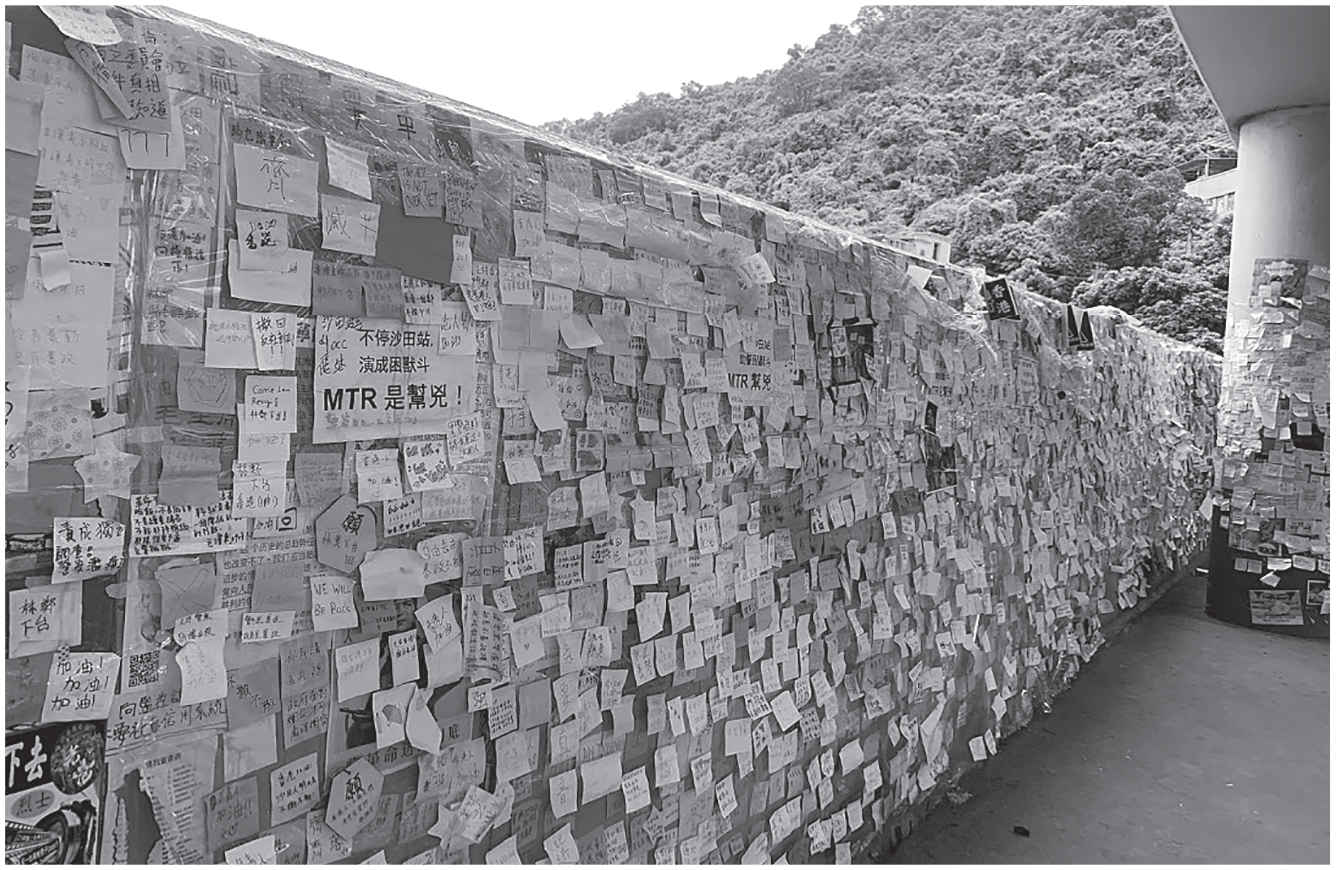
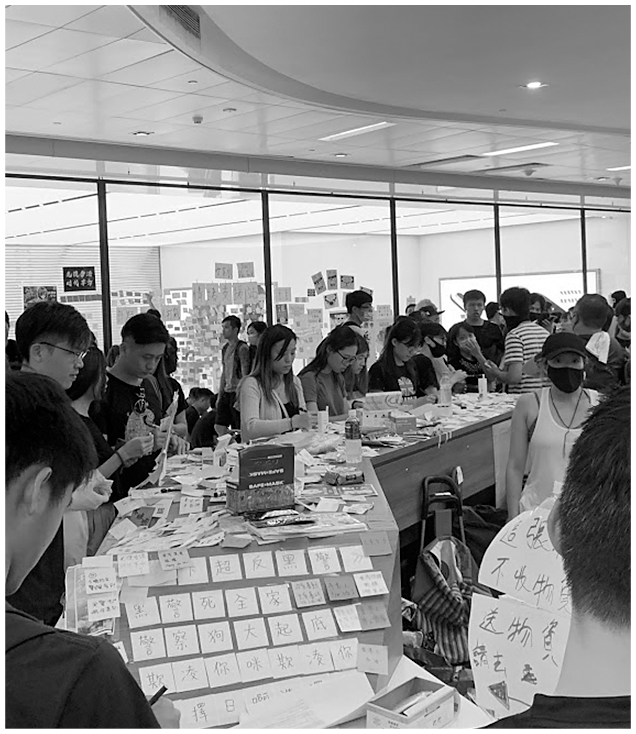
This idea was first appropriated in Hong Kong during the 2014 Occupy Central movement as an everyday resistance strategy. According to Veg, these walls in skywalks, subway stations, and even shopping malls (see the photo above and the photo in the top right corner of page 69), become a narrative field for every single citizen to post their demands, share information and sentiment.
The movement is best understood as a movement seeking democracy and freedom to re-assert Hong Kong identity
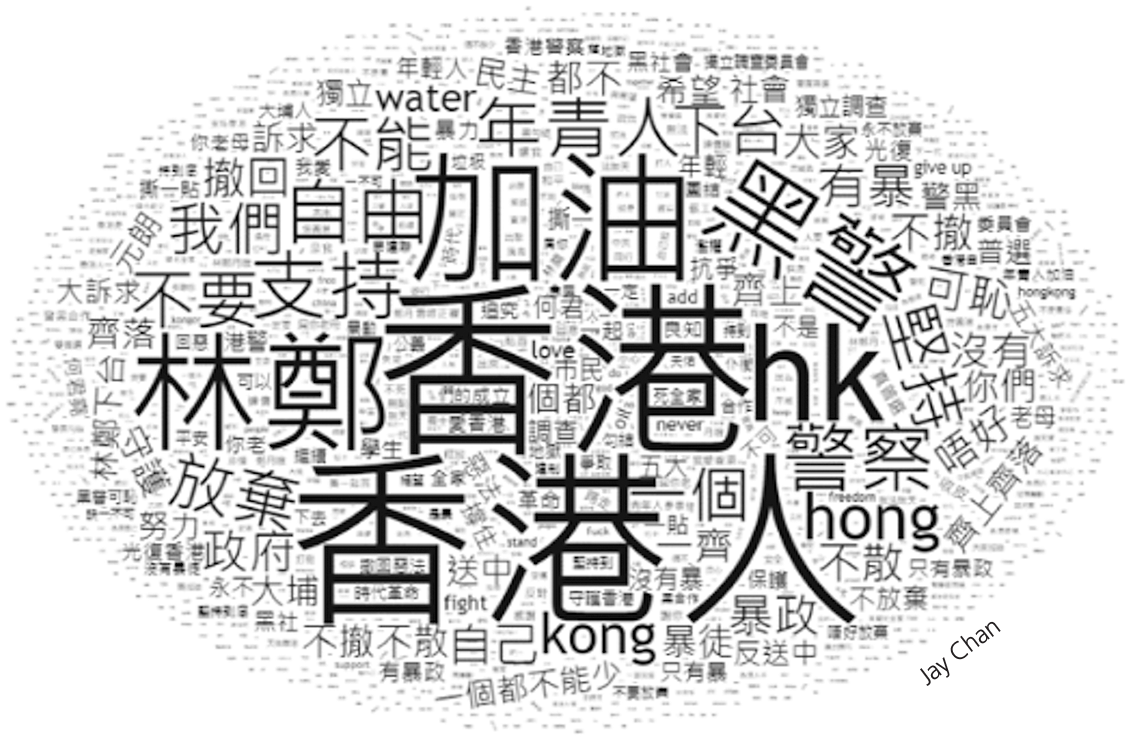
At the height of the movement, between June and October 2019, we coded 10,000 hand-written notes. We visualized the contents based on their frequencies in the two figures on page 69.
The first figure on page 69 shows that the most frequent messages conveyed in the movement are “Hong Kong(ers), add-oil!” (Go Hong Kong(ers)!) (22 percent), “Bad cops” (criticizing police violence) (18.3 percent), “No rioters, only tyranny” (11 percent), and “Carrie Lam resign!” (8.56 percent) (Carrie Lam is the current Chief Executive of Hong Kong). From the above, it is clear that there is strong sentiment attached to Hong Kong. The other central theme here is dissatisfaction with the institutional establishment. These slogans have become tropes of the movement automatically recanted on the walls and at protests; thus they have become somewhat devoid of meaning. Therefore, to tease out sentiments held beneath these catch-cries we excluded the two most frequently appearing phrases (“Hong Kong, add-oil!” and “Hong Kongers, add-oil!”) from our analysis and produced another word cloud in the second figure on page 69.
A word cloud of messages of the Lennon Wall.
Jay Chan
A word cloud of messages on Lennon Wall after excluding “Hong Kong(ers), get!”
Jay Chan
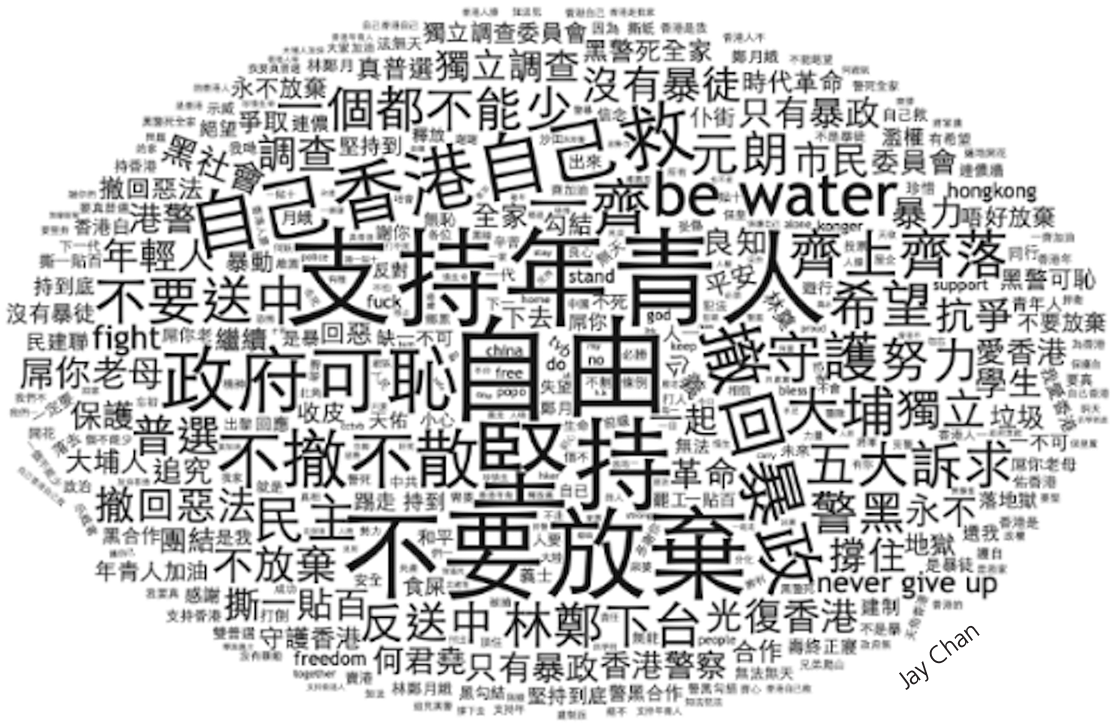
A prominent theme that emerged was closely related to movement strategy. The slogan “Be water” appeared frequently, reminding protesters to draw inspiration from the martial artist Bruce Lee, by being anonymous, spontaneous, flexible and also evasive—just like the flow of water. Another key theme in the discourse was sentiments of solidarity, including statements such as: “Never give up,” “We go together, we leave together,” and “Go young people!” These statements encapsulate both, the collective spirit of the movement and highlight that the younger generation leads the movement. Another key discourse within the messages directly related to the protester’s demands and aims such as “democracy,” “freedom,” and “Save our Hong Kong by ourselves.”
In contradiction to statements by the Chinese government and media outlets that this movement aims for Hong Kong independence or anti-China sentiment, we found no evidence of animosity toward China or Chinese people in the post-it notes. Overall, we found the messages mostly center on citizens’ support for Hong Kong and its people, as well as good governance and democratic values. From the themes and slogans highlighted here, we conclude that the 2019 Hong Kong movement is best understood as a movement seeking democracy and freedom to re-assert Hong Kong identity, rather than an independence movement.
* We thank Wai Ki Wan for her help with taking photos of the post-it-notes in 18 districts of Hong Kong, and manually
entering the data into an excel file. We also thank Mei Ling Chan for cleaning the data and generating the figures. We extend our thanks to Katherine Whit-worth for her constructive comments and suggestions.
Hong Kong citizens wrote post-it notes in a shopping mall.
Yao-Tai Li