



Abstract
This article follows Lety and her family, who were part of the first wave of settlers that established the 50 Casas neighborhood—a once informal community—in Esmeraldas, Ecuador, located near a petrochemical complex. From the outset, the residents of 50 Casas routinely dealt with, and continue to deal with, all the problems associated with living in an urban, informal settlement: lack of services, poor infrastructure, high poverty rates, and insecurity. However, on top of that, the 50 Casas residents also deal with the toxic exposures associated with the refinery.
Lety and her family live in a three-room house constructed with cinder blocks, cement, and a sheet-metal roof in an informal community located in the city of Esmeraldas, Ecuador. A large main room serves as both the living room and dining room and holds a makeshift kitchen in the corner. The walls are exposed cinder blocks decorated with photographs of Lety’s mother and youngest daughter, both of whom passed away years ago. The floor is roughly poured concrete, making it uneven and difficult to sweep. Another room serves as a bedroom with two beds, and the third room has been turned into a little shop.
There is a commercial fridge stocked with beer and soft drinks in one corner of the shop, and a few shelves on the wall are sparsely lined with makeup, nail polish, and school materials. Lety sells her shop items through the bars set in a window facing the street. She is small and plump and can often be found sitting in front of her sewing machine while watching a soap opera on her old TV set or talking to neighbors and customers through her shop window. Lety is divorced and has four children. Her youngest daughter passed away at age 25 from what Lety described as an aggressive pneumonia that struck after her daughter endured a high-risk pregnancy and gave birth in the house. Lety raised her orphaned granddaughter. When I met her in 2015, that granddaughter was a teenager and lived with Lety full-time along with her own baby. In addition, Lety cared for three other grandchildren who lived a few blocks away with their mother, but who spent most of their time with her.
A view of the electric plant from the neighborhood soccer field.
Donna DeCesare
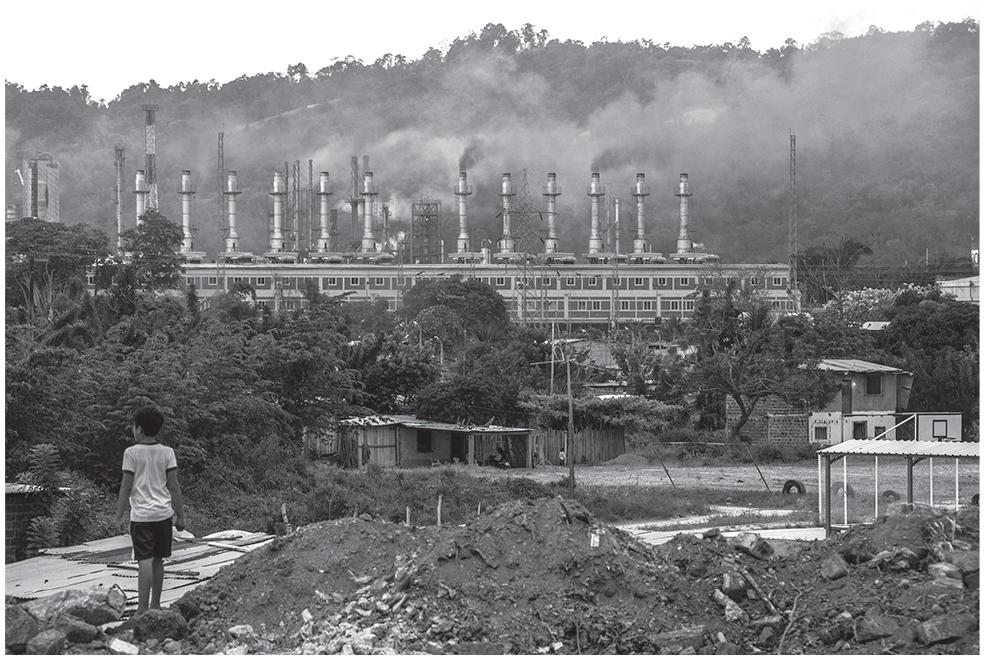
Lety is a mother, grandmother, activist, and neighborhood organizer. She was 60 years old when I first met her, and she is of mixed indigenous and Afro-descendant heritage. Lety was born and raised in Esmeraldas, although not in the same neighborhood where she currently lives and serves as a dedicated organizer and leader. She moved to this neighborhood, known locally as 50 Casas, in 1999, and I met her the first time I visited the area in June of 2015. The neighborhood resembled other informal communities in the south side of the city of Esmeraldas, with its dirt roads lined with small, brightly painted homes built close together. However, 50 Casas was different from other informal neighborhoods in its proximity to the petrochemical complex that has operated in Esmeraldas since the late 1970s. The highly polluted Teaone River serves as the only separation between the complex and the neighborhood. In fact, 50 Casas is so close to the complex that smokestacks and other industrial structures are clearly visible from every home in the neighborhood.
The petrochemical complex, officially called Refinerfa Estatal de Esmeraldas, includes a refinery and an electric plant and is operated by the state-owned company Petro-Ecuador. It has a documented history of disregarding environmental controls and of lingering in a state of disrepair due to poor maintenance. These actions have resulted in toxic emissions, frequent leaks of crude oil and other substances into the river, and even large-scale destructive events such as industrial accidents and explosions. The neighborhood is not only directly exposed to the danger of accidents and daily fumes, but it is also in danger of flooding, as the contaminated Teaone River tends to overflow its banks during heavy rainy seasons. The widespread risks and contamination in the area are well-documented. Without question, 50 Casas is an adverse environment to build a home and raise a family. The contamination issue was first noticed by long-time residents such as Lety upon their arrival in the area, and it continues to be a problem they openly discuss.
After having endured displacement, life in shelters, and a continued struggle to make the neighborhood habitable, life for the neighbors was about trying to make sure they stayed in place, even if it meant being exposed to something that was making them sick.
A smokestack and the 50 Casas main road.
Donna DeCesare
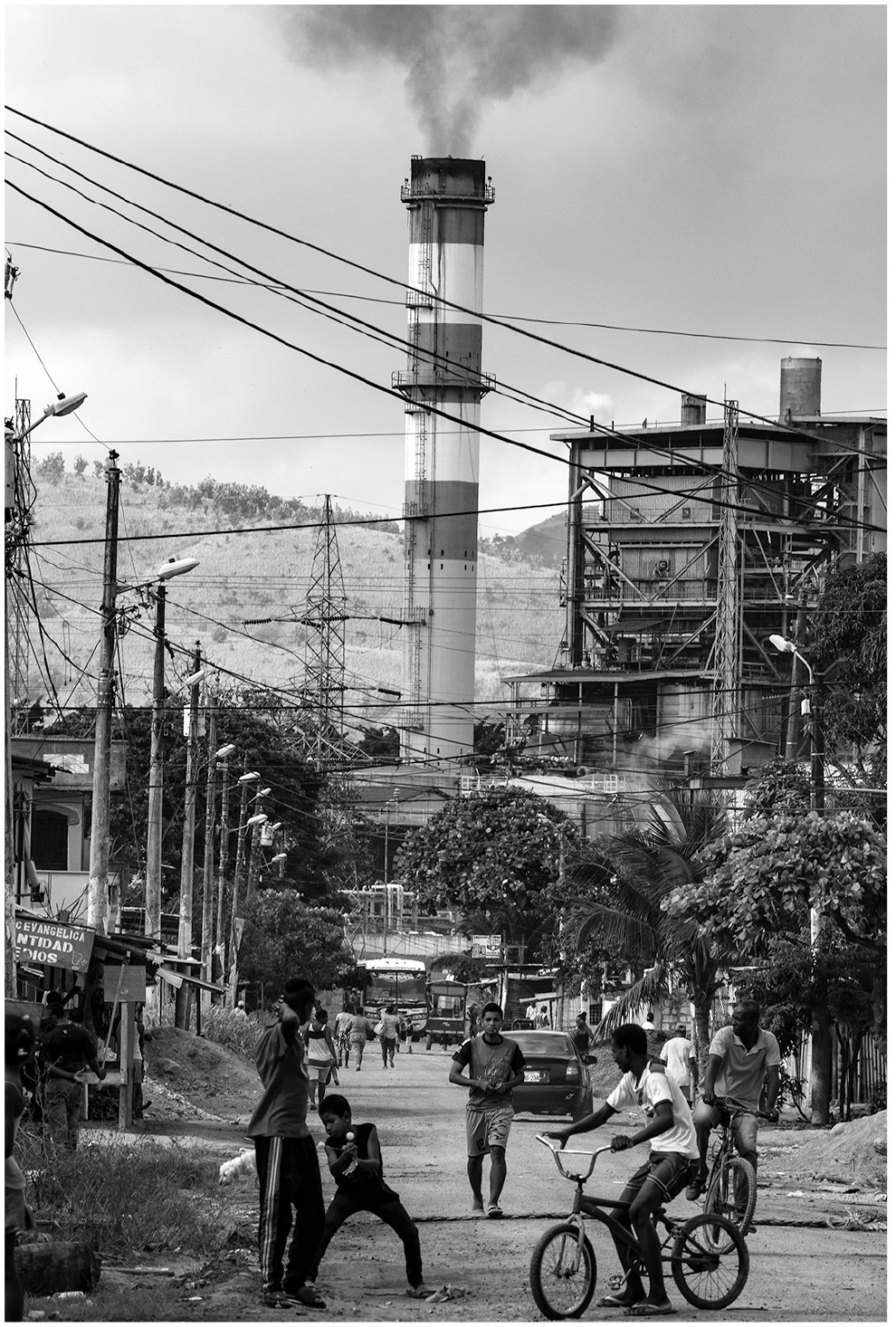
Lety and her family were part of the first wave of settlers that established the neighborhood over 20 years ago as part of a state-led disaster relief relocation program following the El Nino floods of 1998. Lety’s family lived in a makeshift shelter in an unused school building after losing their home in a landslide. She recalls that after living in the crowded and unsanitary shelter for months, she heard of a relocation program where disaster victims were given a plot of land in an uninhabited area in the south of the city. Part of the deal was that each family would receive a donated palm and cane home after they had cleared their own plot of land. Lety recalls the uncertainty she felt upon first visiting the area because it was completely unfit for habitation. She described it as a jungle. The heavy vegetation made the area difficult to access from the main road. Additionally, it lacked access to services and had no infrastructure, but even more worrying, she recalled in an interview, was its proximity to the petrochemical complex, whose smokestacks towered only a few meters away. From the beginning, the neighbors’ experience in the area was plagued by what I call a multiplicity of risks. They had to choose between continuing to live in an inadequate shelter under miserable conditions and accepting the relocation offer, albeit to a toxic place. Lety and her family chose relocation.
Fast-forward 20 years after the neighbors’ initial arrival, and what we find is a thriving community, with over 2,700 residents and access to services such as public transportation and electricity. After many years of collective struggle, organizing, protesting, and making demands on the government, the neighbors have made the place livable, an achievement they take pride in. On one hand, they are proud of their trajectory and struggle, having led to small victories over time that has essentially transformed the place. On the other, they are acutely aware of and openly discuss the toxicity to which they are exposed and its impact on their health. Unlike the bulk of cases documented in the environmental justice literature, this is a case in which conscious toxic exposure coexists with a continued struggle to build up the neighborhood instead of seeking mitigation, relocation, or cleanup of the area. The neighbors openly voice their discontent with the contamination, yet their organizing has been geared toward acquiring services and infrastructure, as opposed to organizing around environmental issues. In fact, the neighbors’ organizing in recent years has been geared towards obtaining land titles. They currently have a state-issued document granting them permission to live on the land but not as the legal owners. Obtaining legal ownership would increase the neighborhood’s visibility and formality, thus further establishing the neighbors’ existence there.
To study toxicity in this informal neighborhood, I used a grounded, ethnographic approach. I documented the trajectory of families into highly contaminated areas, and the reasons they stay there, as well as how people understand and interact with their contaminated residential environments. Drawing from 13 months of fieldwork, I followed and documented the neighbors’ day-to-day struggles to solve the problems of building homes in a toxic environment. I focused on documenting when, how, and why environmental issues became salient and when they were invisibilized or ignored. I lived in 50 Casas during my fieldwork period, where I conducted extensive participant observation and interviews, worked as a teaching volunteer in the local elementary school, and took daily field notes.
Living With Toxicity
Lety often told me about the problems she and her neighbors had collectively faced and collaboratively solved over time, such as protesting to demand electricity and sewage lines from the local government. From the outset, the residents of 50 Casas routinely dealt with, and continue to deal with, all the problems associated with living in an urban, informal settlement: lack of services, poor infrastructure, high poverty rates, and insecurity.
A smokestack and the 50 Casas main road.
Donna DeCesare
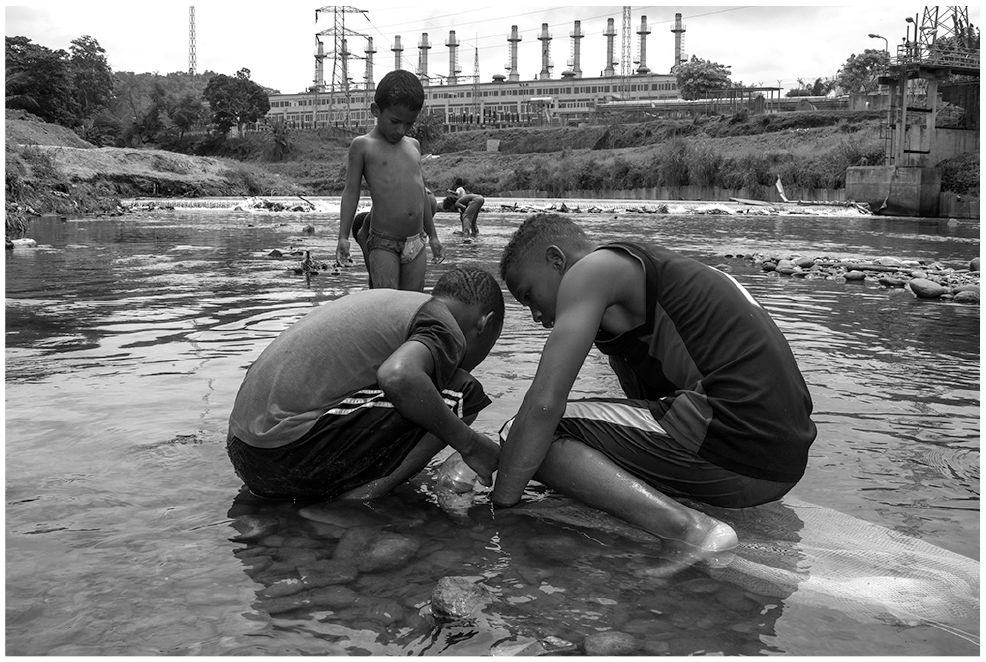
However, on top of that, the 50 Casas residents also deal with the toxic exposures associated with the refinery. Unlike cases in which residents have expressed uncertainty about the impact, source, or even existence of a polluted environment, residents of 50 Casas often discussed and reflected upon the toxicity they faced and its manifestations on their bodies. Consider the following incident that occurred in June of 2016 while I was living in 50 Casas and conducting ethnographic fieldwork.
I routinely walked past Lety’s house on my way in and out of the neighborhood since it was located near the entrance and bus stop. One day, as I was passing by, I noticed the open door, so I stopped to say hello. As soon as she heard me calling from the window, Lety hurried to the front room of her small house. As I squinted into her living room through the metal bars covering a glassless window, she exclaimed, “You would not believe what happened last night! Come in, come in. The baby’s in the hospital! During the day, she was fine, and in just a couple of hours she nearly died of dehydration!” As I walked into Lety’s home and sat on a plastic chair across from her, she spoke hurriedly about the overnight hospitalization of her two-year-old granddaughter. I listened as she went on, full of anxiety and despair, about how her granddaughter was fine one day and dangerously ill the next.
Lety was her granddaughter’s main caretaker and therefore was intimately familiar with the child’s health problems. She recounted a long medical history, from her granddaughter’s problems with gaining weight and growing to her respiratory ailments and constant skin problems. When I met Lety in 2015, her granddaughter was a year old; at that time, the baby looked much younger than her age and did not walk or talk yet. At the time of this visit in 2016, the child had been learning to walk and could say a few words, but she still had not grown very much. She was underweight, prone to rashes and other skin ailments, had thin patchy hair, and had spindly legs that seemed barely able to support her body. She could take only a few steps before she would sit down and hold up her arms, asking to be picked up. She also had a round, dark purplish mark on her right arm, which I had noticed the day I met her. As Lety and I talked about these health issues, Lety attempted to explain the convoluted story of the many hospital visits, the doctor’s diagnoses, and her own views about the child’s health issues. “They say it is one thing and then something else… I don’t understand what the doctors have diagnosed, but I’ve stopped trying to go to the hospital altogether now. I’m sick too, and that place makes me nervous.”
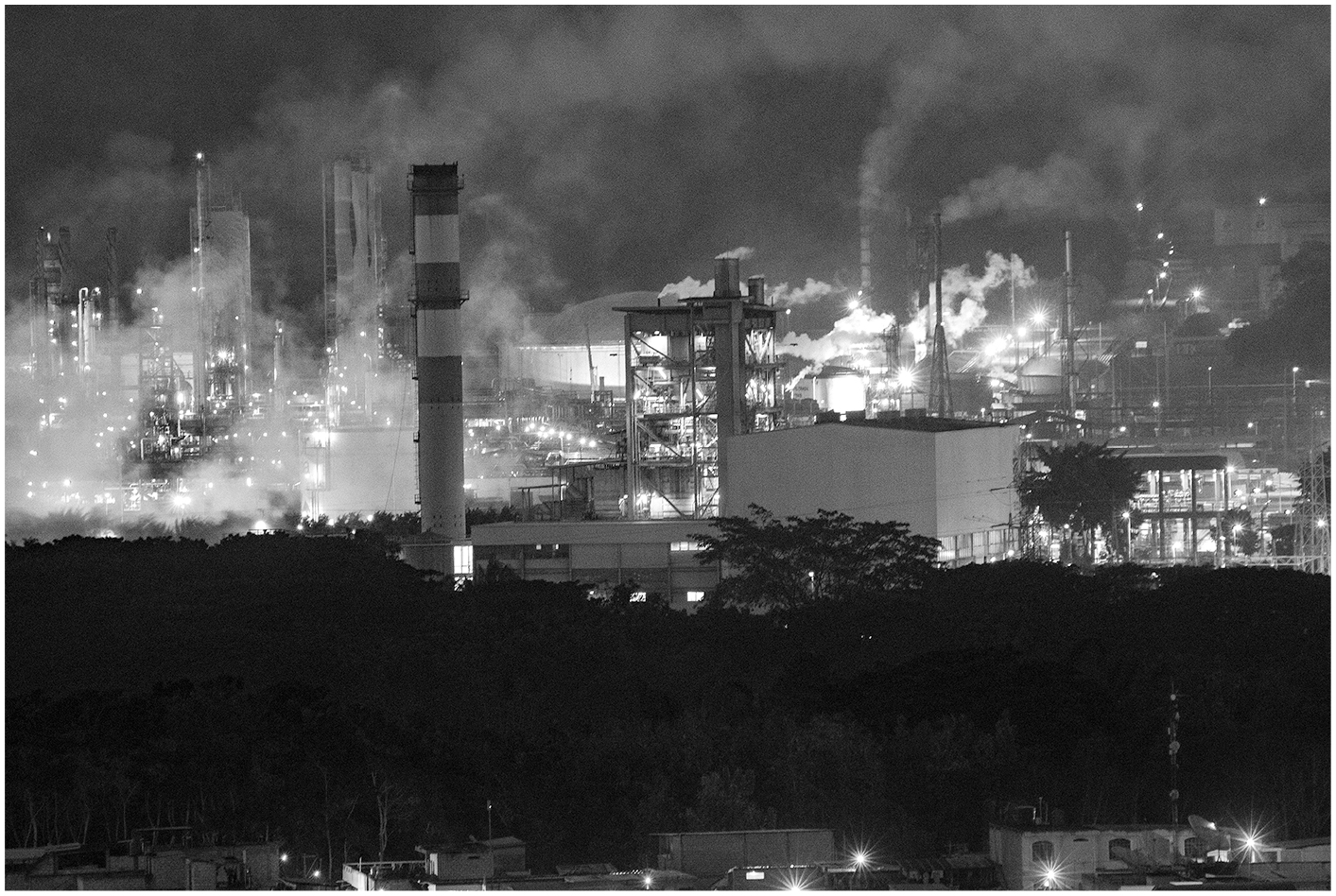
50 Casas is so close to the complex that smokestacks and other industrial structures are clearly visible from every home in the neighborhood.
The refinery at night.
Donna DeCesare
Lety herself had respiratory problems, as well as high blood pressure. She added that the doctors had attributed her granddaughter’s rashes and skin conditions to the intense heat and consequent sweating, but Lety was not convinced. She noted that it was hot in the entire city, but it seemed that only the kids from her area suffered from so many problems. Lety paused, and then she pointed in the direction of the refinery, voicing her suspicion that her family’s ailments and her own were linked to the looming smokestacks sitting across the Teaone River from her neighborhood. Everyone knew the ground, the river, and the air in this place were toxic. Then, with a sigh and a weak smile, she dismissed the thought and said, “Ñaña, but we’ve worked hard for this piece of land. This is our home.”
While Lety lacked a medical understanding or diagnosis that linked her granddaughter’s ailments to toxicity, she was convinced that the link existed. Yet, for Lety and her neighbors, daily life was not about finding a way to leave this toxic space. After having endured displacement, life in shelters, and a continued struggle to make the neighborhood habitable, life for the neighbors was about trying to make sure they stayed in place, even if it meant being exposed to something that was making them sick. Lety and her neighbors were not confused and unknowingly exposed to toxicity. Rather, they coexisted with a multiplicity of risks, making peace with their risky and polluted reality. For the neighbors, this multiplicity of risks included a lack of stable employment opportunities resulting in generalized poverty, which in turn contributed to petty crime in the area. The compounding difficulties of life for families in the neighborhood were best encapsulated by the words of another neighbor and mother I interviewed in 2017. When discussing the problem of long-term toxic exposure, she said, “Yes, I know that the smoke and smells are bad for my kids, and I know that they could cause something worse than allergies in the future. But when I must choose between worrying about finding food for today, tomorrow, and the rest of the week, or worrying about cancer in 10 years… I think first things first. Who cares about cancer later if my kids are not eating enough today?”
Esmeraldas, Oil, and Toxicity
The development of the oil industry in Ecuador began in the 1970s, and it now accounts for two-fifths of Ecuador’s national gross domestic product and over half its export income. The narrative of oil as Ecuador’s means of progress has had complex consequences. On one hand, it funded many infrastructural, social, and public health projects in regions that were central to the extraction and processing of oil, but on the other, it has continued to have a negative impact on ecological and human health. All the same, the Ecuadorian economy has come to depend so heavily on oil revenues that its production and export is an unquestionable necessity.
The areas most heavily impacted by the oil industry are in the Amazon and Esmeraldas, and they are both recognized as the ancestral homes of indigenous and afro-descendant communities. The city of Esmeraldas is lively. Esmeraldas City, the capital of the “black province” of Esmeraldas, as it is nationally recognized, showcases traditional marimba music, salsa dancing, fish simmered in coconut milk, and communal gatherings on sidewalks and front porches. Esmeraldena folklore, dance, music, traditional medicine, and colloquialisms are part of everyday life there. Esmeraldas has been all of these things since “time immemorial,” according to the oral histories of its elders, but since the mid-1970s, the history of Esmeraldas has become increasingly intertwined with that of oil processing, distribution, and exportation. As the host of the largest refinery in Ecuador, as well as the largest oil-exporting port, the city’s recognition as the capital of the black province has taken on another, more ominous connotation: its central role in the production and processing of “black gold.” Following the discovery of petroleum reserves in the Ecuadorian Amazon in the mid-1960s and the decision to make Esmeraldas the center of oil processing and exporting, its inhabitants were promised recognition, economic prosperity, and an abundance of jobs. The following four decades have instead brought accidents, toxicity, and environmental degradation. Unfortunately, neighborhood residents do not have the technical skills required for stable, full-time employment in the refinery Thus, a large sector of the refinery’s workforce is imported from larger cities in Ecuador or abroad. During my time in the field, I met a single 50 Casas resident who worked in the refinery, and he was under a temporary contract as custodial staff cleaning office buildings.
In my exploration of the seemingly paradoxical actions on the part of the community, I analyzed environmental inequalities as products of social power relations. I found that through place-based personal histories of displacement, struggle, and home building, residents of 50 Casas have constructed frames through which they make sense of the multiple risks they live with, including toxicity. I identified four important factors that are crucial to the construction of these frames. First, these include a shared history of displacement that drives their desire for stability; second, the collective experience overcoming harsh conditions upon arrival; third, their communal struggle to acquire services and infrastructure; and last, the reproduction of the neighborhood through keeping family close and storytelling. These four factors are crucial in the neighbors’ understanding of their home in 50 Casas not as a place to leave but as one that through collective struggle and everyday forms of social reproduction should be built-up and improved. They have constructed a meaning of home that coexists with toxicity, and their organizing and everyday survival strategies are prioritized by (what they consider) level of urgency, thus contributing to their extended exposure to the poisonous externalities of the petrochemical industry.
While moments of ill health, such as that described above, prompt fearful conversations about the dangers of living so close to the refinery, these moments of anguish are a part of the multiplicity of risks that neighbors experience. The same that remind them that a home here is better than no home at all. As another long-time resident and neighborhood organizer once said, “having a house here does not make one wealthy, but not having it sure makes one poor.” On various occasions, Lety expressed how fortunate she felt to have her home, and how proud she was for having come so far. She recalled that her original donated house had been made of sugar cane stalks and curated palm, but over the years, Lety had replaced all the original materials, resulting in a resistant, cement home. From the outside, Lety’s home is a small cement box with bars on the windows, and a mix of peeling light blue paint and exposed cinder blocks. To Lety, however, it represented years of hard work and persistence, resulting in her own place where she could pass her old age without worrying about the threat of eviction.
Understanding how neighbors have constructed the meaning of pollution is the tool that helps explain why they, knowingly, work toward a continued existence there; how the neighbors arrived, and the events preceding their arrival, explains why they stay there today. After being displaced and enduring the difficulty of life in a shelter, followed by a flawed relocation effort to an inadequate area, the neighbors have spent years organizing, protesting, and even spending their own resources to carve out space for themselves. Through this process, they have come to prioritize the immediacy of day-to-day survival at the expense of seeking a safer place to live. In understanding this situation, I point toward the importance of considering personal biography in our understanding of history. In 50 Casas, we find a community’s coexistence with a highly polluting industry; to understand the roots of this environmental injustice, we must take into consideration the history of displacement that preceded their arrival in the area and the precarity that plagues their daily lives.
“Having a house here does not make one wealthy, but not having it sure makes one poor.”