



Abstract
In the Southeast Asian context, legal status is ambiguous; it enlarges some risks while lessening others. As is true in many contexts across the Global South, while documentation clearly serves the interest of the state by offering them greater control over migrant bodies, it is less clear that it serves the goals, needs, and well-being of migrants.
“In Thailand, life is risky,” Bunna explained. “We just want freedom… the same rights we have here in Cambodia.” Bunna and his wife Sopheak sat on the wooden slats of their extended family’s open-air home in rural Battambang, describing the reasons for their recent return to Cambodia. Their five-year-old daughter Srey Leat, disabled since birth, lay next to Sopheak while the couple’s other children alternately ignored and entertained her. Srey Leat could not speak, walk or stand on her own, and could not tolerate whole foods. Milk, a costly product in Cambodia, provided most of her daily calories.
Bunna and Sopheak had worked in Thailand’s construction sector for the better part of eight years before returning to Cambodia in late 2017. Migration had been a necessity, not a choice. Even before Srey Leat was born, the family was financially insecure: they had no agricultural land, no home of their own, and limited viable options to make ends meet. Working in Thailand was the only option they saw to support their growing family. Bunna left first, crossing the border clandestinely with a broker and finding work in neighboring Sakeo province. Sopheak followed later with their older children. While Bunna rarely visited home, Sopheak returned often, including extended visits to give birth, and later to visit Srey Leat, who was cared for by Sopheak’s mother.
The couple worked for a number of different employers, with each job change pulling them further towards Bangkok, where wages were higher. It was easy to fi nd work and to earn in Thailand, but migration exacted harsh tolls. Bunna had been held at gunpoint by a previous employer; a police officer threatened him with a knife; the couple had been cheated out of their wages on several occasions; a broker had promised to help them with documents, only to abscond with the money; Bunna had fallen at a construction site and been hospitalized. However, as Bunna spoke about the risks and unfreedoms precipitating their return, it was not these challenges that he was referring to. Rather, he spoke about the costs, risks, and unfreedoms produced through a new state-sponsored regularization campaign.
Bunna and Sopheak left Thailand after their employer demanded they obtain legal status. Like most Cambodians in Thailand, the couple saw significant benefits in having legal status. Yet they were also keenly aware of what this status would require: exorbitant costs leading to precarious debts; a lengthy period of immobility; restrictions in their ability to change jobs; and an increased risk of further splitting up their family. Despite significant financial insecurity and few prospects in Cambodia, the couple rejected regularization. Sopheak left first with the children, and Bunna followed after several more months, trying to earn as much as possible before returning home.
To understand why Bunna and Sopheak choose to return to Cambodia requires setting aside the assumptions many of us hold about legal status and its relationship to migrant rights. In the Global North, migration scholars and practitioners rightfully advocate for legal status (and often regularization) as a way to protect migrant workers. Set against data documenting the benefits of legal status, Bunna and Sopheak’s actions are puzzling. What undocumented migrant wouldn’t want the opportunity to regularize their status? Yet as we will see, in the Southeast Asian context legal status is ambiguous; it enlarges some risks while lessening others. As is true in many contexts across the Global South, while documentation clearly serves the interest of the state by facilitating greater control over migrant bodies, it is less clear that it serves the goals, needs, and well-being of migrants.
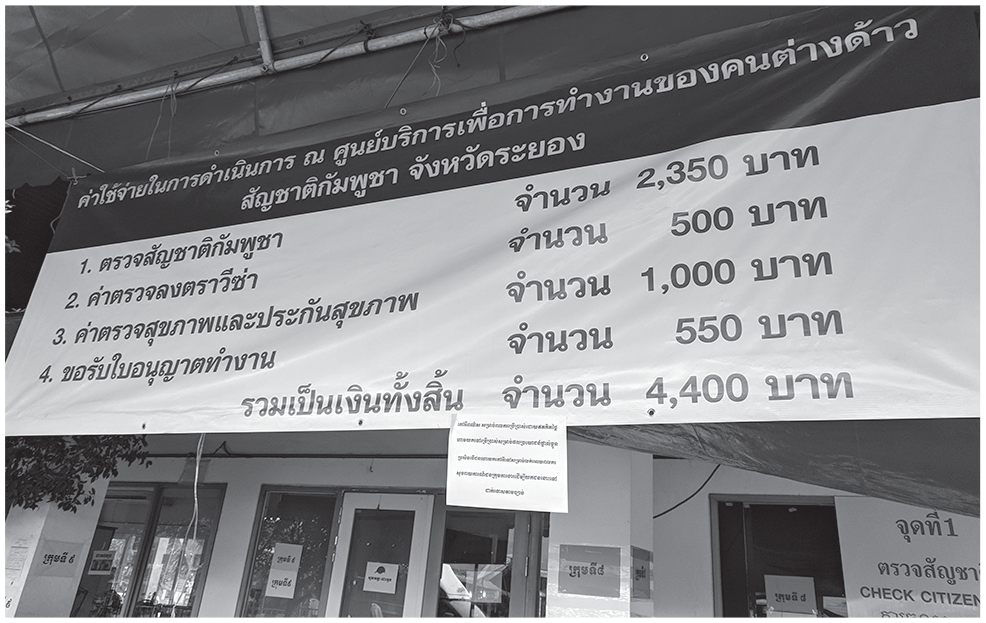
A price list publicizing the cost of the national verification process (4,400 Thai baht). In reality most migrants pay double, or even triple these costs.
Maryann Bylander
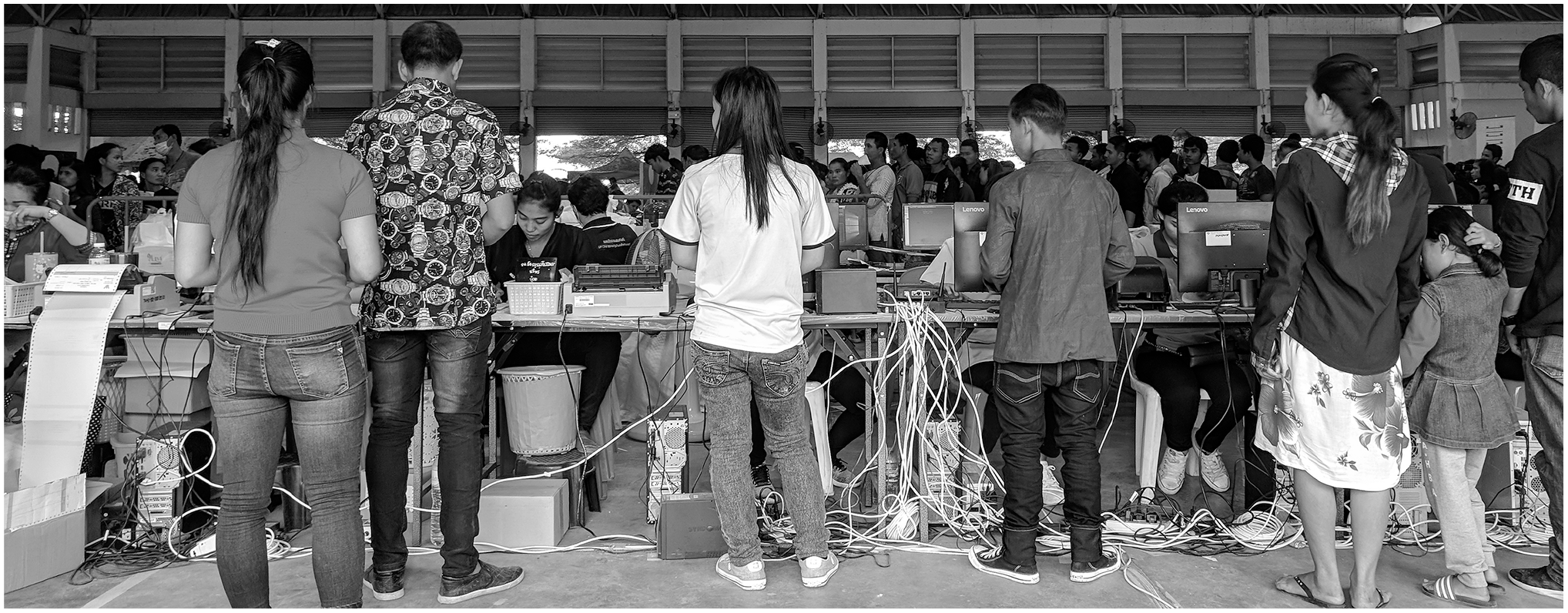
A national verification center in Thailand, where Cambodian migrants are fingerprinted for new documents.
Maryann Bylander
Cambodian Migration to Thailand
Since the late 1990s, Thailand has hosted a sizeable migrant population. Migrant workers from neighboring Myanmar, Cambodia, and Laos form the backbone of the construction, service, agriculture, tourism, and industrial sectors. Historically the vast majority of cross-border movement in the region has been irregular. Typically, Cambodians have crossed the Thai border without formal documents, moving clandestinely with the help of brokers, neighbors, and friends. While the Thai government established regular, legal channels for Cambodian migrant laborers in 2002, the process of regular migration was (and still is) lengthy, complicated, and costly. Cambodians moving through regular channels could expect to pay upwards of 600 USD and wait between six months to a year for placement with a Thai employer. At that point, they were bound to two-year contracts with very limited ability to change employers. In contrast, crossing the border with a broker could cost as little as 60 USD and be organized in a matter of days. Employment opportunities were easy to come by for those with networks, and migrants routinely changed employers to obtain better pay, improve their working conditions, or learn new skills. Undocumented migrants and their employers developed informal, but often effective systems of protection through bribes to local police, guarding against deportation. Exploitation, wage theft, and deception were common, but these were also routinely encountered by those migrating through regular channels.
Importantly, migrants who crossed the border without documents did not always remain undocumented. Since 2002 the Thai government has regularly offered amnesties and made repeated efforts to temporarily regularize workers already present in Thailand. These amnesty programs have made it possible for workers already employed in Thailand to obtain semi-legal status that protected them in important ways. The most recent amnesty project began in 2014, just after Thailand’s military government came to power. Cambodians who registered for amnesty were given a ‘pink card’—an identification card offering them temporary leave to remain. In theory, pink cards were intended to tie workers to specific employers, but this wasn’t easily enforceable in practice. Pink cards weren’t linked to any official identity documents, and often didn’t have workers’ real names or other identifying details. This made them easy to obtain, transfer, and forge.
The Thai government intended pink cards to be a temporary form of documentation valid only until migrants obtained official passports from their home countries, alongside Thai visas and work permits valid for two years—a process the government called national verification. However, very few pink cardholders went through this process. National verification involved thirteen complicated and costly steps, and navigating a range of bureaucracies—things neither employers nor migrants were keen to do.
This changed in the summer of 2017 when Thailand introduced a strict new migration law intending to crackdown on undocumented migrant workers (including those holding only pink cards) and people employing them. Alongside the law, the state enacted a moratorium on implementing the law, and a regularization campaign enabling undocumented workers and pink cardholders to obtain a full set of legal documents before the crackdown began. Across the country, so-called ‘national verification’ centers were set up so that migrants could process passports from their countries of origin and then apply for two-year visas and work permits authorizing them to legally remain and work in their current job. Those completing the national verification process would require permission from their employers to change jobs, and would have to check-in with Thai immigration authorities every three months to maintain their status. In addition, regularized migrants would have to pay for reentry permits each time they crossed the Cambodia-Thai border. Their information would be biometrically linked to their national passport, making it harder to work around the system.
It was this law, and subsequent regularization campaign that resulted in Bunna and Sopheak’s departure from Thailand. The couple heard about the law when it was announced. Soon after, their employer began pressuring them to go through the national verification process. At first, they seemed to have a choice. Their boss just told them that if the police caught them after the moratorium was over, he wouldn’t be able to protect them as he had in the past. A few months later, he started to press the point more forcefully. If they weren’t willing to go through the national verification process, they would have to leave. Employers across the country were making similar demands, making it difficult for those without documents to find decent work unless they were willing to regularize their status.
Methods
In 2017 and 2018, I spent six months moving back and forth across the Cambodia-Thai border, exploring the consequences of Thailand’s new migration law and regularization campaign. Res Phasy, a Cambodian woman from Battambang, and a supremely skilled research assistant, joined me for nearly all of this multi-sited ethnographic work. In Thailand, Phasy and I spent time at four national verification centers, observing the practices of regularization, and speaking with migrants moving through the process. In Cambodia, we spent time at the Migrant Assistance Center in Poipet, where we met Cambodians who were returning home, or visiting on short passport runs. On both sides of the border, we visited migrant communities and spoke with people about their experiences, focusing on questions of documentation and how Thailand’s new law was shaping migrant experiences. We also attended policy workshops, NGO meetings/programs, and trainings for migrant workers. Over the course of this fieldwork, we conducted 34 semi-structured interviews with Cambodians in Thailand, or those recently returned. In several cases we met or spoke with people we interviewed more than once. Bunna was one of those people. We first met Bunna as he passed through the Migrant Assistance Center on his return home, spoke with him in greater detail the following day, and then organized a trip to visit his home the following week, where we also met Sopheak and their family.
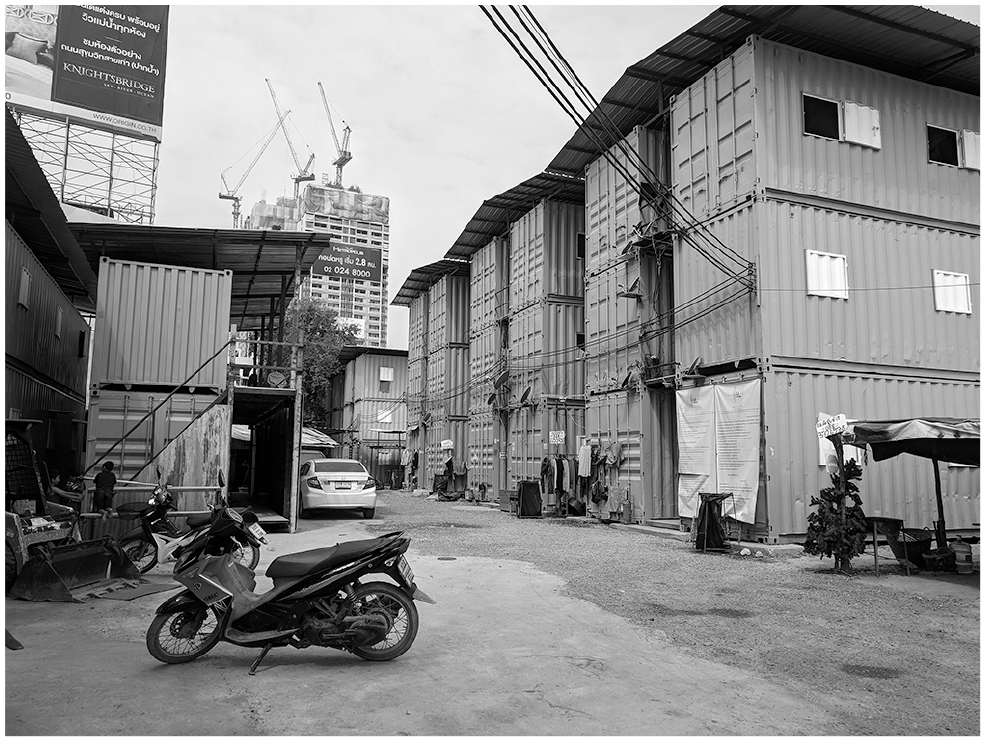
Migrant housing for those working in the construction sector in Samut Prakan, on the outskirts of Bangkok.
Maryann Bylander
The Costs and Risks of Regularization
After Sopheak and Bunna’s employer required that they regularize, they began weighing the risks and benefits of going through national verification. The most obvious drawback was the financial cost. While the Thai state set out a relatively modest fee of 4,400 baht (approx. 135 USD) for the full national verification process, brokers routinely charged two to three times this sum to help employers and migrants obtain documents. Although it may have been theoretically possible to navigate national verification without brokers and their fees, this was rarely an option in practice. National verification had to be initiated and facilitated by employers: migrants could not process documents on their own. Because employers rarely had the time to make multiple trips to labor employment offices and national verification centers, they enlisted costly brokers to do so on their behalf.
In addition, Bunna and Sopheak had particular challenges that increased the costs of their documents. Because of their family’s specific history of internal migration, they weren’t officially listed as permanent residents in their home village in Cambodia—which meant they didn’t have the ID cards necessary to apply for a Cambodian passport. According to the brokers their employer had enlisted, this increased their costs even further. All told, the broker told them it would cost nearly 30,000 baht per person to regularize their status (900 USD). Their employer offered to pay the money for these costs up-front and deduct them from their salary over the next year, but this would laden them with considerable debts. After doing the calculations, they realized that they couldn’t afford documents. Simply to house and feed their family took nearly all the money they could save each month, and they feared that the salary deductions for documents would make it too difficult to send money home, compromising Srey Leat’s well-being.
As is true in many contexts across the Global South, while documentation clearly serves the interest of the state by offering them greater control over migrant bodies, it is less clear that it serves the goals, needs, and well-being of migrants.
However, they had other concerns too. Because the regular-ization process operated through employers and the brokers they hired, migrants were vulnerable to being cheated or defrauded. Brokers had cheated Bunna once in the past, and he was worried about paying for documents that might never end up materializing. Moreover, he had heard that fake documents were rampant now—and he knew he wouldn’t be able to tell the difference between a real and a fake passport. Bunna was also deeply concerned about the new restrictions that regulation might impose on his work and movement. In the past, when employers treated him or Sopheak poorly, the couple simply left and found another job. Pink card or not, Bunna could usually navigate some form of informal protection through his employer and local police. When employers stopped treating him well, he could leave. However, he knew that the new system of documentation would bio-metrically track him through the passport and work visa, tying him to work with this specific employer and making it difficult to change employers without their permission—something that was not always granted. While Bunna didn’t have specific complaints about his current employer, he saw the institutionalized employer-worker links as creating new vulnerabilities and potentially creating an opening for his employer to start treating him poorly. What would stop an employer from cheating them out of a salary or paying them late if they couldn’t leave? In his experience, employers were always decent until the day came where they weren’t. With formal documentation, Bunna would be unable to ‘vote with his feet’ and leave an exploitive employment situation.
Sopheak also had concerns. She was worried about being able to travel home if something happened to Srey Leat or her aging mother. Because the couple would be indebted to their employer for the costs of their documentation, Sopheak knew their boss would hold their passports until these debts were repaid through their salary deductions. Some employers kept passports even after debts were repaid, making it challenging for migrants to make visits home. Sopheak’s fears were grounded in friends’ experiences. An acquaintence of hers was fully documented, with a legal employment contract, but when the woman’s mother died her employer wouldn’t let her return for the funeral.
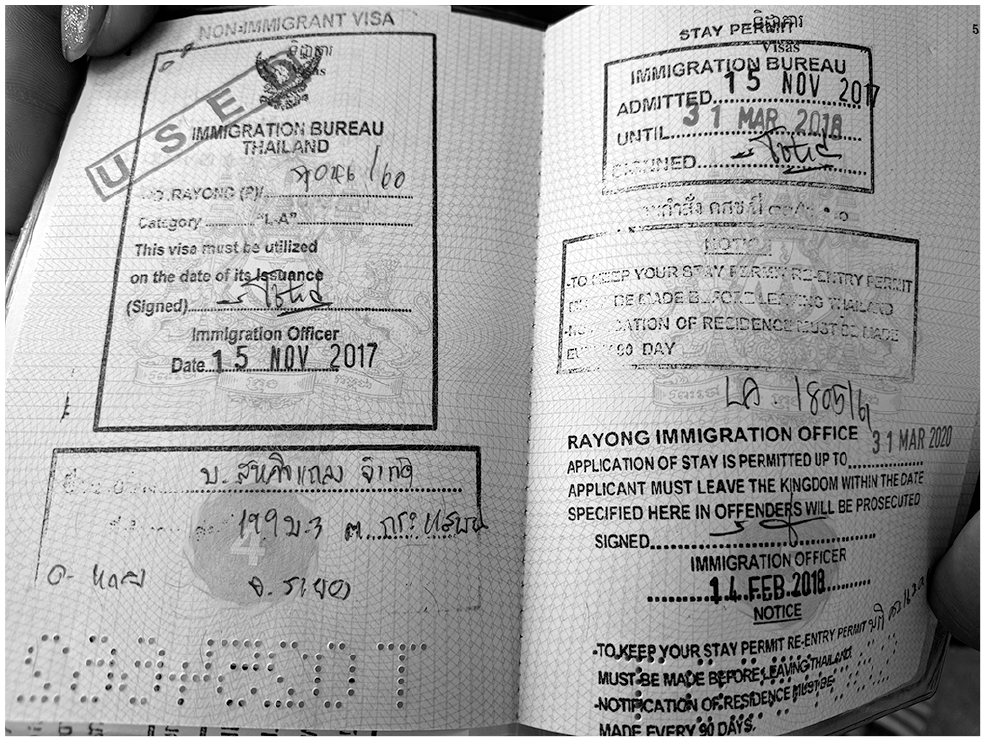
The passport of a Cambodian in Thailand, showing multiple work visas.
Maryann Bylander
Moreover, it wasn’t clear whether their other children—who at the time lived with them in Thailand—would be able to stay in Thailand under the new law. There were rumors that the crackdown would include any non-working dependents. What if they paid the costs for the passport and then the children were deported? They didn’t want to be forced to split up their family further. Finally, their new documents would only provide for two years of legal work, after which they would have to apply for costly document renewals or be forced to stop working.
For Bunna and Sopheak, the costs of legal status were high. At the same time, it was not clear that documentation would change the circumstances of their work, their pay, or the hazards they faced on the job. Documentation was advantageous in that it protected against deportation, but it promised little else. Indeed, prior research in the Thai context has consistently failed to show that regular migrants experience better working conditions than those who migrate through irregular channels, or do not have legal documents. In addition, regularization institutionalized dependencies on employers by making it more difficult for migrants to leave abusive, exploitive, or poorly paid jobs. This is not inconsequential: surveys of migrant workers in Thailand suggest that employers are the most likely source of violence and exploitation.
A Changing System
To be clear, among those I interviewed, Bunna and Sopheak were atypical. While I did meet other Cambodians who rejected legal status, most migrants opted to obtain documents and go through the costly process of national verification. Yet, I highlight Bunna and Sopheak’s experience for two reasons. First, while their decision to return was atypical, the sentiments, concerns, and frustrations they expressed were not. Moreover, the fears the couple described often materialized among Cambodians who did regularize their status. Among migrants I spoke with, national verification routinely resulted in new and unwieldy challenges: unanticipated and exorbitant costs; long-lasting wage deductions; new collateralized transnational debts from microfinance institutions; joblessness; limitations on movement; increased dependencies on employers; failed regularization resulting in significant financial losses; unwanted return; fake documents; exploitation by brokers; challenges in keeping families together; greater difficulties accessing supportive migrant networks; and in extreme cases, the generation of illegality.
In addition, Sopheak and Bunna’s experiences highlight fundamental shifts in the landscape of migration across Southeast Asia. When the couple began migrating ten years ago, they crossed a porous border for the equivalent of 100 US dollars, a sum they were easily able to repay within a month. They changed employers when they were treated poorly, were able to keep their family (mostly) together, and sent money home regularly. While not suggesting that their work was easy, free of exploitation, or ideal, Bunna described feeling a sense of autonomy, and an ability to navigate hardships while still benefitting financially from cross-border movement. In 2017, the cheap, accessible, and flexible migration regime was shifting. To retain their current jobs, Bunna and Sopheak would have to pay nine times the cost of their initial migration. However, because this money would be borrowed from their employer and subsequently deducted from their wages, they would be unable to return home, change jobs, or send money home for at least six months. Moreover, when these visas expired in another 18 months, they would have to pay similar costs to renew their visa. If they wanted to change employers, they would be charged additional fees (best case scenario) or in the worst-case scenario forfeit the passport they had spent half a year paying for. They could have been separated from their family, unable to make visits home easily. If either the broker or their employer broke promises, they would have little recourse.
These changing terms are a clear example of what Xiang and Lindquist call the expansion of migration infrastructure. Across Asia, Xiang and Lindquist argue that this expansion is serving to make migration more accessible, yet also more costly and arduous. This argument easily maps onto Cambodians’ experiences navigating regularization, where the new possibilities for legal status are granted at the expense of migrant freedoms and at an exorbitant cost. These realities are of significant consequence for the potential of migration to engender development and for the realization of migrant rights.
Complicating Legal Status
In the Global North the regularization of undocumented migration, and the promotion of opportunities for legal, regular migration are rightly understood as progressive goals. Migration scholars have consistently documented the benefits of legal status across a range of economic, social, and psychological outcomes. Legal status clearly benefits migrant workers. In part because of the experiences of migrant workers in the Global North, these ideas have been taken up by development organizations, NGOs, policymakers, and multilateral organizations, who closely equate legal migration with migrant rights, migrant safety, and migrant well-being. Thanks in part to the inclusion of migration into the Sustainable Development Goals, efforts to promote “safe, orderly, and regular migration” have now become a cornerstone of both advocacy and practice among migration practitioners and policymakers.
However, both the protective benefits of legal status and the dangers inherent in undocumented labor are worth reexamining, particularly within the Global South. My work highlights that legal status is not always preferred by migrant workers in the Thai context, nor is it always protective for them. This is not to suggest that legal status is insignificant, nor that some workers do not benefit in some ways from gaining status. Rather, I see the Thai case as complicating the assumption that legal status is the most significant axis of concern for migrant workers, and that it necessarily expands safety and well-being. In countries like Thailand, where labor rights are limited and often unenforced, many things besides legal status enable greater freedom and protection for migrants. Among them are the right to change employers, the right to migrate with family and children, the flexibility to return home as desired, the ability to choose a place of living, and the ability to remain close to trusted friends and family.
While much of the world is going to great lengths to keep migrants out, Thailand is working to bring them in—presumably a laudable goal. Yet in doing so, the state is also trying to transform a low-cost, flexible system of migrant labor into a costly one where migrants are more closely controlled, regulated. For Cambodians in Thailand, these shifts have already brought significant and lasting consequences.