




Abstract
This book review explores Sexual Citizens: A Landmark Study of Sex, Power, and Assault on Campus by Jennifer S. Hirsch and Shamus Khan, and describes the complicated nature of sexual experiences as an undergraduate.
Keywords
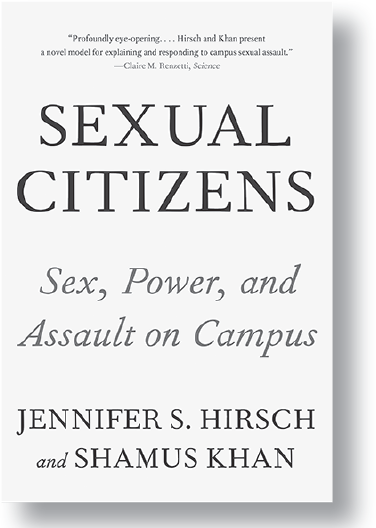
As a graduate student who studies sex and sexual violence amongst college students, I am often surprised at how studies of college sex are monolithic. Many of these studies—focusing on hook-up culture, pornography use, or consent practices—fail to capture my own complicated experiences with sex as an undergraduate, nor do they reflect the experiences of my friends, peers, the undergraduate students I teach, or those I have studied. Jennifer Hirsch and Shamus Khan’s Sexual Citizens: A Landmark Study of Sex, Power, and Assault on Campus offers a seminal perspective of many students’ complex and diverse sexual experiences during college. Growing out of the Sexual Health Initiative to Foster Transformation (SHIFT) Project at Columbia University, Sexual Citizens bridges public health scholarship (Hirsch) and sociology (Khan), both theoretically and methodologically, to capture a more nuanced understanding of sex and power in the lives of undergraduate students in a small, prestigious, and private university setting. The book presents rich qualitative data, driven by regular conversations with undergraduate students, whose contributions were invaluable in shaping how Hirsch and Khan endeavored to study campus sexual violence.
As sexual assault on college campuses is pervasive and enduring, it often seems to have no solution. For Hirsch and Khan, addressing this reality necessitates a broader understanding of how college students navigate all kinds of sexual encounters, not simply those that culminate in assault. This means recognizing and accepting the lack of knowledge and empowerment that college students have about sex in a broader sense. It also requires understanding what students want from sexual encounters, and how their identities, lives, and the social context of college structure both opportunities and barriers to realizing those desires.
What does it mean to be so unsure of one’s sexual boundaries, so without a language for physical and sexual autonomy,” Hirsch and Khan ask, “that you need a workshop on consent to understand that you’ve been violated?
One narrative that demonstrates these factors in tandem is from Kimberly. As a first-year student, she partied hard her first week on campus, at one point being forced to perform drunken oral sex. Kimberly was only given a working vocabulary at orientation later that week to describe her experience as sexual assault. “What does it mean to be so unsure of one’s sexual boundaries, so without a language for physical and sexual autonomy,” Hirsch and Khan ask, “that you need a workshop on consent to understand that you’ve been violated?” (p. 26). Considering this conundrum, Hirsch and Khan develop a novel heuristic for making sense of college sex that encapsulates three distinct yet interrelated aspects of students’ lives: their sexual projects, their sexual citizenship, and the sexual geographies within which they are situated.
Hirsch and Khan define sexual projects as the combined rationales for engaging in sexual practice—attempting to conceive, seeking pleasure, gaining or maintaining social status within a group, and so on. People may have multiple sexual projects simultaneously, such as desiring sex itself while also wanting to build intimacy or connect with a partner. Judgment of these projects is entirely absent from the book; instead, sexual projects are articulated as a central piece of sexual culture that informs students’ behaviors and thus merits a greater role in understanding how and why college sexual violence occurs.
Hirsch and Khan rely on sexual citizenship to reflect a recognition that every individual has the right to their own bodily sexual experiences and identities. Sexual citizenship is built in relationship to others; though agentic, it necessitates acknowledgement from, negotiation with, and acceptance from other people. As suggested by the title of the book, recognition of their peers’ sexual citizenship—alongside their own—plays a pivotal role in the ways students navigate sex.
Finally—and least intuitively, despite common knowledge of how students exist in university spaces—Hirsch and Khan describe sexual geographies as “the spatial contexts through which people move, and the peer networks that can regulate access to those spaces” (xix). This combines spaces in which students find themselves—dorm rooms, bars, friends’ off-campus apartments, public parks—and the interpersonal and structural forces that come together to inhibit or encourage entrée, existence, and behavior within them. As many students’ narratives about various settings demonstrate, sexual geographies contribute to and also specifically create sexual situations that can have dire consequences. Hirsch and Khan discovered, for instance, that university allocation of dorm rooms favoring upper-class students with single bedrooms resulted in younger women going to older men’s private rooms for encounters that often became non-consensual. Insights about the sexual geographies in these students’ lives can help shape possibilities for structural change, in part by inviting a larger group of community members who might now be able to recognize themselves as equipped to combatting sexual violence in new ways (such as administrators who could reprioritize housing assignments).
Sexual citizenship is built in relationship to others; though agentic, it necessitates acknowledgement from, negotiation with, and acceptance from other people. As suggested by the title of the book, recognition of their peers’ sexual citizenship—alongside their own—plays a pivotal role in the ways students navigate sex.
Interrogating how students’ sexual projects, sexual citizenship, and sexual geographies coalesce in varying ways, Hirsch and Khan offer a groundbreaking new approach to studying sexual violence on college campuses. By examining power in many forms—not only the traditional sociological perspectives on race, class, sexuality, and gender, but also intoxication, age, and control of space—the multitude of students’ sexual exploits clarify that assault is not a monolithic phenomenon but is instead many contradictory occurrences that look and feel different depending on one’s community and positionality. Describing how every Black woman the team spoke with endured, at a minimum, unwanted sexual touch on campus—but spoke of this as a mere fact of their existence—is a most poignant example. Hirsch and Khan reflect:
“Building campuses where Black women feel like equal citizens requires complementing prevention focused on consent, alcohol, and healthy relationships with programming grounded in a framework of anti-racism, interpersonal respect, and the right to physical autonomy.” (p. 244)
The most important intervention in this work is its explicit intersectional approach to understanding how, why, and to whom assault happens. Working towards numerous socio-cultural forms of equality amongst students is a primary tool for preventing sexual assault in college communities. Without understanding the cultural contexts in which students exist, and responding specifically to those norms regarding students’ sexual projects, sexual citizenship, and sexual geographies, we have no hope of ending campus sexual violence.
Particularly unique to this study is the institutionalized support SHIFT received. The project was funded by the Columbia University Office of the President and autonomy was given to the research team regarding data collection, analysis, and publication. This simultaneous approval-but-distance makes Hirsch and Khan’s project genuinely unlike any campus effort ever to combat sexual violence, both in its scope and its reception by the campus community. Instead of fighting sexual violence researchers—as is all too common for anti-violence advocates on college campuses—administrators actively lobbied for the project, signaling the university’s dedication to more actively combatting campus sexual violence. The university also exempted the team from mandatory reporting requirements. A site of contention for many sexual violence researchers and advocates, mandatory reporting is a common practice on university campuses where student admissions related to sexual violence must be reported to Title IX offices if shared with staff, faculty, or graduate students. The suspension of Columbia’s mandated reporting procedures for this project offered students the opportunity to genuinely share their experiences without the accompaniment of fears related to campus reporting processes and outcomes (e.g., punishment for other offenses such as underage drinking and drug usage). This offers a more in-depth understanding of the manifestations of sexual violence in students’ lives.
Much work on sexual assault on college campuses—especially that focusing on hook-up culture—takes a generational stance that is not wholly inclusive of the perspectives of undergraduates. Hirsch and Khan capture a more holistic understanding of undergraduate sex, and the explicit emphasis on doing so is laudable as it sets a higher standard for further studies of campus sexual violence. Key to this work is its public health emphasis on conducting community-based participatory research. The individuals whose experiences were central to the study were also consulted every step of the way, and insights from those consultations directed the project from questions on the interview guides to recruitment strategies. All undergraduate students participating in this capacity were paid for their time, ensuring equity amongst the diverse group with whom Hirsch and Khan worked. The demonstrated desire to listen and respect the input the Undergraduate Advisory Board shared with SHIFT ensured the data collected was genuinely representative of the voices and feedback of students themselves, without the passing judgment that prevents so many young people from seeking advice and knowledge about sex in the first place.
As a public health project in part, Hirsch and Khan end with reflections on necessary changes for preventing sexual violence in college and beyond. Although most of what they offer is a new framework for understanding how and why sexual violence occurs, they advocate a single cultural shift forward. Given the fundamental failure of adults to cultivate sexual citizenship in the children they raise, all children must necessarily receive comprehensive, inclusive sex education long before they reach college. This sex education must not only address healthy relationships and consent, but also gender inequalities, racial disparities, and the experiences of LGBTQ+ individuals. For many students, such as Kimberly, this knowledge comes too little and too late to prevent sexual violence, but it does not have to be this way: women at Columbia who received comprehensive sex education prior to starting college were half as likely to be raped as those women who had not (p. 266).
Without understanding the cultural contexts in which students exist, and responding specifically to those norms regarding students’ sexual projects, sexual citizenship, and sexual geographies, we have no hope of ending campus sexual violence.
Sexual Citizens demonstrates the necessity of intersectional, communal approaches for preventing and responding to sexual violence. However, this is only possible with buy-in from parents, teachers, policymakers, university officials, and—of course—the young people developing sexual citizenship for themselves.