



Abstract
I interrogate the killing of Ahmaud Arbery using critical race legal scholar Cheryl Harris’ view of whiteness as property. I offer a counter-narrative telling of events to explain how ideological principles rooted in the concept of whiteness as property continues to undergird the agreed upon practices in neighborhoods like Satilla Shores – where Arbery was pursued, shot, and killed by white residents of the development. In doing so, I explore how these principles and practices breed and foster a form of racialized injustice that gets routinely rationalized and excused through a set of normalizations, which privilege whiteness and white logic.
Keywords
This article builds upon Critical Race legal scholar Cheryl Harris’s concept of whiteness as property to interrogate the myriad ways that the very organization and structure of rules of engagement in white neighborhoods veil the continuing operation of white supremacy in society. I explore how these principles and practices breed and foster a form of racialized injustice that is routinely rationalized and excused through a set of normalizations, that privilege whiteness and white logic. In so doing, I expose how a set of ideological values rooted in the concept of whiteness as property continues to undergird the agreed-upon practices in neighborhoods like Satilla Shores, a predominantly white middle class subdivision in Brunswick, Georgia, where early in 2020 an unarmed Black jogger named Ahmaud Arbery was pursued, shot, and killed by white residents of the development.
Whiteness as Property
Enlightenment philosopher Jeremy Bentham described property as the basis of expectation. In her now classic 1993 Harvard Law Review Journal article, “Whiteness as Property,” Harris further explained this notion. Following enslavement and white conquest, white identity emerged as a type of status property and the basis of racialized privilege. Those who occupied this status (whiteness) received public and private benefits that the law protected. Despite systemic racial (dis)advantages embedded in systems like law, education, and criminal justice, Harris writes, “The assumption seems to be…[that we are] inserting race into an otherwise race neutral landscape.” However, neither the physical nor the social landscape is race-neutral. Property aspects of whiteness include the exclusive right of possession, use, and dispossession. Ancillary rights—tangible and intangible—also follow. By interrogating the Arbery incident, I illustrate how the ideology of whiteness as property is a central aspect of the power dynamic used to maintain white supremacy.
The massive trees throughout the neighborhood were both beautiful and ominous. They reminded me that “strange fruit” might have once hung from those branches.
Barbara Harris Combs
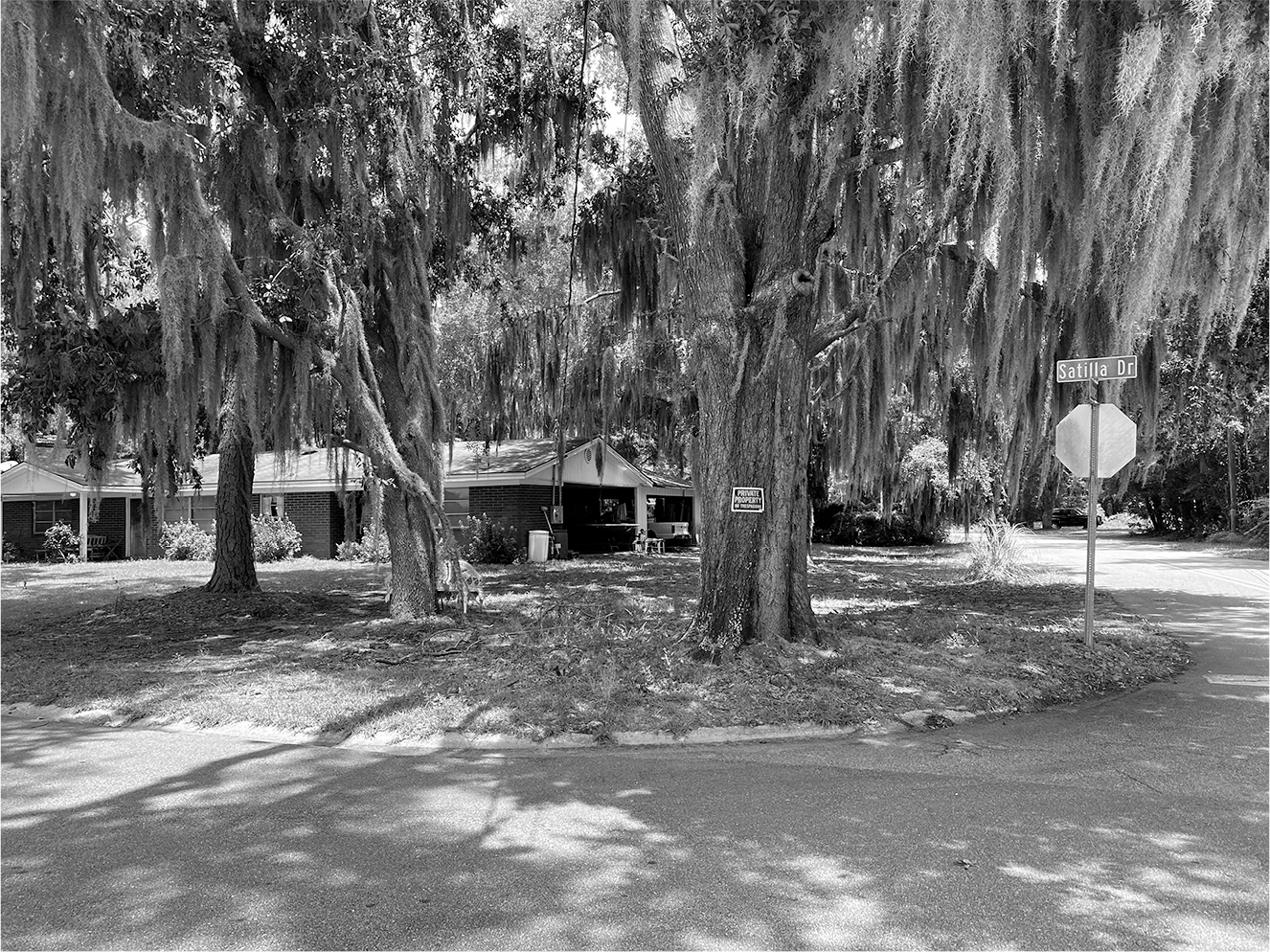
[N]either the physical nor the social landscape is race-neutral.
The Arbery Incident and My Trip to Satilla Shores
On February 23, 2020, Ahmaud Arbery (a 25-year-old Black man) was spotted jogging in Satilla Shores. A father and son pair of residents, Gregory and Travis McMichael, observed Arbery and decided to pursue him in their truck. A third neighbor, William “Roddie” Bryan, Jr. gave chase from another direction. Arbery maneuvered to avoid them, but they continued their pursuit. In a 911 call, Greg McMichael (the father) can be heard barking expletive-laden orders at Arbery to stop running. With the McMichaels on one side and Bryan on another, evasion no longer seemed feasible. After the younger McMichael got out of the truck with his shotgun in hand, Arbery chose instead to turn and fight. The two struggled over the shotgun, and Arbery was fatally wounded. Police arrived within minutes, but no arrests were made, and no charges were filed until months later in response to significant public pressure.
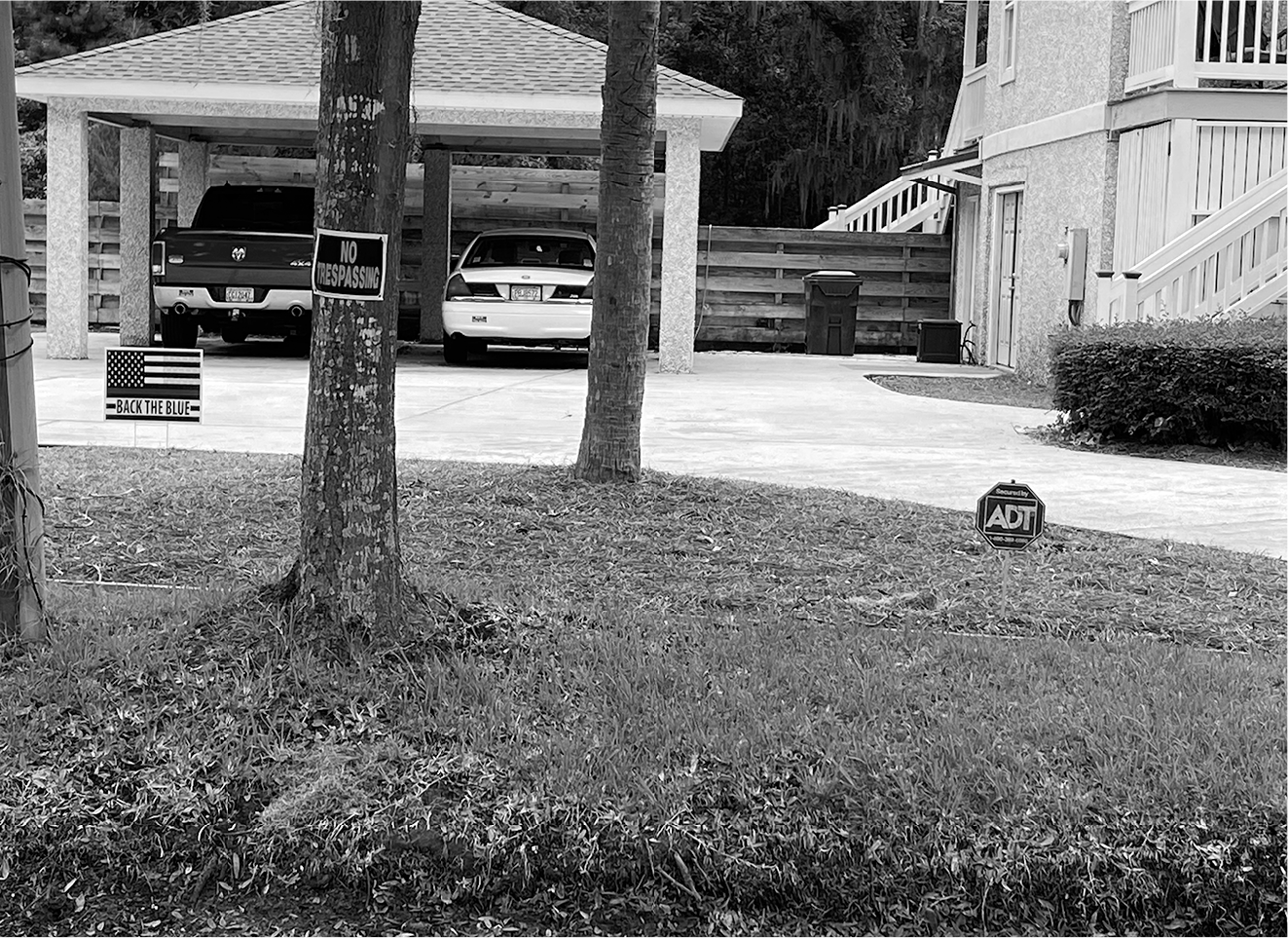
I found signs like this throughout the neighborhood. I do not know if they predate the Arbery incident, but the signage itself suggest that property is more deserving of protection than Black bodies.
Barbara Harris Combs
Do You See What I See? Framing Black Bodies in White Spaces
Like many, I was haunted by the Arbery incident. To me, his death was the starting point for a movement that swept the country after the deaths of George Floyd and Breonna Taylor. This incident can be framed and understood from the perspective of whiteness as property. In his 1974 book, Frame Analysis, sociologist Erving Goffman wrote, “A central component of any dominant racial ideology is its frames or set paths for interpreting information.” Frames give people a way to make sense of details and justify their behavior or response to things. In my ongoing research on contemporary violence against Black bodies, I identify five frames commonly used to justify or rationalize violence against Black bodies. Each is an expansion of Harris’ ideas.
I identify five frames commonly used to justify or rationalize violence against Black bodies.
It’s All White Space: This analytical frame is built upon the status holder’s entitlement of the absolute right to exclude others. Those relying on this frame believe they have the right to wield absolute authority over space and to determine: i) who has a legitimate right to be in the space, ii) what actions are appropriate in the space, and iii) what physical or extrajudicial actions are justified responses when those rules are violated. Arbery was presumed to be in Satilla Shores for illegitimate purposes. He was thought to be a body out-of place with no recognized claim to the space. In his 911 call, Greg McMichaels stated, “I’m out here at Satilla Shores and there’s a Black man running down the street.” The street is a public place, but Arbery’s presence on the public street was deemed improper. The racialized privilege of whiteness cloaked Arbery’s accusers with the full expectation of the exclusive right to use and enjoyment of the community, including the right to exclude others.
Massah has Spoken: Harris describes whiteness as a right of disposition, which includes the ability to buy and sell. Here it includes the final disposition of Arbery’s life. This frame hearkens back to enslavement, during which the master’s orders were to be obeyed without question or delay. The reasonableness of requests by the master were assumed, making questioning them irrational or unreasonable. Failure to do so had consequences, some as dire as death. Arbery had the nerve not to obey the orders of armed white men in a truck chasing him through the streets, and his failure to obey was later used by some to explain the violent response of Bryan and the McMichaels.
Presumed Criminal: This frame assumes that the presence of certain types of bodies in specified areas (or in relationship with certain people) is for ill will or criminal intent. Illegitimacy surrounds the presence of these bodies; this is especially the case with certain intersectional bodies. Black, male, and young is more likely to be presumed criminal than certain other Black bodies, but the presumption exists for most (if not all) Black bodies. Reputation is another property function of whiteness. This presumption of Black criminality (and white purity) allowed the McMichaels to go uncharged for 74 days. These men stalked Arbery, projected criminality upon him, and shrouded their own presumed innocence in the cloak of their white righteousness. Then, they used self-defense as a justification to gun Arbery down in an altercation that they instigated.
You Don’t Belong Here!: In this frame, the presence of Black bodies in certain spaces is not questioned as long as they are performing stereotypical roles in the space at stereotypical times. Otherwise, they are presumed out-of-place. Absent any investigation, then local District Attorney Barnhill stated no charges were warranted against Arbery’s pursuers as they were in “hot pursuit” of a burglary suspect with “solid, firsthand probable cause.” The intangible white property right in operation here is that of reputation and status. Whites have the right to be believed. Nearly a dozen officers reported to the scene of this extrajudicial murder, and they all saw the encounter the same way. Not one officer questioned the word or perspective of the McMichaels or Bryan.
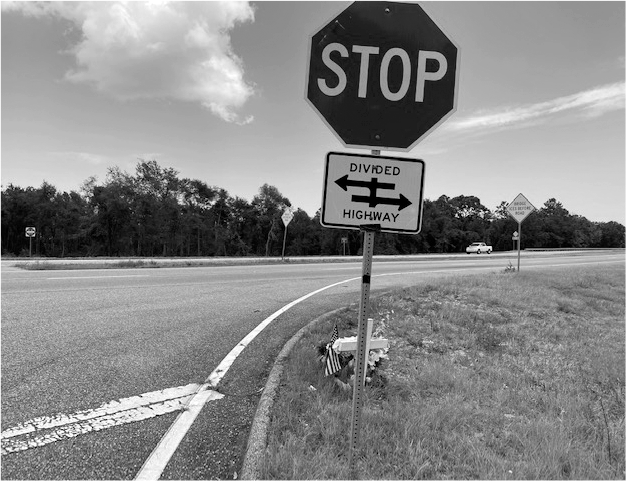
The neighborhood where Ahmaud Arbery resided with his mother sits across this divided highway from Satilla Shores.
Barbara Harris Combs
Historical Fear Response: Those who employ this frame rely on stereotypes, historical inaccuracies, and false perceptions to evoke notions of threat. Once threatened, they manufacture a compelling need for action either for the purported purpose of self-defense or self-preservation against the perceived bad actor. The historical fear response is typified by heightened vigilance of Black bodies in the space and influences how Black bodies are treated and perceived. Armed with stereotypical notions of the Black brut or savage, both the police report and Barnhill’s letter suggest the only reasonable way to interpret Arbery’s physical encounter with Travis McMichael is that Arbery “violently attack[ed]” McMichael and McMichael was defending himself.
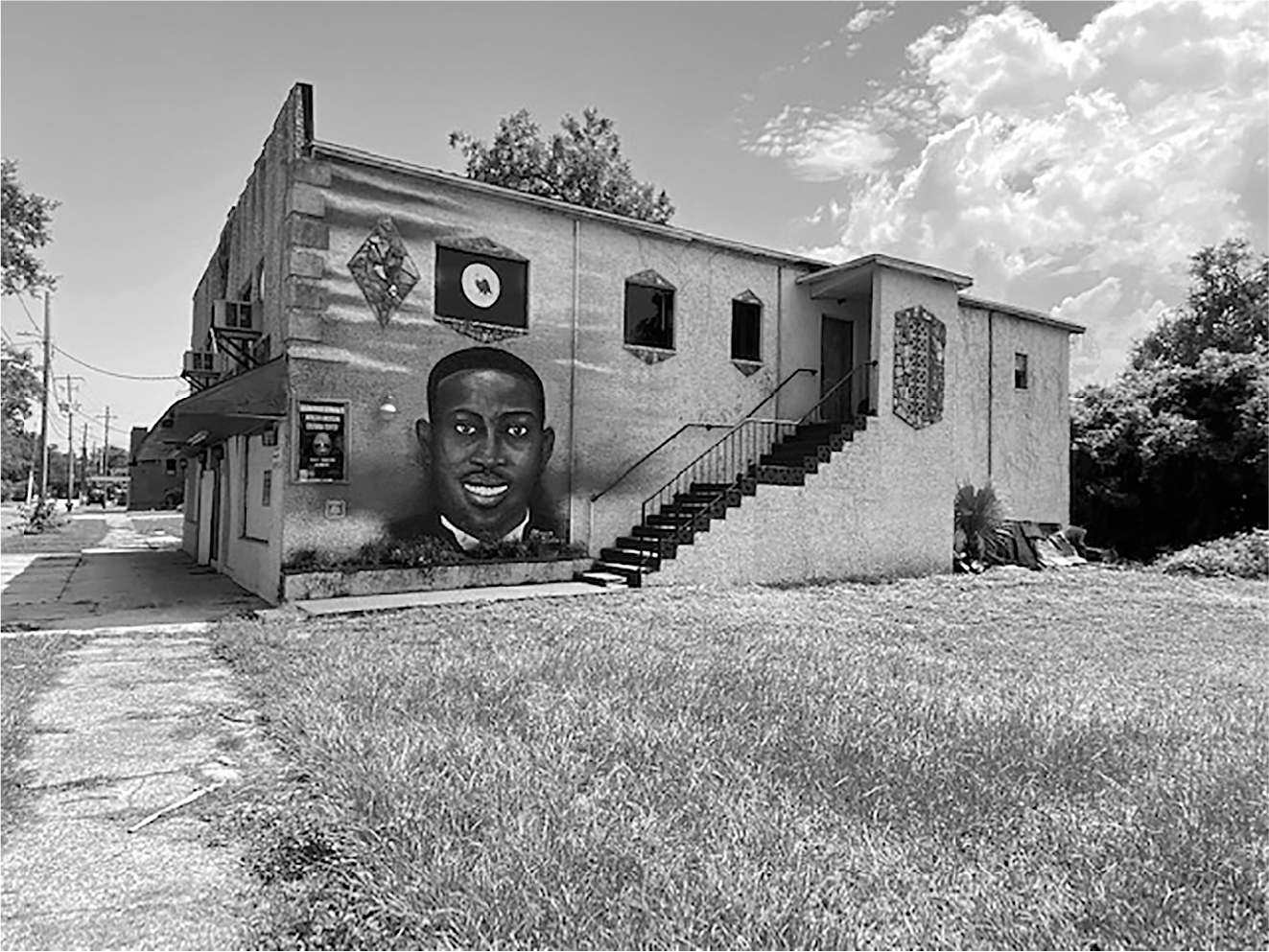
An artist painted a mural of Ahmaud Arbery on the side of this building in historic Brunswick, which sits just a few blocks from the Glynn County Courthouse. It is about 8 miles from the Satilla Shores neighborhood where Arbery was killed. The building, on Albany Street in Brunswick, is the site of the African American Cultural Center. Fundraising efforts are currently underway.
Barbara Harris Combs
Conclusion
Whiteness is a possessory interest in rightness. Rights are only meaningful for those who have the capacity to exercise them. In this article, I unveil three truths. First, blackness, absent any other cause, is commonly treated as a basis for suspicion. Second, that suspicion is used to justify surveillance and both judicial and extrajudicial action against Black bodies. And third, the range of those actions still includes death. Arbery’s pursuers claim they attempted to affect a citizen’s arrest because they suspected the young Black man of committing burglaries in the neighborhood. Arbery’s real sin was being a Black man brazen enough to freely invade the sanctity of white space and use it as his own. Jury selection in the trial of the three men charged in Arbery’s death began in mid-October.