




Abstract
This article shines a light on the dialogue around how redrawing school attendance boundaries has played out during an era of rapid racial change and growing inequality in Richmond, VA.
A year and a half ago, six months before the pandemic, parents, educators and policy makers held a series of meetings to elicit community input on proposals to redraw the invisible boundaries that sort students and communities into public schools. We attended one such meeting in a school library in Richmond, Virginia’s affluent, largely White West End. Emotions ran hot, as the families in attendance—roughly 90 percent White in a school system that is 14 percent White— listened, for the first time, to the outlines of a pairing proposal that would create one large school attendance boundary out of two separate and racially identifiable ones.
Responses to the pairing proposal, many of which were simultaneously colorblind and racially coded, ran the sociological gamut and were delivered in person and through written comment. Some content reflected the ideological framings of the issue, such as one community member who charged that “You all have declared war on the middle class in the name of diversity. None of these options will keep us in the city.” Others focused on social cohesion, such as the commenter who declared, “I attended racially isolated White schools in suburban Richmond and was not prepared for the world. I wish for all children to attend schools that reflect our city.” The Richmond dialogue around redrawing school attendance boundaries played out during an era of rapid racial change and growing inequality, in a country that asks schools to serve as social mobility sites and safety nets even as it leaves them grossly under-resourced.
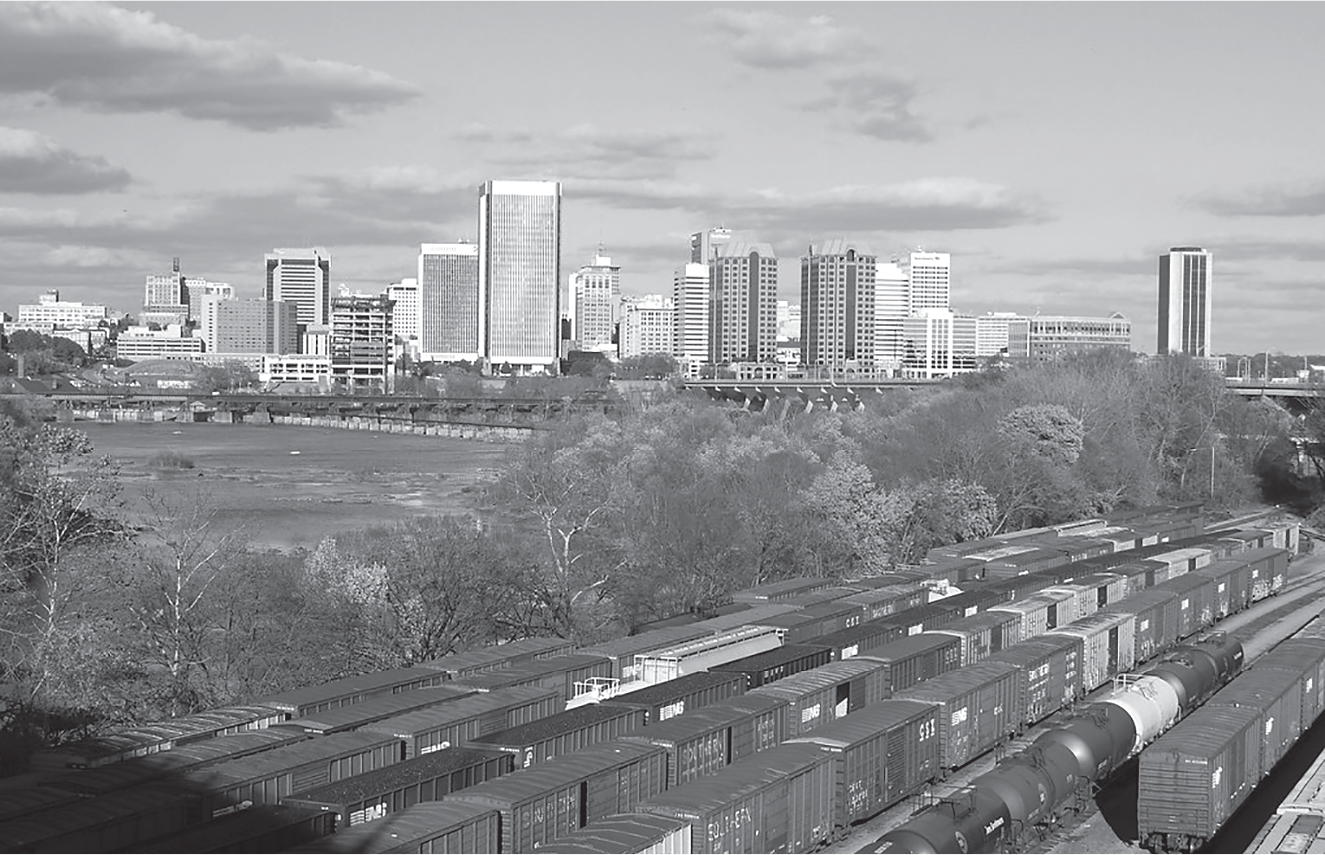
Richmond, Virginia—one of many cities across the country going through a rezoning process.
Rvaphotodude,cc
Parents of Richmond children raised issues heard across the country, partly because school rezoning is a policy that affects social mobility and educational attainment. As an interdisciplinary team of researchers studying race, school attendance boundaries and educational inequality in Virginia, we offer a set of proposals for school stakeholders involved in rezoning processes like the one we followed in Richmond. Unlike many contemporary rezoning efforts, these proposals centering race and racial discrimination can render school rezoning a more inclusive and equitable process.
Policy Proposals
In contrast to our proposal, vague language like “increasing diversity of all kinds” represents a defining characteristic of many rezoning goals related to diversity. Reticence around clearly articulating rezoning diversity goals is related, at least in part, to a judicial system that has steadily curtailed the way districts can use the racial/ethnic backgrounds of students in making school assignment decisions. Yet racial diversity goals are still within the legal parameters set out in the 2007 Parents Involved decision, even if school systems are first encouraged to use race-neutral methods of achieving them. Making race explicit in diversity goals offers an important prompt to center race and racial discrimination in public discourse about rezoning. At the same time, research from the Stanford Education Data Archive (SEDA) increasingly points to the intersection of racial segregation and concentrated poverty in schools as a central explanation for racial achievement gaps. Districts should be prepared to discuss how the long arm of racial discrimination has shaped racial wealth and income gaps—and set clear, measurable integration goals with both race and class in mind.
Given ample research pointing to the academic, social and civic benefits of school integration for all students, as well as to the harms of school segregation for all students, increasing school integration should be a leading priority, if not the highest priority, in rezoning processes. Yet our review of national and local rezoning criteria suggests that when diversity is included—if it is included at all—there is little written guidance around how to prioritize it during the process. And lacking an explicit sense of priority, it is too easy for officials to subsume school integration beneath other goals like efficient transportation or adhering to natural or manmade boundaries.
Dialogue around redrawing school attendance boundaries played out during an era of rapid racial change and growing inequality, in a country that asks schools to serve as social mobility sites and safety nets even as it leaves them grossly under-resourced.
The freeway was used as a racial weapon to put African Americans, and their dreams for inclusive citizenship, back in their proper place. Either obliterated by the freeway, or pressed up against it, through the glaring disrespect for their homes and institutions, African Americans were being told in the most flagrant way imaginable that, despite hopeful new interpretations of civil rights law, they still did not belong on the right side of tracks.
Rivers also have been used to spatially define Black and White communities, as the Anacostia in D.C. reminds us. It stands to reason, then, that relying on natural or manmade boundaries to help give shape to 21st century school zones will do little to disrupt a history of intentional planning around residential segregation.
A history of redlining in Richmond. In 1937, the Home Owners’ Loan Corporation rated different neighborhoods across the city for real estate investment by grading them on a color-coded scale that ranged from “best” to “hazardous”.
dsl.richmond.edu; Mapping Inequality
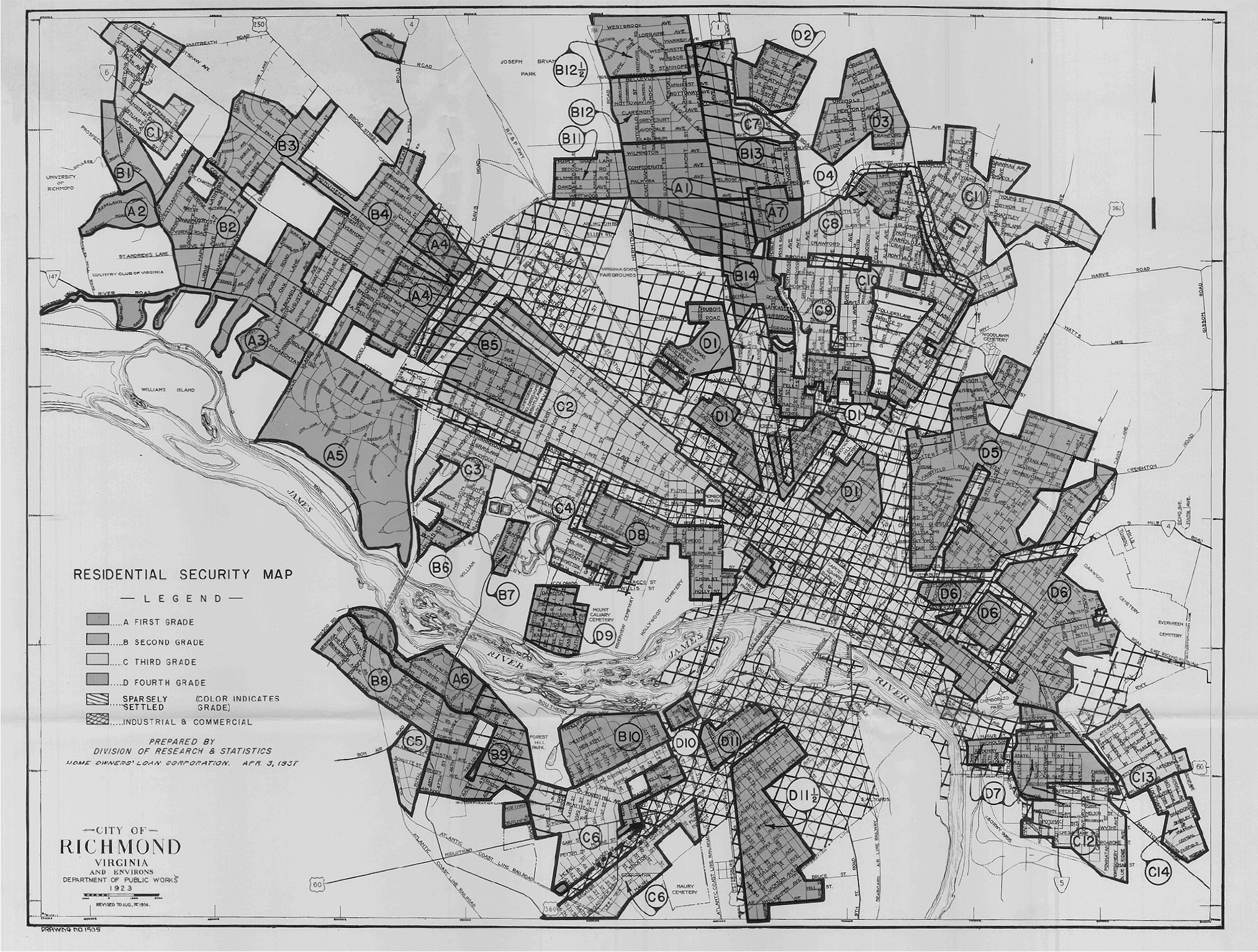
The conflict stems from persistent residential segregation by race and class, particularly, as Ann Owens has documented, for families with children. When boards prioritize efficient transportation or “walkability,” as some rezoning guidelines denote, they crystalize a history of educational redlining and reinforce the link between segregated neighborhoods and segregated schools. That link is the reason Richard Nixon’s 1968 presidential campaign emphasized a race-neutral commitment to “neighborhood schools,” a dog whistle that helped forge a coalition of White voters resistant to school desegregation in the South and industrial North. Educational historian Matt Delmont points out that Nixon’s rhetoric surrounding school desegregation quickly reframed the concept of busing. Instead of a policy tool designed to provide equal protection under the law for Black and Brown students, anti-desegregation rhetoric quickly equated busing with the elimination of the individual rights of White families to choose [racially separate] neighborhoods and schools. If contemporary school boards fail to surface and confront this history as they set priorities around school rezoning, they run the risk of repeating it.
Conclusion
Our policy and process proposals are interconnected. It will be much easier for leaders and advocates to prioritize and set clear, measurable integration goals if the public has at least begun developing a shared understanding of race and racial discrimination as it relates to school rezoning. Ultimately, until we honestly confront the contextual complexities surrounding the criteria, revised or otherwise, it will be difficult to also con-front deepening inequalities explained by the social theories illustrated in the community rezoning comments we observed in Richmond.
Districts should be prepared to discuss how the long arm of racial discrimination has shaped racial wealth and income gaps—and set clear, measurable integration goals with both race and class in mind.
While no one process can perfectly capture the array of concerns found in any community, one that is open and that recognizes historical injustice is more likely to produce an educational experience that benefits all children in a district’s schools.