




Abstract
This abstract is incorrect. Please see the corrected abstract here: https://journals.sagepub.com/doi/10.1177/15365042221083001.
This report examines police-public encounters that resulted in the fatal shooting of civilians during 2015 and 2016. How police contact was initiated varies by race/ethnicity, age, sex, mental health status, and whether (or how) the individual killed by police was armed with a weapon. This crucial information sheds further light on fatal police shootings.
Mental health advocacy organizations and public health officials have raised concerns over calling 911 in a mental health crisis. Police interactions can turn confrontational, and individuals may be transported to emergency inpatient treatment—or even jailed—when other treatment referrals may be more appropriate. Mental health-related calls account for up to 20 percent of 911 calls. From 2015 to 2016, 25 percent of fatal police shootings involved individuals with mental illness. In 2018, Contexts highlighted that, of these, approximately 81 percent were initiated by a 911 call, most commonly made by a family member or friend.
As communities grapple with how to safely and effectively respond to mental health crises in the context of calls to defund police and shift funds toward social services, alternative models of response could become more available. For example, by July 2022, a national number (988) will be launched, connecting callers to Lifeline crisis centers to deliver support by telephone, assess for additional needs, and coordinate additional support services if needed. However, we know little about potential differences in demand for mental illness crisis lines versus calling 911, particularly with regard to race or trust in police.
Call preferences in a mental health crisis
Source: Mental Health in Congregations Study (2020)
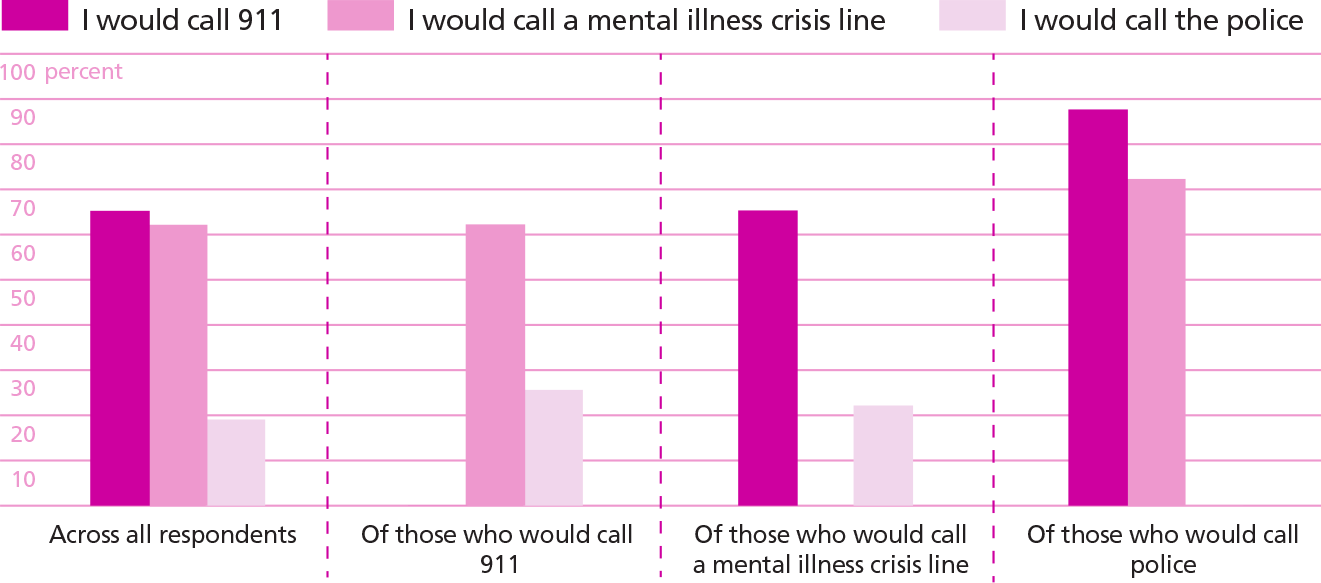
In late 2020, we surveyed a diverse sample of people actively involved in their communities to understand preferences for different support types during a mental health crisis—1,609 individuals from Christian, Jewish, and Hindu congregations in Washington DC, Maryland, Virginia, and Texas.
Religious communities provide crucial civic spaces and advice, especially in times of crisis, while religious leaders play an important role in providing mental health support and often act as gatekeepers to accessing professional mental health services. Furthermore, particularly in Black communities, pastors are often viewed as the most important community leaders.
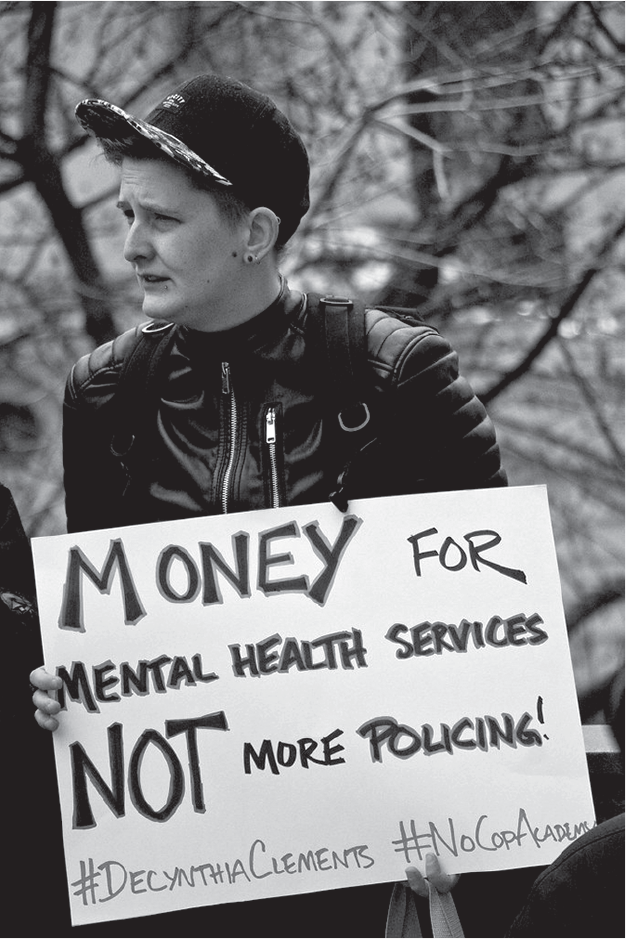
A memorial vigil for Decynthia Clements—a Black woman killed by an Elgin police officer—held in April 2018 in Chicago, Illinois.
BY-SA 2.0, cc
Our sample is similar to the general U.S. population in terms of race/ethnicity. However, on average, the sample is slightly older, is predominantly women, and has higher education levels and income than the general U.S. population. Just over half the sample identifies as Democrat. Therefore, while our sample is not representative of the general U.S. population in terms of gender or socioeconomic status, it is similar in racial and ethnic composition, and provides insight into how actively involved community members would perceive the police and navigate mental health crises.
We investigate the links between race, trust in police, and preferences for mental illness crisis resources in this sample. In our survey, we asked, “If a loved one was experiencing a mental illness and was threatening to harm themselves or others, what would you do?” Options included “I would call 911,” “I would call the police,” and “I would call a mental illness crisis line.” Respondents were able to select all that applied—in reality, people may choose several courses of action, depending on the urgency of the situation, so we wanted to capture the range of options people felt were viable. The first figure captures the complexity of respondent’s ability to select all that applied. We included “mental illness crisis line” to understand whether respondents would choose an alternative to the police. As the National Alliance on Mental Illness observes, “often crisis situations can be resolved over the phone, dramatically reducing the need for law enforcement intervention.”
Trust in the police by race or ethnicity
Source: Mental Health in Congregations Study (2020)
Trust in police and call preferences in a mental health crisis
Source: Mental Health in Congregations Study (2020)
We included both calling police and calling 911 to understand whether there is a difference in preferences between calling 911 generally, or specifically calling to request police. Police are typically first responders to mental health crises when a 911 call is made, whether or not the caller requests a medical response. Examining preferences for both allows us to identify whether respondents understand this. We found 65 percent of respondents would call 911, 19 percent would call the police, and 62 percent would call a crisis line (see the left side of the first figure). Of those who would call police, 88 percent would also call 911. However, the reverse is not true—of those who would call 911, only 26 percent would also call police—suggesting a majority of those who would call 911 are not seeking a police response.
Lower levels of trust in police are associated with fewer respondents willing to call 911 or police
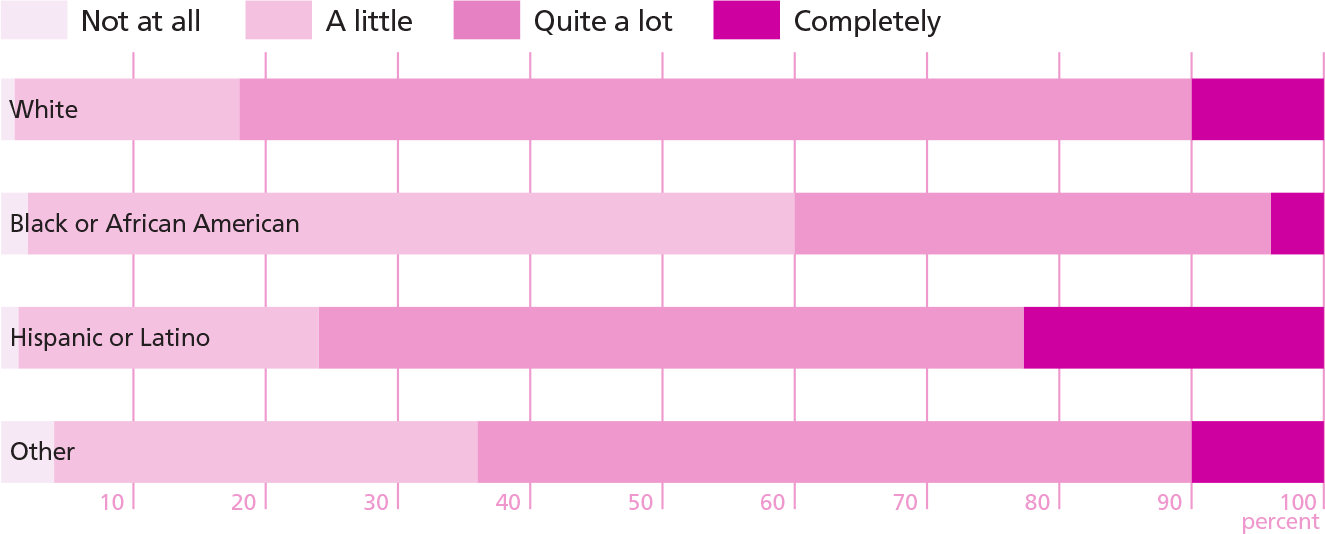
We also asked respondents, “In general, to what extent do you trust the following people? (Police officers).” We created this survey question to directly assess respondents’ trust in police. Trust in police was generally high: 11 percent of respondents trust police “completely,” 64 percent trust police “quite a lot,” 24 percent “a little,” and only 1 percent “not at all.” In line with national public opinion polls, we find diverging views by race (Figure on the top left)—White respondents trust police “completely” or “quite a lot” (82 percent combined) more than other respondents, with Black or African American respondents trusting police the least (40 percent combined).
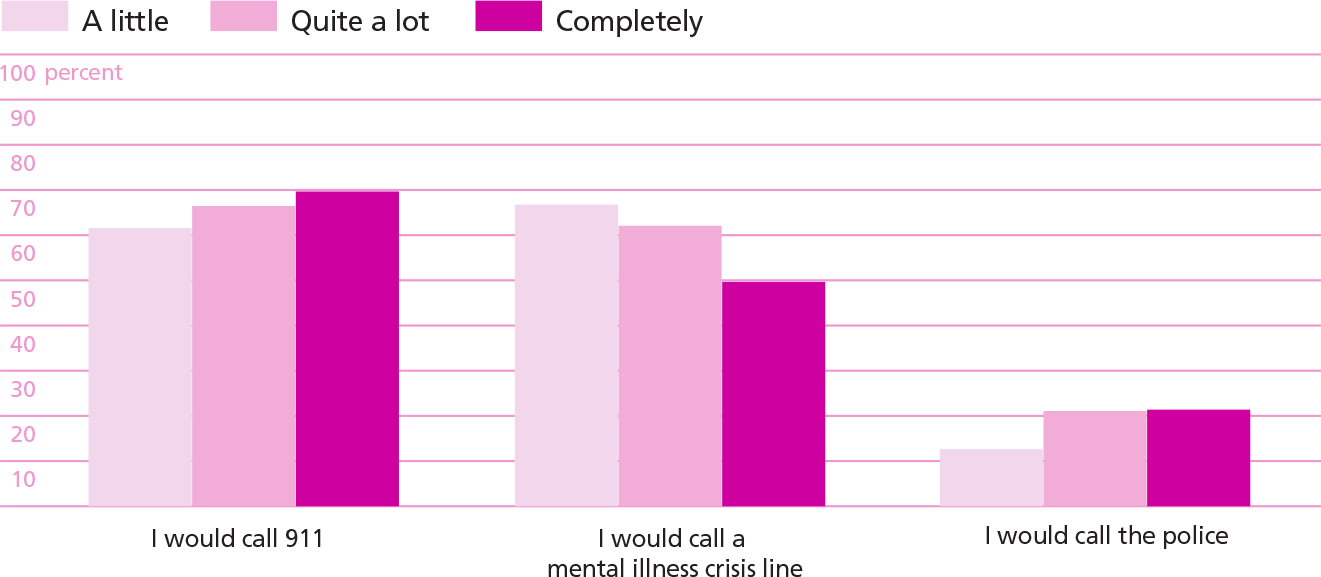
We also examined how trust in police is associated with respondents’ call preferences if a loved one was experiencing a mental health crisis. We find lower levels of trust in police are associated with fewer respondents willing to call 911 or police—reinforcing that respondents understand calling 911 leads to a police response, which some don’t want.
Figure on the bottom left shows that among respondents who trust police “completely,” 70 percent would call 911 versus 62 percent of respondents who trust police “a little.” Of respondents who trust police “completely,” 21 percent would call the police versus only 13 percent who trust police “a little.” We don’t examine call preferences of respondents who trust police “ not at all” because there are too few responses to reliably provide insight.
Conversely, lower levels of trust in police are associated with respondents preferring a mental illness crisis line. The figure on the top left shows that among respondents who trust police “completely,” 50 percent would call a mental illness crisis line versus 67 percent of respondents who trust police “a little.”
Racial or ethnic differences in trust in the police and call preferences in a mental health crisis
Source: Mental Health in Congregations Study (2020)
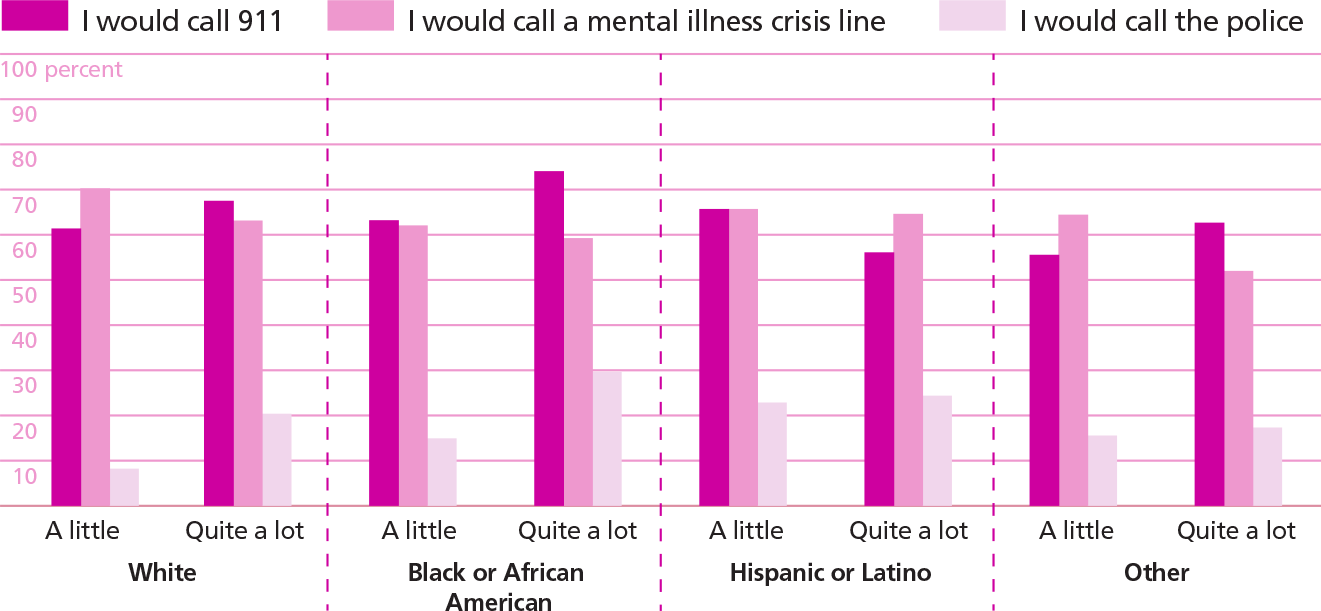
Finally, we jointly examined trust in police and race—is trust in police a proxy for underlying racial or ethnic differences? There are too few respondents who trust police “completely” to include an analysis of their call preferences by race, so we examined preferences of those who trust police “a little” or “quite a lot.”
How policy makers fund, support, and publicize mental illness crisis lines for individuals seeking alternatives to a police response is critical
As shown in the figure above, there is a positive association between trust in police and preferences to call police. For example, while only 15 percent of African Americans who trust police “a little” would call police, 30 percent of African Americans who trust police “quite a lot” would do the same. However, there are important differences by race and ethnicity: when taking into account trust in police, Whites are less likely than African Americans or Hispanics to want to call police. For example, only 8 percent of Whites who trust police “a little” and 20 percent of Whites who trust police “quite a lot” would call police.
The inverse is true for preferences to call a mental illness crisis line: higher levels of police trust are associated with a lower likelihood that a respondent would call a mental illness crisis line. However, as with preferences to call police, there are differences by race and ethnicity—when taking into account trust in police, African Americans are less likely than Whites or Hispanics to want to call a mental illness crisis line.
How policy makers fund, support, and publicize mental illness crisis lines for individuals seeking alternatives to a police response is critical. Communities of color, in particular, experience a lack of access to good quality mental health care which can lead to a cycle of “more severe symptoms, greater criminal involvement, and more frequent arrest.” African Americans disproportionately face barriers to mental health care, including a lack of insurance and not receiving appropriate information about services, as well as deterrents including a lack of culturally competent providers, and being less likely than Whites to receive guideline-consistent care. As a result, African Americans are less likely than Whites to access mental health specialists. Only one in three African American adults who needs mental health care receives it, and—as our data show—African Americans are less likely than Whites or Hispanics to want to use a mental illness crisis line.
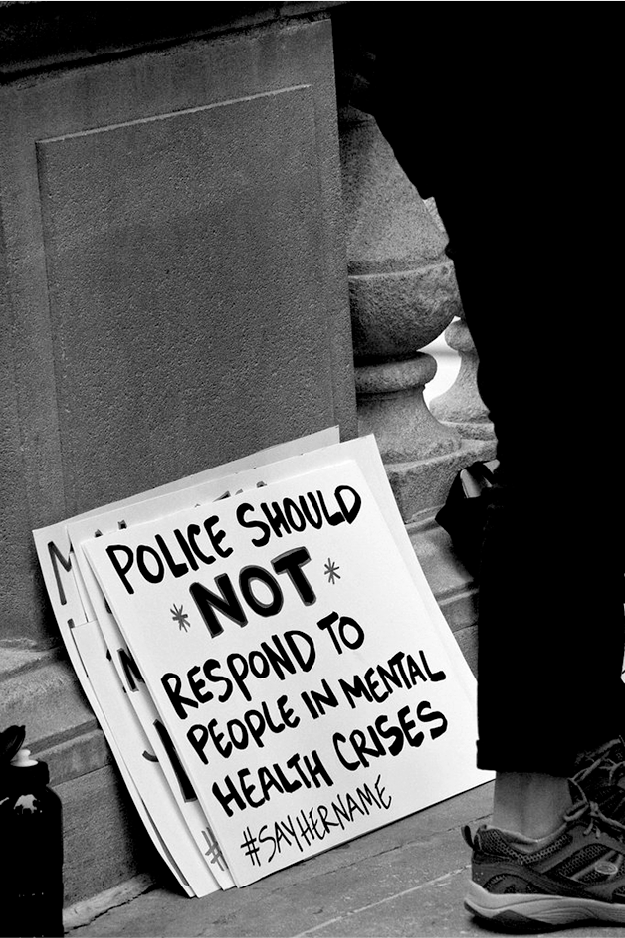
A protest sign at the April 2018 vigil for Decynthia Clements.
BY-SA 2.0, cc
Therefore, if resources intended to divert people in crisis away from a police response will be successful, work needs to be done to raise awareness of alternatives and encourage conversations about mental health. As the National Alliance on Mental Illness argues, “we need better access to care and crisis services for Black people with mental illness. One way we do that is by giving communities another option to call when a neighbor or loved one is experiencing a mental health crisis… When 988 finally goes live, let’s all be mobilized and ready to greet it.”
This study was funded by the John Templeton Foundation (#61107). A full list of recommended readings can be found in the online at www.contexts.org.