



Abstract
Over one million individuals obtain lawful permanent resident (LPR) status each year (DHS 2020). Beginning February of 2020, LPR applicants became subject to new public charge rules that seek to bar admission to anyone who “is likely at any time to become a public charge.” Motivated by the misconception that immigrants overuse U.S. welfare benefits, the rules seek to employ unnecessary vetting criteria that are both unfair and unsafe.
According to the Department of Homeland Security, over one million individuals obtain lawful permanent resident (LPR) status each year. However, beginning in February of 2020, LPR applicants became subject to new Public Charge Rules that seek to bar admission to anyone who “is likely at any time to become a public charge” (8 U.S.C. 1182(a)(4)). Motivated by the misconception that immigrants overuse U.S. welfare benefits, the rules seek to employ unnecessary vetting criteria that are both unfair and unsafe.
The Rules
The Public Charge rule has been a feature of U.S. immigration law since 1882, in that applicants for legal permanent residency who are likely to become a public charge may be denied admission. Until recently, the term “public charge” has been interpreted to mean past use of cash assistance (i.e., Supplemental Security Income, Temporary Assistance for Needy Families) or institutionalization in a state facility.
However, new rules recently issued by the Departments of Homeland Security and State expanded the definition to include past use of non-cash benefits, such as Medicaid, food (i.e., SNAP), or housing assistance. This change alone is unlikely to affect many foreign applicants because very few would have been eligible to receive U.S. public benefits in the past. However, the new rules also provided instructions for inspectors to determine whether an applicant is likely to use public benefits at any point in the future, which will impact a far greater share of applicants.
To calculate an applicant’s likely future use of welfare, a set of positive and negative factors are utilized based on age, health, family status, education, and income.
Unnecessary
The new Public Charge rules are unnecessary. They seek to solve a problem that has been greatly exaggerated and already addressed by past law.
For decades, a handful of researchers such as George Borjas and Steve Cama-rota promoted the notion that immigrants are welfare prone—they are attracted to the United States for its generous welfare benefits and are likely to become dependent if given the chance. Camarota for example, finds that immigrant households use public assistance programs at a rate higher than U.S.-born households (14 vs. 10 percent respectively). The key term ‘households’ highlights a conundrum that Borjas and Camarota do not take into account—many immigrant households also have U.S.-citizen residents that utilize public benefits.
For instance, an immigrant household could be counted as using public assistance if an LPR or U.S.-citizen child living in the household receives free or reduced lunch, or if a non-working immigrant parent receives cash assistance. In Camarota and Borjas’s eyes, both cases are equally problematic to the welfare system even though programs that U.S.-born children of immigrants most often use, such as free or reduced school breakfasts and lunches, are inexpensive and directly benefit children.
A U.S. Green Card; a coveted possession for many, allowing immigrants to live and work permanently in the United States.
Cory Doctorow, Flickr cc
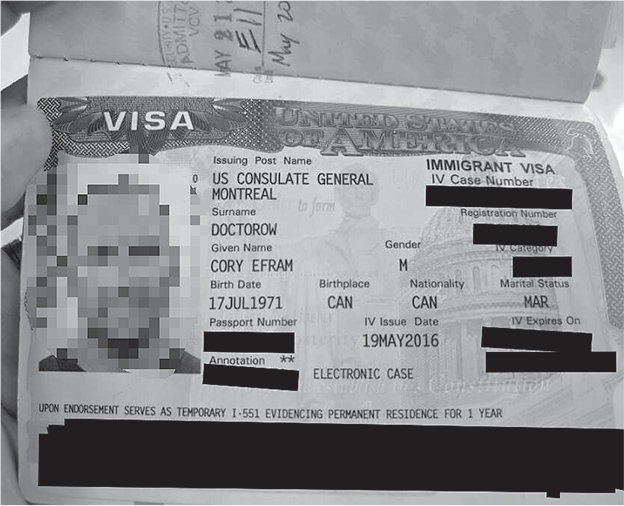
In contrast, the federal government does not count U.S.-born children when evaluating an immigrant’s welfare use. In fact, Congress has repeatedly exempted vulnerable nonimmigrant groups—refugees and the U.S.-born children of immigrants—from laws that make immigrants ineligible for public benefits. They are even exempted by the new Public Charge rules.
Immigrants consume 27 percent fewer benefits than U.S.-born who have similar incomes and ages.
Once refugees and U.S.-born children are excluded from the data, most research shows that immigrants are not welfare prone. On average, immigrants consume 27 percent fewer benefits than U.S.-born who have similar incomes and ages. Furthermore, some programs are utilized as a source of temporary support.
One study by Van Hook and Bean found that the majority of Mexican immigrant women who are on public assistance have shorter welfare spells and are more likely to leave welfare for work than their U.S.-born counterparts.
This makes sense given that most immigrants are adults who were drawn to the U.S. for work and therefore do not attend public schools or use school lunch programs. According to prior research, approximately 78 percent, compared to 59 percent of the U.S. born are of working age and may pay into but do not receive social security as much as the U.S. born.
Finally, laws already prevent many immigrants from receiving public assistance. The 1996 Personal Responsibility Work Opportunity and Reconciliation Act (PRWORA) enforced a five-year ban on public benefit use for newly arrived immigrants. Not only does this mean that immigrants are unlikely to use public assistance, it also deters those who may be drawn to the U.S. for the purpose of using public benefits.
Unfair
The new Public Charge rules also unfairly penalize Latinos.
In our role as expert witnesses in a court case, we replicated and expanded upon earlier work conducted by the Migration Policy Institute on the disparate impacts of the Public Charge rule. One of the major conclusions of both reports was that nearly one-half of applicants from Mexico and Central America—more than four times that of European-origin applicants—would be at high risk of being deemed inadmissible for green cards solely due to their lower levels of education, low English proficiency, and low income.
This alone might not be construed as unfair if this group were also the most likely to use public benefits. But they are not. We’ve found in our research that Mexicans and Central Americans are among the least likely to use the most expensive forms of public assistance—cash public assistance and Med-icaid—after 5 to 10 years in the country.
Many immigrant children benefit from free or reduced school breakfast and lunch programs, which are inexpensive and directly benefit children.
Nevada Department of Agriculture, Flickr cc

In fact, they use these programs at about the same rate as do European-origin immigrants (about 12 percent). Research published in Immigration and Immigrant Welfare Receipt shows us that aside from those utilizing free or reduced school lunches, the majority of immigrant welfare use is concentrated among the elderly, who have mostly aged out of employment.
The positive and negative factors used to determine inadmissibility are weak predictors of future welfare use, causing Mexicans and Central Americans to be penalized more than any other group even though they are among the least likely to use public benefits.
This descriptive analysis reveals the unfairness of the new Public Charge rules. The positive and negative factors used to determine inadmissibility are weak predictors of future welfare use, causing Mexicans and Central Americans to be penalized more than any other group even though they are among the least likely to use public benefits.
Unsafe
Finally, the new Public Charge rules pose a risk to public health and safety because they have chilling effects on immigrants’ use of health and support services.
Immigrants fear that using medical services or public benefits may jeopardize their ability to secure legal status or citizenship for themselves or their family members in the future.
Indeed, after the Public Charge rules were leaked to the public, immigrants almost immediately started disenrolling themselves and their children from public assistance programs, such as SNAP and the school lunch programs. According to Perreira and her colleagues, immigrants fear that using medical services or public benefits may jeopardize their ability to secure legal status or citizenship for themselves or their family members in the future. Roughly 1 in 7 adults in immigrant families reported having fearfully dropped out of welfare programs shortly before the Rules were implemented, reported Bernstein and colleagues.
These chilling effects may have been part of the plan. Davis and Sheer noted in their 2019 Border Wars: Inside Trump’s Assault on Immigration, that according to New York Times journalists who interviewed several White House officials, the Trump administration leaked the Public Charge rules early to get them in front of the public ahead of the 2018 mid-term elections, without any worries about creating chilling effects. If immigrants began to disenroll in public programs in response, they reasoned, all the better.
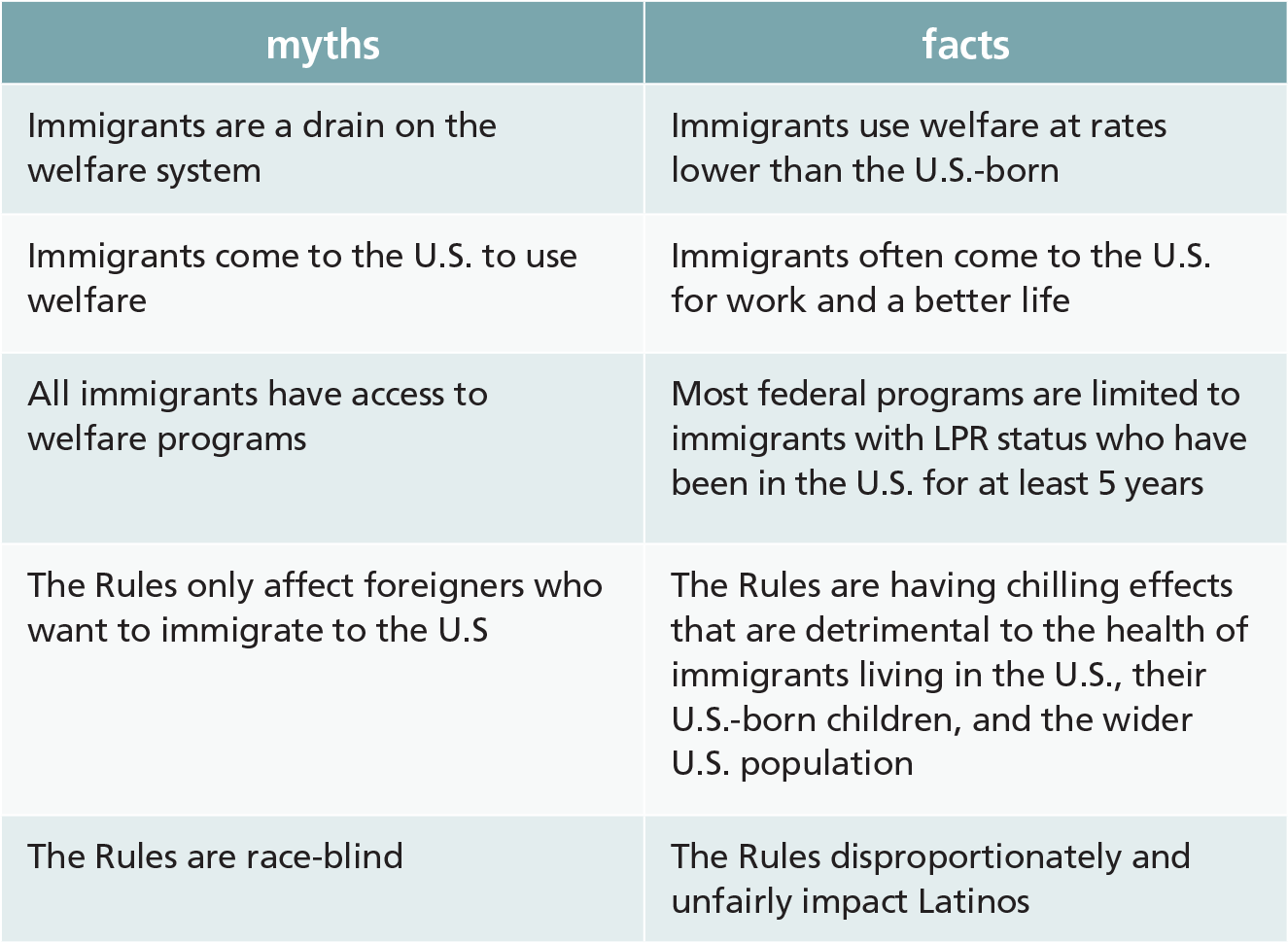
Summary of the Myths Versus Facts of Immigrant Welfare Use and Public Policy
This cavalier attitude is especially troubling during the COVID-19 pandemic. Even though federal agencies state that immigrants, regardless of their legal status, will not be subject to investigation when seeking medical care, anecdotal accounts suggest unwavering fear. Undocumented immigrants recognize that Immigration and Customs Enforcement (ICE) has detained immigrants at doctors’ offices and emergency rooms in the past. Moreover, immigrants are especially vulnerable to the pandemic. Immigrants are over-represented in frontline occupations designated as essential and in sectors with mass employment layoffs, yet they fear seeking help and are often ineligible for stimulus benefits.
Contesting the Rules
On February 2, 2021, the Biden Administration issued an executive order that directed the Secretary of Homeland Security to review the implementation of the public charge grounds of inadmissi-bility. As a result, on March 9, 2021, the DHS determined that the rule “is neither in the public interest nor an efficient use of government resources.” The future of the Public Charge Rule will be a return to the inadmissibility policy that was in place before the 2019 Rule.
Although the legal battles over the public charge rules have been set aside for now, the social forces that promoted them remain. Like many contemporary U.S. immigration policies, the new Rules emerged out of a political movement that continues to frame immigration as a threat to the U.S. As depicted in the table on the left, the Rules are not based on social science evidence about immigrants’ relationship to the U.S. welfare system and appear to rely on myths rather than the facts about immigrants’ use of public assistance. Van Hook and Bean show that consequently, the rules are at odds with their own stated goals to reduce immigrant welfare dependency, which is low already. Instead, they are likely to impose a disproportionate and unfair burden on Latino immigrants. This may not be a coincidence given how President Trump had frequently targeted Latinos for political purposes.
According to Douglas Massey and colleagues, as shown repeatedly, policy changes that are ill-informed are likely to have unintended consequences. In the case of the new Public Charge rules, the Trump Administration attempted to advance policy consistent with their framing of immigrants as a threat to Americans. Even in light of immigration policy changes in the Biden Administration, the sentiments that the rules propose remain a danger as they are unnecessary, unfair, and unsafe.
Kendal Lowrey is a PhD candidate in Sociology and Demography at the Pennsylvania State University. Jennifer Van Hook is Roy C. Buck Professor of Sociology and Demography at the Pennsylvania State University, and non-resident fellow at the Migration Policy Institute. Lowrey’s research interests are focused on immigrant wellbeing, immigration policy, and the demography of immigrants. Van Hook’s research focuses on the demographics of immigrant populations and the socioeconomic integration of immigrants and their children.