



Abstract
The author examines The Politics of Losing: Trump, The Klan, and the Mainstreaming of Resentment by Rory McVeigh and Kevin Estepwere in investigating the changing terrain of White “identity politics.”
Keywords
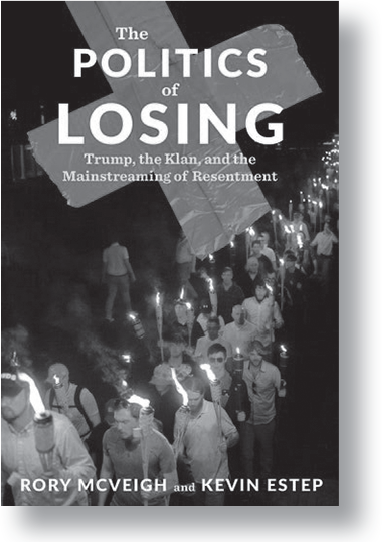
The election of Donald Trump as President of the United States in 2016 led to an immediate flurry of activity among the political punditocracy to attempt to explain this “shocking” outcome. For many, attention focused upon the “forgotten” White working class, whose toxic mixture of racial and class resentment led to a shift in voting that changed the outcome in the key “swing states” that determined the election. On the other hand, social scientists such as Melissa Abrajano and Zoltan Hajnal, Megan Burke, Ashley Jardina, Jonathan Metzl, and Cameron Lippard, Scott Carter, and David Embrick, among many others, were already hard at work investigating the changing terrain of White “identity politics.” Rory McVeigh and Kevin Estep’s The Politics of Losing is a useful addition to this burgeoning literature.
McVeigh and Estep immediately set themselves apart by beginning with a description of a 1923 Klan rally in Indiana. From this event, they segue to the 2016 election of Trump, which becomes the point of departure for a lengthy comparison between the 1920s and the current era. The material on the 1920s era Klan is fascinating and certainly benefits from McVeigh’s earlier work in this area, but what makes it important are the parallels with the present—White independent producers, small business owners, and workers who felt left behind due to the rise of large-scale manufacturing, similar to today’s sentiments spawned by globalization, during a period of economic expansion and facing the perceived threat of displacement by an influx of culturally “different” immigrants (the period between 1880 and 1924 was, along with the past few decades, one of the two great waves of immigration in U.S. history). Anti-immigrant nationalist rhetoric was compelling both to potential Klan recruits in the 1920s and to potential Republican voters in the 21st century (for those who came of age in the 1950s, 1960s, and 1970s, the “foreign born” population of the U.S. was at its ebb tide, and the overwhelming preponderance of the foreign-born were aging European immigrants). What I find particularly engaging about all of this is that McVeigh and Estep use it to pose two fascinating general questions: first, “when and how do White nationalist movements emerge?” (p. 20); and second, “when is the loss of power threatening?” (p. 57). These questions transport us from a consideration of the Trump phenomenon to a broader consideration of the ebb and flow of White nationalism in the United States.
From this foundation, McVeigh and Estep move in Chapter 5 (“Where Trump Found His Base”) to a deep quantitative dive into contemporary White nationalism. What changed? After eliminating a number of possibilities—percent unemployed, percent non-White, median income, percent women in the labor force, percent non-White, and percent “evangelical” Christian—the authors settle upon percent of college graduates per county as the key explanatory or intermediate variable for the other variables. The argu-ment—that educational polarization among Whites was a key factor—is persuasively presented, but at the end of the chapter, I found myself underwhelmed. This is but a small part of the puzzle. In most cases, a 10 percent increase in the percentage of college graduates per county led to a modest but significant decline (3 percent) in votes for Trump. To be fair to the authors, in an election where a shift of less than 80,000 votes in key states out of 136 million votes cast would have changed the outcome, a small change at the margins could have been crucial. However, the bottom line is that despite these key variables, Trump had a core base of support of more than 40 percent of the electorate. I kept returning to the fact that Trump carried a majority of all White groups with the exception of college-educated women. And as the authors themselves demonstrate, the vote for Trump tracks very closely on top of the vote for Romney in 2012 (one of the tightest scatterplots that I recall seeing). So, beyond the modest differences highlighted by the authors, the more salient question is why did a majority of White Americans vote for Trump?
McVeigh and Estep seek to answer the question by highlighting the deep divide within the Republican Party, the reservations of many who voted for Trump (pp. 118-124), and the “unstable alliances” that he would have to contend with as President. From the vantage point of early 2020, I think it is safe to say that the overwhelming majority of the Republican Party, whatever their reservations, have fallen into lockstep behind Trump. Years of racially coded and dog whistle politics have left the Republican Party ethically and morally bankrupt when it comes to issues of racism. At the end of the day, the core issue is not the voters on the margins who may have swung the election in favor of Trump, but the majority of White Americans who supported his candidacy and continue to support his policies.
In the remaining chapters, McVeigh and Estep work to cement their argument that “fear of loss” drives White nationalism. Core issues that they explore (continuing the comparison with the 1920s) include fear of losing political power and fear of cultural/status decline, both of which are measured vis-a-vis the racial/ ethnic other. If there is a populist element to White nationalism, it is in the feeling of being ignored by economic elites (in both parties), yet it generally takes a racialized turn (immigrants) in identifying the source of the problem. And as I have written on before, White nationalism requires a bogeyman, a set of threats both internal and external, ranging from ISIS and the migrant “caravan” to Hollywood and college faculty (and most recently COVID-19 “stay at home orders) to the “liberal” media and politicians of color such as “the Squad.” All of this leads to the final question: “why do movements that we thought were defeated years ago keep returning?” (p. 201).
White nationalism is better understood as fundamental to the entire history of the United States.
To answer this question, we need to move beyond The Politics of Losing, although I think that McVeigh and Estep point us in the right direction when they conclude that the underlying dynamic is White nationalism. I contend that “White nationalism,” which is usually conceptualized as an extremist project, is better understood as fundamental to the entire history of the United States. White nationalist groups and social movements are not separated from the larger society, but are socially, politically, and ideologically connected to the mainstream in ways that reinforce White supremacy. From the first days of the United States, a White nationalist agenda has permeated American politics—from the Naturalization Act of 1790 to the Know Nothing Movement of the 1850s to the rise of the Klan during Reconstruction to immigration restriction movements—there has always been a White political project that has benefitted from White “resentment” and worked to defend White privilege. “Lost power” does not refer to legitimate power, but to power realized via White supremacy in a racialized social system. Trumpism is but the latest manifestation of this project. As historian Carol Anderson notes in White Rage (2016), the assertion of whiteness predictably occurs in response to real or perceived gains made by oppressed minorities. McVeigh and Estep recognize this, as they refer to other instances of White assertion (e.g., during Reconstruction), but they ultimately fail to connect the dots in a manner that encompasses the totality of U.S. history.
In many ways, McVeigh and Estep’s The Politics of Losing points to a bleak future as “White” Americans become more militant in the face of the “fear” of social, political, and demographic changes.
It is frightfully easy to envision a descent into fascism as Trumpism becomes more virulent, and conservative Republicans become accommodationist to the point of being willing to jettison democracy in order to maintain a grasp on state power.
It is frightfully easy to envision a descent into fascism as Trumpism becomes more virulent, and conservative Republicans become accommodationist to the point of being willing to jettison democracy in order to maintain a grasp on state power. As W.E.B. Du Bois (quoted by McVeigh and Estep on p. 227) observed in 1926, “the Ku Klux Klan is doing a job which the American people, or certainly a considerable portion of them, want done.” In the final analysis, we are talking about the confluence between White nationalism and the history of the United States.