



Abstract
The authors of this article are both sociologists working just 10 miles from Harrisonburg, Virginia—the scene of the Ivan Teleguz case—which involved a host of topical issues, from fears of organized Russian criminal activity in the United States to American xenophobia about migrant-perpetrated violence. The authors dove into a qualitative analysis of all relevant trial transcripts and court filings, certain that they would find Teleguz cast as the villain of this courtroom drama. What they did not anticipate, however, was who emerged from the trial narrative as its hero: the hired killer.

On the afternoon of April 20, 2017, Ivan Teleguz’s life was spared. 11 years earlier, he had been sentenced to death for hiring two men to murder Stephanie Sipe, his ex-girlfriend and the mother of their child, in the poultry-processing town of Harrisonburg, Virginia. However, just five days before the scheduled execution, Terry McAuliffe, then-governor of Virginia, announced that he was commuting Teleguz’s sentence to life in prison without the possibility of parole.
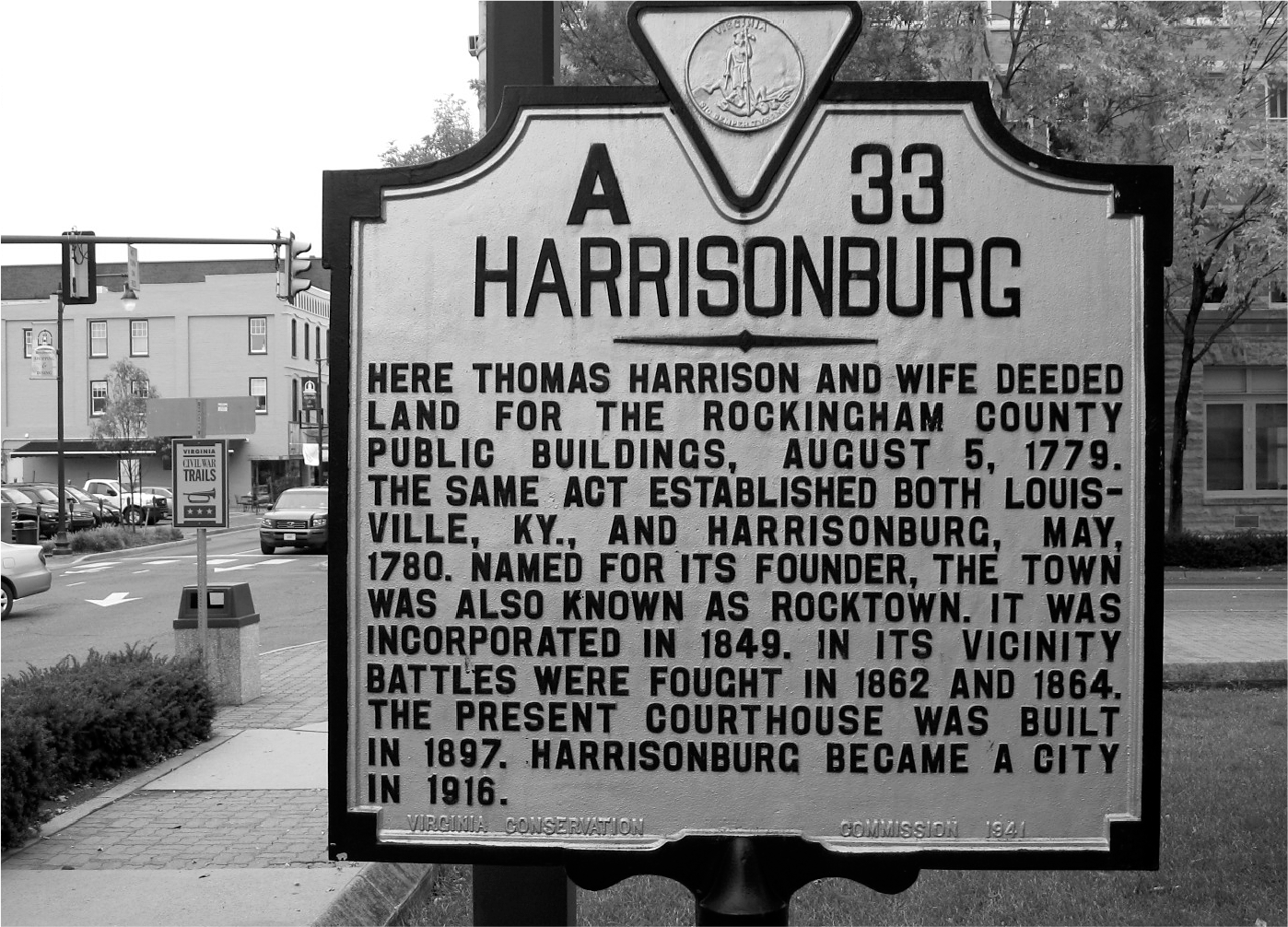
A short history of Harrisonburg, Virginia.
Doug Kerr, Flickr cc
What we did not anticipate, though, was who emerged from the trial narrative as its hero: the hired killer.
Though McAuliffe made clear his belief that Teleguz was guilty of the crime, he declared the sentencing phase of the trial “terribly flawed and unfair.” Specifically, McAuliffe cited as “false, plain and simple,” the local commonwealth attorney’s repeated, unsubstantiated claims that Teleguz, a Ukrainian-American immigrant, was a member of “the Russian mafia” who had also orchestrated a mob-style execution in Pennsylvania—a homicide that never occurred. “The jury should never have been given that information,” McAuliffe concluded at his press conference.
As sociologists working just 10 miles from Harrisonburg, we were intrigued by the Teleguz case, which involved a host of topical issues, from fears of organized Russian criminal activity in the United States to American xenophobia about migrant-perpetrated violence. We dove into a qualitative analysis of all relevant trial transcripts and court filings, certain that we would find Teleguz cast as the villain of this courtroom drama. What we did not anticipate, though, was who emerged from the trial narrative as its hero: the hired killer.
Michael Hetrick, a White college dropout and petty drug dealer, was the star witness implicating Teleguz as the mastermind behind the murder that Hetrick actually committed. Throughout the trial, the prosecution presented Hetrick as an average Joe in direct contrast with the foreign “Otherness” of Teleguz. Though Hetrick was an out-of-state drifter who had committed homicide, he was made to seem like a thoroughly relatable local boy victimized and led astray by a dangerous outsider. By the trial’s end, Hetrick’s supposedly benevolent self-sacrifice in helping the community purge itself of an alien agent’s mayhem somehow redeemed even his butchering of Sipe, a young mother and lifelong Harrisonburg resident.
The Teleguz trial thus complicates oversimplified accounts of rural America in the wake of the 2016 election. Specifically, our study of the case has unearthed an overlooked social fact lurking within these communities: masculinity is so centrally important to White working-class identity that even a man who commits a seemingly treasonous act, like the murder of a local woman, can still somehow be cast as a community protector against perceived external threats. To best understand the “White working-class,” then, we must examine how gender, especially masculinity, intersects with race and class.
The Scene of the Crime
Harrisonburg is located in the heart of Virginia’s Shenan-doah Valley, a region that has a long history of ethnic and geographic isolation from surrounding areas. The town, which lies between the Alleghany and Blue Ridge mountain ranges, was settled by various strands of the German Mennonite church during the colonial era. As a community, it was characterized for centuries by traditionalist, agrarian life organized around apple orchards and poultry farming.
In the second half of the 20th century, however, Harri-sonburg began a period of relatively rapid change. Family-run agricultural operations were increasingly displaced by large-scale poultry-processing factories. By the 1990s, the biggest names in mass food production, like Cargill and Tyson, had taken over the industrial landscape, replacing a previously unionized workforce with more easily exploitable labor. As a result, growing numbers of immigrants began arriving, willing to accept worsened employment conditions in order to gain a foothold in the local economy.
Among these emigres was a small number of Russians and Ukrainians who left their village lives behind to escape state-sponsored religious persecution in the former Soviet Union. And while they, like the locals, were White, hard-working, socially-conservative, and God-fearing, their seeming insularity and relative upward mobility were met with suspicion. Media outlets from Education Week to a local NPR affiliate described a “culture clash” developing between Harrisonburg townsfolk and an enclave of former Soviets that seemed to hide secrets.
By the 1990s, the biggest names in mass food production, like Tyson, whose plant is pictured here, had taken over the industrial landscape of Harrisonburg.
Taber Andrew Bain, Flickr cc

To help explain this kind of conflict, sociologist Arlie Russell Hochschild has introduced the concept of “the deep story,” a “language of symbols” that offers a “subjective prism” through which communities understand their social reality. Lake Charles, Louisiana—which Hochschild chronicles in her recent bestseller, Strangers in the Their Own Land—has many parallels with Har-risonburg. Similarly ravaged by corporate consolidation and industrial deregulation, both Harrisonburg and Lake Charles are typical of rural Southern towns whose rank-and-file citizenry have endured a decades-long process of downward mobility. Hochschild argues that the deep story in places like these involves the metaphor of standing in line: local folk see themselves as having patiently waited their turn to access the American Dream, only to find themselves increasingly displaced by various groups of “line cutters,” especially immigrants and refugees. Along these lines, law professor Joan Williams, in her influential 2017 book, White Working Class, argues that rising anti-immigrant sentiment in such communities has coincided with the citizenry’s sense of a “fall from blue-collar grace” as steady jobs have been eroded over the past several decades.
Amidst these sorts of tensions, the Teleguz family, a Ukrainian Pentecostal household that included 16-year-old Ivan, arrived in Harrisonburg in 1995. Within four years of his arrival, Ivan met Stephanie Sipe, a high-school girl from a local family, and the two were expecting a child less than a year later. Their relationship was short-lived, though, as Ivan departed for Pennsylvania with his family during Sipe’s pregnancy, informing her that he did not want to raise the child. At trial, Sipe’s mother would recount only seeing Teleguz once after Sipe gave birth, when he briefly returned to try and convince Sipe to abandon the baby and leave with him.
On a summer’s day in 2001, Sipe’s mother discovered her daughter’s dead body inside the latter’s Harrisonburg apartment, with Sipe’s unharmed 23-month-old son, Zachary, still in a water-filled bathtub from the morning before, when Sipe had been slain. The murder scene was so bloody that photos from it are still used to prepare Harrisonburg police trainees for the grotesque situations they may encounter on the job. While investigators immediately singled out Teleguz as the likeliest culprit, a lack of any direct forensic evidence linking him to the crime stymied their case.
It took until 2004 for law enforcement to receive the break they had been looking for: a Kazakhstani acquaintance of Teleguz’s, hoping to avoid deportation for charges related to illegal firearms dealing as well as for overstaying his visa, claimed to have rejected an offer made by Teleguz to murder Sipe for money. He named Edwin Gilkes, an African American who lived in the same Pennsylvania town as Teleguz, as the possible culprit. An interview with Gilkes led Harrisonburg PD to Michael Hetrick, the sole perpetrator whose blood and DNA they retrieved from Sipe’s apartment. Both Gilkes and Hetrick explained their involvement as rooted in fear for their own lives, having signed-up for a $1,000 hit job sponsored by a callous “Russian mafia” member named Ivan Teleguz.
These allegations of a murder-for-hire orchestrated by an immigrant outsider were convincing to the homicide’s investigators: Teleguz was immediately apprehended from Washington state (where he had since relocated) and extradited back to Harrisonburg to face a charge of capital murder. The local community’s deep story that a malevolent foreign agent was responsible for corrupting the social order was seemingly borne out.
Trial Tales
The Commonwealth of Virginia vs. Ivan Teleguz began in February 2006. Over the previous 16 months, a grand jury had indicted Teleguz on all charges, and Judge John J. McGrath, Jr. had contributed to a prosecutorial home-court advantage through several pre-trial rulings. Specifically, McGrath approved a deal brokered by the lead prosecutor, Marcia Garst, that ensured Hetrick would testify on behalf of the Commonwealth provided they agreed not to seek the death penalty against him. Further, McGrath allowed Garst to introduce the unsubstantiated references to “the Russian Mafia,” which ultimately became the basis for the governor’s commutation of Teleguz’s death sentence. These decisions set the stage for a courtroom drama whose climactic conflict pit Hetrick, the proxy local hero, against Teleguz, the villainous outsider.
Across the various proceedings, both sides invested heavily in impression management, or “legal face work,” to juxtapose the pair at the center of this case. For the prosecution, Hetrick became Harrisonburg’s redeemer, the one person who could paradoxically bring forth justice on behalf of the woman he had killed, while Teleguz was demonized as a sociopathic foreigner responsible for helping destroy the fabric of the local community. Meanwhile, defense counsel presented Hetrick as an opportunist who simply sought to save his own life by implicating an innocent immigrant and Teleguz’s attorneys attempted to portray Teleguz as a God-fearing family man, calling several of his humblest and most modest relatives to the stand. Noticeably absent in this duel was much, if any, discussion of Sipe, whose presence at trial was mostly limited to crime scene photographs of her mutilated, lifeless body.
Ultimately, the prosecution won over the jurors. Criminolo-gist James W. Messerschmidt’s concept of “structured action” helps explain this outcome: Messerschmidt describes crime as a performance, or “accomplishment,” of identity, whether gender, race, and/or class, that exposes the ways social structure is always woven into individual action. In this case, Hetrick’s murder of a local woman became legible through Garst’s trial tale, which framed the homicide as a performance of White working-class masculine virtue amidst the malevolence of outsiders. Garst thus reconstituted Hetrick’s crime as an accomplishment of community identity
...the Commonwealth was successful because its characterization of Hetrick, even at his worst, more closely fit the larger social conditions and concerns of the Harrisonburg community.
Put differently, the Commonwealth was successful because its characterization of Hetrick, even at his worst, more closely fit the larger social conditions and concerns of the Harrisonburg community.
To accomplish this feat, the prosecution spoke to the very beliefs about gender, race, and class that Hochschild and Williams identify as central to contemporary rural America. For Hochschild, the deep story in communities like Harrisonburg includes celebration of a nostalgic, romanticized ideal of manhood that is closely associated with pride in work, traditional values, and the pursuit of honor through sacrifice. Williams deepens this persona by distinguishing between “good men” and “real men,” the latter being preferred by the “White working-class” since they take charge and act authoritatively, suppressing any weaknesses—even basic moral principles—to do what is needed.
Accordingly, Garst ensured that Hetrick presented himself to the jury as diligent and reliable to a fault. During his testimony, Hetrick claimed that Gilkes was originally enlisted to commit the actual murder, and that his role was merely to “keep [Gilkes] in line to make sure that he completed the job, that things got done the way they were supposed to.” Here, words like “job” and “things” come to stand in for the far more brutal reality of wielding a knife to slash and stab Sipe to death. And when the duo arrived at Sipe’s apartment and Gilkes got cold feet, ever-responsible Hetrick stepped up to the plate, as he “was afraid that what we were supposed to do wouldn’t get done.”
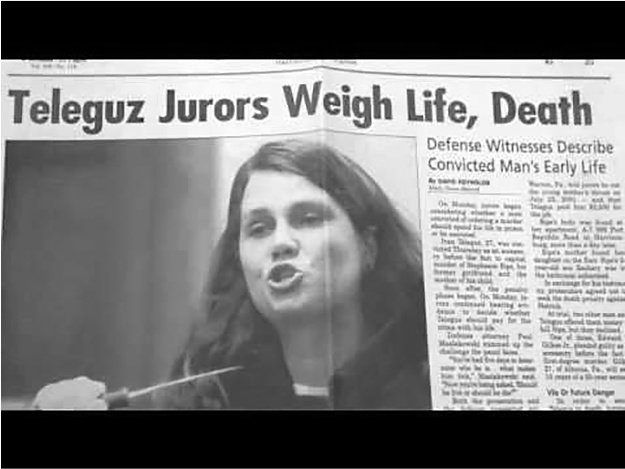
The headline of a local newspaper in Harrisonburg highlighting the Ivan Teleguz trial.
Garst was careful not to probe too deeply into Hetrick’s terminology for describing cold-blooded murder. After all, such workmanlike language helped keep Sipe further from the collective consciousness of the courtroom while reinforcing the idea that Hetrick was simply an industrious young man. Garst even parroted this lingo herself during closing arguments, citing Sipe’s defensive wounds from a struggle with Hetrick and rhetorically asking if that carnage was “consistent with somebody that knows how to kill?” She answers, “No. It’s consistent with somebody’s who’s [...] trying to do what’s to be done,” repeating Hetrick’s own euphemistic language, and absolving him from moral culpability in Sipe’s murder.
In fact, Hetrick was able to cloak his resolve to kill Sipe in valor, stating: “[...] If we didn’t go through with it, [Gilkes] and I would die in her place. We knew too much. I was afraid of Ivan Teleguz, ma’am. [...] I felt very seriously that [Teleguz] would kill us.” Hetrick was thus not committing murder in cold blood, but out of an obligation to save Gilkes and himself, two lives that at the grand jury hearing he claimed Gilkes “was sacrificing” through dereliction of duty.
Indeed, the number of lives Hetrick seemed to save increased to three when Garst painted Hetrick as heroically restrained for not harming Sipe’s son, Zachary. In closing statements, she described Hetrick as “mad” that, unbeknownst to him, Teleguz sent him and Gilkes to a home containing a young child. She then repeated Hetrick’s earlier testimony, “He’s a kid, ma’am. He did nothing to me.” Given the prosecution’s insistence that Teleguz’s motive was the avoidance of child support, Hetrick thus came to embody more appropriate family values than Teleguz: he described child support as a necessary sacrifice “people [make] to support their own kids.” Such humane reasoning, when combined with Sipe’s mother’s testimony about Teleguz’s deadbeat delinquency and defense counsel’s request for a paternity test for Zachary, perversely made Hetrick seem an almost more suitable father to the boy whose mother he had killed than the boy’s biological father.
The jury thus witnessed the complete redemption of Michael J. Hetrick. As Garst put it, Hetrick was “no Baptist minister or boy scout” and may have even seemed “repulsive,” but he was really a down-on-his-luck hired hand caught in the tangled web of a monster. Over the course of the trial, he had become a scion for local White working-class men—with their attendant virtues and excusable misgivings—who were routinely misunderstood and manipulated by outsiders. Hetrick was, at worst, a sympathetic victim of circumstances, and more likely a community shield helping rid the town of a pressing social ill.
Meanwhile, Sipe herself was almost nowhere to be found other than as a bloody corpse in evidentiary photos or as a faceless maternal figure to Zachary. Garst delivered a bit of a generic eulogy about the tragedy of Sipe’s death in her closing arguments but firmly embedded it in the context of a lamentation about the boy who would grow up motherless. Even Teleguz seemed to recede from the proceedings, consistently overshadowed by the rising prominence of Hetrick. This marginality was only worsened by the fact that Teleguz refused to take the witness stand and thus remained completely evil, foreign, and inassimilable on the courtroom stage. His attorneys, sensing defeat, could only resort to abstract pleas about the Constitutional principle of reasonable doubt. With relative haste, the jury found Teleguz guilty, and sentenced him to death.
Community Service
Amongst the thousands of pages of court documents that we analyzed, there is not a single explicit mention of the phrase “White working-class.” This is not altogether surprising, as the Teleguz trial took place a full decade before the 2016 presidential election, when that demographic label became a household term. However, by employing Messerschmidt’s conceptual framework of structured action, our research evaluated this courtroom drama within the context of a community forging an identity in response to various social forces, including downward mobility, increased immigration, and cultural change. The Commonwealth of Virginia vs. Ivan Teleguz thus represents an important extension of recent scholarship on the White working-class and its deep story.
For instance, Hochschild observes that White working-class manliness is, “at the core,” predicated on being willing to lose one’s life in battle or using one’s strength to protect the weak— qualities clearly embedded in the trial narrative. Hetrick was consistently identified as the one who stepped up to do the job when Gilkes lost his nerve, and it was Hetrick’s supposedly honorable sacrifice that helped save the Harrisonburg community by turning in, and testifying against, the “Russian mafia” monster. At the same time, Garst’s closing statements offer a textbook example of Williams’ “good men” vs. “real men” distinction; though Garst acknowledged that jurors may have found Hetrick “repulsive,” she credited him for ridding them all of Teleguz by doing the right thing and so bringing justice for Sipe. In short, Hetrick may not be a good man, but at least he’s a real man.
Further, by viewing the Teleguz case through the lens of structured action, we are able to follow the findings of Hoch-schild and Williams to their logical end: masculinity may be so crucial to White working-class identity as to be constitutive of it. For instance, we can explore more deeply Hochschild’s assertion that “pride in the self of the deep story” underlies all other bases of White working-class honor—Hochschild does not state the gender of this “self,” but the centrality of masculine virtue to constructions of Hetrick’s heroism at trial hints at the assumed masculinity of the metaphorical subject standing in line. And though Williams claims that sexism is “a pervasive problem that crosses class lines,” the stunning erasure of Sipe from legal proceedings about her own death underscores the background positioning of womanhood in the “White working-class” vis-avis the seemingly essential structured actions of men.
Thus, this crime saga offers an unusually candid glimpse into the interweaving of social structure, community identity, and individual action. Even if the prosecution chose their narratives simply as a trial strategy to secure a conviction, such storytelling could only work if it met a receptive audience. And in February 2006, a courtroom of rural Southern folks willingly—if unwittingly—bought in, transforming a bloody killer into an embodiment of masculine virtue who helped them purge a monstrous outsider and redeem the elimination of a woman’s life. Reduced to its simplest form—as a contest of existential value—he won. Ultimately, the Teleguz case reveals that the intersection of race and class known as the “White working-class” is always already imbued with gender politics. What lies beneath the deep story of a community like Harrisonburg may not be good, but it is real.
Footnotes
Acknowledgements
The authors thank the Virginia Capital Representation Resource Center for sharing case-related documents, Bridgewa-ter College’s administration for granting sabbatical leave, and Gretchen York for providing editorial assistance.