



Abstract
While there is a scholarly consensus on sexism's critical role in contemporary society, we know little about the basic facts regarding sexist attitudes. How widespread is sexism in America? Which Americans are most sexist? Is sexism limited to men, or do many women also express sexist attitudes? Here, the authors answer these questions and more.
The 2016 presidential election highlighted the prevalence of sexism in American society. The contest not only featured the first woman running as a major-party nominee, but also a male Republican nominee who frequently made sexist remarks on the campaign trail. Through a litany of studies, it’s evident that sexist attitudes had a strong effect on voting decisions in 2016. Sexist views coincided with an increase in support for Trump and sexism appeared to again be an important predictor of the vote in the 2018 midterm elections. Sexism also shaped how Americans responded to the #MeToo movement and controversy over the confirmation of Brett Kavanaugh to the Supreme Court.
While there is scholarly consensus on the critical role that sexism plays in contemporary society, we know little about the basic facts regarding sexist attitudes. For instance, how widespread is sexism in America? Which Americans are most sexist? Is sexism limited to men, or do many women also express sexist attitudes?
The most prominent measure of sexism is the Ambivalent Sexism Inventory (ASI). The ASI was developed by psychologists Peter Glick and Susan Fiske and measures two dimensions of sexism: hostile and benevolent. Hostile sexism is founded on the belief that women’s incompetence and inferiority make them incapable of holding positions of authority. This dimension of sexism stokes negative attitudes toward norm-violating women by asking whether individuals agree with statements like “women are too easily offended” or “women seek to gain power by getting control over men.” Benevolent sexism, on the other hand, is a set of stereotypical beliefs toward women that express a sense of protective paternalism and chivalry. These beliefs rely upon traditional gender roles to place women on pedestals. People who score higher on benevolent sexism tend to agree with statements like “women should be cherished and protected by men,” and “a good woman should be set on a pedestal by her man.”
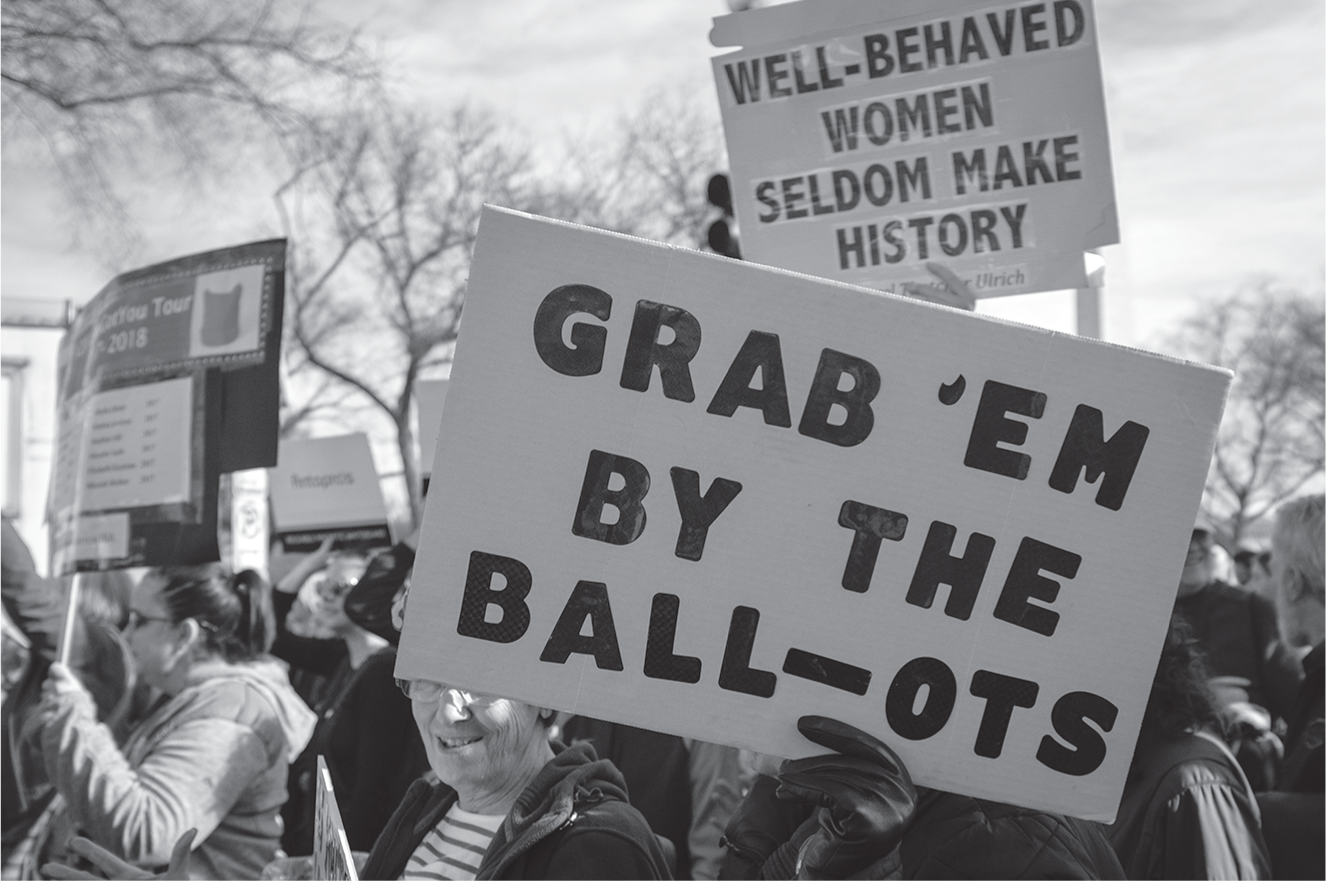
A poster at the 2018 Women’s March—a march that began occuring annually after in January after Trump was elected in 2016—with a play on words that highlights sexist statements by Trump during his candidacy.
ep_jhu via Flickr
Studies of vote choice in the 2016 election demonstrate that hostile sexism played a strong role, while the effects of benevolent sexism were less important. Indeed, benevolent sexism is often overlooked as the less negative of the two dimensions of sexism; however, its effects are not benign. Benevolent sexism minimizes agency, perpetuates marginal-ization, and constrains women’s ability to attain leadership positions.
Prior to the 2016 election, the study of sexism was most prevalent in the field of social psychology, where scholars typically rely on convenience samples. Accordingly, few sources provide representative data on how much sexism exists amongst the American public and for which demographics sexism is most prevalent. To address this shortcoming, we fielded a nationally representative survey of 993 American adults on July 31 and August 1, 2019. The survey was weighted to ensure that it reflects the American adult population on factors such as education, race, age, sex, and region. Our survey included the full 22-item ASI.
How prevalent is sexism among American adults? To determine this, we calculated the average response given by each individual to the hostile and benevolent sexism items. We show how Americans are distributed based on their average responses in the plot above. For example, people tend to cluster around the midpoint of the benevolent sexism scale—three-fourths of Americans average either an “agree slightly” or “disagree slightly” response to the benevolent sexism items. In other words, people appear to feel less strongly about statements related to benevolent sexism; they neither strongly endorse nor strongly object to such statements.
Average responses to hostile and benevolent sexism items
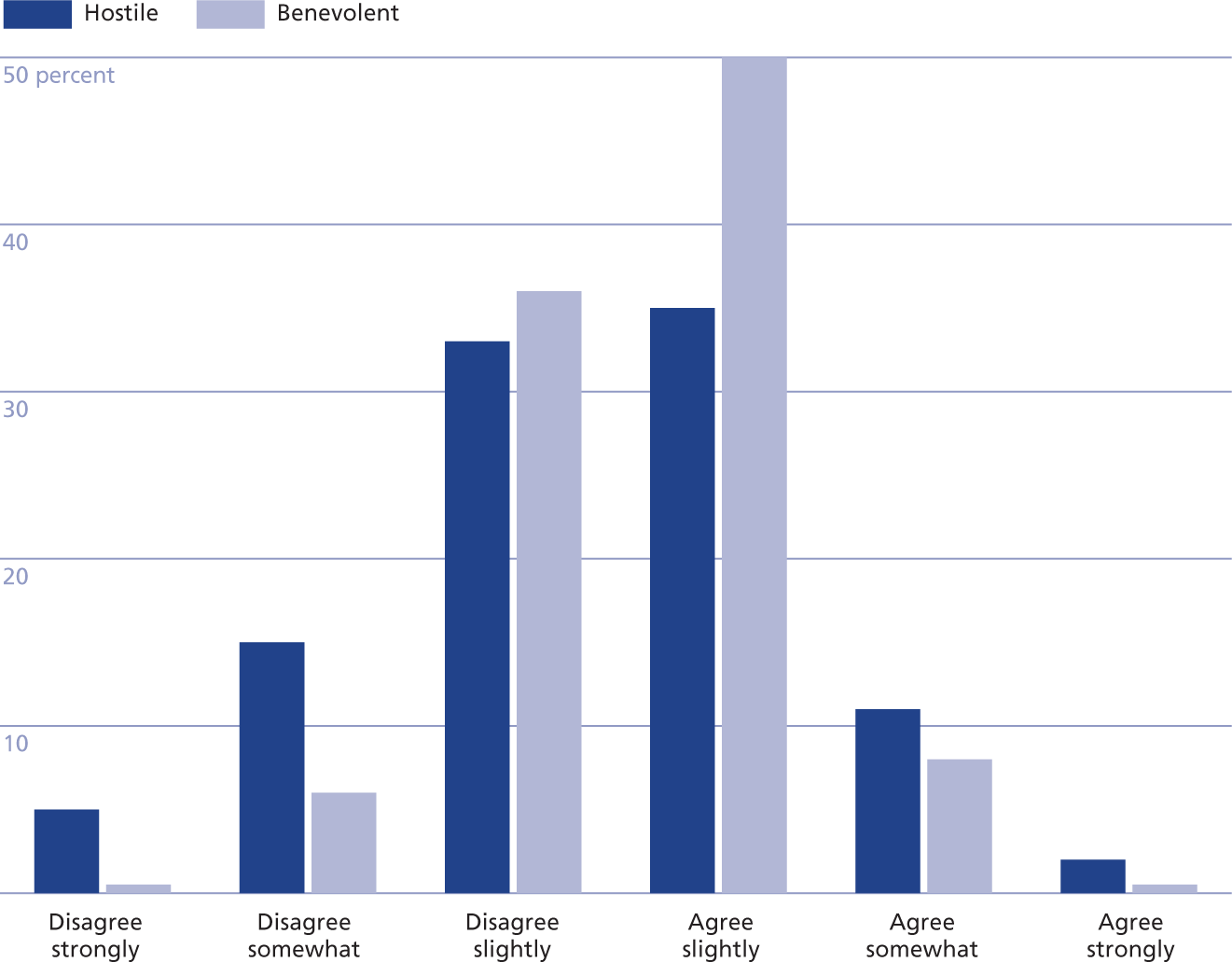
There is more variation in how people score when it comes to hostile sexism, with fewer Americans clustering around the midpoint of that scale and more responses recorded on the extremes. About one-fifth of Americans somewhat or strongly disagree with hostile sexism statements on average while another 12 percent strongly or somewhat agree with such statements. Nearly half of Americans at least slightly agree with the hostile sexist statements.
Notably, hostile and benevolent are distinct types of sexism. In fact, the two scales correlate at.14, which means that how one scores on benevolent sexism has little bearing on how they score on hostile sexism—and vice versa. To gain a better sense of what this means for how sexism is distributed among American adults, we divided respondents into four groups: (1) those who disagree with both benevolent and hostile sexist items; (2) agree with benevolent but not hostile sexist items; (3) agree with hostile but not benevolent sexist items; and (4) agree with both benevolent and hostile sexist items. Only 26 percent of the sample tended to disagree with both the hostile and benevolent sexism items. By contrast, nearly one-third of Americans (32 percent) agree with both hostile and benevolent sexism items more often than not. 27 percent of Americans score as benevolent but not hostile sexists, while the remaining 16 percent are hostile sexists but score below the midpoint on the benevolent sexism scale.
Even in 2020, a large percentage of Americans continue to agree with statements designed to capture both hostile and benevolent sexism.
What explains the variance in sexism? Two factors that we might expect to be associated with sexism—especially hostile sexism—are sex and education. Sex is an obvious culprit, given that the scales are designed to measure prejudice towards women. As the target group in these statements, it is reasonable to expect that women would generally express less sexism than men. Yet, women are not unified in their attitudes, meaning that many may hold sexist views themselves.
Higher education is typically associated with lower levels of prejudice toward all groups. Attending college increases the openness of an individual to less prejudiced attitudes by increasing the contact people have with diverse individuals and viewpoints. Furthermore, at institutions for higher education, individuals are exposed to stronger norms against prejudice. Education might matter more for how one scores on hostile sexism than for benevolent sexism, though, since the benevolent sexism items can generally be viewed as positive. For example, while it may not be socially acceptable to agree that “women are too easily offended,” it is likely acceptable even in well-educated communities to agree that “women, as compared to men, tend to have a more refined sense of culture and good taste.”
The figure below plots the average agreement with hostile sexist and benevolent sexist statements by sex and education. Again, higher values on the y-axis indicate stronger agreement with these statements (and therefore more sexism) while lower values are stronger disagreement (and thus less sexism). The points in each plot represent the average score for both men and women by four educational groupings and the vertical lines are 95 percent confidence intervals, which show the range within which we can be confident each group’s mean score falls. There are several interesting patterns, especially when it comes to hostile sexism. First, on average, men are more likely to agree with hostile sexism statements compared to women. However, the gap is not as large as one might expect. On average, men score about four-tenths of a point higher on the 1-to-6 hostile sexism scale than women do.
Hostile sexism
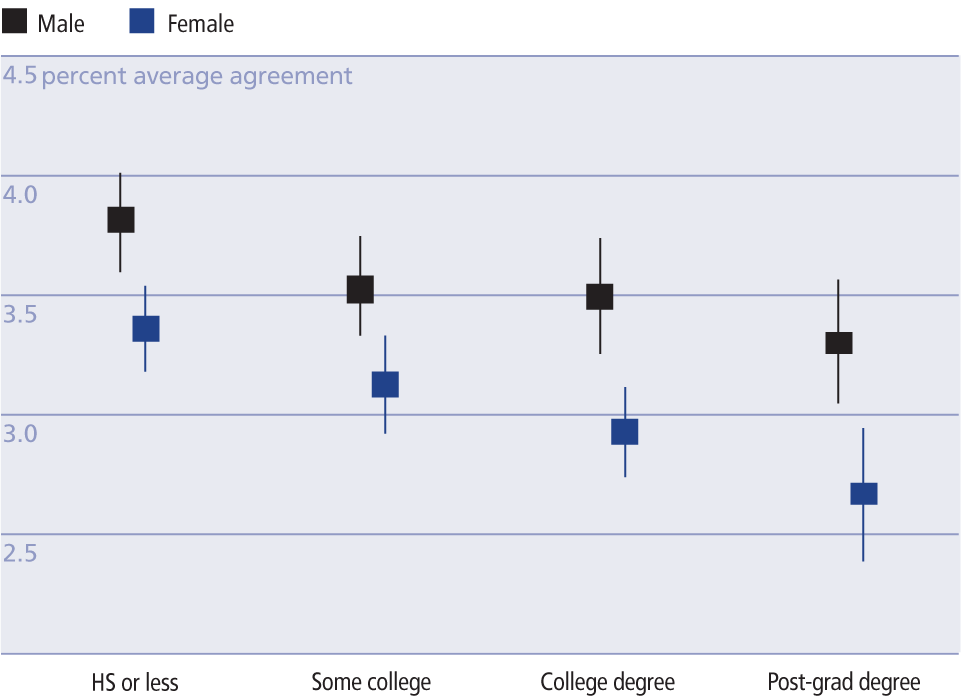
As expected, people with higher levels of formal education are less likely to agree with hostile sexist statements. The effect of education is especially large for women. Women with a postgraduate degree scored about.7 points lower on the 1-to-6 hostile sexism scale than women with a high school degree or less. By contrast, education has a more muted effect on men. Men with any exposure to college score about one-quarter of a point lower in hostile sexism. The effect of additional education is fairly limited, though. In fact, the gap in hostile sexism between men and women is largest among Americans with postgraduate degrees. Women with postgraduate degrees are more than a half point less sexist than their male counterparts.
Benevolent sexism
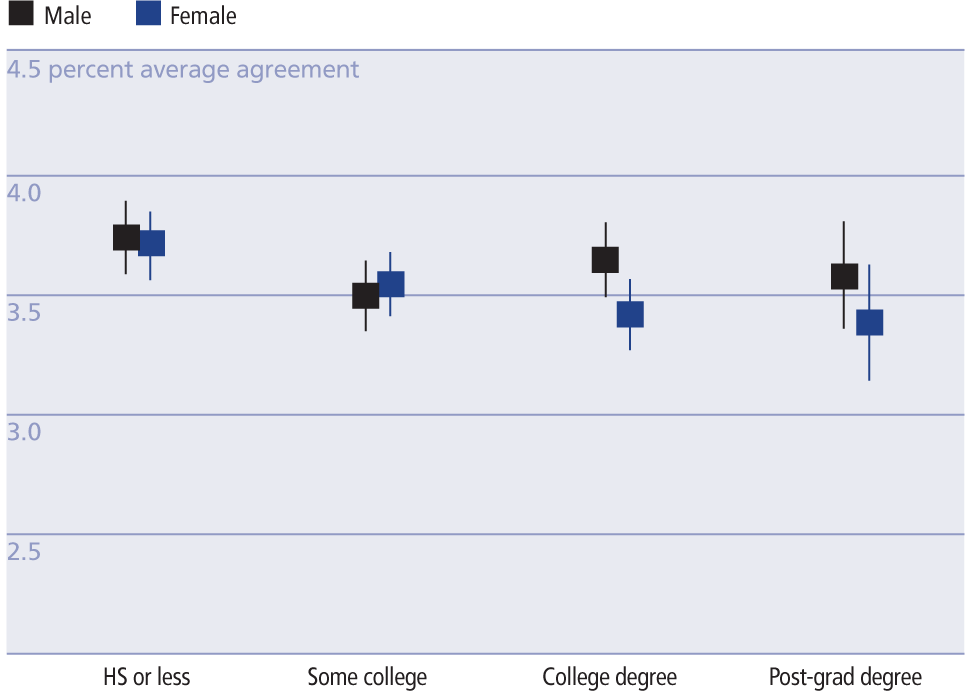
Unlike with hostile sexism, there appears to be little difference in benevolent sexism based on sex or education. Having at least some exposure to college does slightly decrease the amount of benevolent sexism one expresses, but the size of the effect is marginal. Women and men produce similar scores across all levels of education, generally hovering around the midpoint of the benevolent sexism scale.
Even in 2020, a large percentage of Americans continue to agree with statements designed to capture both hostile and benevolent sexism. Exposure to higher education appears to tamper, to some degree, hostile sexist viewpoints, but plays only a modest role in reducing benevolent sexism. Given the significance of hostile sexism in predicting support for Donald Trump and Republican candidates in recent elections, it is instructive to consider how American adults are divided largely along the lines of sex and education when it comes to their adherence to hostile sexism. This suggests that if sexism continues to play a major role in future elections, the gender and education gap between Republicans and Democrats will continue to grow even larger.