




Abstract
“Consumption of bat meat has been at the center of COVID-19 discussions. However, it is not the first time that the eating of bat meat has been debated as it has also been linked to other diseases like SARS, MERS, and Ebola. However, COVID-19 has once again put bat meat under the radar of suspicion and reignited the debate of whether or not it is fit for consumption.”
“Revolting footage shows Chinese woman eating a whole bat at a fancy restaurant as scientists link the deadly coronavirus to the flying mammals.”
The quote above is a headline from a news article published on January 23, 2020 in the United Kingdom’s Daily Mail. Food has been at the center of deliberations on COVID-19, especially bat meat. After the outbreak of the novel coronavirus in Wuhan, China in December 2019, there has been a debate on where the disease originated and how it has spread to other parts of the globe.
Consumption of bat meat has been at the center of these discussions. However, it is not the first time that the eating of bat meat has been debated as it has also been linked to other diseases like SARS, MERS, and Ebola, according to undark.org. COVID-19 has once again put bat meat under the radar of suspicion and reignited debates of whether or not it is fit for consumption.
Historically, bat meat has been consumed in many parts of the world, including Africa, Asia, Oceania, and Central and South America. According to a Reuters article about bat meat, it is still very popular in many countries like Indonesia, where the Minahasans of North Sulawesi eat bats in a curry-like dish known as Paniki. Even the outbreak of COVID-19 had not affected its sale. Mildenstein and colleagues have also noted in their book, Exploitation of Bats for Bushmeat and Medicine, that bats are hunted and consumed in these places for various other reasons like exotic eating experiences and medicinal properties apart from its regular eating.
In Assam (a north-eastern state in India), for instance, it is believed that eating bat meat has medicinal properties and cures asthma. Namima Kalita, a practitioner of traditional medicine from Pathshala (a town in Assam) said that “eating bat meat can cure many diseases like asthma. I have recommended it to many severe asthma patients who have come back and told me that they have been able to control it after eating bat meat.”
I have known about the medicinal usage of bat meat since 2007, through a family I am acquainted with. In a telephonic interview, the father, who does not wish to be named, shared, “we got it in a village market and cooked it like any other meat. Since both my daughters have asthma, we gave it a try… it is not uncommon to eat bat meat to treat respiratory disorders. My daughters have found significant relief after that. Although they still use inhalers, the quantity has reduced.”
What is interesting to note was his reaction when I asked him questions about eating bat meat after so many years. He was surprised and said, “There is no prohibition on eating bat meat. It is not unusual.” Consumption of bat meat in Assam as a common practice has been shown in popular culture as well. For instance, in the Assamese movie Aamis, in one of the scenes, the two protagonists are shown enjoying a delicious meal of bat meat.
Similarly, in the neighboring state of Meghalaya, bat meat is seen as healthy. In 2013, the Hindustan Times reported that Meghalaya’s governor, Ranjit Shek-har Mooshahary, said that “the caves of Meghalaya have bats that can yield healthy meat rich in proteins.”
A still from the movie Aamis where the two protagonists are enjoying a delicious meal of bat meat.

Eating bat meat is not restricted to China alone as these examples from Indonesia, Assam, and Meghalaya illustrate. However, most news articles on COVID-19 primarily focused on the Chinese culture of bat consumption, blaming them for the virus.
Hence a lot of racism was directed towards the food habits of the Chinese. For instance, as reported in a March 2020 Washington Post article, John Cornyn, a senator of the United States of America (USA), criticized Chinese eating habits saying, “China is to blame because of the culture where people eat bats, snakes, dogs and things like that.” Similarly, it was reported in a March 2020 Time article and an April 2020 The Conversation article that the President of the USA, Donald Trump had called the novel coronavirus a “Chinese virus” and “Wuhan virus” several times. There was a linking of the virus with a particular ethnic group, that is, the Chinese.
Historically, bat meat has been consumed in many parts of the world, including Africa, Asia, Oceania, and Central and South America.
It is perhaps not surprising that the Chinese in the USA drew racist ire, keeping in mind the historical relationship between the two countries. According to Kim’s 2015 Dangerous Crossings: Race, Species, and Nature in a Multicultural Age, both China and the USA are in a continuous battle to assert their supremacy in world geopolitics and thus, accusing each other of devastating actions is part of it. In the process, common citizens suffer, and using the Chinese as a scapegoat during COVID-19 reflects this. For instance, there are certain perceptions about the Chinese in the USA. Kim notes that they are seen as immigrants—the ‘others’ often associated with ‘infections’ and ‘diseases.’
Chinese food, also, is considered ‘different’ and ‘uncivilized.’ Chinese eating habits have been typecast as ‘different’ even before the COVID-19 pandemic. There were large-scale protests by animal rights activists against the sale of live animals in San Francisco’s Chinatown in the 1990s. Kim has also noted that the sale of live animals was seen as a ‘cruel’ and ‘inhuman’ practice by the protesters, which raised the question of who gets to decide what is ‘cruel’ and what is not.
This process of ‘othering’ is also visible in everyday life. For instance, a January 31, 2020 Washington Post perspective piece discussed the stereotypes around Chinese food. An American who was interviewed stated, “my father said he wouldn’t eat at any place run by Chinese. You can’t trust what they will try to pass for meat.”
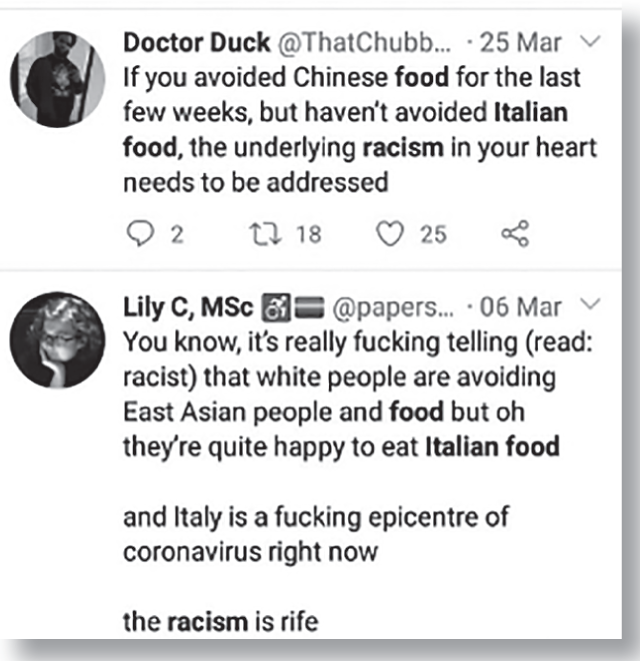
Chinese food is constantly ‘othered.’ Therefore, it was convenient to blame Chinese eating habits for the COVID-19 crisis. According to a February 2020 Daily Mail article, many Chinese restaurants across the world, including in the USA, closed as people began to draw a false equivalence between Chinese food and COVID-19. Many social media users called out this behavior as racist, drawing comparison to the fact that Italian restaurants and eateries did not arouse the same fears, even when Italy had become the epicenter.
A screenshot showing tweets from two twitter users calling out racism against the Chinese.
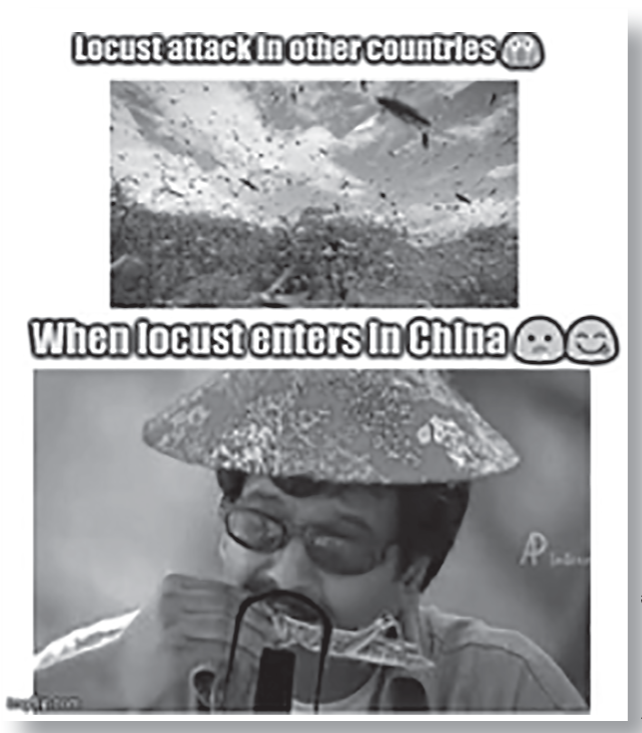
A meme highlighting prejudice against the Chinese rooted in the idea that their eating habits include eating anything and everything, including things that other cultures find gross.
One can argue that it was a case of finding a ‘scapegoat’ in a crisis, which in this case was the Chinese. According to Frazer, the word scapegoat in sociology is used to describe a person, an object, or an event that is seen as responsible for any crisis or calamity that hits a community. For instance, Soma Chaudhuri’s work highlights that it has been used in studies of witch-hunting to describe the women who become easy ‘scapegoats’ of abuse and violence as they are blamed for the misfortune of their community. Jensen adds that scapegoats deal with negative treatment for crises or problems that they did not cause. Most often, this happens through conspiracy, rumors, and accusations as there is pressure to hold someone accountable during moments of crises.
Scapegoating during times of austerity is a deeply structured socio-political process that is based on pre-existing stereotypes and beliefs.
It is this crisis scapegoating that led to the association drawn between bat meat and Chinese identity. Stereotypes about the Chinese have been reignited after the outbreak of the novel coronavirus. O’Flynn and colleagues have noted that this is a multi-faceted process and is reproduced and amplified by forms of mass media like news stories and memes.
For instance, the photograph above shows a meme that had been widely circulated around social media as India faced the worst locust attack in decades according to a May 2020 Times of India article. It pokes fun at the eating habits of the Chinese, who are seen as the consumers of anything and everything, including locusts. The circulation of such memes, which are supposed to be funny, is rooted in prejudices against the Chinese and their eating habits. They suggest that the Chinese have no reason to fear or be disgusted with locusts as they can just eat them.
Again, Jensen’s work highlights that the scapegoat is blamed or ridiculed for crises as both a deliberate diversionary strategy or as cathartic displacement of anger and fear. Scapegoating during times of austerity is a deeply structured socio-political process that is based on pre-existing stereotypes and beliefs. In the case of COVID-19, food is used to create a scapegoat and reinforce stereotypes about a certain culture during crises, which in this case is the Chinese. As such, food is a fascinating site to understand the nature of society. It tells us that racism and stereotypes against particular cultures still exist in multiple ways. While it is true that stereotypes against Chinese eating habits are not new, they have been amplified. In fact, it’s been reported in the New York Times that the Chinese face discrimination in many aspects of life, such as renting houses after the outbreak of COVID-19. Therefore, in times like ours, the study of food offers a window into understanding the socio-cultural practices like scapegoating during crises that exist in society.