




Abstract
“Amid the COVID-19 pandemic, ‘social distancing’ and ‘stay-at-home’ have become two of the most pushed recommendations from the World Health Organization (WHO) and governments across countries. This paper presents exploratory graphs and analyses to show the relationships among the governments' initiatives during the coronavirus pandemic and people’s responses to keep them staying at home.”

Amid the coronavirus pandemic in most countries, social distancing has become the most widely applied and arguably effective recommendation that governments have advised, and citizens have followed. In relation to the idea of social distancing and contact tracing, the mantra of “person, space, and time” takes on an even greater significance when it comes to controlling the spread of the coronavirus. Studies support the notion that social distancing plays a significant role in mitigating a pandemic’s public health impact and has a direct, positive influence on flattening the curve, preventing an overwhelming spike in cases, and maintaining a manageable number of cases.
The Oxford COVID-19 Government Response Tracker suggests that if governments implement even more stringent social distancing measures in response to outbreaks, it will reduce the rate of contagion. Therefore, policies restricting people’s movement during the pandemic have actually played a notable role in curbing coronavirus growth rates. My goal is to reveal whether any significant relationship exists between the strictness of country-wide policies and social distancing practice. In this case, “social distancing” refers to limitations on the number of people who are allowed to gather in one area, as well as official recommendations not to visit certain non-essential locations. Public health experts maintain that such measures can help prevent infection.
We now know that the coronavirus spreads through respiratory droplets such as those scattered by coughing, sneezing, or speaking. Therefore, public health experts have affirmed that physically distancing can help prevent the spread. Some nations have already observed significant decreases in COVID-19 cases as a result of their general public following the advice to keep their distance from each other. Therefore, it’s clear that when governments worldwide implement COVID-19 prevention policies, it plays a significant role in raising awareness.
Some countries under discussion here have already been able to contain the rate of COVID-19 infection; however, others are still struggling. In most states where outbreaks have remained a problem, people blame a lack of inclusive initiatives and social distancing policy-enforcement. The World Health Organization (WHO) Director-General, Dr. Tedros Ghebreyesus, recently said, “The greatest threat we face now is not the virus itself. Rather, it is the lack of leadership and solidarity at the global and national levels.” While long-term social distancing can have differential impacts on people’s social life and their mental and emotional well-being, most state policymakers have straightforwardly imposed movement restrictions from the get-go. However, the “life-or-economy” dilemma has shaken the world’s major economies, triggering some governments to fumble their policy responses to COVID-19.
Implementing strict social distancing policies to prevent the spread of the virus yields an increase in the likelihood of individuals abiding by those policies.
Degree of policy responses to COVID-19: This map shows variable degrees of policy stringencies across studied countries. The spatial distribution of policy responses to COVID-19 in this study did not include unidentified countries mentioned in the legend.
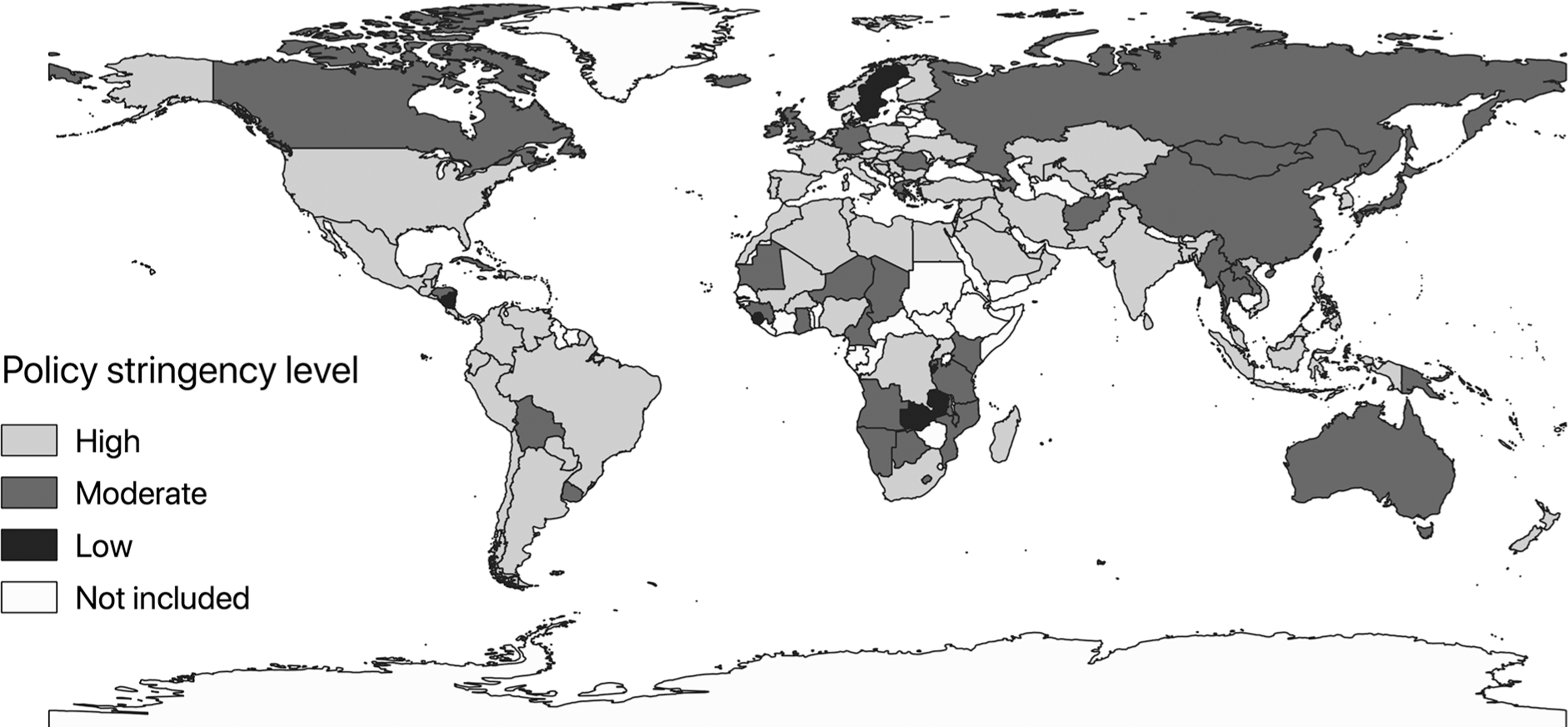
Policy Responses to COVID-19 Pandemic
The state’s responsibility is to create public awareness about policies and their socially appropriate implementations. The effectiveness and societal impact of social distancing largely depend on the credibility of public health authorities, political leaders, and institutions. The less strict the social distancing behavior is with regard to the variety of state interventions, the more time it takes for life to return to normal, and the more lives are at risk. Case in point: the cities and states that implemented early and broad isolation and preventive measures during the Spanish flu pandemic nearly a century ago saw smaller outbreaks and lower fatality rates.
The countries with stricter policies are more likely to achieve more social distancing practices than those with more lenient guidelines.
As governments around the world respond to the COVID-19 pandemic, it is essential that they have access to the latest information on the effectiveness of their policies in order to offer more options for addressing this pandemic (or any future pandemic). Organizations worldwide have been scrambling to collect data about the socio-political forces at work to understand disease outbreaks and consequent policy responses. For example, The Johns Hopkins University Center for Systems Science and Engineering created a publicly available data repository from sources like the WHO, the Centers for Disease Control and Prevention (CDC), and ministries from multiple countries. Additionally, the Oxford COVID-19 Government Response Tracker (OxCGRT), which produced a robust new Stringency Index that assesses the rigidity with which national governments have implemented policy measures to tackle the spread of the virus, addresses the issue from a social and political perspective. In addition, Google has made community mobility reports available to the public to provide insights into changes to these policies. The reports use location services from Google to track the movements of users. Using this method, Google has identified six major location types that people frequent in their everyday lives: home, work, parks, transit stations, retail and recreation centers, and groceries and pharmacies. Here, I will consider people’s relative movement towards these six categories as indicators of their social distancing efforts.
Governmental policy responses, which attempt to enforce social distancing and limit community mobility, have included limiting public gatherings, closing schools and public services, and changing prison-related policies. Socio-economic and government measures have involved declarations of states of emergency, economic measures, activation of emergency administrative organizations, and import/export limits. Meanwhile, governmental initiatives related to public health introduce, implement, and strengthen quarantine policies, awareness campaigns, behavioral recommendations, public health systems, testing policies, psychological assistance, and medical social work. Globally, policy responses have also been targeted to people’s movements and mobility, including surveillance and monitoring, border closures, visa restrictions, domestic travel restrictions, additional health requirements upon arrival at ports of entry, and curfews. Finally, with some exceptions, countries have declared partial or full lockdowns at the national or state levels.
Data and Analysis
To explore the differences in social distancing practices relative to stricter policy responses to the COVID-19 pandemic, I used two sources of data: the OxCGRT (Oxford COVID-19 Government Response Tracker) Stringency Index and Google’s data on community mobility. The OxCGRT has developed a stringency index for each country, depending on its policy responses to the COVID-19 pandemic. It has used 11 government COVID-19 response indicators and created an index that scores each country’s stringency level. A “zero” score indicates the lowest degree of stringency, and 100 marks the highest level of policy response strictness. OxCGRT has collected data on policy responses for each country and calculated the composite scores on a daily basis since January 1, 2020. In order to use country-specific social distancing data, I have taken advantage of Google Community Mobility data, which has country-specific daily observations from February 16, 2020, to March 29, 2020.
As Google explains, this dataset contains information about people’s movement between different locations and compares it with a baseline period, which was between January 3, 2020, and February 6, 2020. I merged the two datasets with the condition that they have daily observations for the actual timeline, which is February 16, 2020, to March 29, 2020. Provided that data from the OxCGRT and Google are available for the actual timeline, I looked at 32 countries totaling 1,376 observations. The selected countries are: Australia, Austria, Belgium, Brazil, Canada, Denmark, Finland, France, Germany, India, Ireland, Israel, Italy, Japan, Malaysia, Netherlands, New Zealand, Philippines, Norway, Singapore, Portugal, Saudi Arabia, South Africa, South Korea, Spain, Sweden, Switzerland, Taiwan, Thailand, Turkey, the United Kingdom, and the United States of America.
Policy stringencies over time: This set of charts demonstrates stringency variants in policy responses to COVID-19 in the period from February 16, 2020, to March 29, 2020. The vertical axis represents levels of stringency, and the horizontal axis designates time. The dotted line marks the threshold score.
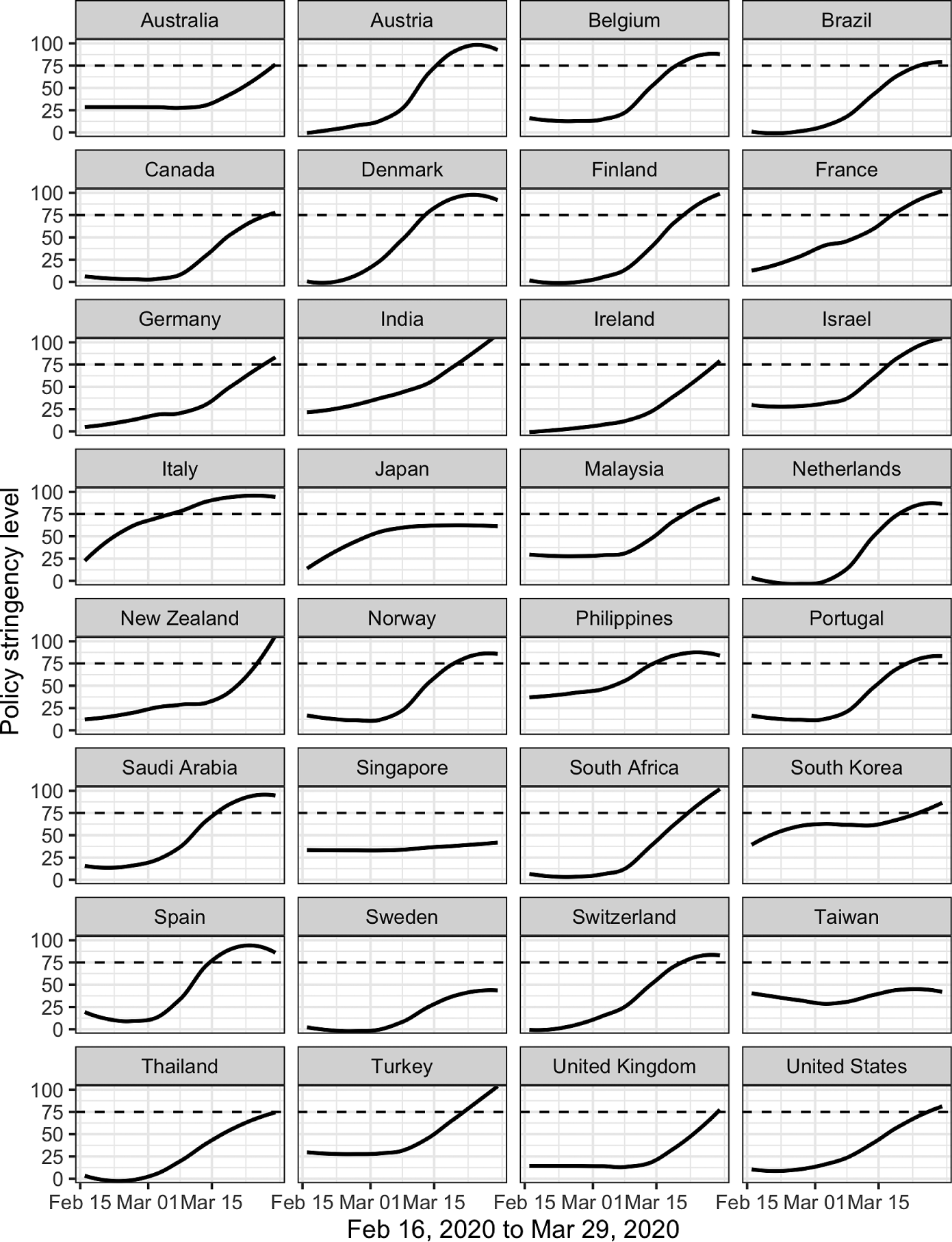
To show the differences in policy responses and the resulting changes in people’s movements across countries and over time, I used the difference-in-differences (DiD) technique. As a quasi-experimental design, it is one of the most popular and powerful techniques for evaluating the causal effects of policy interventions. This technique compares data before and after a specific time and between treatment and control groups. Per their strictness in policy responses to the COVID-19 pandemic, I grouped treatment and control countries, setting a stringency threshold of at least 75 percent, meaning that I chose those countries with at least 75 percent stringency as the treatment countries and those with less than 75 percent stringency as the control nations. I also have defined time-span for pre- and post-policy. I set the period from February 16 to March 5, 2020 as the pre-treatment period because the policies declared by those countries showed a level of stringency of 25 percent or less until March 5. Finally, I used the time period from March 6 to March 29, 2020 as the post-treatment timeline. In this analysis, policies’ social distancing indicators are phrases like: “at home,” “movement to workplaces,” “movement to public parks,” “movement to transit stations,” “movement to retail and recreation centers,” and “movement to groceries and pharmacies.”
How Stringent are Policy Measures?
The degree of strictness with which governments ensure social distancing varies over time and space. Australia, Ireland, Japan, Singapore, South Korea, Sweden, Taiwan, Thailand, the United Kingdom, and the United States implemented less stringent measures than the other countries studied. Countries with a Stringency Index over 90 include Austria, Denmark, Finland, France, India, Israel, Italy, Malaysia, Netherlands, New Zealand, Norway, Philippines, Saudi Arabia, South Africa, Spain, and Turkey. Among the countries hit hardest by COVID-19, the United States and the United Kingdom employed the least stringent policies in response to the pandemic. As of October 26, 2020, the United States was responsible for one-fourth of the total COVID-19 death toll in the world, while among European nations, the United Kingdom has the third-highest number of deaths per million. Several Asian countries on this list—India, Israel, Malaysia, the Philippines, Saudi Arabia, and Turkey—are among those with the most stringent policies. However, some other Asian nations, such as Japan, Singapore, South Korea, and Taiwan, had less stringent policies. Singapore, which had a minimal number of confirmed cases until late March 2020, now has one of the highest case numbers among ASEAN countries.
The effectiveness and societal impact of social distancing largely depend on political and public health institutions’ credibility, but the life-or-economy dilemma has shaken the world’s major economies, triggering some governments to fumble their policy responses to COVID-19.
Stringent State Policies Decrease Movement During COVID
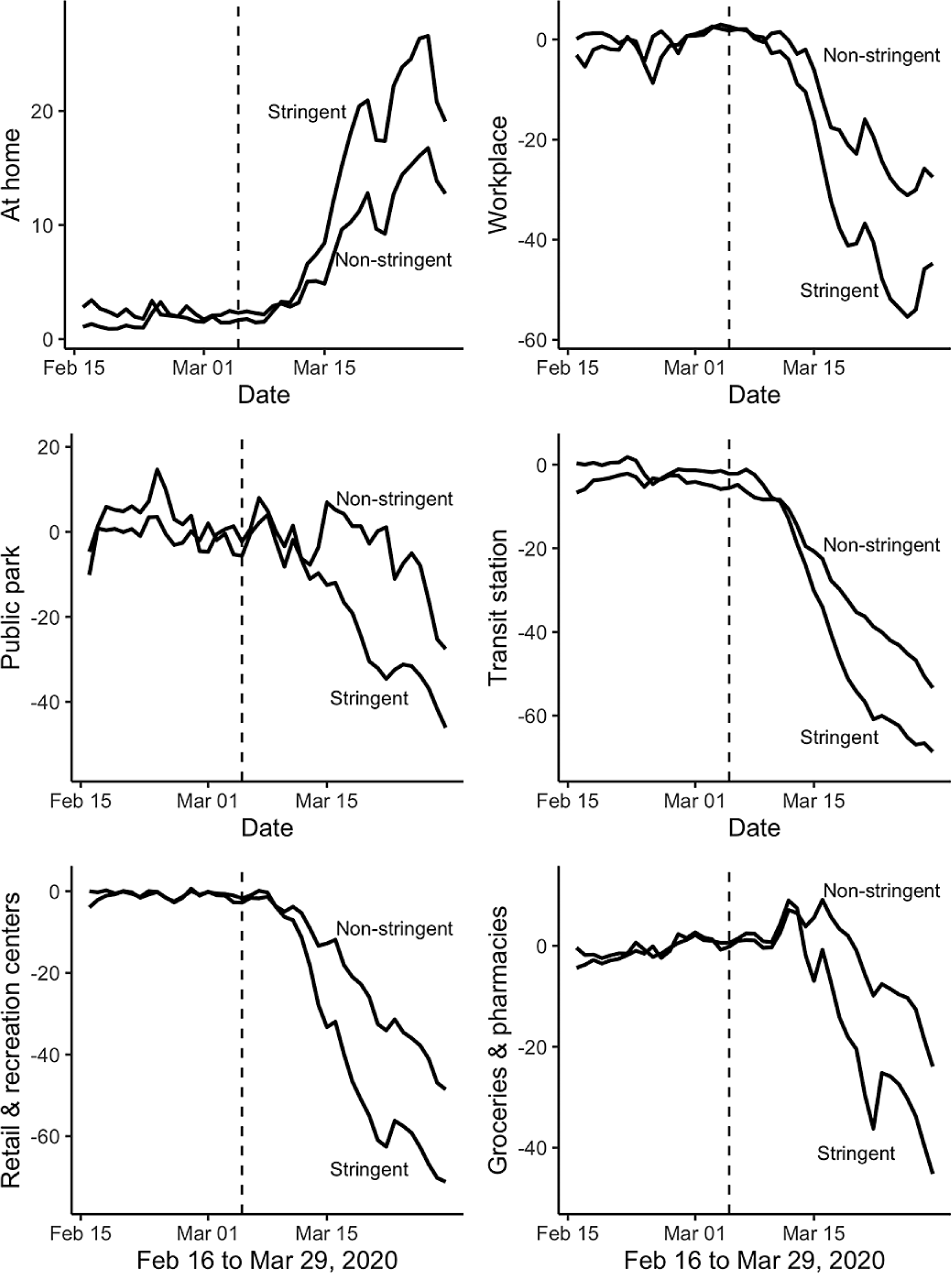
The findings indicate that governments with rigorous policy responses to the COVID-19 pandemic see better compliance with social distancing expectations and, therefore, may curb the number of cases more effectively. The visual presentations of the comparative impacts of policy interventions are summarized in the last set of charts. Implementing strict social distancing policies to prevent the spread of the virus yields an increase in the likelihood of individuals abiding by those policies. For example, in the first model, where “stay at home” is the dependent variable, the countries with stringent government policy responses—the treatment group—demonstrated a 5.788 unit increase in the probability of people staying home compared to the control group—the countries with lax measures in place.
The second model demonstrates that people’s “movement to the work-place” in the treatment group of countries reduced significantly (-13.594) over the study period, compared to the control group. In the next model, however, where “movement to public park” is the outcome variable, the treatment group experienced a significant reduction (-18.237-unit) in the movement toward public parks over the period studied, compared to the control group—meaning that citizens were less likely to visit parks in these same countries.
The same trends were found in other models where “movement to transit stations,” “movement to retail and recreation centers,” and “movement to grocery stores and pharmacies” are the dependent variables. The analysis found that in the intervention group of countries, the probability of significant reductions in people’s movement to transit stations (-13.697), retail and recreation centers (-17.287), and grocery stores and pharmacies (-12.007) was high, proving that stricter policies evoked greater adherence.
Inclusive Policy Responses Can Reduce the Risk
The data analysis reveals that in most countries, people’s physical movement to particular places is relative to government policy initiatives. As a result of those policies, people have stayed at home and reduced their physical mobility to workplaces, public parks, retail and recreation centers, transit stations, grocery stores, and pharmacies—to varying levels. The principal reason for initiating policy measures is to motivate people to minimize their social contact with others and thereby limit the rise of COVID-19 cases. The results of this piece suggest that those countries with stricter policies are more likely to achieve more social distancing practice compared to those with more lenient guidelines.
People’s movements between locations flatten as policy responses become stringent. The vertical axis represents the unit of people’s movements between locations, and the horizontal axis designates time. The dotted line marks the policy intervention time.
Since the virus was first identified, more than one million people have died in the United States, India, Brazil, and Russia, and over 200 other countries. I consider this underlying health situation as symptomatic of the “risk society.” According to Ulrich Beck, risk depends on decisions, but these decisions are not politically reshaped into preventive risk management policy when risk grows. To him, the most important and primary risk is that of social dependency upon institutions and actors. Anthony Giddens said that the question of how to handle risk politically stands in stark contrast to the growing need for action and policymaking. Therefore, calculated, probable, timely, and inclusive policy measures can reduce the risk.
The risks and transformations discussed in Beck’s Risk Society remain very much matters of contemporary concern, particularly in regard to the COVID-19 pandemic. In the context of the risk society, the scientific and legal calculation of risk seems to be collapsing. We have seen many political leaders try to ignore science, offer up the rhetoric of normalcy, and avoid realities in what Habermas calls a “rationality crisis” and “legitimacy crisis.” In this pandemic situation, states may run the risk of a rationality crisis when they fail to meet the economy’s demands, but states may also run the risk of a legitimacy crisis when they fail to meet the citizens’ demands.
The pandemic is a re-emerged characteristic of a risk society that involves local, national, and transnational policy actors. As social distancing policies are vastly important among political leaders, public health experts, and policymakers, some studies also urge that political leaders must introduce social-distancing policies that do not show bias against any population group. The COVID-19 pandemic disproportionately affects different groups of people depending on age, gender, and health conditions. The sweeping movement restriction policies most countries take can increase employment insecurity and job loss, reduce income and food security, and increase the risk of mental health problems, particularly for low-income households. State policies should be socially inclusive, at the same time, restricting people’s movements as well as taking care of socially and economically vulnerable citizens. The reality is that the effectiveness and societal impact of social distancing largely depend on the credibility of political and public health institutions.