




Abstract
Marybeth Stalp on quilters helping to alleviate the shortage of personal protective equipment amid the COVID-19 pandemic.
The shortage of personal protective equipment—N95 masks, surgical masks, caps, gowns, and gloves—amid the current COVID-19 pandemic is well-documented. In researching women’s leisure quilters for 20+ years, there is no doubt that they will act quickly to fashion homemade protective equipment in a time of crisis because they can. They have the raw materials on hand. They have the skill set. They have already-established local networks through quilt shops and quilt guilds, as well as access to quilt-related social media. As they engage in gendered cultural production, they glean comfort from doing carework for themselves and carework for others.
It is wonderfully generous and compassionate that private citizens are fabricating masks, surgical hats, and gowns, as well as 3D-printing plastic face shields for both medical staff and personal use throughout the U.S. during the global COVID-19 pandemic. Video tutorials on making surgical masks at home began appearing on YouTube weeks before the CDC recommended that nonmedical personnel begin wearing them. Quilters, with well-established quilting YouTube channels and large followings, created many of the earliest tutorials. As quilt guilds donate baby quilts and other handmade items to hospitals, cancer centers, and shelters—part of their non-profit organizational mission—early and open communication with medical workers helped in designing and distributing mask, hat and gown patterns. Many quilters are also making masks for hospital patients and visitors, communities in need, as well as family, friends, and neighbors.
Beyond the altruistic benefits, these DIY mask trends illuminate long-standing gendered patterns in cultural production. Who is doing the work? With which materials? Furthermore, how is this tied to broader social perceptions? Currently, the majority of leisure quilters and sewists are women, while the majority of 3D printer enthusiasts are men. All are contributing in this crisis, but these gendered patterns suggest how binary gender differences become essentialized by social imagery, as gender scholar Judith Lorber noted nearly 30 years ago.
Carework as “Productive” Leisure
Quilters are well equipped to respond to natural and human-made disasters—they have been collecting raw material surplus (e.g., 100 percent cotton fabric) ever since they started their chosen leisure activity. As quilters (and sewists and tech enthusiasts) make masks, caps, gowns, and face shields, they are engaging in carework for the self by engaging in carework for others. As I argued in my 2007 book, Quilting: The Fabric of Everyday Life (Chapter 6), quilters enjoy the act of quilting, and they feel better when they are doing it. Adding to this, quilters, when making a gift for someone, are typically thinking about the person they are making the quilted gift for (e.g., a new baby, a couple celebrating a wedding, a t-shirt quilt, etc.). Simply put, these makers feel better when they are doing something they enjoy doing, and they also feel good knowing that their efforts will assist another.
However, quilters and sewists are primarily women. Digging deeper into this generous impulse reveals the community’s underlying gendered structure and perceptions. The “other-oriented” expectations of normative femininity can make solo chosen leisure a difficult activity for women. Knowing that women consistently have less and lower-quality leisure time than men, this activity walks the line between a “productive” and a “leisure” activity.
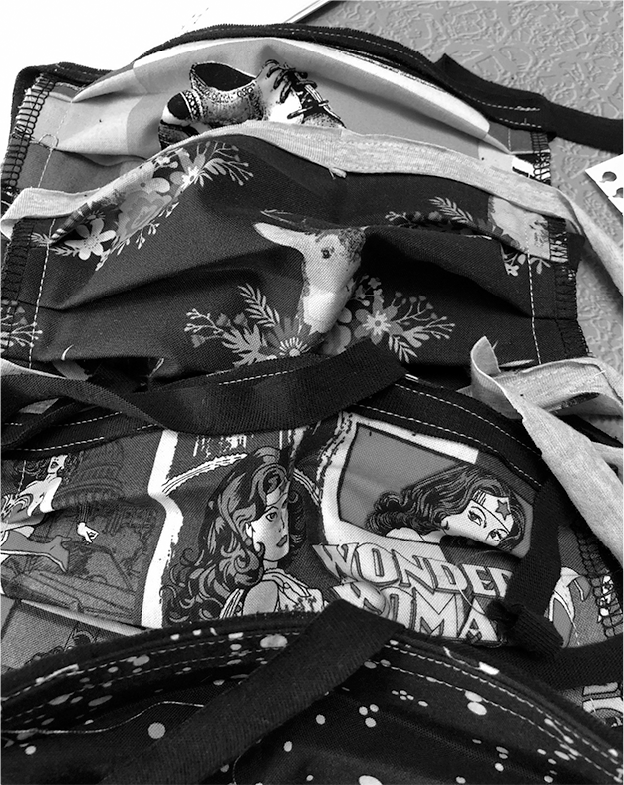
These face masks, just finished, are ready to find a new home.
Marybeth Stalp
Navigating these expectations is clear from the negative stigma often attached to women engaging in unpaid feminine leisure. Many of the quilters I’ve talked to over the years get ribbed by family and friends with questions about quilting. “Why are you buying fabric, cutting it up, and then sewing it back together?” they ask, especially when mass-produced quilts can be purchased for a fraction of the cost and time commitment of homemade ones. More often, family members will simply ask, “Where’s dinner?” signifying that a woman’s quilting habit gets in the way of her primary duty to her family. Some quilters say nothing, some reply honestly, while others reply in jest. At any rate, there is a lack of understanding of unpaid feminine leisure until a crisis like COVID19 presents itself.
The resources involved in quilting (e.g., high-cost fabric and equipment, extensive time and space needed in the home) can breed secrecy and increase misperceptions. Many quilters hide their fabric from family and friends so that no one knows exactly how much they have in their “stash.” As this term would suggest, guilt is attached to the stash, as is the literal act of stashing the fabric. It is for leisure purposes, lying idle and not being used; the unused stash exists just for the quilter (not for the household). The opportunity to dig into the stash and make something (unselfishly for someone else) can relieve guilty feelings of engaging selfishly in solo leisure and legitimize both the deviant fabric stash and the “deviant” quilter. Altruistic volunteering—such as using one’s personal stash to make masks for the community—is often more easily understood by the general public and provides quilters with a greater social appreciation for their skills.
Old-Tech/High-Tech
COVID-19 has revealed a confluence of social problems and inequities stemming from anti-science attitudes, racism and xenophobia, globalization, capitalism for its own sake, and broken supply chains. An army of mask-makers is to be expected, just as personal feelings of anxiety and helplessness are to be expected. Mask-making has gone far beyond the quilting community. New sewists are contributing as well as 3D printing enthusiasts who are manufacturing related components. However, in observing social media and news posts of makers addressing the need for protective equipment, there are some gendered patterns.
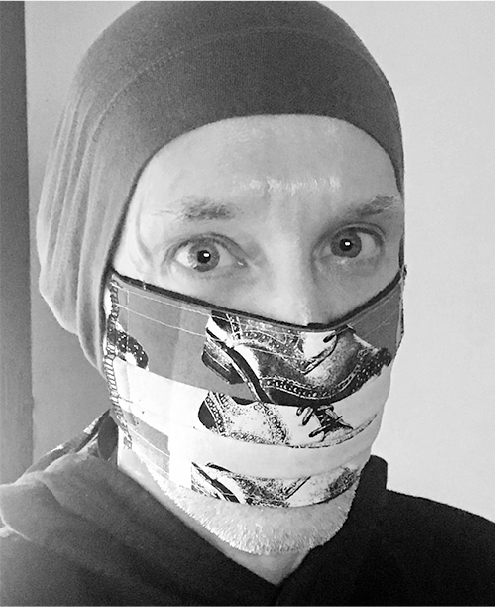
A selfie taken by R. McDaniel in a face mask made from a shoe print fabric.
Marybeth Stalp
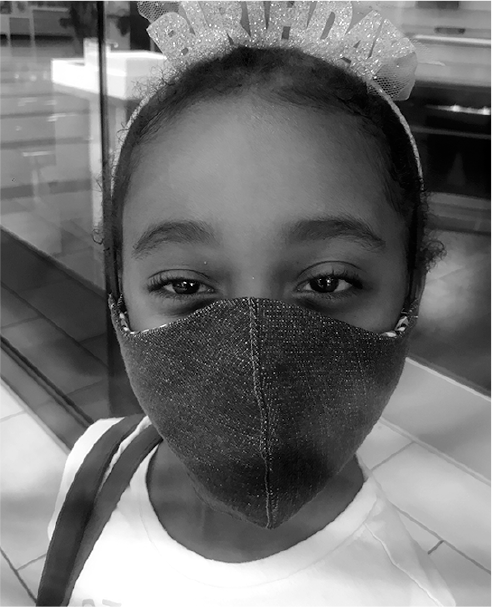
Marlie Adams celebrates her seventh birthday, with a denim mask on, at Target.
Krystal Adams
Beginner sewists benefit from an open and generous community ethos—of mostly women—solving skill deficiencies, getting materials, and developing workarounds on construction. Simultaneously, social media and news posts highlight how mostly men are making use of both personal 3D printers and those in local maker spaces. Both groups offer innovative solutions, for example, to “ear burnout.” In 3D printing, they create a plastic piece with notches for appropriate sizing to connect the elastic loops, and sewists recommend buttons on surgical caps, knitting or crocheting a strip with buttons, or a tie from household materials.
Makers demonstrate care for themselves and their communities by engaging in COVID-19 mask-making efforts. These volunteer makers are also engaged in gendered cultural production. In U.S. culture, amateur sewing and quilting have long been thought of pejoratively as women’s work. At the same time, 3D printing technology is more analogous to men’s amateur workshop activities, trying out new computer technology, or university or community maker spaces where innovative tech design happens in a (mostly male) capitalist, entrepreneurial way. Inherent in these differences is the presumption that quilting is less skilled or less technical, but both sewing, quilting, and 3D printing share difficult technical design and implementation challenges. The mundane fruits from sewing are more ordinary, more every day, and perhaps more taken for granted. For example, the seams holding your clothing together (including your Zoom shirt) are most likely a result of sewing technology.
My final point is this. We are very lucky to have quilters in our lives right now.
Fortunately, quilting resurfaced in the U.S. in 1976 and grew into a multi-billiondollar global industry. Because of this, we have easy access to quilt fabric—100 percent high-quality cotton fabric to make masks. The quilting industry estimates that there are about 7 million U.S. quilters, 99 percent of whom are women. Many “dedicated quilters” are stereotypically white women, upper-middle-class, around 63 years of age, and spend around $3,000 annually on quilting supplies (roughly $250 a month—comparable to what avid amateur golfers spend in the U.S.). So many more quilters are older or younger than this and exist throughout the socioeconomic, racial, and ethnic spread. These numbers do not include sewists, crafters, and fashion designers, so the number of people who know how to sew (but may not self-identify as a quilter) is much higher.
It’s important to recognize that sewing is a life skill and is something to be respected and valued—with the help of 3rd Wave Feminism, this is beginning to happen. Quilters are voluntarily making masks in and for their communities, donating use of personal equipment, time, and materials, and teaching others as they have done and will continue to do. My research on leisure quilters demonstrates that understanding aging women’s choices to spend their free time making quilts is of great sociological significance. After all, that is the existence of their oft-overlooked leisure pursuit, which is helping to make more and more fabric masks available when they are needed most.
Support your local quilt shops, and those who are making masks.