




Abstract
In March of 2019, news of the college admissions scandal broke. Opinion pieces flooded the media on how and why such a thing could have happened. Here, the author argues that the scandal is more about parenting than the institution of higher education.
Keywords
On March 12, 2019, news broke that 50 individuals were accused of bribery, fraud, and racketeering in attempting to ensure the successful matriculation of their children into several selective universities. At the center of the scandal is a college admissions consultant, William Singer. Singer bribed athletic coaches to falsely certify the applicants as recruits. He also arranged for the applicants to take the SAT or ACT exams in specific locations where their tests were checked for accuracy before they were submitted and were falsely provided test modifications intended for students with disabilities. Fifty-three individuals have been charged in the case (including parents and former universities athletic staff); over a half entered guilty pleas, several have been already sentenced, and others are awaiting trial.
Opinion pieces flooded the media on why and how such a thing could have happened. The titles speak for themselves: Entitlement! Privilege! Helicopter Parenting Gone Wrong! A Star’s Fall from Grace! While there are many different angles through which this lurid case can be dissected, the scandal highlighted the complex relationship between parenting, education, and social class. I would argue that the scandal itself is more about parenting than the institution of higher education. It’s not so much about the policies and mechanisms that shape access to universities, as it is about perceptions of what it means to be a good parent in today’s upper-class America.
Parenting and Social Class
In its article about the college admission scandal on April 17, 2019, the L.A. Times used the term “parenting on steroids,” spoken by the defense team of one of the families. This term sounds like an updated version of intensive mothering, first introduced by Sharon Hays in her 1996 book, The Cultural Contradictions of Motherhood. Somewhat similar ideas are also articulated by Elinor Ochs and Tamar Kremer-Sadlik in their 2013 book, Fast-Forward Family. Upper and middle-class parents perceive responsibility for their child’s health and wellbeing comprehensively, starting with providing physical needs to attending and fulfilling cognitive, social, and emotional needs. Attending to the authors, “the good enough family” is a complex notion that parents seem to be grappling with, often feeling inadequate to achieve their own standards. Parents seemingly want to combine the fast pace that characterizes the 21st century family with the feel-good, old-school ideas and habits they grew up with. For the families involved in the scandal, this apparently included making sure their children attended a specific university, regardless of whether the child was interested in doing so or qualified for it.
…the scandal is more about parenting than the institution of higher education.
In a well-known, richly detailed ethnographic 2011 study of children’s lives in the U.S., Unequal Childhoods, Annette Lareau described how social class- based cultural patterns, habits, and skills are created and reinforced by differential parenting. Lareau coined parental practices found in middle-class families as “concerted cultivation” and used the “accomplishment of natural growth” to describe low-income families. Lareau found that poor and working-class parents saw themselves as primarily responsible for providing for their children’s physical needs, such as clothing, food, and housing. Poor and working-class parents shared that accomplishing such tasks can be challenging, given the scarcity of resources at their disposal.
Several families were accused of attempting to ensure the acceptance of their children into selective university.
Tawny van Breda, Pixabay

Lareau and her team witnessed several families in her sample facing severe financial hardships, as well as many who also struggled with the physical and mental health challenges of their family members. Thus, from the parents’ point of view, schools and teachers are the ones who are both qualified and supposed to take care of their children’s educational needs. By contrast, middle and upper-middle-class families actively fostered the development of their children’s skills, interests, and talents. Children in these families spent much of their leisure time in structured activities lead by adults (such as art and music classes, sports, drama, clubs, etc.).
Analyzing relationships with different institutions (educational, health-related, and others), Lareau found that poor and working-class parents often experienced frustration, a sense of dependence, and powerlessness. Parents felt judged by teachers, doctors, and social workers and tried to minimize their interaction with authority figures. On the other hand, middle-class parents felt comfortable in their interactions with other professionals, expressed criticism, and intervened on behalf of their children, thus teaching children by example to speak up and stand on their own. While all parents in the study shared their desire for a better future for their children and often connected that better future with educational success, low-income parents found themselves ill-equipped to provide for it.
For the second edition of the book, a decade later, Lareau contacted the original families for the interview. It turned out that the social class-determined paths had continued as her elementary school respondents went through the rest of grade school and transitioned to young adulthood. The social class divide determined whether the youth studied had their driver’s license and predicted their likelihood of early marriage and childbearing, and college attendance. The same social forces of inequality that were emerging when the children were in the 4th grade had come to a full display when they reached their 20th birthday.
The findings of this ethnographic study are supported by multiple quantitative investigations. According to Reardon’s work, the relationship between family socioeconomic background and academic achievement has tightened over the last 50 years, with the gap between high and low-income students now twice as large as the White/Black achievement gap. Interestingly, the association between income and achievement grew in the families above the median income, suggesting parents’ differential investments in their children’s education. Kornrich and Furstenberg found that as economic inequality grew, so did the gaps in parental spending on various children’s needs, as well as parental time investment in developmental activities, according to Altintas.
Back to the college admission case: one of the most recognizable faces of the scandal is former Full House actress Lori Loughlin. While the other families involved include lawyers, investment bankers, and real estate developers and managers—who most likely received both undergraduate and even graduate education—Loughlin’s case stands out. On April 29, 2019, People magazine ran a story on Loughlin, stating among other things that because the actress never attended college, it was important to her that her daughters did.
In a rather ironic twist, Laughlin behaved similarly to the low-income respondents from Lareau’s study. The parents in the study did not feel they understood how college worked (having never attended one themselves), and thus willingly deferred to the authority of people who did know (or claimed to). One of Lareau’s respondents shared paying $1,000 for help with college applications for her child, as she wasn’t able. Loughlin allegedly paid $500,000 to do essentially the same. Lack of cultural capital (knowledge of the system) and the appropriate habitus (the know-how, a feel for the education game) put Hollywood celebrities in the same position as families on the opposite side of the income distribution.
Parenting and Education
Without a doubt, the affluent families involved in the scandal possess enough wealth (economic capital) and social connections (social capital) to ensure prosperity and successful employment for their children. Yet, these families craved the legitimacy of educational credentials to such an extent that they opted to engage in criminal activity. This brings to mind the 2014 work of David Baker, The Schooled Society, in which he describes the expansion of the institution of education and its intrusion into every sphere of life, including the necessity of academic certifications to attain legitimacy in almost every industry.
Baker argues that education does not just change the ways jobs are offered, capital is made, or authority is exercised. Instead, education ultimately changed the way people perceive themselves, others, and their behaviors—and to a great extent, define success and failure. By this logic, the parents’ successful careers and social connections in entertainment, finance, real estate, or design were not sufficient, from their point of view, to ensure their children’s success. Moreover, just a college degree wouldn’t suffice. The parents in the scandal desired educational credentials from particular elite institutions to legitimize their children’s abilities and worthiness of success.
Parents are aware that attending selective colleges exposes students to not only the knowledge gained from their specific major, but also a plethora of other social, professional and academic opportunities. These parents believed that the schools were venues that would ensure their children’s social mobility or help preserve their already high status. This thought process illustrates the concept of “pathway consumption,” introduced by Alison Pugh in her 2009 book Longing and Belonging. Diving into the world of parenting, peer pressure, and consumption, Pugh described a process by which parents purchase material things and experiences for their children, intending to assist with current and future educational success. Such experiences include expensive summer camps, participation in prestigious organizations and activities, and trips abroad. In a sense, college matriculation is a type of pathway consumption.
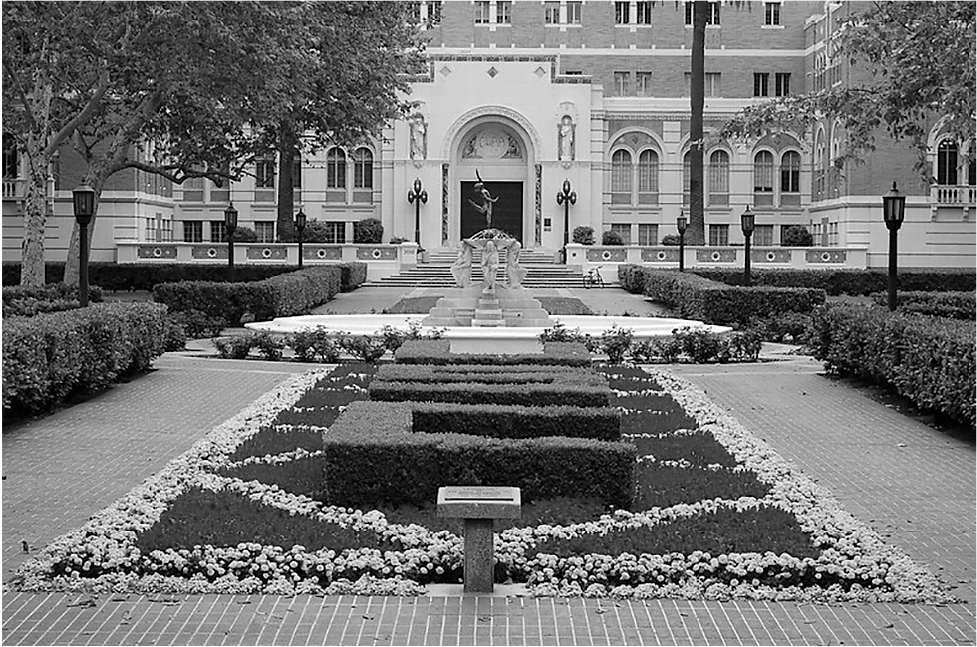
The University of Southern California, the school where Lori Loughlin is accused of paying $500,000 to have her two daughters admitted.
Peter, Flickr CC
A good example to illustrate this point is that of Douglas Hodge, the retired CEO of PIMCO, a global investment management firm, who was accused of paying bribes to get four of his seven children into selective schools and attempting to do the same for the fifth. Mr. Hodge himself received his undergraduate degree from Dartmouth College and an MBA from Harvard School of Business. His family was clearly in possession of large amounts of financial, human, cultural, and social capital. According to a February 2020 New York Times article, Mr. Hodge said in court: “I do not believe that ego or desire for higher social status drove my decision-making. Rather, I was driven by my own transformative educational experiences and my deep parental love.” Contesting the notion that his actions were driven by a desire to preserve the high status of the family, Mr. Hodge emphasized that his educational experiences (at Dartmouth and Harvard), were transformative, and he wished for his children to have a similar experience—all out of parental love. Several other defendants emphasized the love for their children as the main force behind their actions, which brings us to the next topic—emotional capital.
It’s not so much about the policies and mechanisms that shape access to universities, it’s about perceptions of what it means to be a good parent in today’s upper-class America.
Parenting and Emotional Capital
The concept of emotional capital is a useful tool to understand parenting in general, and to shed additional light on the college admission scandal. Allatt defined emotional capital as “emotionally valued assets and skills, love and affection, the expenditure of time, attention, care, and concern”. The works by Reay and Gillies described a variety of emotions experienced by mothers in situations related to their children’s schooling; these include excitement, pride, and satisfaction, as well as anger, anxiety, guilt and frustration. Similarly, the middle-class respondents of Hays, Lareau and Ochs and Kremer-Sadlik also mentioned the feelings of guilt, ambivalence, concern and doubt when it came to their children’s present and future. That being said, middle-class mothers may still generate more emotional capital as they have other resources available to them (economic, cultural, and social). They channel their emotions to promote their children’s academic success by creating and maximizing various opportunities for their children inside and outside of the classroom. On the other side of the economic spectrum, poor and working-class mothers live under constant stress to provide for their children’s basic needs. They use emotional capital to compensate for their children’s disadvantage, discrimination and marginalization. Their emotional investment, as intense as it can be, does not produce the same educational success experienced by middle-class mothers, being directed toward everyday survival.
Evidently, the parents involved in the scandal did not trust their children to get into selective schools on their own merit. Some parents wanted to prevent a potential heartbreak of failure, so they intervened to ensure success, and allegedly kept their children in the dark about what was going on. Parents used their financial power to build up confidence in their children and simulate the sense of their accomplishment. The parents were involved in the works of emotional capital, investing time, care and attention to create positive emotional experiences for their children. The college admission scandal demonstrated the willingness and ability of parents with means to go the distance to ensure the best educational setting for their children that is supposed to produce various forms of capital: human (if the children successfully graduated from the university), financial (if the acquired diplomas facilitated their earnings), social (connections built via campus networks) and cultural (the attitudes, ideas, tastes and soft skills that students would acquire while pursuing their degrees).
Lack of cultural capital (knowledge of the system) and the appropriate habitus (the know-how, a feel for the education game) put Hollywood celebrities in the same position as families on the opposite side of the income distribution.
Ironically, however, the works of emotional capital seem to have backfired in this case. Actress Felicity Huffman who admitted to paying $15,000 to cheat on her daughter’s SAT test, wrote in her letter to the court: “In my desperation to be a good mother I talked myself into believing that all I was doing was giving my daughter a fair shot… I have broken the law, deceived the educational community, betrayed my daughter and failed my family.” Huffman’s example highlights the issue of parental trust, or the lack thereof, and shows that her actions essentially jeopardized her daughter’s emotional capital by putting into question her belief in her own abilities. The emotional capital deteriorated in the families involved in the scandal, as the children discovered how little trust their parents had in them.
Lori Loughlin, an American actress, model, and producer who pleaded guilty in the high profile college admissions scandal.
Lloyd Klein, Flickr cc

Stretching Social Class
On the other end of a child’s educational trajectory—from college matriculation—is their participation in early childhood education. In her 2019 New York Magazine article, Pressler shares a thriller-like saga of recent events in a high- end nursery school in Brooklyn Heights. Pressler’s piece displays the magnitude of social class influence on children, even such young ones. It also highlights the depth of parental anxiety in 21st century America to do right by their offspring. Barely containing her sarcasm, the author tells the readers, “Each spring, Grace Church School holds an annual exmissions meeting, where the parents of Threes, soon to be Fours, are invited to learn about the stressful process of applying to kindergarten the following year.” Quoting the school director from the meeting, she shares the horrifying truth: “This is the first time in your life you are not a consumer. All the control belongs to the elementary schools.” The dynamic among different groups of parents, the school board, and the director would make another Veblen-like bestseller or be a natural addition to Currid-Halkett’s 2017 tale of the Aspirational Class. The bottom line is this: social class rules all aspects of supposedly class-less American society and education, starting very early.
Calarco places the college admission scandal within the framework of privilege, arguing that even “mundanely privileged families” will exhibit every behavior within their repertoire to promote the interests of their children. Indeed, navigating a highly decentralized, complex educational system requires a nontrivial amount of knowledge, effort, and familiarity with the rules of the educational game. More educated parents are in a much better position to understand how the institution of education works, having successfully gone through it themselves. Upper and middle-class parents put concerted effort into choosing a high-quality school for their children, looking for one that fits their child’s personality, needs, and interests. They can afford to buy a home in the catchment area of a better school. They volunteer in the classroom and participate in PTOs to get to know teachers better and to best help their child to navigate the educational opportunities presented to them. Better-educated parents are usually holding middle-class jobs that allow more flexible schedules to do all that, in addition to driving their child to multiple extracurricular activities and social events. They can afford to pay for tutoring if needed, as well as purchasing educational materials, technology, or any other equipment. Upper and middle-class parents in America possess the types of capital, including cultural and emotional capital, that allow them to play (and win) the game of social competition through education.
Legal scholars will debate the details of the criminal case; educational policy makers will ponder over policies that should prevent such a thing from happening again while thinking broadly about the transition to higher education. Sociologists, meanwhile, can bring this case into their classrooms to illustrate how various sociological concepts can be useful in understanding both quotidian and sensational, news-worthy situations. The college admission scandal highlighted the existing social stratification in parenting, opportunities for children in general, and their access to education in particular. Of the myriad of ways to describe the processes and mechanisms that are at play in American homes and schools that affect children, socio- economic stratification remains the main, painful theme. The college admission scandal highlighted the existing stratification in parenting and just how far the families at the top of economic distribution take the notion of being a “good parent”.