



Abstract
For the Lower Elwha Klallam Tribe, the Elwha River is life. However, since the river was dammed, the community has been greatly affected. The dams on the Elwha River demonstrate how such infrastructures serve to reinforce and structure inequality.
K. Whitney Mauer
“Coming back I just stopped. I wept. Will this happen to the rest of the village? Will we be moved out of here because of floods? Because of whatever? How are we going to end up? Where are we going to end up? There are young children who have no idea of the water ways. Of down here. No idea of fish runs. Of experiencing the awesomeness of seeing not only hundreds, but thousands of fish crowding up the river, crowding up the creek. To me that’s almost a thing of the past. We pray that will be renewed with the freeing of the river.”
When members of the Lower Elwha Klallam Tribe talk about the Elwha River, they often use the phrase “so thick with fish you can walk across their back” to describe the river past and future, but not the present. For the Lower Elwha Klallam, the fish-thick version of the Elwha River lives in stories passed from the generations alive before the river was dammed. The phrase represents the imagined future of both the river and the Lower Elwha Klallam Tribe community. The Klallam are a salmon people for whom salmon occupy a central role in cultural values, traditions, and social and economic systems. For almost a century, each successive generation has had fewer fish to feed their families or to sell for necessities, causing the Klallam to rely on off-reservation wage work and store-bought foods.
Near Port Angeles, Washington, the Elwha and Glines Canyon dams have blocked the Elwha River since the early 20th century, supplying power to the logging industry. The dams on the Elwha River demonstrate how such infrastructures serve to reinforce and structure inequality and settler-colonial power. The two dams blocked about 145 river kilometers (rkm) of the upper Elwha River, which is located in what is now the bounds of the Olympic National Park. The lower 8 rkm flows through private land and then through the Lower Elwha Klallam Tribe Reservation, where it meets the Strait of Juan de Fuca.
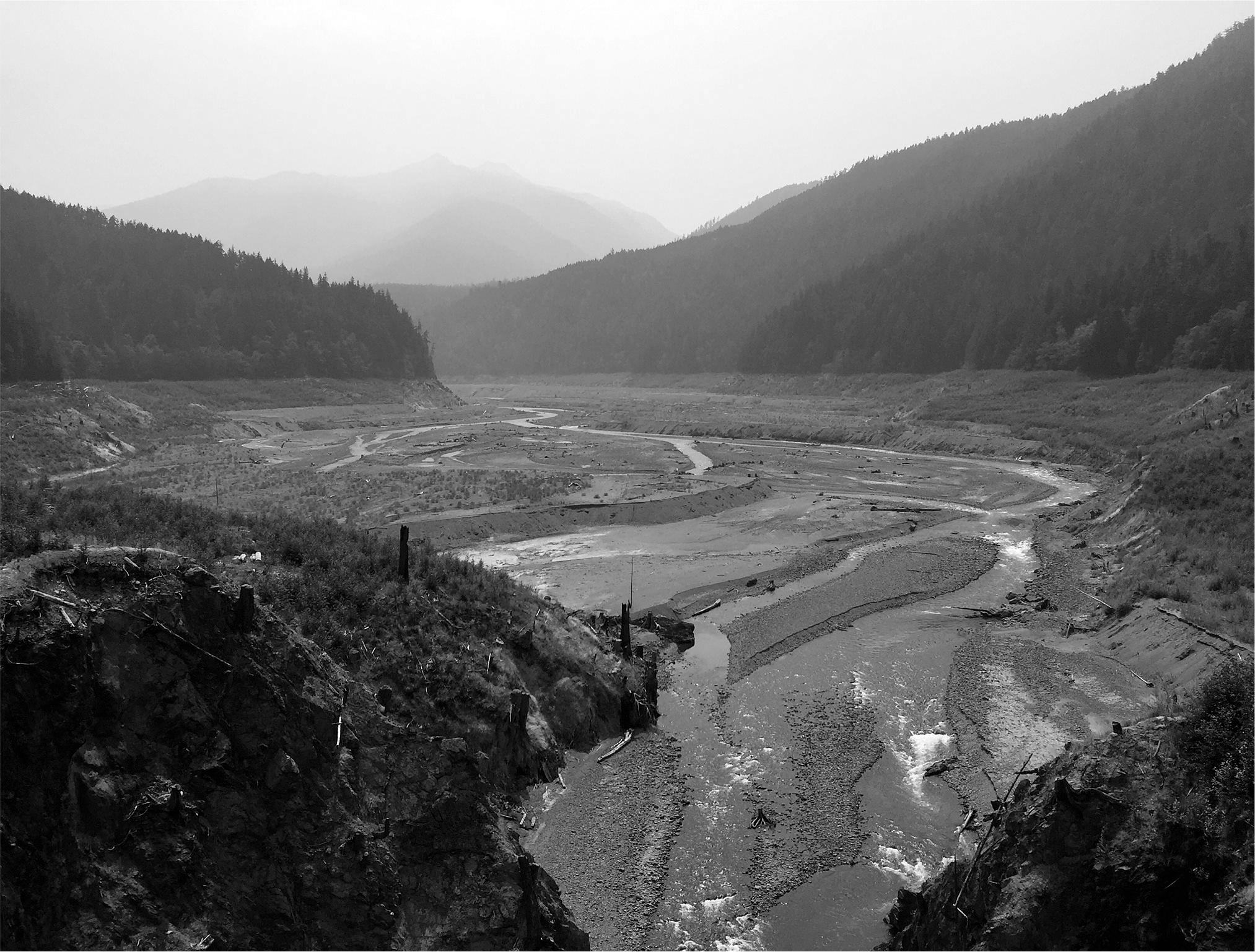
<< A view upriver from the site of the former Glines Canyon dam, one year after Elwha River dam removal.
Settler-colonial systems of private property and Federal Indian law that dispossessed the Lower Elwha Klallam enabled the damming of the river and the logging of adjacent land, which substantially deteriorated fish habitat and decimated salmon runs in the Elwha River. The loss of fish undermined Klallam economies and cultural practices tied to salmon by submerging Klallam sacred sites and inhibiting Klallam access to traditional sites, villages, and resources. The contemporary impacts of the dams can be traced through the lineage of settler- colonial ecological violence. As one elder stated, “Our whole history is lack of land. I mean, that is the entire history of our people. And who got what size assignment and who could be a farmer. We didn’t even want to be farmers, but because of the lack of access to land, our people jumped on it. And then to have flooding in the 70s. We finally got housing, and then we couldn’t have it because of the dams.” The dams were a powerful yet singular force among a myriad of other tactics deployed by settler-colonial actors to assimilate and dispossess Indigenous populations. Water infrastructure, residential schools, reservation and allotment, and other colonial structures converged to produce ecological violence and the historical trauma experienced by the Klallam.
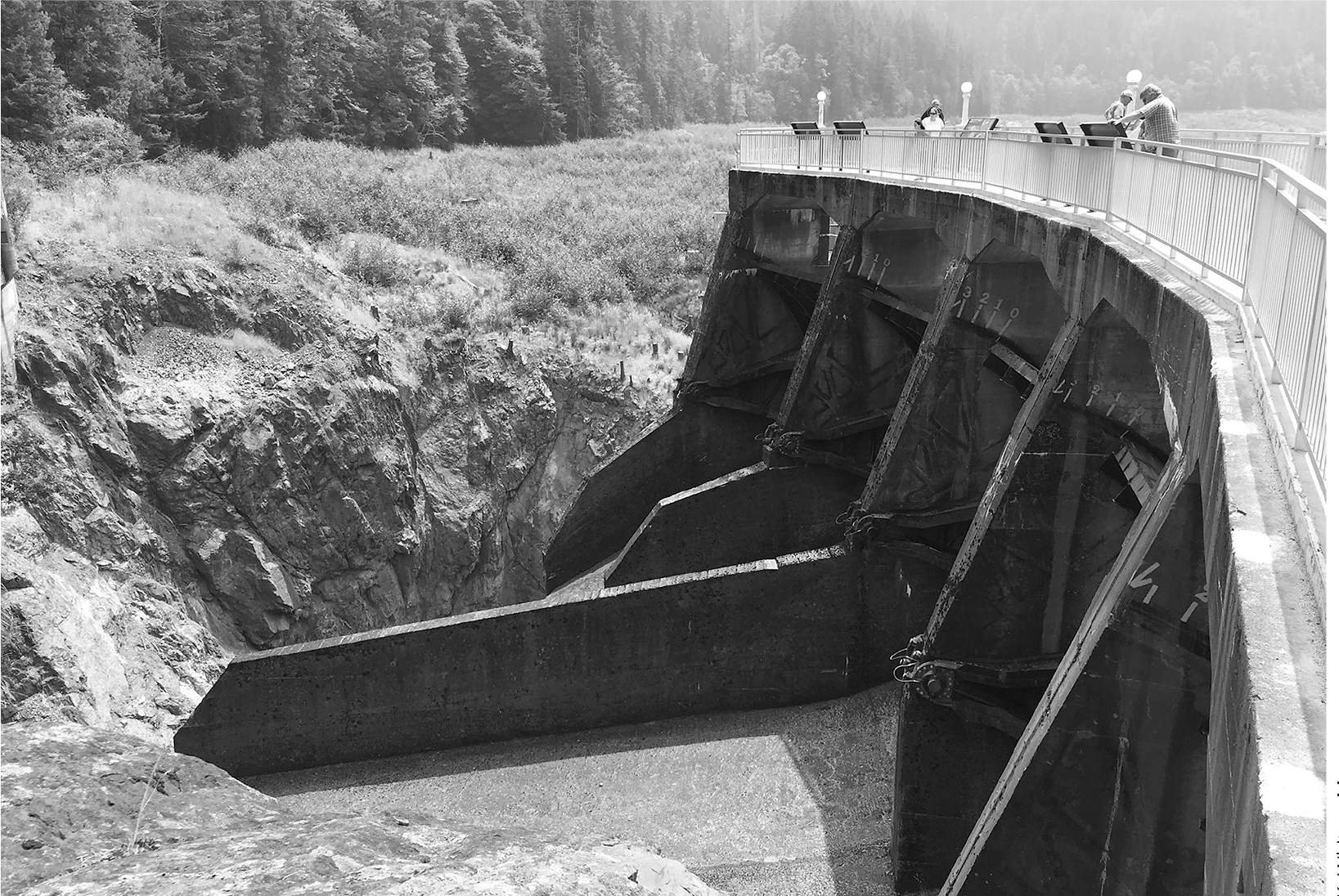
A view of the Glines Canyon Spillway Overlook located in Olympic National Park. The viewing deck was built on a remaining section of the Glines Canyon Dam that does not impede the flow of the Elwha River.
K. Whitney Mauer
Indigenous survival and collective continuance, or “survivance” to use the term coined by Anishinaabe writer and scholar Gerald Vizenor, in spite of colonialism, has characterized Indigenous life since colonial contact. The Klallam resisted colonial encroachment and tried to maintain traditional practices by remaining in their homeplace despite the dams and the imposition of a reservation outside of their traditional territory. By the 1960s, settler population pressures and commercial fishing exacerbated the salmon decline in Washington state. Indigenous nations, including the Lower Elwha Klallam politically mobilized for the protection of Indigenous fishing rights when the state weaponized conservation against Indigenous fisheries in an effort to protect commercial and recreational fishing interests. Building on the political momentum of this era when one of the dams came up for relicensing, the Lower Elwha Klallam Tribe worked alongside environmental groups to remove the dams. The last blast to the dams occurred in 2014, more than 30 years after the Tribe filed a petition to have them removed. This is the largest scale dam removal in U.S. history to date.
Bounce Back
In the last few years, headlines about the Elwha River restoration have included titles such as, “Elwha River: Roaring back to life” and “the Elwha bounces back,” which refer to the riverine ecosystem’s ability to recover from the damming and undamming. In ecology, scientists call this ability to cope with or absorb a disturbance “resilience.” When policymakers use resilience as a planning tool, the objective is to prevent social and economic change or to return to conditions prior to disruption. The prevention of change raises questions about the relevance of resilience as a concept, particularly to Indigenous nations. Can ecosystem restoration support both bouncing back and bouncing forward in which Indigenous nations not only survive, but also renew and revitalize? How can sociological analysis inform resilience-based policy and practice so that it is more attentive to settler-colonial structures that inhibit Indigenous ecologies and capacities for resurgence and self-determination?
For the Klallam the desired outcome of the restoration is a future consistent with Klallam ecologies and values. To quote one Klallam elder, “I try to look forward…We can’t look that far ahead. Our physical bodies probably won’t allow us to be that far ahead. So it’s just something that remains as a dream or a wish. So, I keep praying, Lord, make it good for [the youth]. Because these are our territories.” The Klallam, like many other Indigenous nations, desire healing that is both restorative and transformative for future generations. They have survived and continued despite settler-colonialism, but surviving the historical trauma is not the end goal. Survivance is rather a precondition for Klallam renewal and self-determined development of cultural, social, and economic systems.
In recent years, the concept of resilience has expanded beyond ecosystems to include social and economic systems. This change reflects a growing interest from diverse disciplines in developing a more holistic understanding of how societies and environments interact within complex systems. The term is also increasingly popular among policymakers and activists interested in addressing the social and community impacts of natural disasters and climate change. This contemporary orientation focuses on a community’s capacity to prepare for and reorganize social and economic systems in response to environmental disturbances. Policymakers may use resilience frameworks to make decisions about where to invest in disaster preparedness, limit disaster-induced losses, and how to encourage recovery from disasters.
Resilience has a long history in ecology and an even longer history in psychology, where it is used to refer to an individual’s ability to cope with and recover from psychological distress. Within Indigenous populations, resilience refers not only to individual ability to cope with trauma, but also to community- level responses to historical trauma—the collective experience of combined oppression and psychological trauma. For the Klallam, the damming of their community reinforced, propelled, and intensified historical trauma through the dispossession of lands, displacement from homeplaces and lifeways, and the disruption of Klallam cultural and economic systems.
Such historical trauma is representative of settler-colonial violence that produces cultural loss and marginalization in Indigenous communities. Though rooted in history, settler-colonial eco-social structures endure, producing compounding impacts that are transmitted intergenerationally. The maintenance of oral traditions and narratives, healing practices, and family roles and responsibilities can support resilience by mediating traumatic impacts. However, when ecological change erases the landscapes and biota that inhabit important roles in those practices and responsibilities, Indigenous capacity for survivance is undermined. For this reason, the Klallam look to the dam removal and river restoration not simply for the revival of ecosystem health, but for the revitalization of Klallam ecologies. For the Lower Elwha Klallam, the return of salmon to the Elwha River and the restoration of the surrounding ecosystem are fundamental to community recovery and resurgence.
Loss and Recovery
“I’m glad it happened. But it’s like it penalized us.”
In collaboration with the Lower Elwha Tribal Council, I worked with a Klallam research assistant to talk with community members about their experiences with the Elwha River restoration. In spite of the original damming of the river, Klallam people exhibit both collective and individual capacity to adapt to its traumatic impacts. The river, even while dammed, remained a central site of Klallam traditional activities. Present day elders who grew up on the dammed river, who had never seen it undammed, were able to maintain some oral traditions and narratives, connection to land, and traditional practices and responsibilities. However, the maintenance of these practices had to be creatively adapted in response to changing ecological conditions. For example, as Chinook salmon runs disappeared, Klallam shifted to relying on the smaller pink salmon, or humpies. They also adapted their smoking practices to accommodate the lower fat content of the fish. Historically, humpies were considered a famine food for the Indigenous peoples of the Pacific Northwest coast. For the current generation of Lower Elwha Klallam elders, humpies were central to food security and the maintenance of traditional fishing sites and practices.
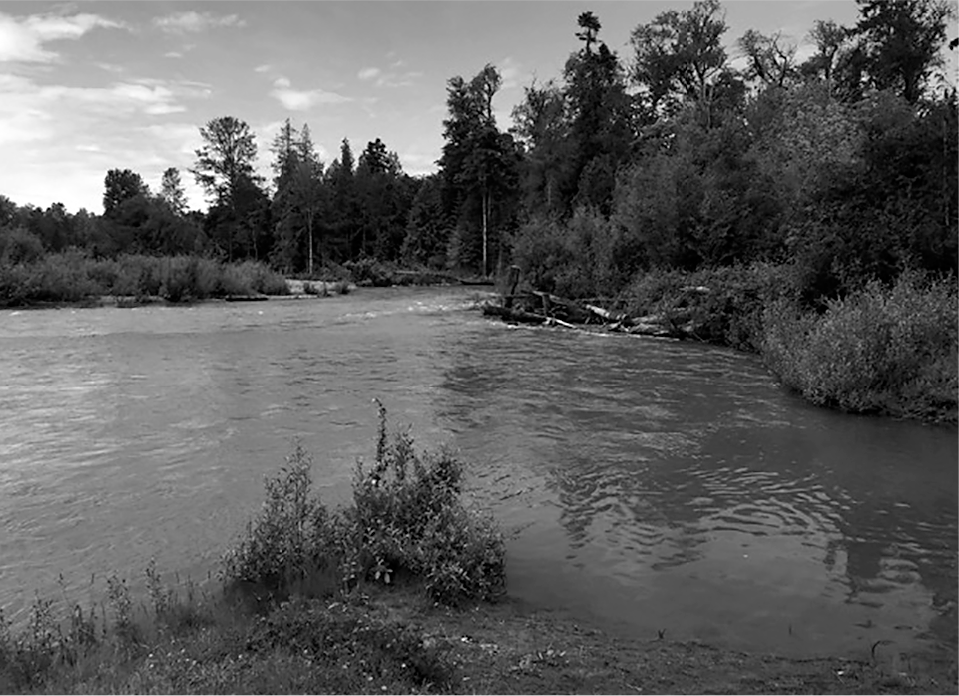
Looking downstream at the Elwha River from near the Lower Elwha Klallam Tribe fishery. A log jam can be seen on the right side of the river. River restoration included log jams’ construction to provide a shady resting place for salmon as they migrate up the river to spawn.
K. Whitney Mauer
I try to look forward…We can’t look that far ahead. Our physical bodies probably won’t allow us to be that far ahead. So it’s just something that remains as a dream or a wish….So, I keep praying, Lord, make it good for [the youth]. Because these are our territories.
By the 1960s, the Elwha’s ecological conditions converged with pressures from commercial fisheries and increased demand by the growing population of Washington state to further collapse fish runs of all salmon species in the Elwha. Across the state, commercial and recreational fishers viewed Indigenous fishing as competition, and their practices were criminalized despite treaty language that guaranteed off-reservation fishing rights. Like other Indigenous peoples throughout Washington state, the Klallam persisted by continuing to fish despite the risk of arrest by game wardens. Klallam elders told us that because of the dams, there were few fish to catch and that they would collect dead fish from the river’s edge when dam waters were released. Even these practices often led to their arrest until the landmark “Boldt decision” in 1974 (U.S. v. Washington) that upheld off-reservation treaty rights to hunt and fish. For the Lower Elwha Klallam, however, the decision was cold comfort in light of the damage to fish populations resulting from the dams. Despite these challenges, the Klallam still talk about the runs of Chinook salmon they have never seen, know where fishing sites and villages used to be, and talk about a future informed by a past they have not experienced.
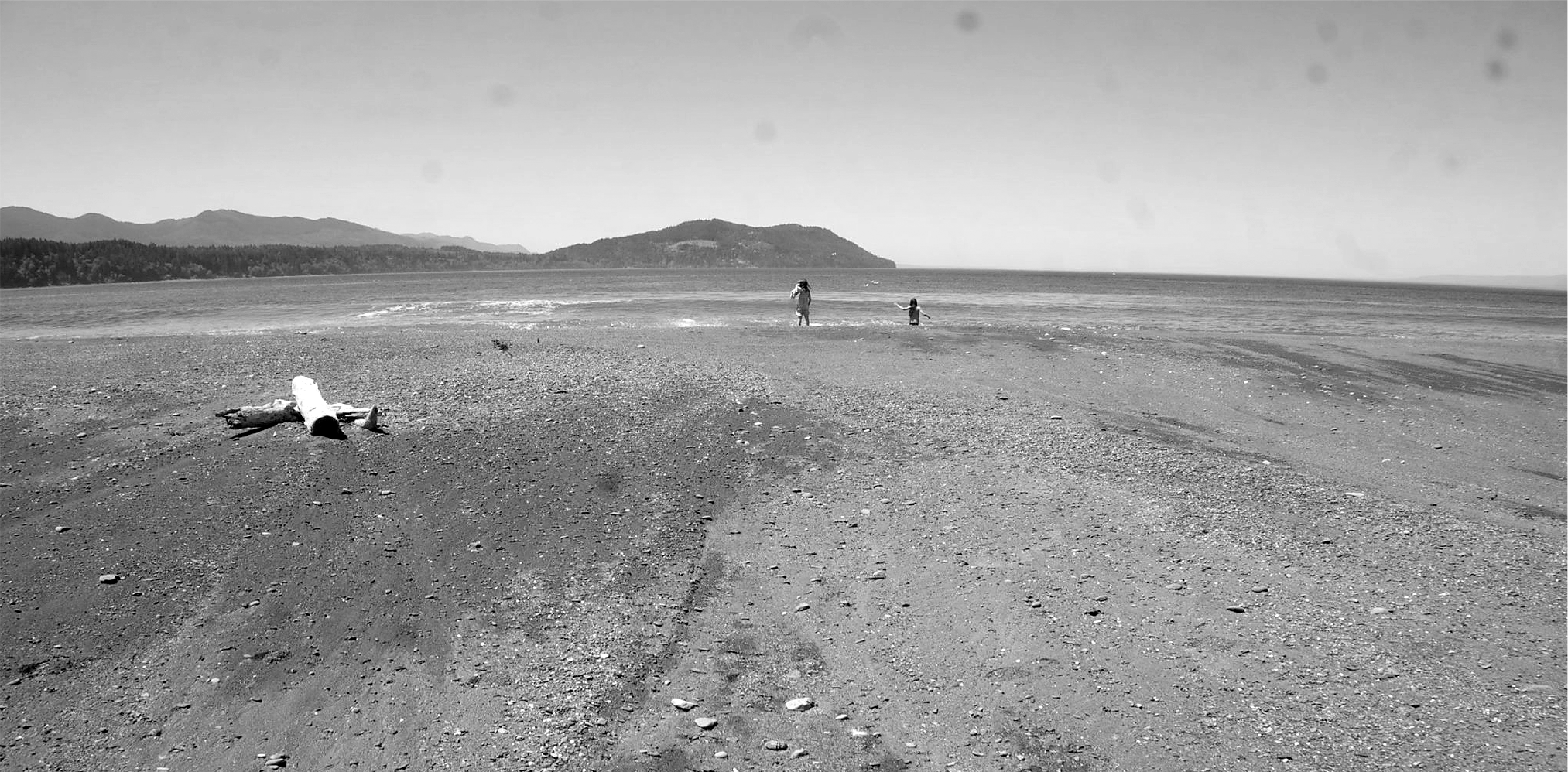
New beach 2015. One year after dam removal, children are enjoying the large sandy beach formed at the mouth of the Elwha River.
K. Whitney Mauer
To go to the river’s edge and experience it is reinforcing everything that we understand or feel or sense from the river. The power, the restoration to our own souls and minds, to our spirituality. It impacts us just to be there.
The dams are now gone and the ecosystem restoration is still in its infancy. Yet, the ecological health of the river ecosystem looks promising with the highest fish populations in 30 years and the growing estuary and delta. The restoration is accompanied by regular monitoring by scientific professionals and has attracted the attention of tourists, journalists, and documentary filmmakers. In our interviews with tribal members, they reported that they had observed the emergence of a sandy beach, the presence of more “swimming, flying, and running animals,” and an increase in plants in and around the mouth of the Elwha River.
We heard members of the community express strong hopes for ecological restoration to contribute to cultural renewal. One member described her experience: “To go to the river’s edge and experience it is reinforcing everything that we understand or feel or sense from the river. The power, the restoration to our own souls and minds, to our spirituality. It impacts us just to be there.” Many of the people we talked to referred to restoring conditions that they had never personally experienced. For example, when asked about the importance of the river to the Klallam, one member began to describe her hope for the restoration of cultural spaces (emphasis added); “I would like to see them bring back our longhouses. I would love to see them have a cultural building. We need to have a ceremonial place. I would love to see our canoes land on our beach again rather than in Port Angeles harbor.”
Klallam hopes and dreams for the future were deeply tied to memory—both direct memory and those embedded in the stories of elders who have passed. As Indigenous researcher Linda Tuhiwai Smith stated, “The remembering of a people relates not so much to an idealized remembering of a golden past but more specifically to the remembering of a painful past and, importantly, people’s responses to that pain.” For the Klallam, the painful remembering of the damming informs the ideation of a future in which the wound has healed. This is an expression of Indigenous futurity in which Klallam remembrance of settler-colonial violence is linked to a self-determined future free of such violence.
Klallam members that we spoke with expressed pleasure unanimously regarding the dam removals and ongoing restoration. They expressed hope for the revival of ceremony, access to sites for traditional practices and healing, and the return of salmon and traditional food sources. However, the hope expressed for the community’s future was tinged with pain and loss. Few of the desired changes to the Klallam community have yet to materialize.
The Lower Elwha Klallam Tribe’s reservation is at the mouth of the river with housing and administrative buildings in the 100 and 200-year floodplain. Freeing the river results in a substantially higher flow of water, changes in the river’s course, and the deposition of debris and sediment over a wide area as the river winds toward the Strait of Juan de Fuca. To make way for this change and to protect human health and safety, the lands in and around the river have been evacuated, and the levees were enlarged to protect the rest of the reservation from flooding. Today, some families feel hurt that they were displaced and have lost family homes that were close to the river. Moreover, several Klallam elders mourn the loss of their childhood sites imbued with memories of fishing, swimming, playing, smoking fish, and avoiding arrest by game wardens. The impacts of the original damming and the attendant historical trauma reverberate through contemporary Klallam life, and the restoration has re-opened that wound for many of the current elders who are experiencing loss.
Resurgence
“How long will it take for the river to have its complete cleansing to a place where the salmon will smell that freshness, will grasp ahold of the fact that this is our home and return.”
The dams remade the Elwha River to serve the settler state, undermining Klallam capacity for collective continuance and self-determination. To this end, the restoration of the Elwha River and its fisheries holds the potential for enhancing Klallam traditional food systems, customary practices, and for more generally revitalizing Klallam ecologies. Ecological restoration alone, however, has limited ability to upend the social hierarchies and settler-colonial structures that underpin environmental injustice. As one Tribal member explained, “I’m glad for all of the things that are being done, but I still see that our government is patterned after non-Indian governments because they’re blocking us from this and that and we’re not able to do these things any longer.”
The Klallam have survived and resisted settler encroachment and interference, adapting cultural, social, and economic systems in response to the changing landscape. However, in the present form, restoration practice risks reinscribing trauma by triggering memories of past colonial ecological violence. The restoration of the landscape may help support Klallam survival, but without revitalization of Indigenous institutions and practices, it is unlikely to support Klallam resurgence and self-determination.
In light of Klallam articulations of their particular challenges with ecological restoration, academic concepts of resilience should be reconsidered. Sociologists can help bridge the gap between resilience-based environmental practice and Indigenous ecologies by critically questioning whether resilience approaches reproduce settler-colonial, eco-social structures or whether they center Indigenous systems and resurgence.
In July 2019, for the first time since 2005, the Lower Elwha Klallam Tribe hosted a canoe landing as part of the Canoe Journeys, in which canoe families travel their ancestral water routes to an annual gathering of hundreds of Indigenous nations where songs and stories are shared among nations. The canoe landing was made possible by the emergence of the now 100+ acre beach. Since the undamming, the thin edge of rocks and pebbles that separated Klallam homesites from the Strait of Juan de Fuca has transformed into a vast stretch of sandy beach created by the deposition of sediment that had been trapped behind the dams.
The beach and other remarkable changes in the appearance of the river have attracted scientists, tourists, and the curious to the Lower Elwha Klallam Reservation, which in turn created a new set of tensions about access and control of this new land. During my last visit, a little beach shelter made of smooth, water- worn logs sat on the grey, sandy beach. Written in marker on one of its logs were the words “Tribal land!! No fires!!”