




Abstract
Deploying Indigenous imagery without including Indigenous peoples perpetuates the idea that these communities are of the past, erasing them from the present. Here, the authors explain it as “terrortory”, or the lawful use of fear and violence to alienate peoples and land for power.
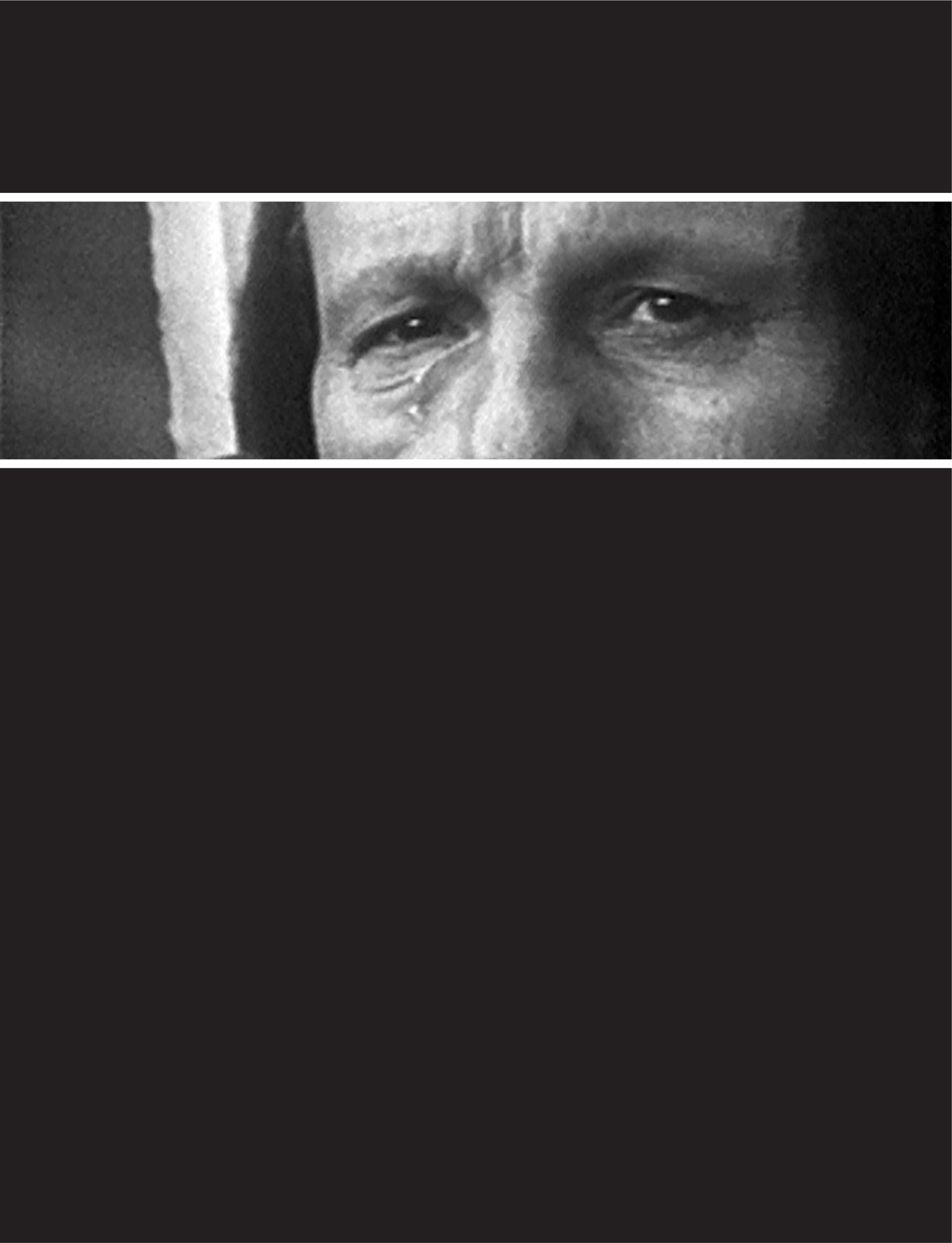
Dressed in full costumed regalia—buckskin with fringe, long hair braided into two ponytails on either side of his head, a bead and bone necklace, and feather in his hair—Iron Eyes Cody paddles a canoe down river. Soon we see garbage floating in the river next to the canoe; the camera reveals Cody paddling into filthy water outside a major, anonymous, metropolis. The water is contaminated; factories sit along the water’s edge. As he pulls his canoe ashore amid garbage, a deep voice explains the message: “Some people have a deep abiding respect for the natural beauty that was once this country and some people don’t. People start pollution. People can stop it.” The camera focuses on Cody turning to look directly at the audience, stoically shedding a single tear. This simple ad for “Keep America Beautiful,” first aired on Earth Day, starring Cody, a second-generation Italian American who passed as an Indigenous person, invoking an entire history of violence, land, terror, erasure, and racialization.
Deploying Indigenous imagery to guilt white colonizers to stop polluting, the imagined lone Indian, feeds on assumptions that Indigenous peoples are remnants of the past, erased from manufacturing and modern urban life; a rhetorical and discursive violence. Where did the other Natives go? What happened to them? The physical violence that removed them from the land or the narrative violence that removed them from the story (or memory) reinforces the vanishing Native ideology—Indigenous peoples are absent. Only the idyllic, imagined noble savage remains. Genocide and colonization are presented as foregone conclusions, not ongoing terrors; Indigenous lands as long ago taken and repurposed by colonizers who fail to appreciate the land aesthetically. Of course, this “progress,” with its factories, cars, and roadways is neither preordained nor the apex of society. Here, we want to reclaim the narrative, frame it in both time and space, and suggest other possibilities.
Consigning Indigenous peoples to the past erases them from the present. There are bodies of research, art, and story- telling, showing how colonization severs, alters, and remakes relationships. This altering of relationships happens through fear and violence, deploying institutions, ideologies, and practices—like courts, systems of property ownership, and schooling. Violence operates at overt, epistemic levels through genocidal acts of removal and systemic murder, and at the seemingly mundane deployment of imagery that enacts violence of erasure, like Iron Eyes Cody’s single tear.
To highlight the interconnected violence against land and peoples that comes from colonization, we frame these colonial practices into a concept we call “Terror-tory.” We define terrortory as: the lawful use of fear and violence to alienate peoples and land for power. A portmanteau of terror and territory, terrortory inverts the U.S. government’s definition of terrorism—”unlawful use of force and violence against persons or property to intimidate or coerce”—to emphasize the legal legitimation of violence against lands and peoples. State-sanctioned violence creates and maintains social structures.
Cody, as the lone Native, is part of a terrortory framework: violence to the land led to factories that pollute water; violence in the erasure and removal of Indigenous peoples from the lands so that civilization could commence; violence in the use of Cody as a proxy when there were unemployed Native actors. The entirety of the scene is rooted in taken-for-granted violence. Terrortory unmasks.
We emphasize a relationship to land that is not about a superior claim of right or title; Indigenous peoples are not Indigenous simply by being the first occupants. They are Indigenous, with a capital I, because of their relationships to the land. These relationships are grounded in reciprocity and respect, stemming from a relationship to a place of origin and the stories of how they came to be. Relationships between lands and peoples represent how communities coalesce and connect to different lands, forming connections that are reverent and sacred, and rarely recognized by colonial laws like property or individual ownership. Indigeneity centers the relationships of belonging, not an individual as an owner, but in relation to peoples, place, time, and others. Contrarily, terrortory is a relationship between people and land grounded in domination. It centers individuals, present possessory interests, and a conspicuous absence of origin stories.
Wiki Commons
Iron Eyes Cody (left), an Italian-American actor who portrayed Native Americans in Hollywood films, and Roy Rogers in the movie, North of the Great Divide.
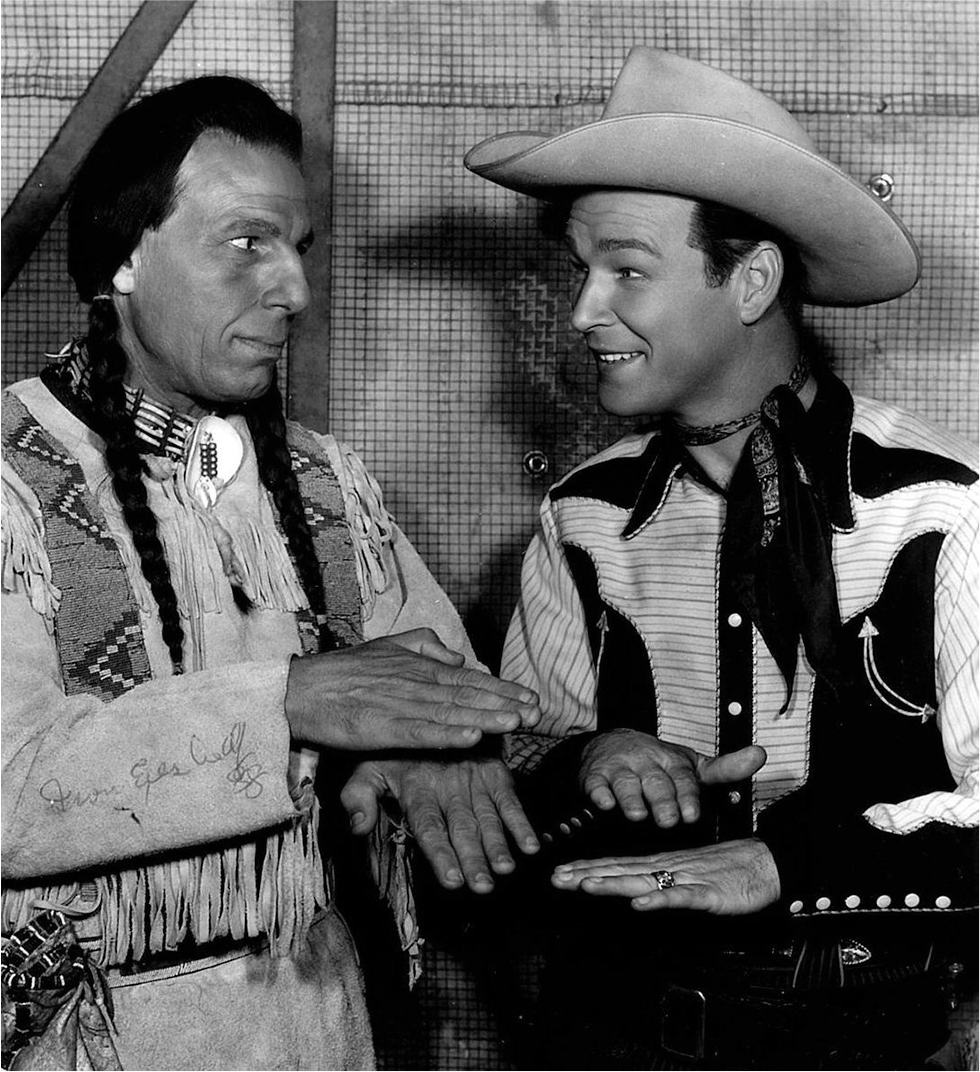
Terrortory is in the simultaneous presence of the imaginary Indian and the absence of an actual Indigenous person.
Terrortory has many manifestations, but its logics rely on the disconnection—obscuring the continuum of violence and domination. In the 18th century, British Colonies would become the United States. In either manifestation, colonial leaders placed bounties on indigenous peoples, offering payment for scalps in order to remove peoples from land, clearing space for the sale, and theft of land by white colonists. Scalping bounties terrorized, killed, and displaced Indigenous peoples for property, simultaneously constructing the racialized savage boogeyman “other.”
Violence is a means of possession/dispossession—terrorizing and trying to scare away and remove those who would contest colonial uses for land ownership. The land’s inherent value becomes lost, obscuring the symbiotic and mutually constituted relationships of peoples to land and land to its peoples. History shows that both individuals (including corporations and their workers) and governmental entities (including Congress, the courts, and other agencies) have dehumanized land and peoples through removal and disrupted the relationships between peoples and place.
Today, terrortory is operationalized in the seemingly mundane regulation of the hair of Black and Native youth. These students are too often threatened with suspension or expulsion simply for styling their hair in natural, culturally meaningful ways that do not match generic, eurocentric, policies of hair and dress. Terrortory also manifests itself in the explicit conflicts over land and space. From North Dakota—where Indigenous peoples resisting the building of an oil pipeline are met with physical violence—to countless cities across the U.S. where demonstrators lawfully assemble to protest police violence against Black people, terrortory is at work. Repeatedly, citizens are confronted with state-sanctioned violence and terror as they gather to protest.
School discipline, corporate exploitation, and police violence all are sanctioned by law in neutral tones, preserving a hierarchy of power that prioritizes whiteness and colonial interests, without having to mention either. Educators no longer follow the words of Richard Pratt, to “Kill the Indian, and Save the Man.” Now the violence is masked in neutral tones of school dress codes that require “clean and neat” haircuts for boys, often leading to Black and Native students being singled out, disciplined, suspended, or even expelled for wearing their hairs in ways that do not conform to white norms. This means Black and Indigenous youth are removed from school and alienated from their Indigeniety—relationships to home, culture, and peoples—via racially coded, white supremacist policy. Scalping bounties and dress codes are different implementations of the same continuum of racialized, colonial violence through alienation. Forcing students out of schools is a means of control, reinforcing hierarchies of domination.
This special issue focuses on the problems of research and deficit-orientations for Indigenous peoples. Terrortory as a practice, is deficit-oriented; the presence or privilege of those in power is rooted in the violent imposition of absence, or illusions of deficiency. It is sustained through rhetorical and discursive violences masked by neutral wording and assumptions about the “natural order to things.” In the remainder of this essay, we want to delve into terrortory by exploring how deficit-orientations and frames are implementations of state-sanctioned violence and fear, erasing the ongoing presence of Indigenous peoples, or reinforcing a mindset that Indigenous peoples do not belong, or all of these things.
Behind Iron Eyes
The so-called “Crying Indian” ad conjures a mirage of Indigeneity—supernaturally attuned to the environment, from the past, solitary, stoic, male, sad. The iconography of Indigeneity deployed by Cody plays on the commonsense narratives of colonization; assumptions about who Indigenous peoples were, and that they are no longer present, while skipping over the legacies of violence, fear, and terror deployed to remove Indigenous peoples. Terrortory is the simultaneous presence of the imaginary Indian and the absence of an actual Indigenous person. Our focus is not just the white western imaginary of Indigeneity that Cody represents but also the simultaneous absence of Indigenous peoples. Cody’s presence invokes the absence of Indigeneity, down to the fact that he is simply, as Philip Deloria says, “playing Indian.”
The “Keep America Beautiful” campaign is a message of a return to a past that doesn’t exist. This erasure is an act of violence at the core of a campaign about the environment. Factories and cities do not just appear by the waterway. They are built on a foundation of genocide and slavery disclaimed by later generations of white colonists since they did not individually remove Indigenous peoples from their lands or own slaves, simultaneously denying and embracing the inherited benefits of whiteness. Violence against the land is present and centered by the visual cues of pollution; the violence against people, however, is absent. Colonial progress creates a false dichotomy between land and people. The violence used to empty lands and construct factories is avoided, left only with the imaginary past of pristine land, byproducts of modern industry, and imagined Natives.
“Keep America Beautiful” is a deficit frame rooted in terrortory; the veiled absence of Indigenous peoples is juxtaposed with colonial progress to trigger an ethos of personal responsibility. The PSA correctly observes that people can stop pollution, but prioritizes the land’s aesthetic qualities over inherent relationships to land, individual action rather than a systematic remedy. Keeping America Beautiful perpetuates terrortory; state-sanctioned violence enabled the cars, factories, and pollution, but law will not stop it. Cody’s character is alienated from the land by pollution. In contrast the viewer is alienated from Indigeneity—”some people” have a deep and abiding respect for the land, but those people are not the intended audience. They are invisible; erased.
We emphasize terrortory as an intervention to common sense assumptions about relationships between land and peoples. “Keep America Beautiful” relies on Indigenous peoples’ erasure while invoking Indigeneity to respond to waste—an aesthetic deficit—affirming the absence of Indigenous peoples through the imagined Indian. By looking at these deficit narratives through the lens of terrortory, we look to the spaces between the lines where relationships between lands and peoples have been severed through legal, state-sanctioned violence and fear. Terrortory frames how rhetorics of deficit—particularly for Black and Indigenous peoples—both stem from and enact colonial, white supremacist violence.
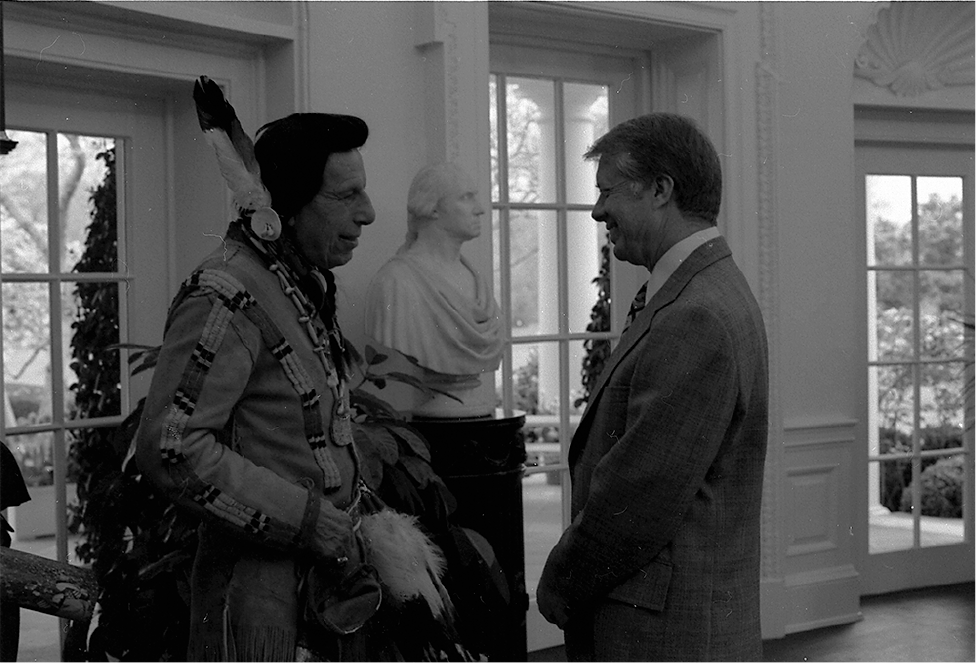
President Jimmy Carter with “Iron Eyes” Cody.
National Archives and Records Administration
Deficit Distractions
Over 5.6 million American Indian and Alaska Natives currently live in the United States, representing more than 650 Indigenous nations. Indigenous peoples make-up roughly 2 percent of the U.S. population. Despite the diversity of Indigenous cultures and governments, Indigenous peoples are often framed as a monolithic deficit, particularly the so-called achievement gap between Indigenous students and White counterparts in standardized testing. Deficit frames blame entire communities for disparities revealed by standardized measures—overlooking problems of measurement or intervening variables—to place the onus of low standardized academic performance on youth and communities.
Problems of deficit framing for Native youth is emphasized by conspicuous flux and absence from national testing—because surveys and samples did not gather a large enough sample. For example, the National Center for Education Statistics 2016 report on the Condition of Education notes that, “the relatively small sizes of the American Indian/Alaska Native and Pacific Islander populations pose many measurement difficulties when conducting statistical analyses.” This conclusion leaves longitudinal and contextual gaps in the data on Indigenous youth in primary, secondary, and postsecondary education. Failing to gather a sample of Native youth is the simplest way of reinforcing absence—leaving out entire peoples because colonization has reduced their relative population. They are made invisible; erased.
In looking at the ways state-sanctioned violence alienates land and peoples, terrortory is a reminder that attempts to quantify violence, which must come with qualitative and historical accounts to contextualize the numbers. Without context, quantifying violence may elide the scale and extent of violence, avoiding systemic implications. Violence, like racism, is often wrongfully reduced to an individual act of meanness or aggression. However, both violence and racism must be thought of multidimensionally; at individual, systemic, and epistemic levels. Macroaggressions and microaggressions are interrelated acts of violence that can have profound effects on peoples’ relationships to land and place.
Another way of thinking about deficit framing is in the racist stereotypes of Indigenous peoples: substance abuse, savage, uncivilized, extinct, mired in tradition, unable to learn, good with our hands, etc. In these deficit frames, the racist trope is in relation to whiteness—centralizing the colonizer in the narrative of what is proper. These narratives and data can easily be debunked with extensive evidence, but it is generally not the point. As Toni Morrison explained in a 1975 speech at Portland State University, “the function, the very serious function of racism which is a distraction. It keeps you from doing your work. It keeps you explaining, over and over again, your reason for being.” Deficit narratives distract in order to preserve racial hierarchies that put Black, Brown, and Red peoples in our “proper place” set out by white supremacy and colonization. Deficit is linked to a hierarchy of domination. Violence maintains the racial status quo, defining belonging through the hierarchy that entitles whites, disinherits Indigeneity, and displaces Blackness.
Deficit-oriented approaches to research are similarly rooted in white supremacy, the result of policies and practices dependent on violence and exploitation. For Indigenous people in particular, many of these approaches rely on statistical absences and erasures. Heather Shotten, Shelly Waterman, and Stephanie Lowe articulate this as the problem of the “asterisk.” Because Indigenous people are a small percentage of the total population, and often a small percentage of any sample or study, they are footnoted, asterisked, omitted, or otherwise placed at the outskirts of research for lack of statistical significance. This makes Indigenous peoples absent—decontextualized, eliminated from coalitions for solidarity, and minimizes Indigenous peoples’ struggles and accomplishments in education. Deficit-orientations are at best a funhouse mirror that distorts the experiences of Indigenous peoples. At worst a shrink-ray that so minimizes Indigenous experience that they become invisible to the naked eye; erased.
This marginalization-through-insignificance perpetuates histories of violence by failing to grapple with the underlying reasons why Indigenous peoples are such a statistically small percent of the population. At one point in the past, every part of the land within the United States’ political boundaries was filled with Indigenous peoples. Then 371 treaties, 5,000 acts of Congress and executive orders ceded approximately 1 billion acres of Indigenous land to the United States.
Treaties offered exchanges—sometimes land exchanges, usually guaranteeing federal protection from violence and encroachment, and including benefits such as health, education, and welfare, in perpetuity. The Treaty of New Echota in 1835, for example, was a land exchange between the Cherokee Nation and the United States. After the discovery of gold on Cherokee lands in the southeast, the state of Georgia sought to expand, while the Cherokee Nation refused. Georgia pressed on, necessitating federal intervention.
The United States offered land in the Indian Territory that would become Oklahoma in exchange for Cherokee homelands, offering sovereignty and jurisdiction, removed from state interference. Otherwise, Cherokee would be left to fend against incursions by Georgia on its own. Faced with removal, assimilation, or outright conflict, a select group of Cherokee signed the treaty, without the full consent of the Cherokee Nation. Terrortory alienated the Cherokee from their lands; alienation would occur either by disavowing the Cherokee as a nation, enabling assimilation, or by forced removal, or by removal by treaty. The United States accepted the treaty as law, and President Martin Van Buren enforced the treaty by forcibly removing any Cherokee who declined to leave their lands, creating the Trail of Tears.
Theoretically, treaties recognize the sovereignty of Indigenous nations as peers with the United States—treaties are agreements between nations, after all. However, the United States Supreme Court has taken a unique approach to treaties with Indigenous nations. Congress may unilaterally break, or abrogate, a treaty because of its plenary power, according to the Supreme Court in Lone Wolf v. Hitchcock in 1903. While Congress and Indigenous Nations mutually agree to treaty terms, often under duress, Congress has the sole power to expressly disavow treaty obligations at its own discretion—as Congress did in Lone Wolf when it disregarded the Medicine Lodge Treaty of 1867 by reducing the Kiowa-Comanche-Apache reservation without treaty-mandated consent of Tribal members.
Just as the “Keep America Beautiful” PSA relied on narratives of Indigenous absence to overlook histories of violence, treaties emphasize how fear and violence are legitimized through the operation of law. The Treaty of New Echota sanctioned the removal of the Cherokee, even though it was made under duress. The Medicine Lodge Treaty outlined requirements for the taking of Tribal land. However, the Supreme Court ruled in Lone Wolf that because “Indian tribes are the wards of the nation… dependent on the United States”, Congress could be assumed to act in “good faith” when repudiating treaty obligations. Terrortory centers the lawful use of fear and violence; treaties legitimize the use of violence to enforce agreements made between sovereigns. It was simpler for the United States to agree to exchanges. It could break and ignore, compounding the violence of treaty-making with unmet obligations and responsibilities, rather than engage in costly full-scale warfare against Indigenous nations.
Indigenous peoples’ marginalization is a story filled with other forms of legally sanctioned, interdependent violences— warfare, starvation, removal, scalping, and deterritorialization. Physical violence initiates theft of land. Legal rhetoric legitimizes the violence as policy of civilization or benevolence, erasing the brutality of the U.S.’s origin story. Terrortory emphasizes that these acts of violence—rhetorical erasure, physical violence, colonization, and white supremacy—are all interrelated as measures under the law to alter relationships between land and people. The relationships are altered through the removal Indigenous peoples from lands—both in the United States and abroad as Africans were taken and imported in as property into chattel slavery—and refashioning those lands through colonization and property ownership into wealth and power for white Europeans.
Terrortory feeds deficit orientations by altering the relationships between lands and peoples, alienating peoples from the land by making land a saleable commodity (alienable) and by changing the nature of that relationship by changing the character of land and peoples to estrange peoples from places they call home. Relationships change, shift, and are mediated by policies of violence and terror that are weaponized through racial hierarchy known as white supremacy and colonization. A core feature of terrortory is extraction via terror—extraction of labor, land, dignity, and even humanity from Black and Indigenous peoples. For land to be possessed in the United States, peoples must be dispossessed toward the ends of “progress” and material gain.
There is an inherent relationship between lands and peoples. Consider our origin stories. Who we are is directly linked to where we come from; where our ancestors are, were, or have been. Land has inherent value, and that’s related to the people who are from there, who live there, and have always lived there. Peoples’ origin stories about their lands come from, how they relate to that place, no matter where they are presently located. It is a way of identifying relationships across space and time, where you are related to where you have been, where your people come from, and how they come to be there.
Consider, for example, Bryan’s people, the Lumbee, who are tied to the Lumber River. That river has intrinsic value in who he is as a person and who Lumbees are as a people. It feeds and nurtures, providing water for farming and fish for food. The river is a source of strength, lessons and cautions, and inspiration for Lumbee. Stories revolve around the river. This origin story is the basis of a relationship between his people, the Lumbee, and land.
Even though Bryan currently lives in Arizona, his relationship to this place is still shaped by his relationship to that land. Indigenous peoples are grounded in the relationship between land and people that travel with them no matter where they go. Relationships between lands and peoples are harmed by violence, fear, and terror as land is stolen, misappropriated, and colonized. Land is dehumanized—as peoples are removed from land—and the land itself is commodified as a transaction, reduced to an extrinsic value that puts humans at the center rather than as part of the larger ecology.
Compare Bryan’s relationship to the river with the “Keep America Beautiful” campaign. Cody appears on a river, alone on a canoe, to shed a single tear and encourage white colonists to pollute less. This noble savage stereotype alienates Indigenous imagery from Indigenous peoples—no relation to the river or land, just the stereotype of Indian. The presence of colonizers from Europe is dependent on the absence of the Indigenous. Colonization is oversimplified, reduced to arrival and accumulation—this rhetorical presence obfuscates Indigenous peoples’ presence and theft of the land. The story often goes something like: the pilgrims come to the land, make friends with the Indians, share a meal together, and then the Pilgrims thrive. The Indigenous peoples are erased from the narrative after that first, shared meal. The Pilgrims are present, and the stories remain with them, while Indigenous peoples fade and disappear. Indigeneity is consumed, the land is possessed, skipping colonial violence, terror, scalping, and expansion.
Changing the Terror-Story
In the 21st century, we see how people and property are related through violence. Confederate monuments glorify those who fought to keep Black peoples as possessions on lands taken from Indigenous peoples. Land is exploited for use rather than appreciated space sacred to Indigenous peoples: battles over oil and water in North Dakota, uranium at Bear Ears National Monument, gold in the Black Hills (because it worked out so well the first time around 150 years ago), and the maintenance of a telescope on Mauna Kea in Hawai’i. Importantly, these engagements around monuments and land are intimately linked to the connections between time and space. The battles for land, space, and people run deep in the U.S., particularly for Indigenous peoples whose relationship with lands clash with notions of White ownership entrenched in the laws of possession in the United States. This is still the struggle of terrortory, where land is dehumanized through dominance, possession, and control, while Indigenous peoples and others continue to tell origin stories of self, people, and place that defy the frame imposed by ownership, to show how they belong in relation to others and place.
In its physical, rhetorical, and epistemic forms, violence is a means of possession and dispossession—terrorizing and removing those who would contest colonial uses or ownership of land. Dogs, water cannons, rubber bullets, and tear gas are used to deter protesters—implements that are violent and potentially lethal, like the police shootings, chokeholds, and toxic pollutants protestors rally against at Standing Rock, Flint, Minneapolis, and cities around the United States.
The talk of profit and the superiority of science or a particular narrative overrides Indigenous connections to land. DNA testing perpetuates colonial definitions of race and place, confusing relationships of peoples and land with biology. The land’s inherent value is lost, especially in the symbiotic and mutually constituted relationships of peoples to land and land to its peoples. The presence of Indigenous peoples is erased. We must begin to expand our thinking about violence and race in relation to how we think about lands and peoples. Terrortory is an organizing concept, to connect the various threads and implementations of violence against land and peoples. However, terrortory is neither final nor all-encompassing. Peoples refuse to be consumed by violence and terror and instead respond with humor and joy. Indigeneity, the relations between peoples and land, perseveres.
We imagine that exploring the connections between race, land, and indigeneity through terrortory will be illuminating for Indigenous peoples and others. Future conversations on water, sacred sites, and monuments, how bodies are engaged, the (re)-writing of origin stories, and the relationships between people and place—rooted in asking the question: who belongs here?—will offer us room to stretch and grow. We also must consider the multiple dimensions of the relationships between land and people, noting the role of race and colonization in the relationships between land and people means understanding the ways Black, Native, and other marginalized people relate to place, and what their stories look like in relation to the land and to each other, and what colonial and white supremacist violence has done to those relationships.
As we elaborate on this concept, we welcome an opportunity to think about the role of coalitions between those marginalized and removed because of an ahistorical narrative or through the legalization of violence. There is violence in the physical attacks on peoples; there is also violence in ignoring the sacred nature of land to its original inhabitants, in the erasure of their histories, and in creating a sense of unbelonging. We intend to explore all of these in the coming years.