



Abstract
The history of the U.S. Census is needed to understand the count and participation of American Indian and Alaska Native peoples. The challenges and lessons learned from the census reveal an opportunity for social research to collect meaningful data in Indian Country.

The 2020 U.S. Census is underway to count all persons who currently reside in the United States. This year, the decennial census has some unique challenges, including transitioning to an online submission option as well as minimizing in-person census takers due to the COVID- 19 pandemic. The Census Bureau is regularly navigating challenges and is continuously finding innovative ways to increase response. One population with its own set of considerations, however, is American Indian and Alaska Native peoples and communities. We will lay out the parts of U.S. Census history relevant to understanding the count and participation of American Indian and Alaska Native peoples. The challenges and lessons learned point to a path for social research and survey research to collect meaningful data in Indian Country.
U.S. Census Bureau
The U.S. Census Bureau collects data through the decennial census and the American Community Survey. This data, particularly the decennial census, is used to help state and federal governments to disperse funds. The decennial census began in 1790 and has occurred every 10 years since then. Between 1890 and 1920, there were separate counts from the census for the Native population who lived on and off reservation lands; it also included recordings of “proportion of Indian blood.” However, Native peoples were not inclusively counted by the U.S. Census until the 1930 census, and there were no separate schedules for Native peoples living on reservation lands. The table below on racial categorizations illustrates the various racial categorizations for Indigenous peoples in the U.S. from 1890 to 2020. Notably, Alaska Native peoples have been formally separated and named in various years, and, since 2000, Alaska Native peoples have been combined with American Indian peoples.
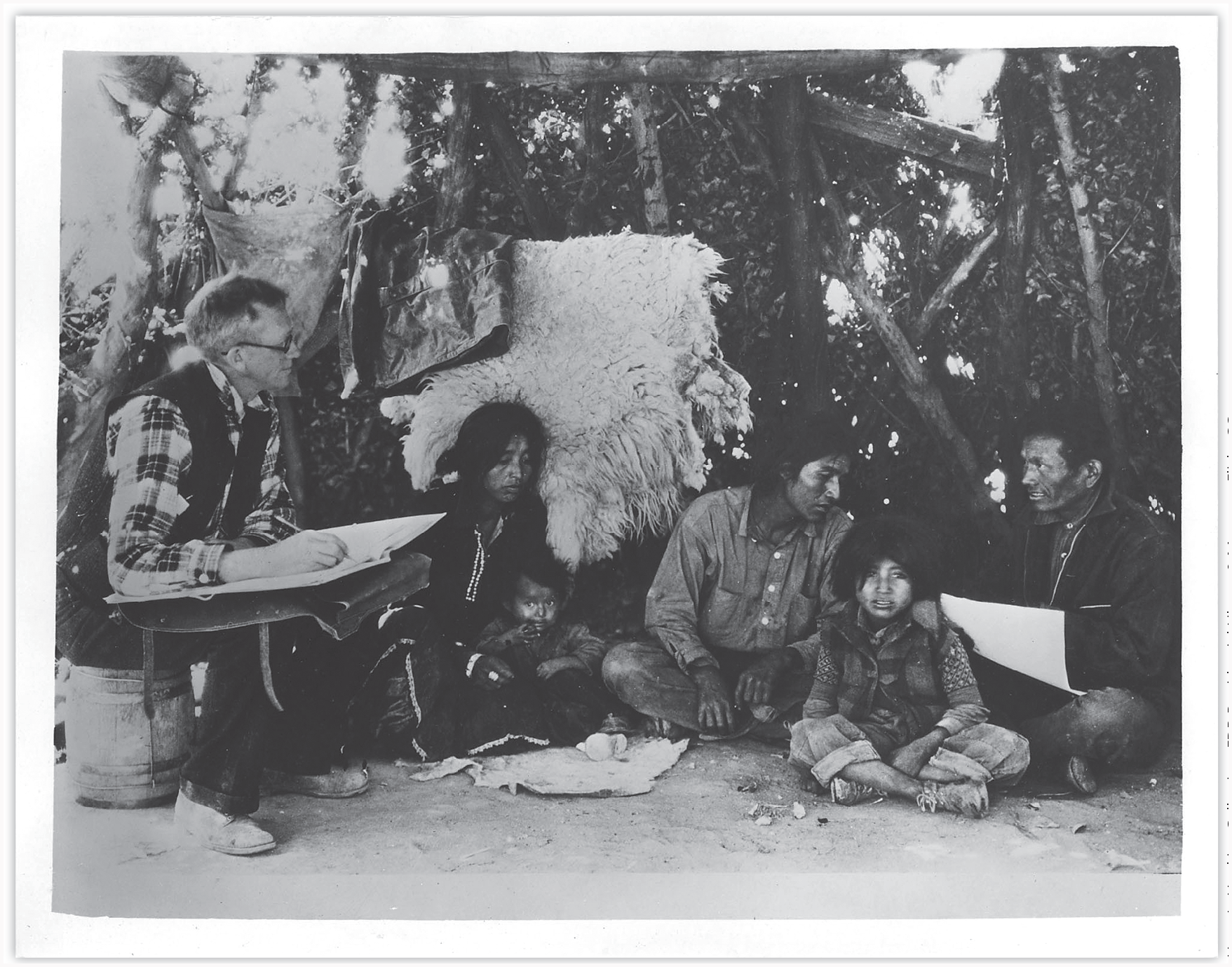
Prior to 1960, the decennial census was collected through enumerators—census workers who went out in-person to collect information directly. The enumerators were often the individuals who determined the Census respondent’s race, and these decisions were made through observation or assumption. Unfortunately for American Indian and Alaska Native peoples, this method of recording race information resulted in frequent racial misclassification of Native persons. However, the complexity of racial misclassification with enumerators was not as simple as enumerators merely being unaware of Indigenous persons and households. Even in the event of the knowledge, enumerators would often only record the household or person as American Indian or Alaska Native if the respondent was an enrolled member of a tribe or recognized as a member of a Native community.
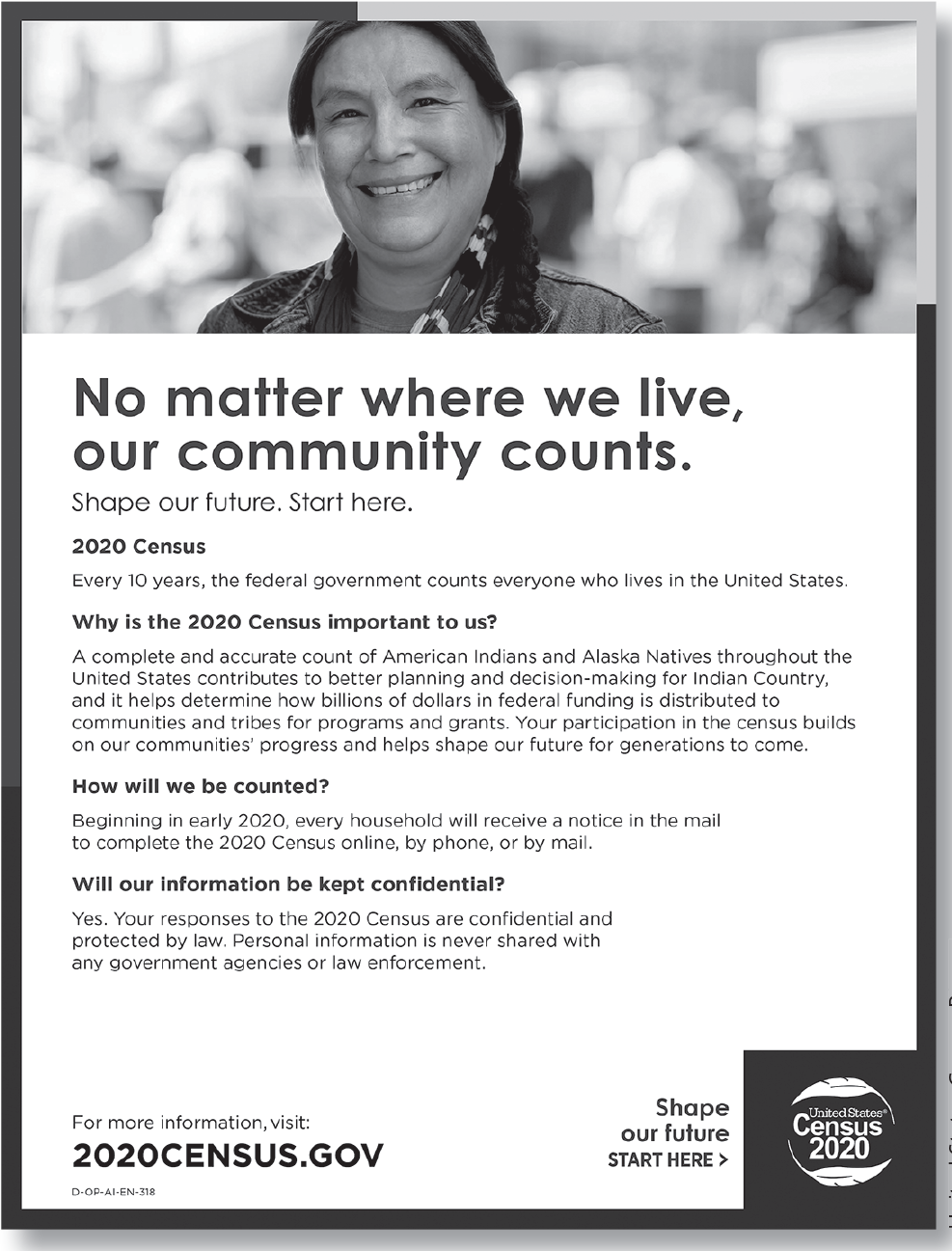
A handout for Urban American Indians and Alaska Natives describing why the 2020 Census is important for urban AIAN communities and how to respond.
United States Census Bureau
Racial Categorizations for Native Peoples in the U.S. Census from 1890 to 2020
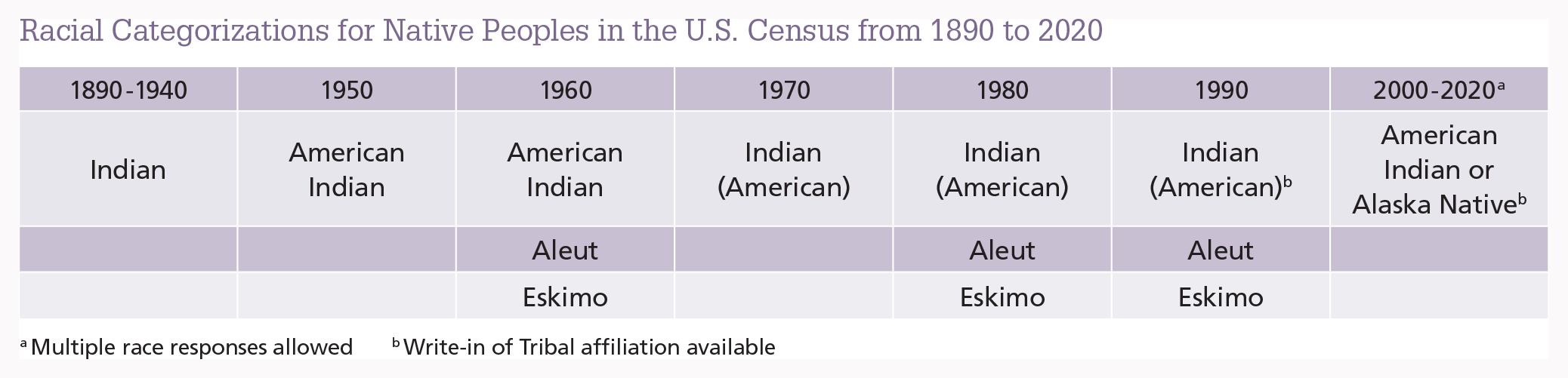
Multiple race responses allowed b Write-in of Tribal affiliation available
Starting in 1960, the decennial census transitioned to a mail-in format that allowed respondents to self-report their information, including their race and ethnicity. In other words, individuals can now choose their race responses without providing verification and documentation to support their responses. This change to self-reporting in 1960 has resulted in a 46.5 percent increase in American Indian and Alaska Native peoples. The contemporary census continues to use self-report information. In every decennial census, the national American Indian and Alaska Native population has expanded so substantially that births and deaths within this population do not explain it. The growth has been largely explained by adult individuals switching from a non-Native race to choosing the American Indian or Alaska Native racial category.
Prior to 1960, the decennial census was collected through enumerators—census workers who went out in-person to collect information directly… Unfortunately for American Indian and Alaska Native peoples, this method of recording race information resulted in frequent racial misclassification of Native persons.
In 1997, the U.S. Office of Management and Budget made the federal definition of “American Indian” more inclusive to include the original peoples of North, South, and Central America, which has brought new individuals into the racial category. Due to this broadening definition, the Latinx American Indian population has doubled from 1990 to 2000. Research has examined the new American Indian and Alaska Native peoples within the census, and found disproportionate increases in the number of Native peoples who are very well educated, Latinx, or born outside of a state with reservation lands. The sociological literature also points to the change in the U.S. societal and political culture that stemmed from the Civil Rights Movement and American Indian activism, which has brought about a decrease in negative stereotypes and cultural repression of American Indian and Alaska Native peoples.
Although at the national level, we have seen a substantial increase in the count of American Indian and Alaska Native peoples in the U.S. Census since 1960, this does not hold true for tribal land areas. In fact, there has consistently been an undercount of Native Americans living on reservation lands. The Census Bureau has reported that nationally there was a 4.9 percent undercount in 2010, a 0.7 percent undercount in 2000, and a 12.2 percent undercount of American Indian and Alaska Native peoples on reservations in 1990. In the 1980 census, some tribal reservations have reported up to a 24 percent undercount of their community members. Not only does undercount miscalculate the Native population in the U.S., but it also results in revenue loss for the state and tribal governments; the estimated loss per person not counted by the census is approximately $1,091.
Policy Shaping Access to American Indian and Alaska Native Identity
The U.S. federal government decides which Native Nations are recognized and, in turn, influences which individuals can legally claim an American Indian or Alaska Native identity. In that, the U.S. Department of the Interior Bureau of Indian Affairs (BIA) issues a certificate of degree of Indian or Alaska Native Blood to tribal members, which show the individual’s relationship to an enrolled member or members of a federally recognized tribe. American Indian or Alaska Native peoples are the only group that the federal government continues to demand computed lineal ancestry to acknowledge formal belonging.
Currently, there are 574 federally recognized Native Nations (i.e., Tribes, Nations, Bands, Pueblos, communities, and Native villages). The Federal Register publishes and provides the current list of tribal entities eligible for funding and services from the BIA and the Indian Health Services. This publication and acknowledgment is also important because it concedes that tribes have a unique political relationship with the U.S. federal government.
Census taker enumerating a Navajo family with the assistance of an Indian interpreter.
Harry L. Hopkins Collection, FDR Presidential Library & Museum, Flickr CC
Federally recognized tribes are subject to the U.S. federal government’s trust doctrine—a legal and moral duty to assist in the protection of tribal lands, resources, and cultural heritage— and plenary power, which broadly maintains the federal to tribal governmental relationship. This relationship was generated from the treaties between the U.S. government and tribal nations. In these treaties, tribes exchanged vast amounts of land to the U.S. to protect themselves from attacks upon their lands, for the U.S. to provide health care, education, to acknowledge and protect sovereignty and religious freedom, and to confirm and protect certain rights of self-government, fishing and hunting rights, and jurisdiction over their own lands. Thus, at the individual citizen level, an American Indian or Alaska Native person would be an individual who has met the enrollment criteria for the federally recognized tribe. Because the U.S. has treaty obligations to fulfill, the U.S. government has a vested interest in identifying citizens of federally recognized tribes.
There are also approximately 63 state-recognized tribes. State recognition does not confer benefits under federal law unless explicitly authorized, such as the Administration for Native Americans’ Native American Programs, which provides discretionary grant funding for community-based projects. There are also hundreds of tribes petitioning for recognition at both the federal and state levels.
Each Native Nation (federally recognized and state-recognized) has its own criteria for individuals to be identified members of the tribe. The Navajo Nation is a federally recognized tribe. To enroll in the Navajo Nation, a person must be at least ¼ or one-quarter Navajo direct ancestry. Thus, an individual must trace direct Navajo ancestry, have at least one grandparent who is or was considered an enrolled member, and have a 100 percent blood quantum level. Currently, the Navajo Nation primarily uses blood quantum criteria to determine who is eligible for membership.
In a differing example, the Lumbee Tribe of North Carolina has recently changed their new enrollment process and channel of proving tribal contact. Individuals who wish to newly enroll must provide both historical and present day contact. The historical contact is determined by one’s connection to a school that was all Indian prior to desegregation or membership to a historic Lumbee church. The present day connection consists of completing a class on Lumbee history and culture. Each new applicant must have this historical and present day contact with the Lumbee Tribe and have the necessary documentation such as a certified county birth certificate to qualify for enrollment.
These are only two examples among hundreds of tribes in the U.S. For American Indian and Alaska Native persons, claiming a Native identity consists of more than family lore. It is also legal and political designation of membership of a Native Nation.
Federal Policy Separating American Indian and Alaska Native Peoples From Their Identity and Community
Policy has not only narrated who has access to claiming an American Indian or Alaska Native identity but has also worked to sever the connection between tribal communities and individual Native identity. Unfortunately, discussing each of the policies is beyond the scope of this article, however, there will be brief discussion of each. It is important to understand the external forces that shape racial identity, in general; however, for American Indian and Alaska Native peoples in the U.S., there have been distinct efforts to shape their collective histories. Knowledgement of these issues advises on understanding, defining, and discerning information on American Indian and Alaska Native peoples.
The history of boarding schools and child welfare in the U.S. has removed children from their homes and communities. The U.S. boarding schools for Native American children began in the late 19th century; the last residential school closed in 1973. The purpose of the boarding school experience was to assimilate Native children. The children were not allowed to speak in their Indigenous languages and were given English names and uniforms. The U.S. boarding school system intentionally disconnected Native children from their communities and families.
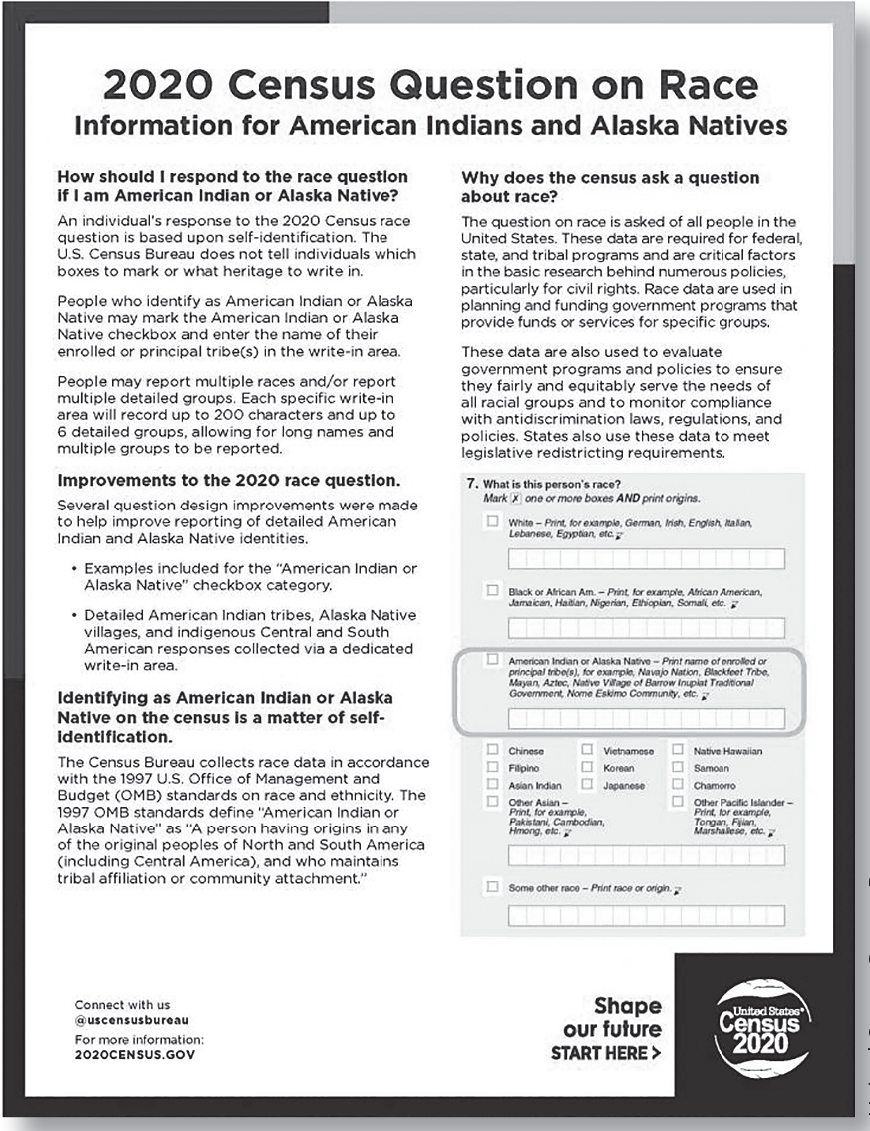
The “race question” on the 2020 U.S. Census.
United States Census Bureau
The child welfare system has also disrupted American Indian and Alaska Native families. Prior to the passing of the Indian Child Welfare Act (ICWA) in 1978, it was estimated that 25 percent to 35 percent of all Native children were removed from their families. Of these children, 85 percent were placed outside of their Indigenous families and communities for foster care or adoption. The purpose of ICWA is to protect the best interests of Native children and promote the stability and security of Indian tribes and families by establishing minimum federal standards for their removal and placement by state and private child welfare agencies. ICWA establishes a number of protections to deter the unwarranted removal of Indian children from their families and communities, including requirements related to the legal notice of court proceedings, intervention, and placement. It is important to note that ICWA is a federal law that addresses Indian children in the state system; ICWA adds federal standards to state child welfare laws. It does not apply to children under tribal jurisdiction.
Although at the national level, we have seen a substantial increase in the count of American Indian and Alaska Native peoples in the U.S. Census since 1960, this does not hold true for tribal land areas. In fact, there has consistently been an undercount of Native Americans living on reservation lands.
The 1950s BIA Urban Relocation Program had the stated goal of addressing poverty in rural reservations. It is estimated that 160,000 American Indian and Alaska Native people were relocated off of reservation lands to live in urban cities between 1952 and 1960. Relocation offices were set up in Chicago, Denver, Los Angeles, San Francisco, San Jose, St. Louis, Cincin-nati, Cleveland, and Dallas. The Native individuals and families who moved to urban cities were a part of building the existing network of urban Indian centers that foster a Native community environment. These centers offer cultural enrichment programs as well as workforce development opportunities.
Lessons Learned and Navigating Forward
The U.S. Census and its decennial census have highlighted how the method of information collection shapes how a population is defined and the important role of both contemporary and historical context in understanding who has access to these identities. For American Indian and Alaska Native peoples, each of these things has simultaneously caused exponential growth at the national level and undercount of the Native population at the tribal land level in the decennial census. However, there are lessons to be garnered from this case study of American Indian and Alaska Native peoples and the decennial census.
Evidence from low participation of American Indian and Alaska Native persons in the decennial census highlights three important factors to consider for survey research among the Native population: movement between tribal lands and urban areas, historical distrust, and incomplete methodological procedures. American Indian and Alaska Native peoples, particularly men, travel between tribal lands and urban areas for economic opportunities on a regular basis. American Indian and Alaska Native peoples have resistance to participating in the census and research due to current and historical distrust and misuse of collected data by researchers. Finally, the census has had methodological problems such as incomplete Census maps, inconsistent data collection procedures, and culturally biased processes. Each of these challenges faced by the U.S. Census is a lesson for social researchers who wish to collaborate with Native Nations on research projects.
Ultimately, the American Indian and Alaska Native identity is inherently political. It is political through the formal enrollment and connection to Native Nations. For federally recognized tribes, this also confers a government-to-government relationship between the U.S. federal government and the tribal government. Thus, the complex nature of Native identification necessitates the importance of a multidimensional measurement of race— self-reported race, socially assigned race—and questions about the connection to a Native Nation or Native community. The connections to an American Indian or Alaska Native community should be tailored for each community that tap into mechanisms of mutual acknowledgment.
It is important to be mindful of the contemporary and historical context of American Indian and Alaska Native identities, and the particular nuances of each nation or tribe to rebuild trust between Native Nations, their members, and social science researchers. In the past, many American Indian and Alaska Native communities have regretted their participation in research efforts that highlighted specific, often stereotypical, problems and had wide-ranging negative effects. The effects have included unfavorable publicity, decreased investments in local projects, and declining tourism—all of which have negative impacts on local and tribal economies. To help prevent negative descriptions to specific tribal localities, community confidentiality must be maintained. Any data release for tribal lands or areas should be suppressed and be released in accordance to tribal nation’s preferences and guidance. This will ensure Indigenous data sovereignty—the inherent authority of tribal nations to govern their data.
American Indian or Alaska Native peoples are the only group that the federal government continues to demand computed lineal ancestry to acknowledge formal belonging.