Abstract
This photo essay takes the reader on a visual journey through two Cambodian memorial sites 40 years later.
Shortly after the United States withdrew from its war in neighboring Vietnam, Cambodia descended into genocide. Intent on using violence to create an agrarian utopia, Pol Pot and his communist Khmer Rouge cadre forcibly displaced and murdered nearly two million people over four brutal years. Today, the memory of the regime’s violent crimes continues to shape Cambodian society and a global community of scholars and activists committed to ending mass atrocities.
The genocide began on April 17, 1975, the day the Khmer Rouge seized the capital of Phnom Penh. They ruthlessly targeted perceived enemies of the communist revolution, including former government officials, members of the urban and educated classes, religious individuals, and minorities including those of Chinese, Vietnamese, Cham, and Thai descent. Khmer Rouge leaders ordered mass evacuations from cities, sending civilians to the countryside to perform forced agricultural labor, where they faced widespread deprivation and starvation. The regime, asserting its control over the population through fear, established a network of around 200 security centers to detain, torture, and execute men, women, and children. Ultimately, the regime’s paranoia and aggression led to its downfall. In 1977, the Khmer Rouge intensified their attacks against Vietnam, which later invaded Cambodia and toppled Pol Pot’s regime.
Since then, the people of Cambodia have attempted to reckon with the country’s violent past by holding trials of Khmer Rouge leaders, rewriting their history books, and building public memorials. Preserving the memory of genocide has been central to Cambodia’s transition to peace, but pressing questions remain about the social and political implications of this process. Whose stories are told? What exactly is being remembered? And who is supposed to do the remembering?
I traveled to Cambodia to explore these questions. Camera in hand, I visited two nationally-recognized, public memorial sites and created a photo ethnography of my experience. The first site was the Tuol Sleng Genocide Museum, a former Khmer Rouge torture center in Phnom Penh where about 14,000 individuals were imprisoned and eventually executed. The second was the killing fields at the Choeung Ek Genocidal Center, a burial ground outside the city where the remains of several thousand victims are interred in mass graves. I chose to visit these sites as a cultural outsider with almost no prior knowledge of the genocide itself. Instead, I relied on the memorials themselves to show me what happened. The photo-essay presented here was a deeply reflexive exercise as I sought to make sense of everything I witnessed and experienced at these sites.
I found that when it comes to societies recovering from mass atrocities, memory can be a tool—for pursuing reconciliation and justice for victims, for solidifying the political legitimacy of a post-conflict government, and for cultivating a global culture of compassion founded on mutual respect for human rights. Over the last 40 years, Cambodia’s genocide memorials have been visited, documented, lauded, criticized, and revisited countless times. Yet, every time is significant since we—the ones who do the remembering—enter into a process that is ongoing, social, and creative. The memories we make by engaging with others’ stories form our own identities and shape the world we share. Memorials challenge and inspire their visitors with an enduring question: After you have seen this, who will you be?
The Tuol Sleng Genocide Museum
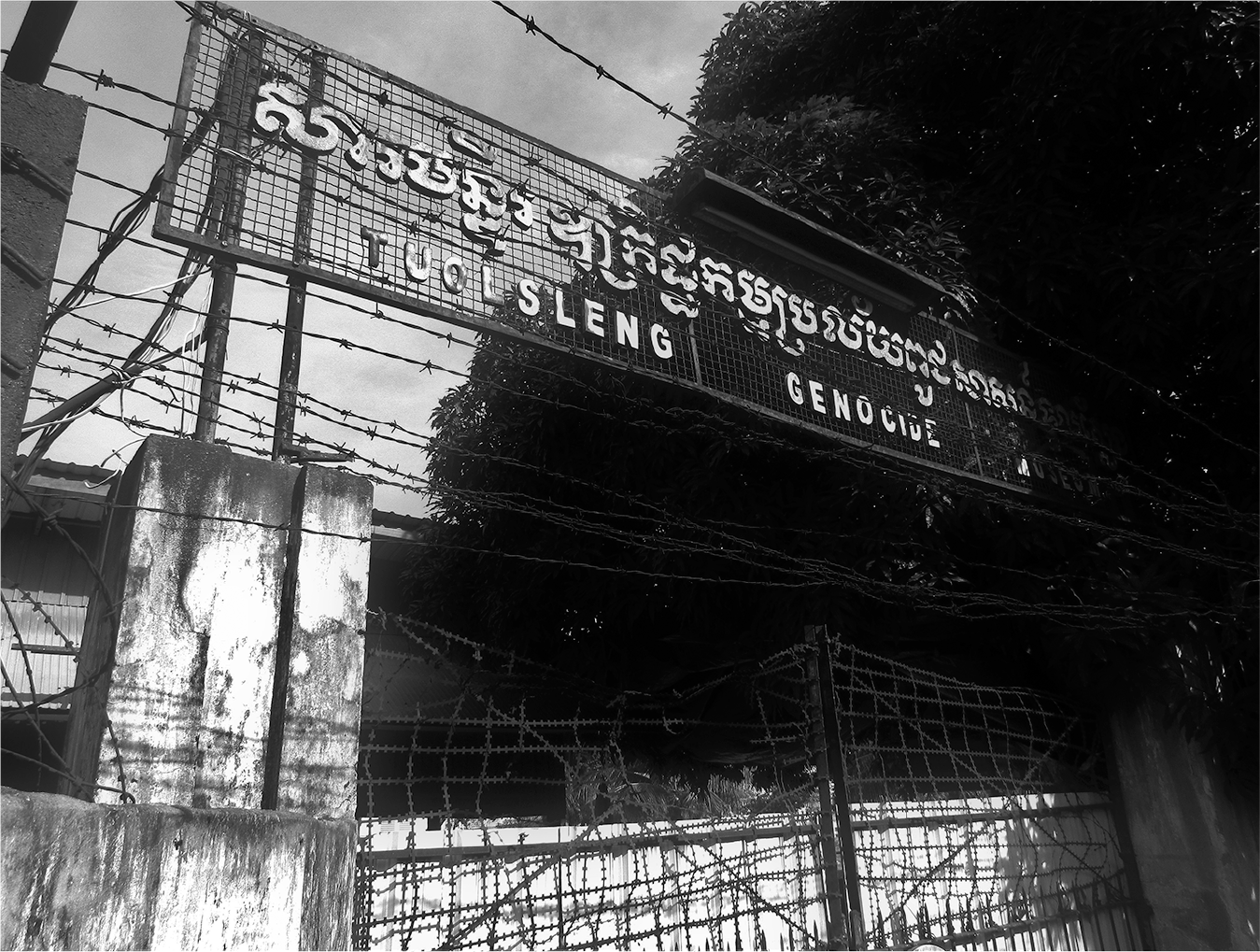
The gate outside.
Before the genocide, Tuol Sleng was a school. Viewing education as a source of inequality and oppression, the Khmer Rouge repurposed the campus into a detention center to imprison and torture thousands of the regime’s perceived enemies. The people who entered here were shackled, beaten, humiliated, starved, and killed for their identities or beliefs. When you step inside, you follow in their footsteps.
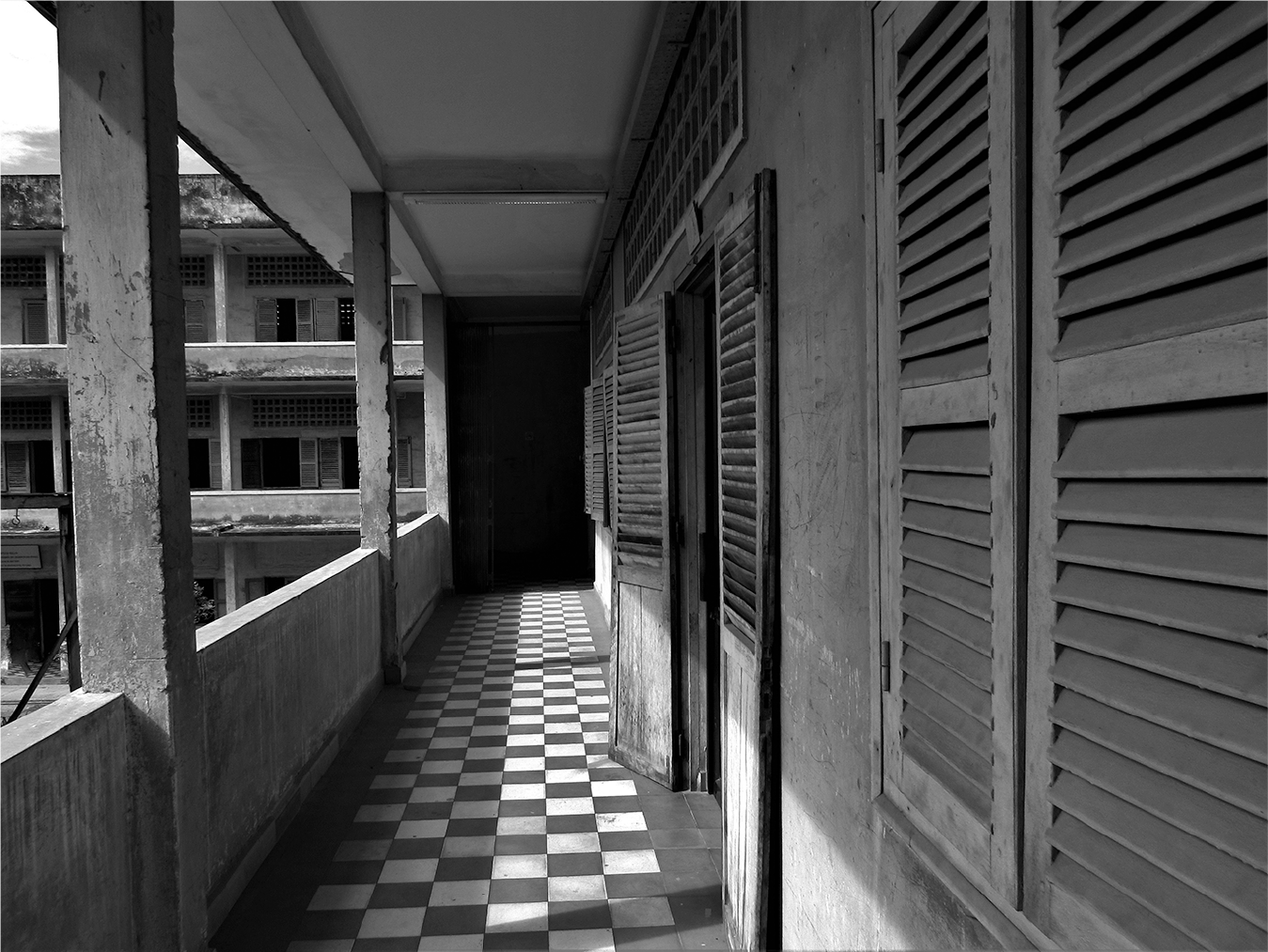
A second-floor hallway.
The audio tour guides you down the hallways, from room to room. You enter a room where the orange-and-white checked floor is bare, except for a solitary iron bedframe, where a mutilated body was found. Other rooms have torture instruments inside. Every stain on the floor tiles or scratch on the walls makes you wonder: What happened here? The scars that remain are a constant reminder of the horrific violence inflicted on the bodies that were once here.
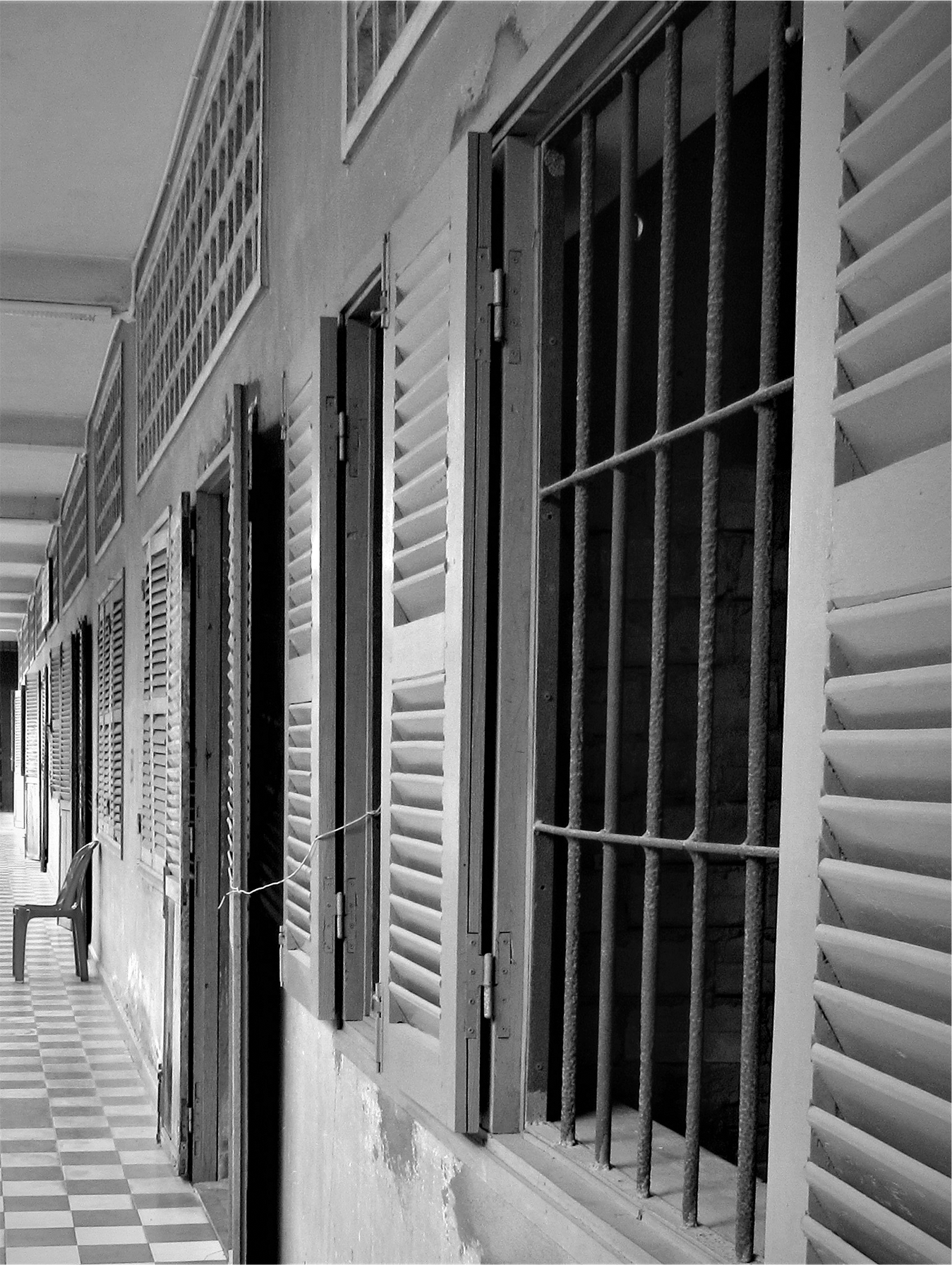
Bars and shutters on the windows.
Other rooms are filled wall-to-wall with photos of the dead. Hundreds of mug shots are tacked on easels in neat grids, the very ones taken by the perpetrators to inventory and catalog the victims. They have no names—only faces. Some jump out at you, their expressions ranging from fear to resignation to defiance. These photos represent only a fraction of those who were killed, making two million seem like infinity. Should you pause to look into the eyes of each person? The task seems overwhelming.
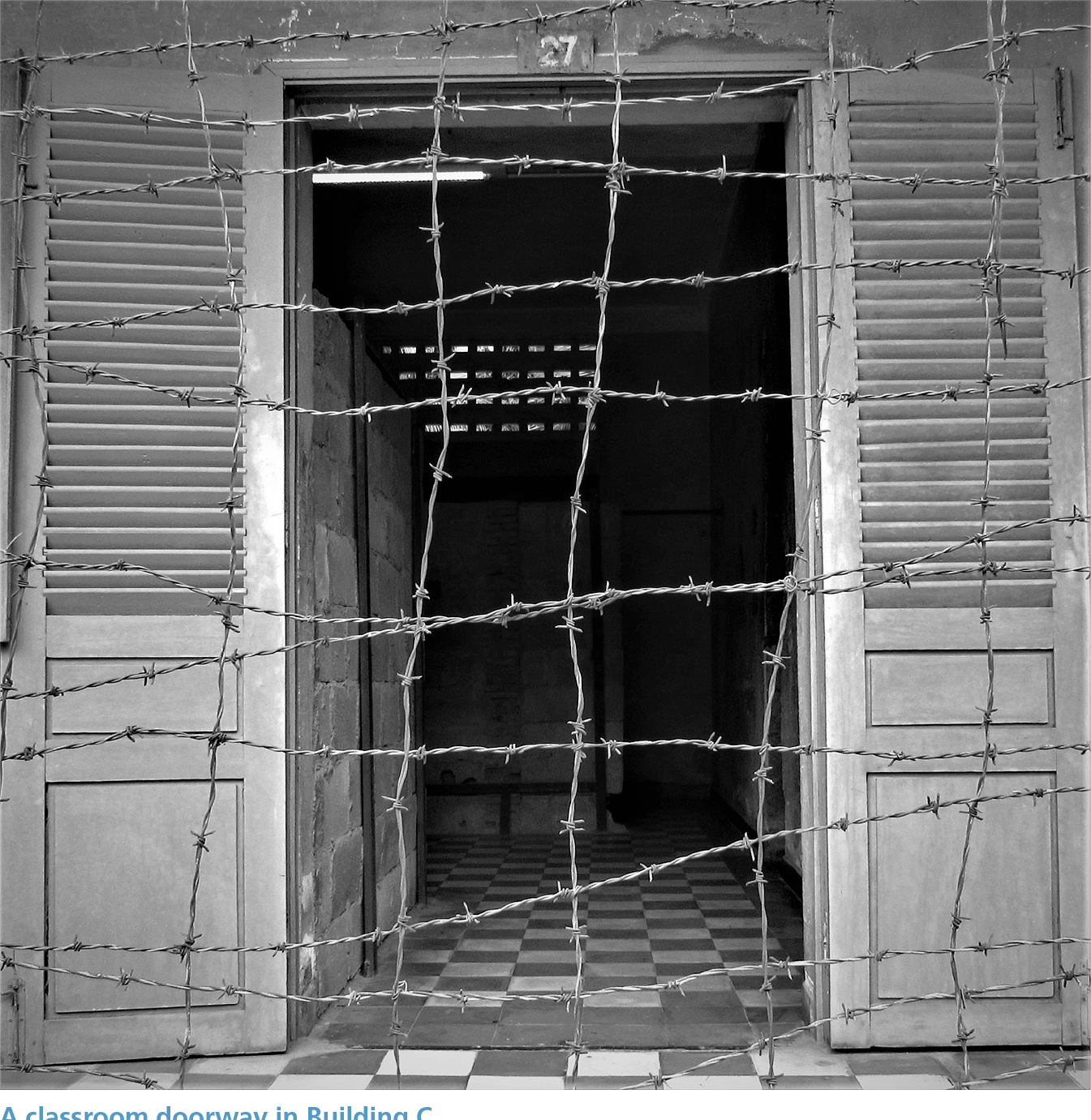
A classroom doorway in Building C.
You approach a building covered in barbed wire. When you enter, the crisscrossing wires instantly trap you. Inside Classroom 27, there are rows of brick cells. This is where the prisoners once slept, crammed on top of one another in only a few square feet. You look up at the dark ceiling. As the prisoners laid here, did they think about home? Did they plan their escape? Did they pray? Did they cry? You’ll never know. But you can imagine.
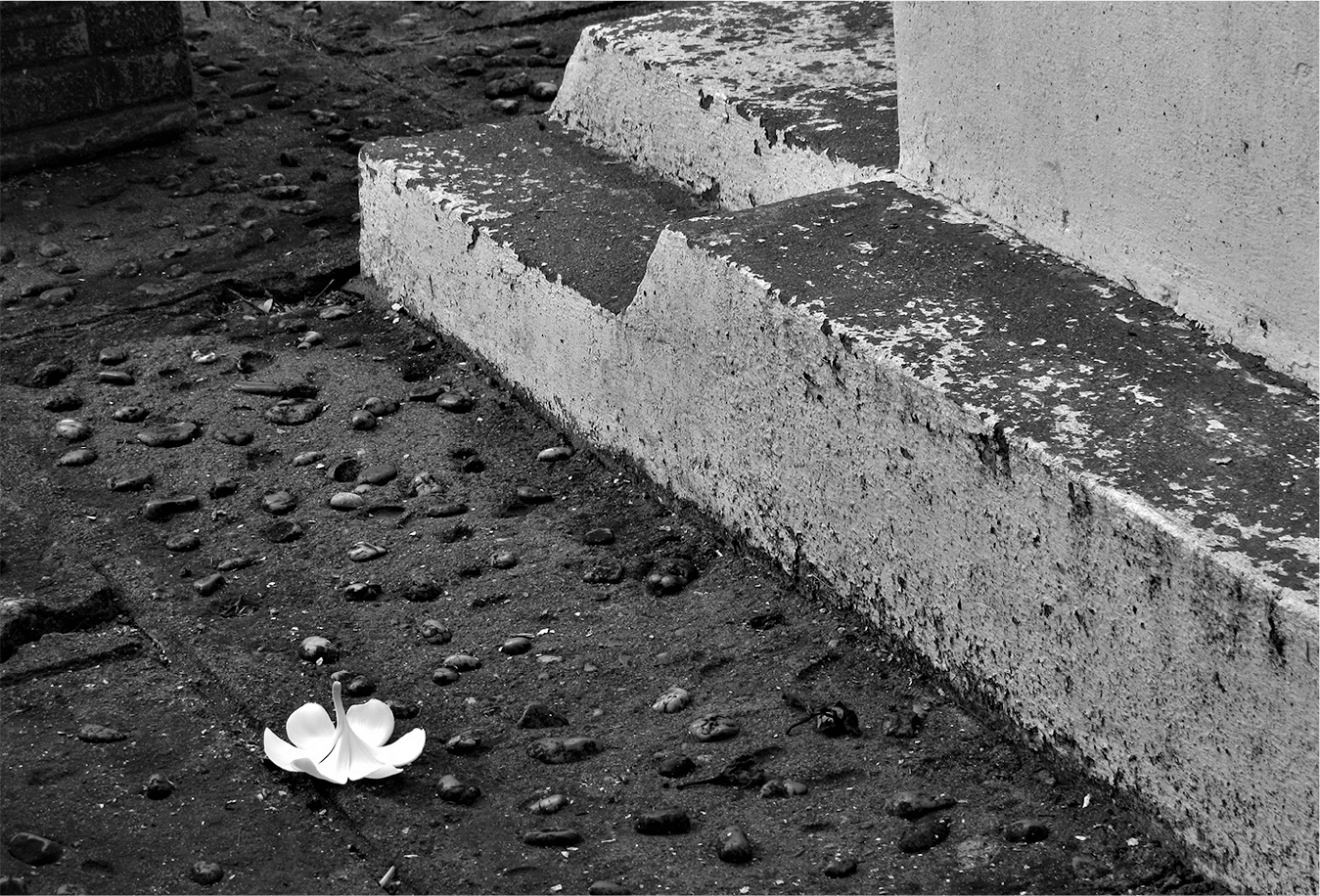
A flower fell at the corner of an unmarked grave.
As you step back out into the sunlight, you come across a garden. Resting underneath a flowering tree are 14 unmarked white graves. They are dedicated to those who died but remain unknown. You don’t know who they were, but you can still mourn them. Genocide is about loss—of life, of culture, of identity. To remember those who were lost is to hold on to what the perpetrators wanted the world to forget.
The killing fields at Choeung Ek
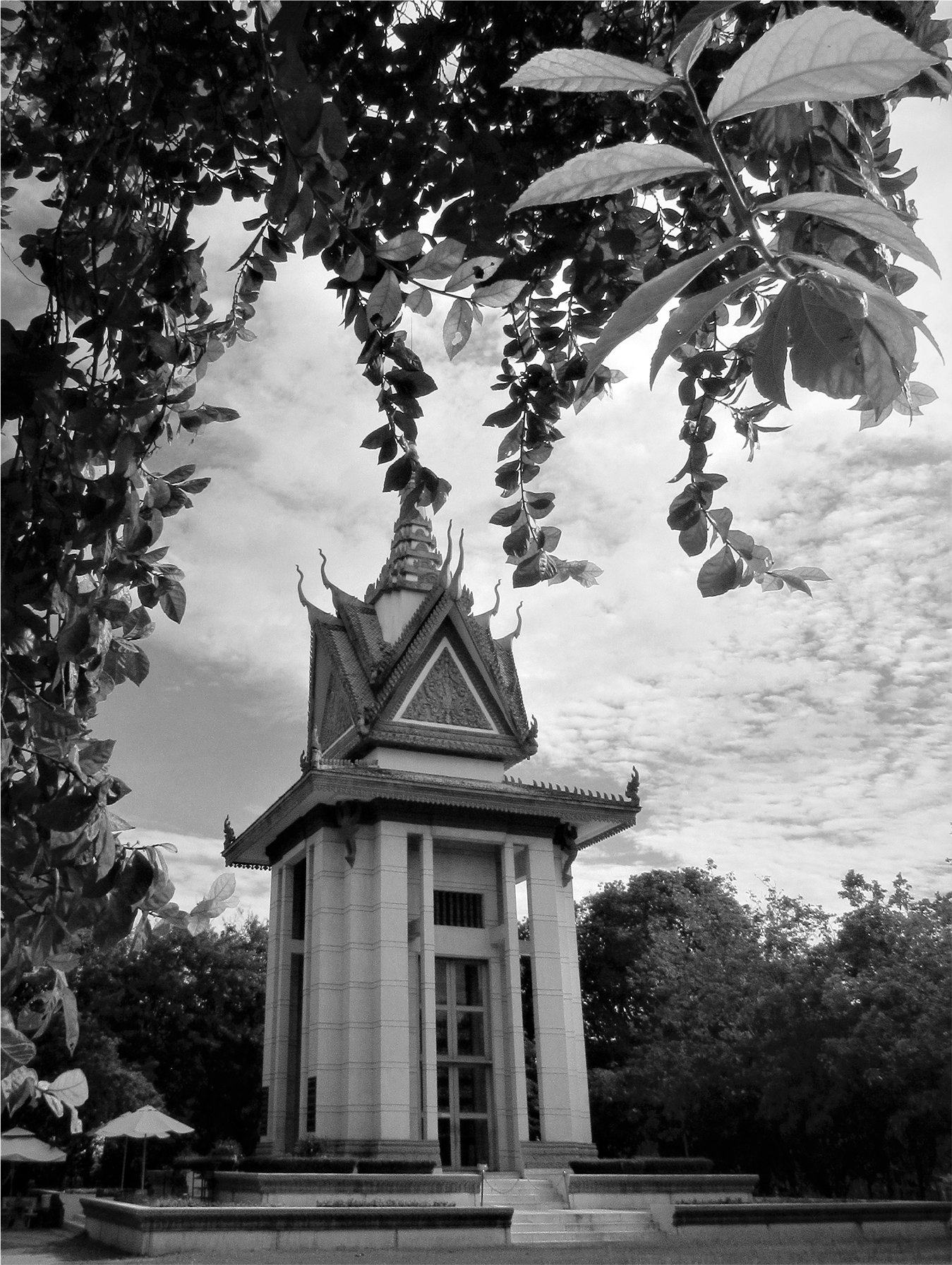
The memorial stupa.
The Killing Fields are a burial ground. The memorial stupa, a towering stone structure adorned with religious symbols of peace, stands at its center. You stop to pay your respects. Inside there are shelves upon shelves of human bones. Behind the glass, the skulls of victims who died here are arranged in rows, one on top of another. You notice subtle variations in size, color, and features, but they have no names and no faces. You are witnessing the evidence of genocide—death and anonymity.
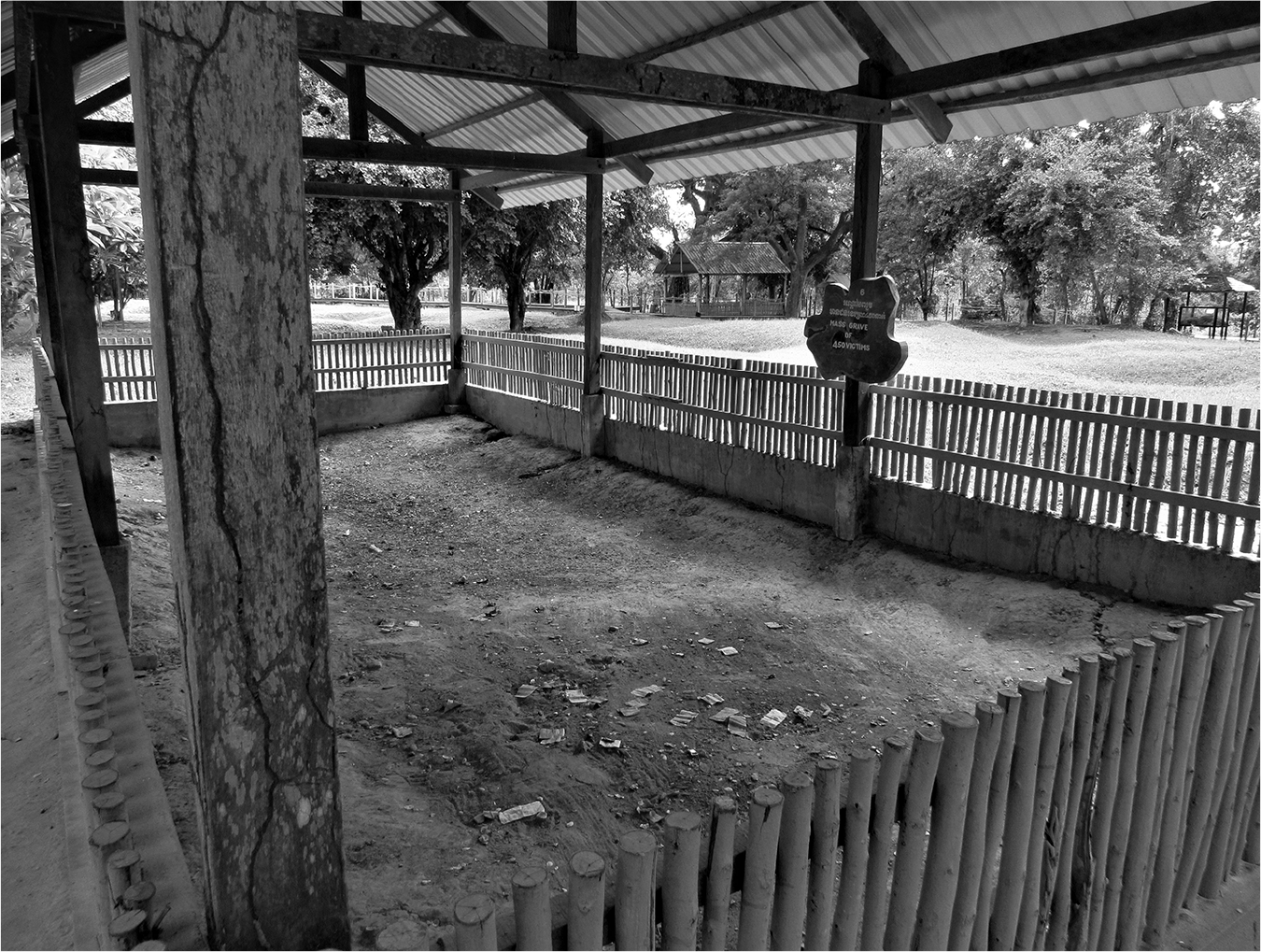
A mass grave.
This is where many of the prisoners taken from Tuol Sleng were slaughtered. You come upon the first mass grave on the site, contained by a rectangular, gray wooden fence. The gently sloping hills in the grass beyond reveal pits where the bodies were uncovered. Their bones were sorted, counted, and buried again. Some 450 people rest beneath the dirt in this one spot. There are thousands of other mass graves throughout the countryside, many marked informally or forgotten entirely. Not everyone gets a memorial.
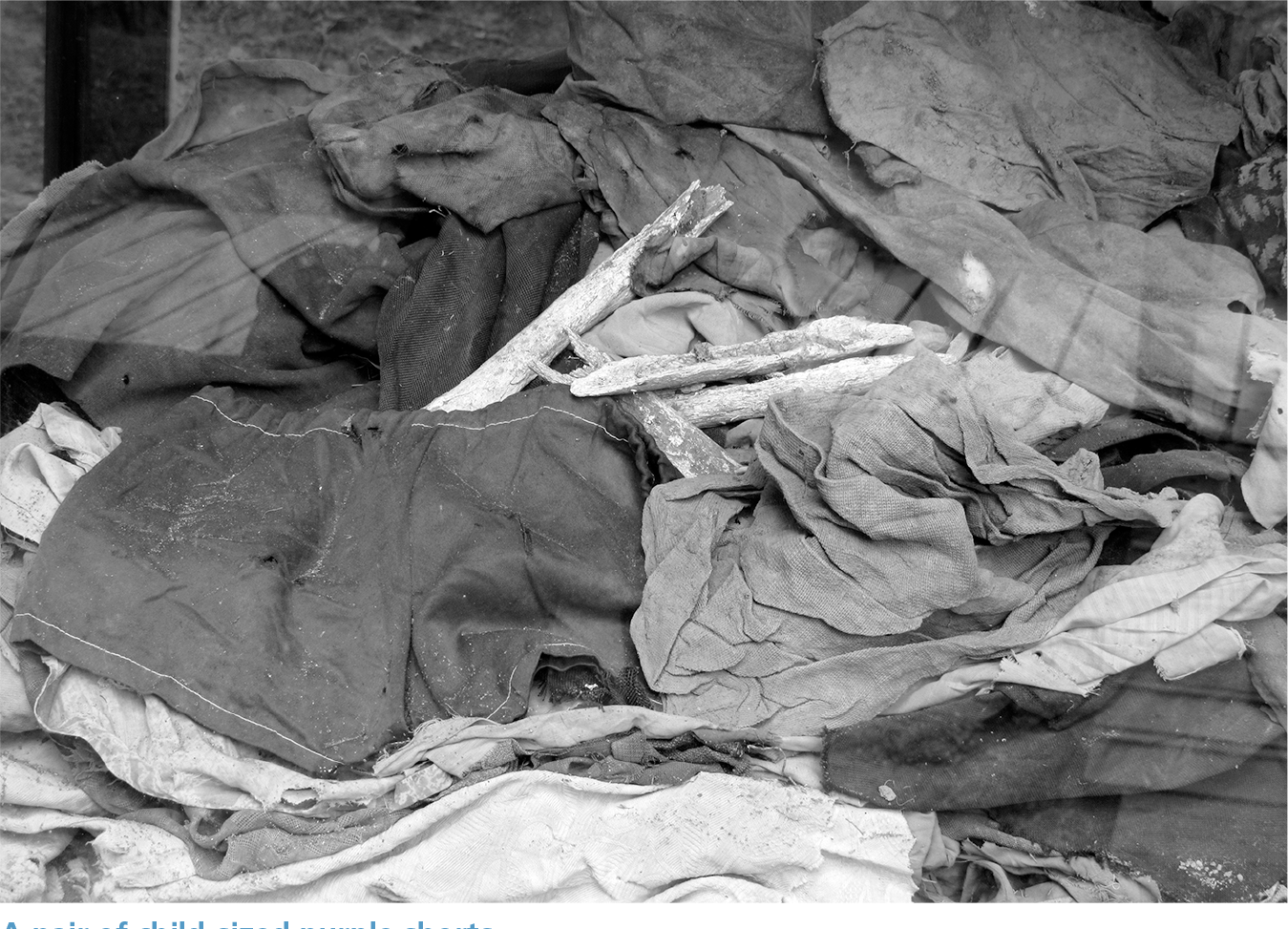
A pair of child-sized purple shorts.
You are warned to watch your step as you walk through the fields. When it rains, the clothes and remains of victims still wash up from the dirt underfoot. These artifacts are collected and displayed in glass cases. You stare for a while at a pile of battered and faded clothing. It is as if seeing something that belonged to those who died connects you to them. There is a pair of small purple shorts on top of the heap. It isn’t difficult to call to mind a child who might have fit them.
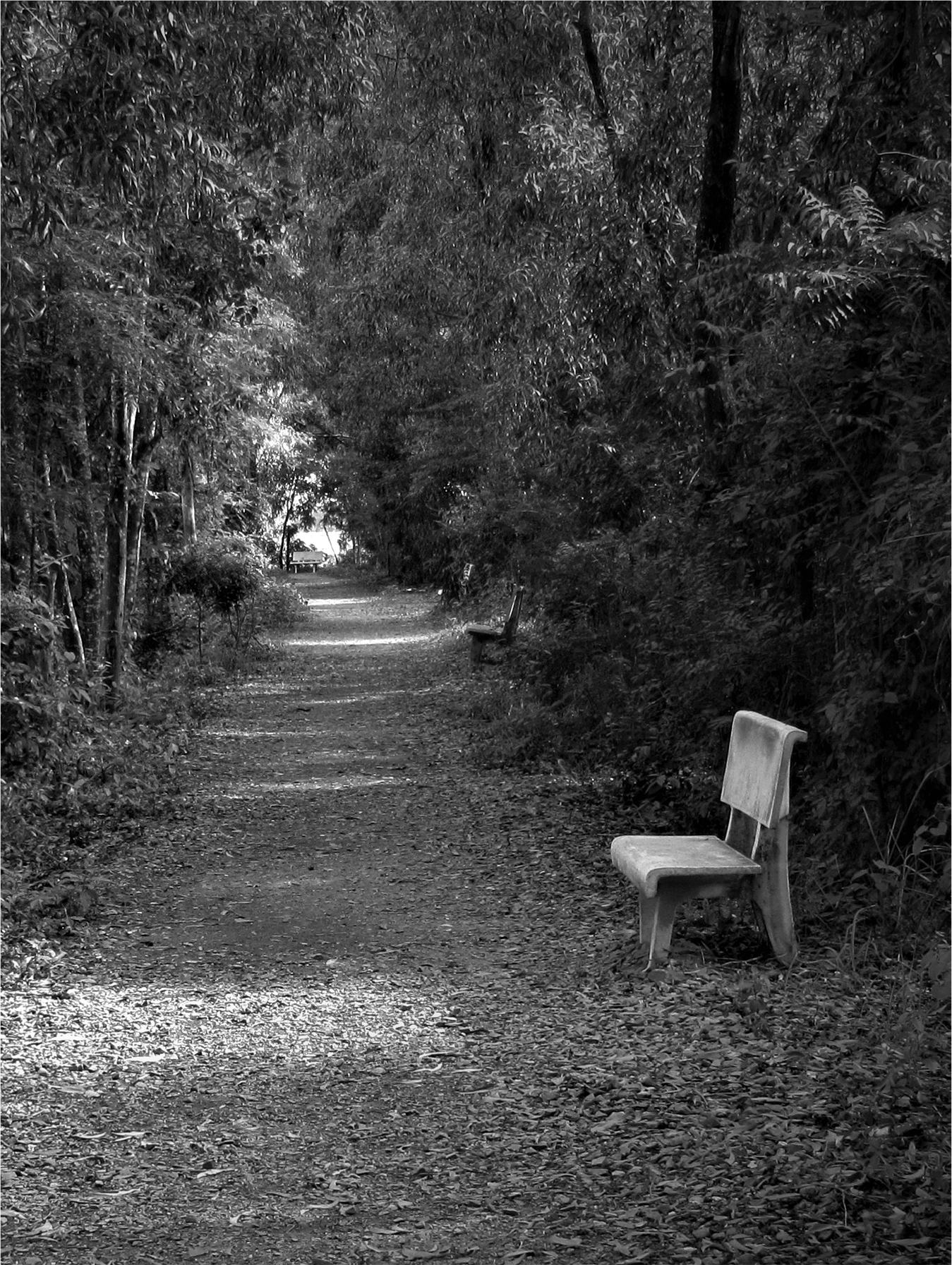
A place to sit by the lake.
You make your way to a trail that runs through the trees alongside a quiet lake. If you didn’t already know, there would be no way to tell that bodies are interred beneath the still water. The audio guide instructs you to listen to survivor testimonies as you stroll along the parallel earthen path. You will never know or truly understand the stories of those who rest under the water, but you can take a seat and reflect.
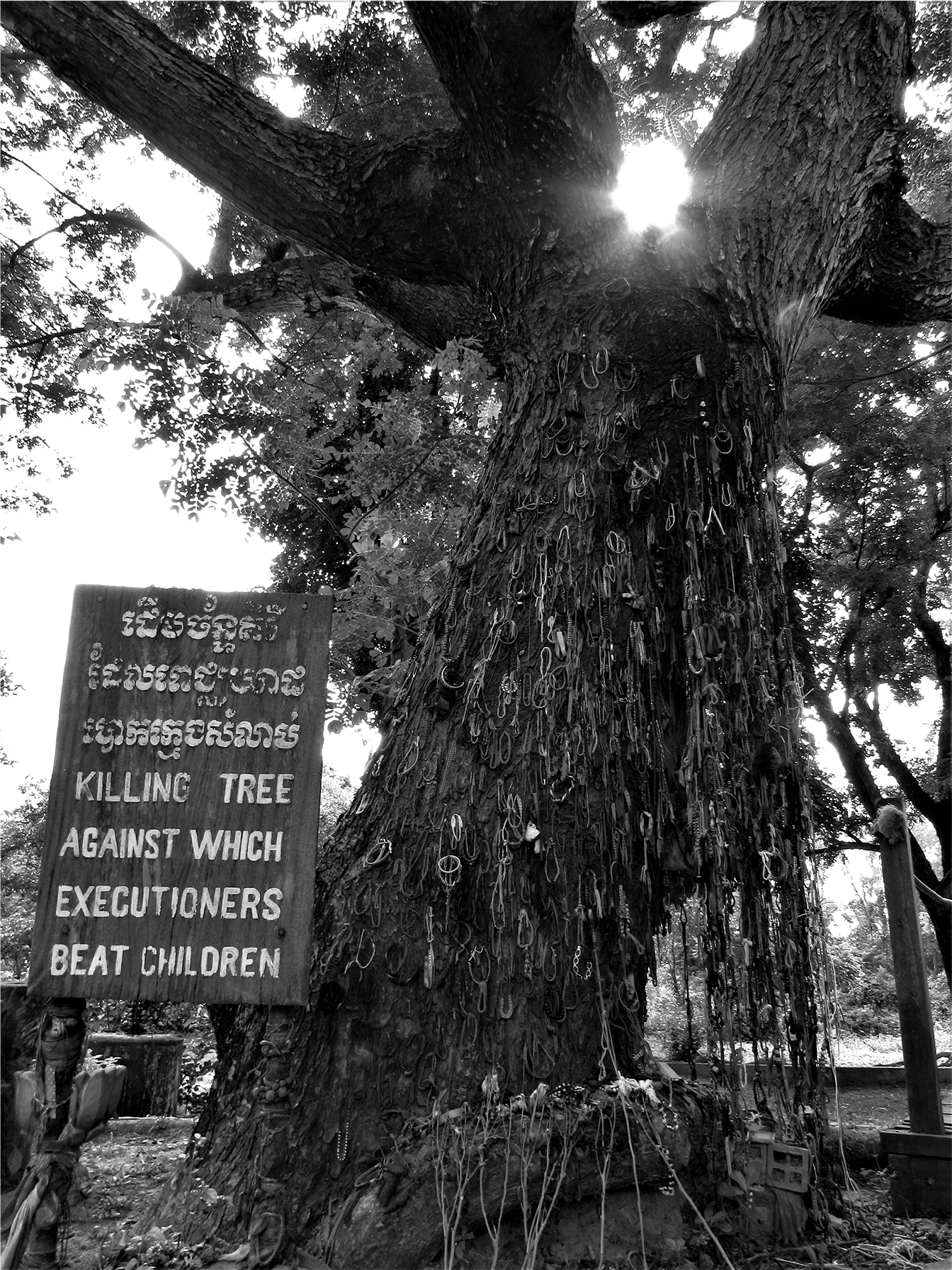
The Killing Tree.
Seven heart-wrenching words. The Killing Tree is adorned in colorful bracelets, cascading down its weathered bark. Visitors have left them behind in remembrance of innocence lost. You can leave something too, to restore a symbol of darkness and death to beauty and life; this is the ultimate hope of remembering the violence of the past, to transform a history of hate into a future of peace.