




Abstract
Not everyone born into the uppermiddle-class is equally advantaged. The disadvantaged portion of the advantaged class can fall into the middle class, or lower. This happens by making the most of the resources they have rather than trying to gain more resources.
The American class system is often presented as closed—especially near the top. In the past few years, the media and scholars have accused the upper-middle-class of creating a “hereditary meritocracy,” acting as “a new aristocracy,” and being “dream hoarders.” While it is undeniable that upper-middle-class families have more opportunities than families in the classes below them, it is not true that all children born near the top of the class structure remain there—not even those with racial privileges. Indeed, even in this moment of profound inequality, one out of two white Americans born into the upper- middle-class fall out of it as adults. That is, one of two white youth with at least one college-educated professional parent does not become, or marry, a college-educated professional themselves.
Usually, downward mobility is considered evidence of an open class system—evidence that there isn’t a “hereditary meritocracy” or “new aristocracy” after all. However, this claim is based on the mere existence of downward mobility, with no analysis of who is downwardly mobile or how they fall. If we knew which youth born into the upper-middle-class remained there and which youth fell, would we still consider downward mobility evidence of an open class system?
To answer this question, I drew upon data from the National Study of Youth and Religion (NSYR). This dataset includes interviews with 107 white upper-middle-class youth selected from a quota sample of the NSYR’s national survey. Each respondent was born between 1984 and 1990 and had at least one parent with a bachelor’s degree and professional job, defined as jobs that, according to the U.S. Department of Labor’s O*NET, require considerable or extensive preparation. The research team interviewed each respondent up to four times from when they were 13 to 28 years old—the time when youth move through school, college, work, and marriage and begin to establish their class trajectory.
Fifty-three percent of respondents became or married college-educated professionals, reproducing their class position; forty-seven percent did not become or marry college-educated professionals, moving closer to downward mobility. While these respondents were young, their trajectories were still meaningful. Contrary to popular perceptions, most upper-middle-class youth who are downwardly mobile by education and occupation at age 26 continue to be downwardly mobile at age 40.
Class reproducers and the Downwardly Mobile
The difference between class reproducers and the downwardly mobile is not immediately apparent. Compare two typical respondents from the NSYR: Molly and Virginia. Molly was raised by a doctor and a stay-at-home mom. Virginia was raised by a vice president of a large company and a stay-at-home mom. Each had a parent at the top of the occupational and educational hierarchies—each appeared to be raised with profound privileges.
Yet, if we take a closer look at Molly and Virginia’s lives—in particular if we examine the resources they received from their parents—we start to see that they are not as similar as they initially appear. Even in the upper-middle-class, families possess and pass down different sets of resources. Molly received more resources from her parents than Virginia received from hers—and it was this difference that set them on different mobility trajectories.
Even in the upper-middle-class, families possess and pass down different sets of resources. Molly received more resources from her parents than Virginia received from hers— and it was this difference that set them on different mobility trajectories.
Resource Disparities
There are three key resources that help upper-middle-class youth stay in the upper-middle-class. The first is money. Money buys access to good schools, nutritious food, and relative safety. Money also helps students become favored by teachers and college admissions officers, who sometimes mistake access to the experiences money buys for intelligence and interest. The second key resource is academic knowledge. Though we often think of some people as naturally smarter than others, social scientists know that it’s not this simple. Many parents teach their children academic lessons at home. This extra academic support gives them a head start—an advantage that stays with children for years. The third key resource is institutional knowledge, or knowing how to navigate school, college, and work to get ahead. This resource is not trivial.
Teens who don’t know how to get placed in an advanced course despite low test scores will be worse off than equally smart teens who know how to argue their way into those spaces.
A bride preparing for her wedding day.
Pixabay, Gloria Agostina

Despite all being in the upper-middle-class, not all upper- middle-class parents possess equal amounts of these resources. Of course, not all upper-middle-class families—families with at least one college-educated professional parent—have the same amount of money. Here, just think of the difference in incomes between a social worker and a CEO. In addition, not all upper- middle-class parents have high levels of academic and institutional knowledge. Some upper-middle-class parents gain these resources through their education and jobs. Others do not acquire these resources themselves but marry someone with them.
Of course, parents’ possession of resources isn’t enough to help their children—they must successfully transfer them to their children. If the parent(s) with the academic and institutional knowledge typical of the upper-middle-class does not actively transfer these resources to their children, their children will not receive them. This transfer can easily happen, as the parent with the most academic and institutional knowledge may specialize in work while the other parent specializes in childcare, or because parents with these resources are too sick, emotionally or physically distant, or preoccupied to pass them down. Similarly, if the children aren’t equipped to accept their parents’ resources—due to, for example, a physical or mental health issue or negative perception of their parents—then these children won’t receive as many resources either.
Upper-middle-class youth then grow up with different resources, even when their parents look similar on important dimensions. Molly and Virginia’s resources were not as similar as they first seemed. Molly’s parents each had graduate degrees, and Molly’s mother worked as a doctor before becoming a stay- at-home mother. Molly’s parents used their own academic and institutional knowledge to help Molly gain her own. Molly said her mom taught her academic knowledge: “She really helps me with homework” and that her dad did too: “My dad really helped me pass that class with an A.”
Molly’s parents also helped her gain institutional knowledge. They set her goals high: “My parents drove in that you’re gonna get an undergrad, you’re gonna get a masters, you’re gonna get a terminal degree.” They also guided her through the higher education system. Molly’s mother enrolled her in a community college and taught her how to transfer the credits to a four-year college. Molly’s mother then picked out Molly’s four-year college, her father picked out her major, and Molly attended her mother’s alma mater for graduate school. Molly also purposefully lived with her mother while she was in college so she could easily ask her mom for help with homework and choosing courses.
Virginia did not receive the same amount of academic and institutional knowledge from her parents as Molly did from hers. Virginia’s mother stopped attending college when she became pregnant with Virginia’s older sister, and she never worked in a professional job. As much as she tried to help Virginia, she didn’t have access to high levels of academic or institutional knowledge herself. Virginia’s father, a college-educated business executive, did have this knowledge. Yet, he did not pass it down. According to Virginia, though she lived with her father, they rarely talked— not about academics, work, or much of anything. She described their relationship as “two ships passing in the night.” She added: “I don’t really know how to have a relationship with him now because it’s always just been one way” and “I wouldn’t know what to talk to him about.” Without receiving the academic and institutional resources typical of college-educated professionals, Virginia would not be prepared to become one either.
Identities
Of course, growing up with fewer resources than others in the upper-middle-class does not lead to downward mobility alone. After all, youth born into the upper-middle-class still have more resources than most of their peers in other social classes. Moreover, many upper-middle-class youth live in communities where teachers, librarians, coaches, and other adults are available to help youth gain resources they did not acquire at home. For downward mobility to occur, youth must not seek out more resources, even when they are available.
Youth raised with relatively few resources typically did not seek out these resources. Instead, they formed identities that made a virtue of the resources they lacked. That is, they learned to frame their relative disadvantages as strengths and to set goals that their resources allowed them to achieve. These goals were often ones they could meet outside of school, college, and work—institutions that did not require high levels of the resources they were not initially given.
Virginia formed an identity based around the resources she grew up without. Compared to other upper-middle-class youth, she received little academic and institutional knowledge from her parents. Yet, she did not turn to the internet, teachers, librarians, or friends’ parents to turn her resource weaknesses into resource strengths. Instead, she saw herself as a future stay-at-home mother—someone for whom success in school, college, and work was far less important than success in marriage and motherhood. As she put it: “I always knew that I wanted to be a wife and a mother. I always knew that.”
Hard at work, fininshing up a project.
Pixabay, StartupStockPhotos

For Virginia, like many respondents, being a stay-at-home mother was not only a goal but also an identity she enacted. When she transitioned from homeschool to public school as a high school student, she used school as a site to display her identity. She quickly entered a long-term relationship with a high-status partner. She focused on her boyfriend more than academics, and she talked to him about marriage. They broke up after he slept with her best friend while she was passed out, drunk, on the other side of the room. The breakup was an assault on her identity—one tied to displaying her devotion to marriage- like relationships. She explained: “He and I were just so fused together that I just didn’t know how my life was supposed to work without him anymore.” After skipping school due to the depression she experienced from her breakup, Virginia returned to dating—hoping that each new person she dated would be “the one.” As she put it: “I’ve always planned my life in such a certain way and there was always that guy there.” She also felt lost when not in a relationship. She repeatedly asked herself: “I have to have a boyfriend otherwise what am I doing?”
Virginia also displayed her identity through how she treated school, college, and work. Stay-at-home mothers focus on marriage and motherhood more than school and work, and Virginia did the same. She saw school as a marriage market and a holding zone—a place of “sitting in a classroom learning stuff I don’t care about” and a place to meet potential partners. She framed college as unrelated to her goals too, asking: “Why would I waste four years?” She thought she would have to work for pay, but emphasized that she did not want to focus on it: “I don’t want to be married to my work. Ever. Whatever I do, I don’t want it to rule my existence.” To her, work interfered with her goals: “I don’t want to use all of my energy on people who you don’t even know and go home and have nothing left for the people who are actually important to you personally.” She also saw investing in work as foolish: “I feel like a lot of kids, they dream real big and then when life catches up to them, they feel like they got shorted. Because those things are never going to happen. But I’ve never had those kind of aspirations. I’ve always just wanted to work in a salon, I’ve wanted to get married, have kids… I know that, that is definitely not something that is out of reach.”
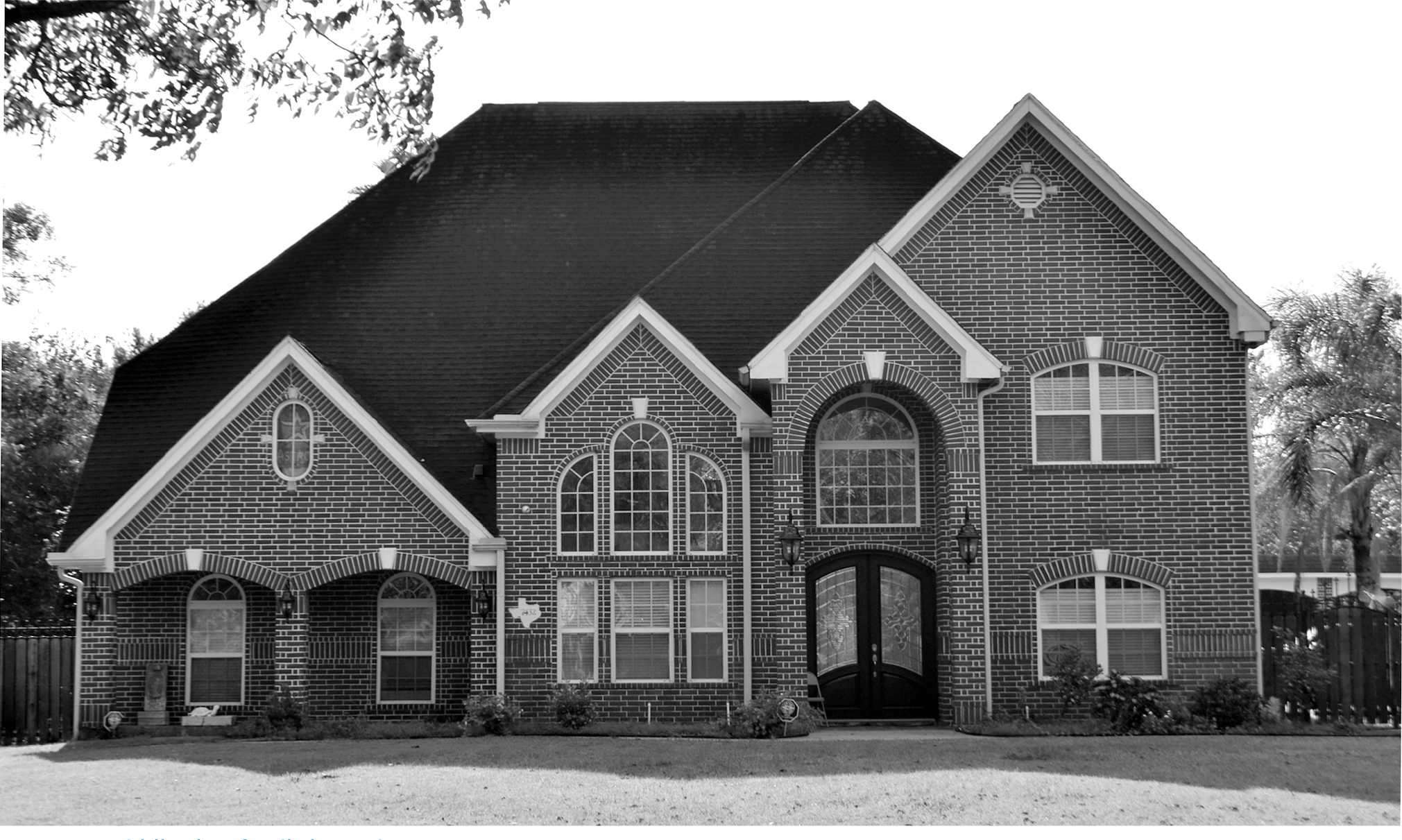
An upper-middle-class family home in Houston, Texas.
Pixabay, F. Muhammad
Virginia’s identity then reflected her early resource weaknesses and later prompted her to maintain them. Raised with relatively little academic and institutional knowledge, she set goals and revolved her identity around not needing them. This strategy certainly had advantages. As she put it, her goals were achievable, and she did achieve them. At age 24, Virginia was thrilled to become engaged and looked forward to having children. However, this strategy had disadvantages as well. Opting out of high levels of achievement in school, college, and work meant opting out of the institutions that could help her remain in the upper-middle-class. Instead, she became a high-school-educated haircutter and barista. Around other high-school-educated people, she married one—a high-school- educated soldier. Between her own education and occupation and his, she entered a downwardly mobile trajectory.
Downward mobility is then not a barometer of whether the American class structure is living up to its ideals. Instead, it is a marker of inequality—that even within the upper-middle- class, unequal resources relate to unequal trajectories.
Molly, on the other hand, inherited high levels of each key resource and formed an identity around maintaining them. Her parents had helped her with her homework and navigating school, and she came to see herself as someone whose purpose came from success in school and work. That is, she saw herself as a professional—someone whose life revolved around school and work. As a high school student, she displayed this identity by claiming to work as much as a high-powered professional: “During the school year, I don’t go out at all. It’s just schoolwork, home, schoolwork, home. That’s all I do.”
In college, Molly continued to present herself as a professional—as someone dedicated to (school)work: “Monday through Friday, I do homework all day. This coming semester, I go to school Tuesdays and Thursdays for most of the morning. The rest of days and after I come home from school, I work out, and I do homework. I have tons of homework to do. Homework and school. Then I hang with my boyfriend one night a week, that’s all I give him, that’s all I have time for. So it’s just homework and school.” Once Molly started working, she maintained the aura of an important professional, describing herself as “definitely hard-working, workaholic tendencies maybe, but definitely hard-working.”
Molly’s professional identity not only reflected her early resource advantages but added to them. Dedicated to building on the academic and institutional knowledge she received from her parents, she spent long hours in front of her books and talked to professors about how to succeed in their courses and prepare for graduate school. Molly’s focus on work also led her to put off dating. It wasn’t until graduate school that she dated seriously. She then married a colleague—a professional with whom she could enact her professional identity.
Raised with high levels of resources and with an identity that oriented her toward maintaining them, Molly sailed through school, college, and onto a professional job. By forming an identity that encouraged her to maintain her resource strengths, she also maintained her class position.
The Broader Patterns
Among the 107 white upper-middle-class youth I followed, the path to class reproduction was generally like Molly’s. The 57 respondents who remained in the upper-middle-class typically received high levels of resources from their parents, developed a professional identity geared toward maintaining them, and remained in the institutions that reward them. The 50 respondents who entered downwardly mobile trajectories generally followed Virginia’s path. They inherited low levels of resources compared to other upper-middle-class youth, developed an identity that revolved around not needing them, and opted out of institutions that reward them.
Of course, the processes of receiving few resources and forming an identity that made the most of them did not happen in the same way for all youth as it did for Virginia. Youth received relatively few resources from their parents not only because their primary parent did not have a college degree, but also because their college-educated parent(s) spent so much time at work, had health issues that prevented them from regularly interacting with their child, or simply because they preferred a hands-off parenting style.
Not all youth made a virtue of their resource weaknesses in the same way either. Women raised with relatively little academic and institutional knowledge in conservative communities generally did so by identifying as stay-at-home mothers, but other groups developed different identities—ones that gave them status given their gender and community. Daniel, for instance, also grew up in an upper-middle-class family that gave him little academic and institutional knowledge. His parents were both college-educated, but neither focused on instilling Daniel with high levels of academic and institutional knowledge. Daniel said of them: “They never really push too hard to get me to do anything. They’ve always trusted me to live my own life and make my own decisions.”
Though Daniel appreciated his parents’ hands-off style, it also meant that he grew up with less academic and institutional knowledge than his upper-middle-class peers. He developed an identity that made a virtue of his resource weaknesses and was particularly high status for men—he identified as a rebel, someone who defied institutional rules. In eighth grade, he started to smoke weed each weekend. Around the same time, he got “in the habit of stealing,” explaining he did it “just to be bad.” He lied regularly—calling it “necessary and convenient,” and he did not strive for high grades: “I don’t try my hardest in school and I don’t achieve as much as I could.” In college, he did the same; he rebelled against the official purpose of school by spending much of his time at college high or drunk. After college, he still identified as a rebel, and avoided graduate school, professional jobs, and marriage as they would require him to follow the rules rather than break them. Approaching age 30, he opted out of each of these institutions and instead served food at a casual restaurant and got high with his friends. The rebel identity that once reflected his resources weaknesses led him to maintain them—to opt out of acquiring the resources and joining the institutions that could keep him from downward mobility.
An Open Class System?
Virginia and Daniel entered adulthood poised to leave their childhood class position. However, their imminent downward mobility is not evidence that the class system is open. Rather, it is evidence that class is measured broadly. When we zoom in on the resources youth received from their parents, we see that the class system is mostly closed. Those who stayed ahead were those who inherited the most resources; those who fell behind were those who inherited fewer resources.
Downward mobility is then not a barometer of whether the American class structure is living up to its ideals. Instead, it is a marker of inequality—that even within the upper-middle-class, unequal resources relate to unequal trajectories.