




Abstract
Sharon Sassler and Amanda Jayne Miller set out to expand our understanding of how cohabitating relationships evolve in their compelling new book, Cohabitation Nation: Gender, Class, and the Remaking of Relationships.
Cohabitation Nation: Gender, Class, and the Remaking of Relationships by Sharon Sassler and Amanda Jayne Miller University of California Press 277 pages
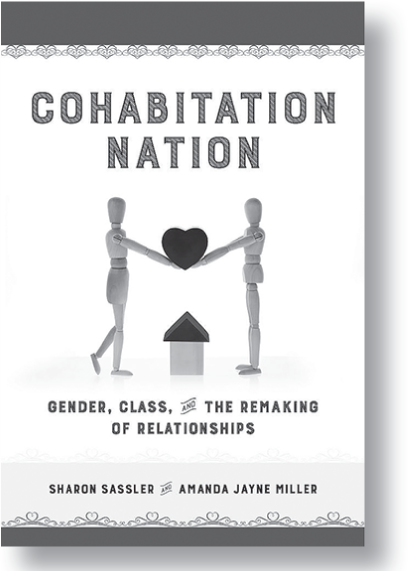
Cohabitation is frequently portrayed as simply the next step towards marriage, however, existing scholarship in the area cannot fully trace how cohabitating relationships evolve. Sharon Sassler and Amanda Jayne Miller set out to expand our understanding of these increasingly normative relationships in their compelling new book, Cohabitation Nation: Gender, Class, and the Remaking of Relationships. Cohabitation has been historically stigmatized, with 45 percent of Americans viewing these relationships negatively in the early 1980s. Today, cohabitation is viewed less negatively, with less than 25 percent of Americans viewing these relationships in a negative light, according to Pew surveys. The authors, however, are not interested in why such living arrangements are devalued, but rather how “the context shaping living arrangements influences how relationships are subsequently experienced” (p. 128).
Sassler and Miller interviewed 30 service class couples and 31 middle class couples in heterosexual relationships. Most of the couples involved two never-married partners, though several couples contained a partner who had been previously married. The partners ranged in age from 18 to 36. Sassler and Miller note that service class couples of today have a markedly different economic position than the working class of generations past, as decent-paying, stable jobs in the manufacturing sector have vanished. Those without educational credentials are increasingly employed in less-secure service-sector jobs that often lack benefits, have no union representation, and offer meager wages. Furthermore, while cohabitation has increased the most among those without college degrees, most discussions still frame cohabitation through a middle-class perspective.
Sassler and Miller find a variety of interesting differences between these cohabitating couples, but why do couples cohabitate to begin with? Middle class couples often framed cohabitation as the next step in their relationship, whereas service class couples frequently viewed cohabitation as event-driven such as financial necessity, housing needs, or for the benefit of children. Service class couples enter cohabitation faster than middle class couples, and often cohabitate for longer periods of time given the events that draw them to one another. In fact, some of the service class couples felt they had been pushed into cohabitation by a lack of viable alternative living arrangements. These life experiences may suggest cohabitation is a precursor towards marriage, but it can also be an alternative to marriage or simply an alternative to living alone. Despite most unmarried adults aspiring to marry in the future, six couples in Sassler and Miller’s study considered themselves “permanently nonmarried.” They rejected marriage as a life-affirming institution in wake of previous relationship issues of parents or religious pursuits, among other justifications for their marriage and cohabitation views.
Sassler and Miller found another prominent difference between cohabi-tating couples of different class backgrounds: the perceived benefits of cohabitation. Whereas middle class couples often mentioned the convenience of shared activities and the ability to deepen their intimacy, service class couples frequently noted that cohabitation served as a check against their partner’s infidelity. Nearly 40 percent of service class individuals (mostly men) reported that cohabitating hurt them financially, indicating they see themselves as the primary provider for the household. Some even admitted that a shared lease was the only thing keeping their relationships alive. Ironically, about half of the men who expressed such sentiments earned significantly less than their partner. Their engrained perception as the breadwinner seems to be rooted more in gender stereotypes as opposed to objective finances.
Borrowing Andrew Cherlin’s phrase, Sassler and Miller argue cohabitation is “incompletely institutionalized” (p. 174); it lacks firmly established scripts for how couples should structure their lives. Unlike marriage, there is little shared understanding for how a cohabitating relationship should begin, function, or progress. This could be advantageous for women negotiating relationship roles, but cohabitating men must be willing to concede some power.
Middle class men embraced more egalitarian relationships compared to their service class counterparts. The classic example of sharing housework was on full display for service class couples with women doing the majority of the domestic labor. Many couples described a traditional indoor/outdoor division of domestic labor, which particularly dis-advantaged women in the service class given their residence were often apartment units with little outdoor space. As a service class man said, “Garbage of course I think is a man’s job, ‘cause lots of times it’s heavier. You’ve got to walk out in the cold and being a gentleman, you know, you take that on” (p.77).
Nonetheless, Sassler and Miller find the perception of equally sharing domestic labor is more important than how chores are actually divided among couples.
As in all relationships, cohabitat-ing couples must navigate challenges. Communication skills are arguably the most important difference between the two groups of couples. Sassler and Miller note “the college-educated couples compromised more, argued less, seemed to engage less in magical thinking regarding the capacity of their partners for change, and worked together more frequently to come to consensus” (p. 144). Drawing much from Anne Swidler’s conception of a toolkit, Sassler and Miller argue middle class couples benefit from a life-long accumulation of skillsets that are advantageous in building healthy relationships. This partially explains why middle-class couples viewed marriage as more desirable than service class couples, who often perceived each successive phase of their relationship to be marred with additional challenges. Nowhere was this more apparent than in discussions about contraception and parenthood. Most cohabitating couples wanted to become parents in the future but thought their present situation was not ideal for raising children. Service class couples exemplified the conundrum of not wanting children quite yet, but also not effectively using contraceptives. Women in these relationships lacked access to and knowledge of effective contraceptive use, while men did not work with their partners to effectively use contraceptives either.
Despite clear class differences in how cohabitating couples experience daily living, Sassler and Miller found gender was central to relationship initiation and progression. Although about 40 percent of couples began cohabitating at the woman’s suggestion, many men were hesitant to relinquish their power in deciding how a relationship should progress. For context, only about one-fifth of relationships were initiated by women, and hardly any women felt it was acceptable for them to propose. While women often initiated conversations about the possibility of marriage, the act of proposing was left exclusively in the male domain. More service class women found themselves waiting to be asked than middle class women, who felt more comfortable nudging their men towards proposing an engagement. Cohabitating women felt that proposing would make them unfeminine and cohabitating men often treated the idea of women proposing as if it were a joke; reinforcing gendered relationship expectations.
Consistent with past research, Sassler and Miller found cohabitating couples routinely emphasized the importance of being financially stable before getting married, buoying the idea that the institution of marriage has become a luxury good. The ideal or typical wedding characterized by a lavish ceremony and tropical honeymoon creates additional stress for couples who can barely make rent. Surprisingly, middle class couples were more likely to economize their weddings, prioritizing the act of getting married over the perceived material requirements. This economizing tendency is captured in one middle class couple’s plans to bake their own wedding cake, something the man in the relationship thought could be completed weeks in advance (p.236, footnote 17). Conversely, many service class couples emphasized desires for ceremonial grandeur and expected little inancial support from families. This is just one of the many reasons cohabitation has “become a waiting room” (p. 193) for service class couples, many of whom aspire to eventually have sufficient resources for a “proper wedding.”
Sassler and Miller provide some of the most in-depth information on the daily lives of heterosexual cohabitating young adults, though future research is still needed to explore how this incomplete institution is experienced by other cohabitators. For example, as cohabitation becomes more normative, investigating how older individuals enter and experience cohabitation would be fruitful. Similarly, considering the experiences of cohabitators with different sexual orientations, ethnicities, and non-monogamous arrangements is necessary to diversify our understanding of cohabitation. While the authors only interviewed intact cohabitating couples, it may also be interesting to interview cohabitators who ended their relationships. Despite these limitations, Cohabitation Nation should make for an excellent book in courses examining gender, families, or relationships… I used this book in my last section of Sociology of Love and students had favorable reactions overall. By illuminating some of the common ways young adults experience stress while cohabitating, the book identifies best practices for avoiding interpersonal conflict that could be informative inside classrooms and beyond.
Cohabitation Nation indicates both service and middle class couples valued good relationships, but social class differences early in life provide advantages for middle class couples. Within their relationships, these couples practice better communication skills, compromise more, and plan for future developments, including pregnancy and marriage. While service class couples are certainly capable of emulating these characteristics—and in fact, those who do enjoy better relationship quality—structural disadvantages shape their relationships more so than individual failings.
What can be done to better the lives of young cohabitators? Tackling structural inequalities could be the key to supporting cohabitating couples. Employers should be held accountable for paying a living wage. Affordable housing needs to be built and maintained. Our education system should inform students about healthy, egalitarian relationships. Finally, health care needs to be more accessible, especially effective contraception. As Sassler and Miller’s study poignantly shows, such structural changes would make family life less volatile for all couples whose social mobility appears stalled.
