



Abstract
Using data from interviews with self-identified climate change skeptics, it becomes clear that there is a public misperception about climate change skepticism. Skeptics are concerned about pollution, support environmentally friendly policies, and oppose continued reliance on oil. Current climate change communication is problematic; here, we explore the policies that garner skeptics’ support.

Nick was not always skeptical about human-caused climate change; for most of his life, he believed the science as presented in documentaries and on the news. Things began to change for Nick around 2014 when some of the predictions Nick believes were made in Al Gore’s Inconvenient Truth still hadn’t been realized. In Nick’s words: “You have Gore and other people who have said the ice caps should be melted by now… Clearly, that was wrong.”
Nick was born and raised in southern Idaho. The child of divorce, he doesn’t feel a strong connection to any particular place because he “bounced around a bit.” Nick is a self-declared “news junkie.” He remembers being moved by Reagan’s “little Star Wars speech.” However, after facing personal tragedy, Nick lost faith in both major political parties—seeing them both as corrupt, weak, and lacking the political courage to do anything that would improve people’s lives.
Nick told us that he views the ‘celebritization’ of climate change as disingenuous, a move to get more viewers, “People who are not scientists at all are making flamboyant claims… the best example is John Stewart… when you have people exaggerating claims beyond what the actual thing should be, that puts enough doubt in me.”
In spite of his present doubts about climate change, Nick harbors several pro-environmental views and supports some environmental regulation, particularly for curbing pollution. In this vein, Nick argues: “The EPA has done some good things in the past. Like sulfur dioxide is a pretty big one with that… I think the EPA shouldn’t be too underfunded because if it is too underfunded… They’ll end up cutting corners…”
Nick isn’t alone in his views that are both simultaneously skeptical of climate change yet, in specific areas, pro- environmental. In research conducted in 2017 and 2018 among self-identified climate change skeptics in Idaho, we found that the prevailing view of ‘climate skeptics’ within the political and cultural discourse, a monolithic group who opposes most or all climate action, lacks a nuanced understanding of skeptics’ perceptions. Our research suggests that people who are skeptical about human-caused climate change often hold pro-environmental views. They demonstrate support for political measures to curb pollution, investments in renewable energy, reforestation, and preservation of the Earth. Many of the initiatives that seem to be gaining support among skeptics are likely to improve air quality in the short term and reduce levels of greenhouse gas emissions in the long term. Understanding and better communicating these nuances among skeptical views is particularly important where politicians and political pundits often tend to reject pro-environmental policies in the guise of widespread climate skepticism.
Our research suggests that people who are skeptical about human-caused climate change often hold pro-environmental views.
Our Participants
Idaho was ideal for this research as the state has a higher percentage of climate change skeptics than the national average. The high numbers are likely due to being home to a disproportionate number of libertarians, evangelical Christians, and Mormons—all groups who are more likely than the average American to deny climate change. Our research among skeptics consisted of 33 in-depth interviews with adults residing in Idaho. Participants came from a variety of religious and political backgrounds. Of the participants who chose to reveal their religious affiliations, one identified as nondenominational Christian, one as Christian, three as Evangelical, four as Catholic, and four as Mormon. Politically, one person identified as a Democrat, one as an anarchist, one as apolitical, one as a conservative Democrat, one as a conservative Republican, one as an independent, two as conservative, two as moderate conservative, two as leaning Republican, four as libertarian, and five as Republican. Twelve of our participants identified as politically unaffiliated, skeptical about both parties, or on the line. Thirty-two of our participants were white, and nine were women.
Idaho was ideal for this research as the state has a higher percentage of climate change skeptics than the national average. The high numbers are likely due to being home to a disproportionate number of libertarians, evangelical Christians, and Mormons—all groups who are more likely than the average American to deny climate change.
Eoghan OLionnain, Flickr CC
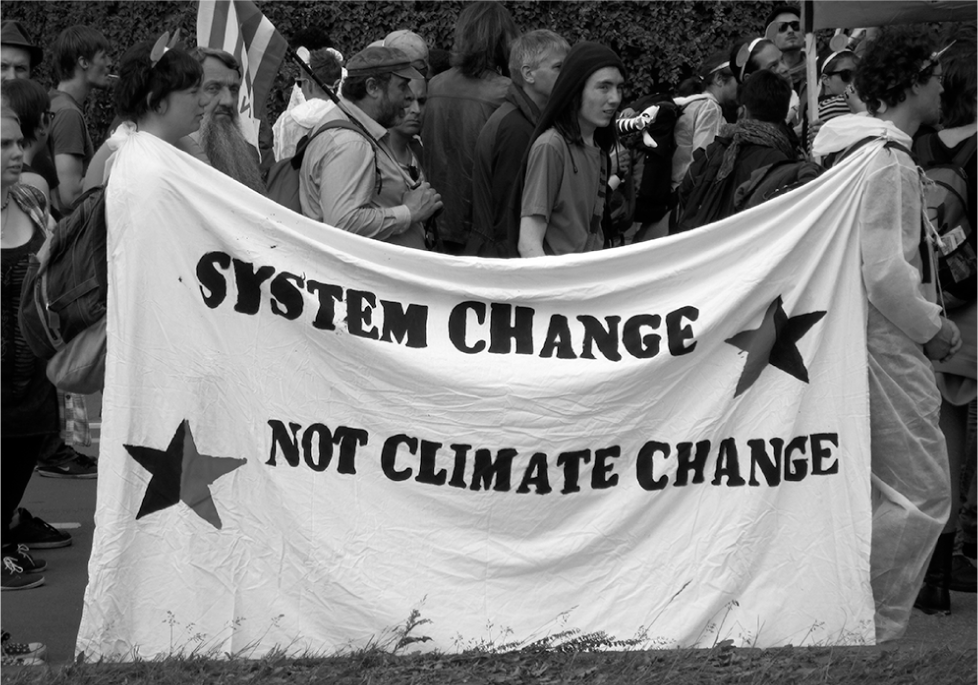
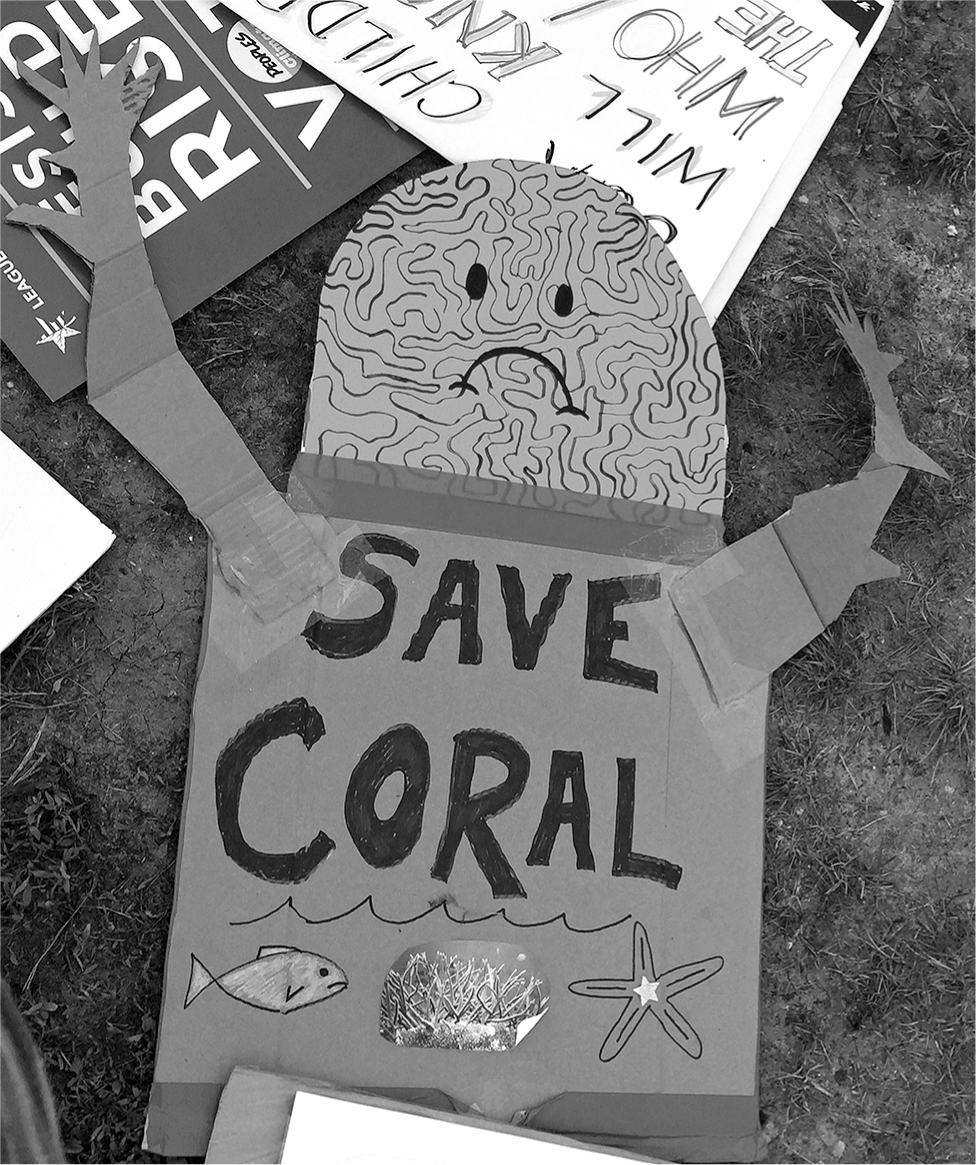
A sign made at the People’s Climate March on April 29, 2017, in Washington, DC
Paul and Cathy Becker, Flickr CC
Prior Research on U.S. Climate Change Skepticism
In the United States, doubts about anthropogenic climate change are a shared sentiment by a significant fraction of the public. According to the 2018 Yale Climate Opinion Maps, 14 percent of Americans overall do not believe that global warming is happening. This number is higher in Idaho at 20 percent. In the same study, 32 percent of Americans do not believe that human activities cause warming, again, this percentage is higher in Idaho at 36 percent.
Recent social science scholarship reveals several important patterns within public skepticism of climate change. First, scholars have found that people who are politically conservative, white, male, and members of an evangelical religious organization are more likely to be skeptical about climate change. This indicating that these fractions of the public are more likely to be resistant to messaging and actions related to climate change. Second, consistent with motivated reasoning, social scientists have found that personal vulnerability to climate change and exposure to information about climate change does not necessarily correlate with one’s beliefs about climate change. Finally, sociologists and psychologists have demonstrated that climate change skepticism typically correlates with beliefs in other scientifically unsubstantiated claims (e.g., the existence of conspiracies related to 9-11, Apollo moon landings, etcetera).
In the United States, climate change skepticism has remained relatively constant over the past ten years, despite an increase in media attention and scientific understanding of the issue. This skepticism is likely due to a well-funded and well-organized disinformation campaign sustained by the fossil fuel industry, libertarian think tanks, and, more recently, networks of actors integrated into various U.S. philanthropic institutions. Using the “tobacco model” these organizations hire dissenting scientists and magnify their voices to manufacture the perception of disagreement between scientists, despite the fact that over 97 percent of active climate scientists agree with the eminent dangers of human-caused climate change.
In this backdrop of scientific uncertainty and perceived public skepticism towards climate change, the Trump Administration and other Republicans have moved away from major pro-environmental platforms touted by former party leaders, such as John McCain during his 2008 presidential campaign. Instead, the current administration has moved towards rolling back a large number of environmental programs enacted by previous administrations. Yet, contrary to this administration’s prevalent environmental policies, our research reveals a considerable amount of pro-environmental views among self-identified climate-change skeptics, including support for regulations to curb air and water pollution, as we discuss below.
Support for Curbing Pollution
Despite not believing in human-caused climate change, when asked about pollution, all of our research participants stated that they were concerned. One participant, David, an evangelical Christian raised in Idaho, aptly summarized, “It’s not like conservatives want to breathe dirty air.” Indeed, for some, concern about pollution was quite personal. Jennifer, a transplant from the American southeast, expressed disgust at the noticeable pollutant levels in her community: “There are times of the year where the entire city of Nampa smelled like peanut butter and onion.”
Despite not believing in human-caused climate change, when asked about pollution, all of our research participants stated that they were concerned.
Her peers agree. Zed, a politically unaffiliated man born and raised in southern Idaho, was concerned about the direct health effects of pollution on his family. His first wife struggled with asthma, prompting the young family to move to Northern Idaho so that they “were in clean air.” Following his divorce and relocation to the Boise area, Zed again found himself in the same predicament when his next girlfriend began struggling with excessive pollution in the region. At one point during the interview, sighing deeply, Zed declared: “I can tell you pollution in the air is a problem.” This sentiment was echoed time-and-time again by our participants.
Not all of the people we interviewed had experienced the negative effects of pollution directly; others cited broad national conversations about pollution as the impetus for their concern about this issue. For example, Pam, a white college graduate from southern Idaho spoke about Flint, Michigan, as an example of why we need to put limits on pollution: “in Flint, Michigan these poor little kids that now have problems because of lead poising. It is terrible…Someone should go in there and immediately clean that up… This is harming people, and instead, we are taking away regulations.” Others expressed concern about toxins or plastic in the ocean, pharmaceuticals in the water system, smog in big cities, pesticides killing pollinators, and other systemic problems as central to their concerns about pollution.
While all of our participants were concerned about pollution, they did not see a link between pollution and climate change. Tyler, a white politically unaffiliated man from southern Idaho demonstrates this shared belief, “I’m not going to sit here and make the distinction saying that dumping toxic waste into our rivers is global warming. No. No. No. Dumping toxic waste in our rivers is wrong. That is pretty straight forward.” Another resident, David, claimed: “I’m certainly not going to demonize carbon because it is plant food… But, keep the air clean. Keep the water clean.”
Despite the Trump Administration’s moves to cut regulations and defund the EPA, people in our study who are skeptical about climate change, even those who identify as politically libertarian, support measures to regulate emissions, much like Nick above. Mark, an atheist anarchist from southern Idaho recognized the apparent contradiction in this viewpoint: “Yeah, it’s ironic, but I suppose we need some government to keep an eye on [pollution and dumping].” He further argued that the government had put themselves “in charge of the commons. And the air and the water and the wildlife are all in the commons that we all share. So maybe we should have government to make sure that that’s not being abused.”
People skeptical about climate change still see government regulations as having helped with historic pollution crises. For example, Nancy, a college graduate from southern Idaho, suggested that air quality has improved as a result of regulation: “The issue of pollution is much better than it had been back in the ‘70s or ‘80s… There have been a lot of rules and regulations that have been put in place.” As further support for her position, she compared the United States to other nations with fewer regulations: “I think other countries are not doing things about pollution which is making pollution globally probably worse.”
Participants in our study also suggested other solutions they would support, including carbon capture, free-market solutions (such as litigation against factories that pollute), and increasing funding for the EPA. These perceptions among our interview participants reflect broader trends among the general public noted by the Yale Climate Communication Project, where 74 percent of respondents support regulating CO2 as a pollutant and 66 percent support setting strict CO2 limits on existing coal-fired power plants. Very few Americans in general support programs that could be detrimental to the environment: only 36 percent of Americans support drilling for oil in the Arctic National Wildlife Refuge, and fewer than half support expanding offshore drilling for oil and natural gas.
Investments in Renewable Energy
Our research also suggests that people skeptical about climate change might still support funding research into alternative energy sources. For example, Bill, a white man and parent to four children, was reflective about the role of renewable energy in our society. While he did not believe in human-caused climate change, he insisted: “exploring alternate energy sources is a great idea.” He specifically believes that solar and hydroelectric power are key to the future. As someone who cares about air quality and pollution, he wants to see us “get away from more of these energy generators, such as coal, that pollute the environment and go into more sustainable ones.”
Support for alternative energy sources among climate skeptics is largely connected to their concerns regarding pollution. Bob, an anarchist from northern Idaho, believes that climate change is a hoax perpetuated by the state to control the population. Nonetheless, he stated that pollution is “definitely something that needs to be tackled, and alternative energy sources is key.” While participants hold a variety of energy sources in which they would like to see investments—solar, wind, hydroelectric—Bob thinks nuclear energy needs to be central to our energy system.
Many skeptics we interviewed are baffled by the fact that we haven’t invested more intentionally in some early technologies. Savannah, a Mormon and political independent in northern Idaho, was deeply concerned about the destruction of coral reefs and animal habitats. Speaking with great emotion, she argued for the need to invest in technologies that could prevent or mitigate such destruction. She would like to see us “build vehicles that are [powered] from water.” She argued that “water is an endless resource that the earth knows what to do with.” Others celebrated the innovation that has taken place with green technologies. Jack, a high school graduate who identifies as a Democrat and holds resentment towards people with excessive wealth, for instance, remarked on Volvo’s success at improving emissions in their vehicles. He stated, “I think it’s wonderful that Volvo just announced that in 2018 every vehicle they offer for model year 2018 will be either hybrid or electric, they will no longer make gas powered engines and that’s the kind of cooperation we need around the world.”
As with our findings, data from the Yale Climate Communication Project affirms support for investments in renewable energy among the general public in the United States. Yale models estimate that 83 percent of Americans support funding research into renewable energy sources and 80 percent support providing tax rebates for energy-efficient vehicles or solar panels.
Guardians of the Planet
In addition to expressing concerns about pollution and interest in renewable energy sources, we were also surprised to find support for investments in reforestation efforts among our participants. When asked about pollution, Jodie, a college student from a conservative, military family stated: “Deforestation is bad, we should combat those things.” Zed, mentioned earlier, agreed, “We’re cutting down forests… The jungle is getting cut down pretty fast and pretty hard and it’s not recovering.”
These concerns, as well as those regarding pollution, emerge from a broader shared value regarding Earth stewardship. Contrary to the rhetoric on the news, our research suggests that many people skeptical about climate change might harbor a sense of responsibility for taking care of the Earth. As our participant Nancy, who sees climate change as a natural, environmental process outside of human control, insisted: “Everybody has a responsibility for the Earth. We all live here.” Allen, a politically unaffiliated participant from northern Idaho, doubts the climate is changing but is deeply concerned about “all the garbage and pollution” and the impact it will have on animal life—for which he feels a deep sense of responsibility. In his words, “We’re not the only people out here, or the only things on Earth. We have to share it with animals and we don’t want to, well, we shouldn’t destroy their homes too.”
Participants in our sample recognized that some people might think it odd that they do not believe in climate change yet seek to preserve the Earth. For example, Brent—a current student and member of the Mormon church explained, “Even though I believe [climate change] is a natural occurrence of the world and that… things are just kind of naturally going to heck, I still think that we should do our part to cut back on, not being wasteful. Being appreciative of the Earth and the resources that are available to us. It’s going to naturally occur but that… doesn’t mean that we should stop trying to be good.” For Douglas, an evangelical, born and raised in northern Idaho, the motivation is religiously based. Founded on the principle of the Golden Rule, “How can I love my neighbor in Idaho if I lived in Washington state and we know weather patterns move this direction because of the jet stream. What I do over there in the air is going to impact the air here. Alternatively, what I do in Idaho with the water is going to impact people in Washington state.”
Participant’s perspectives on what Earth stewardship should look like varies. Some believe that individuals are responsible for their own behavior, that people need to collect trash from the ground when they see it. Bill suggests we should reconsider how we do landscaping and lawns. He seeks to reform his own yard to produce food, “One of my long term projects for the place we have out in [our town] is to basically rip up the yard and replace it with more fruit trees and hedges and things like that that produce fruit and stuff cause you can’t really do much with grass… I’d love to see our yard being used for productive things, like fruits, vegetable gardens.”
Others, as mentioned earlier, support regulations to hold people accountable. David told us, “I definitely think there needs to be some type of regulation for air and water pollution. When it’s cheaper to pollute, that infuriates me.” Some suggested that positive incentives, such as grant money, might be an effective strategy. Karen advocated: “Offer grants. ‘Hey, here is two billion dollars to change your factory up and do clear, clean, clean production of whatever it is you’re producing.’ Boom. There you just changed this whole town.”
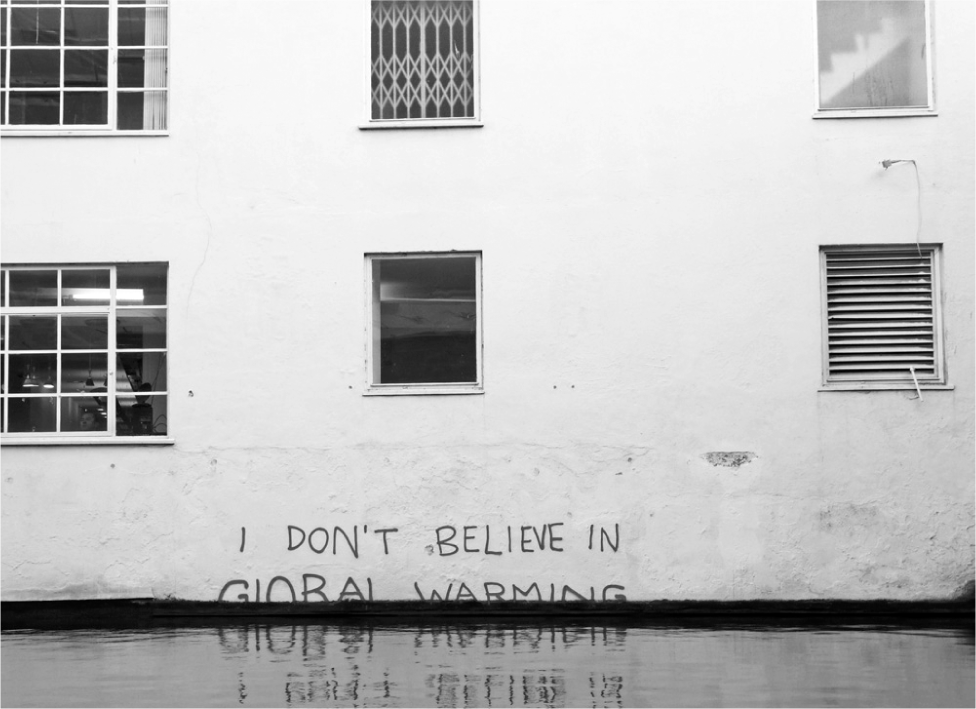
“I don’t believe in Global Warming”: Climate change denial by #Banksy.
Dunk, Flickr CC
A Way Forward
Our qualitative research with self-identified skeptics in Idaho indicates that the current public perception regarding the nature of U.S. climate change skepticism may, in fact, lack the sophistication needed to truly understand the perspectives of skeptics. Popular knowledge, including the larger media discourse, suggests that skeptics are conspiracy-minded conservatives with little regard for the environment. Our research demonstrates that this notion fails to capture the complexities of views among those who are skeptical of climate change or its human causes.
Regardless of their reasons for being skeptical about climate change, our participants expressed a considerable amount of pro-environmental views and support for environmentally beneficial policy initiatives. While we do not intend to generalize our findings to Idaho or the Unites States, the diversity of pro-environmental perspectives captured here suggests that a more nuanced approach to discussing climate change skepticism is necessary when enacting climate policy.
It is worth noting that many of our participants identified as republicans (12). Though we did not explicitly ask if they supported the election of Donald Trump or Trump’s broad environmental program, we did ask what they thought of the Trump Administration’s move to cut funding for the EPA and to expand offshore drilling. At the time of interviews, most participants were not aware that he had cut funding to the EPA or that he was seeking to extend offshore drilling, indicating a potential disconnect between administration’s moves and the awareness of these policies held by voters.
The complexity of our participant’s views on the environment and their disconnect from the Trump Administration’s policies demonstrate the importance of our research on implications for climate communication. We have an opportunity to reframe our conversation to focus on environmental goals that are likely to garner wide public support: curbing pollution, investing in alternative energy sources, and reforestation. Absent is a nuanced understanding of these pro-environmental attitudes of climate skeptics. The environmental policies enacted will continue to fail to address public demands for a cleaner, safer environment. Instead, operating under assumptions based on a mischaracterization of climate skeptics’ reasons for doubting climate change and their preferred environmental goals would exacerbate the existing political polarization and partisan gridlock, preventing the enactment of needed climate policy.
Considering the pro-environmental attitudes of the self-identified climate skeptics we interviewed, our research demonstrates that public acceptability potentially exists in the United States for additional pro-environmental policies. Such policies include, resource efficiency strategies (e.g., extending product lifetimes), investing in efficient products, and supporting product sharing, findings which have similarly been found in the United Kingdom. In our ongoing survey research, we are assessing the prevalence of these pro-environmental attitudes among larger and representative samples of climate change skeptics in Idaho and the United States.