



Abstract
The hashtag syllabus is a crowd-sourced body of work that can, in some cases, challenge the knowledge construction of the academy. Hashtag syllabi have the opportunity to reshape how knowledge is produced, whose knowledge is affirmed, and what knowledge people are exposed to.

The hashtag syllabus is a tool of social change. You may have seen hashtag syllabi making their rounds on your social media feeds. Maybe you’ve clicked on one, or maybe you’ve bypassed the link with the casual disregard of a savvy internet user avoiding clickbait. However, these hashtags you have seen are changing the practice of knowledge production and joining it with social justice activism.
Unlike the syllabi found in your typical college classroom, hashtag syllabi are found on the internet and are user-generated, crowdsourced, and strive to be open-access. Hashtag syllabi are often compiled by people inside and outside of the academe, including activists and scholars and are often People of Color, women, and other minoritized peoples. Some associate the open access aspect of the hashtag syllabi to imply low quality or not peer-reviewed academic work. In reality, this allows users—members of the broader public—to read, access, sometimes modify, and contribute to the works contained within the syllabi. Open access is about expanding access and challenging racist, classist, and masculinist considerations of what “quality” knowledge production looks like, and who should have access to it. More often than not, hashtag syllabi are also interdisciplinary; the texts in the syllabi are not confined to those produced in academic institutions. They do, however, often include journal articles and books from varying academic disciplines while they are also just as likely to include visual media, songs, poetry, and prose.
Unlike the syllabi found in your typical college classroom, hashtag syllabi are found on the internet and are user-generated, crowdsourced, and strive to be open-access
Hashtag syllabi are often shared widely on the internet between activists, scholars, social media users, and those simply interested in learning more about what any given syllabus has to offer. Hashtag syllabi then, are partly demonstrative of the power of and need for intellectual activism. In On Truth Telling and Intellectual Activism, sociologist Patricia Hill Collins asserts that intellectual activism ought to embrace speaking truth to power and speaking truth to the people; hashtag syllabi often effectively embody both of these strategies. While there does not appear to be an intended audience, there appears to be an intended purpose: to disrupt distorted interpretations of knowledge, events, history, and truths. Thus, hashtag syllabi might be a move towards the decolonization of knowledge production due to their creators and curators, the knowledge(s) they hold, and their interdisciplinary nature.
The Promise of Hashtag Syllabi: Shifting Knowledge Production
Hashtag syllabi have the potential to have broader ideological implications about knowledge production. The emergence of these hashtag syllabi implores scholars and the public alike to reconsider 1.) how knowledge is produced 2.) whose knowledge is affirmed, and 3.) what knowledge people are exposed to and how they are exposed.
Sociologists have long discussed, debated, and critiqued the historical and contemporary knowledge construction of the sociological canon, and the ways in which it reproduces anti-black racism. For instance, in The Scholar Denied, Aldon Morris discusses how African American scholar W.E.B. Du Bois and his sociological contributions are too often erased or minimized from the classical sociological canon. Additionally, in Dark Matters, Simone Browne asserts that the development of the sociological discipline and the knowledge construction and production within the field has been built on anti-black racism. These claims critically interrogate the racialized and racist processes of knowledge construction within the academy. Hashtag syllabi interrogate the knowledge construction of academia to some degree, as well as share and promote resources that challenge white narratives of knowledge in part by drawing on the intellectual contributions of scholars who have been marginalized in academia.
Considering the racialization (and racism) of knowledge production, the conventional academic syllabus can function as a tool of exclusivity by determining whose knowledges are to be omitted, erased, and revised. Too often, the academic syllabus has functioned as a tool that reproduces white elitist canons of knowledge. Hashtag syllabi have the potential to shift the power of knowledge construction outside of the walls of the academe firmly into the hands, hearts, and minds of those who have been marginalized and suppressed by white academic spaces. While people do not need doctorates or advanced degrees to create a hashtag syllabus, nor do they need to be endowed with any kind of institutional authority, that doesn’t mean that these syllabi do not include or value the work of institutionally trained academics. It does mean that they do not have to be restrained by the conventions of the academe.
Considering the racialization (and racism) of knowledge production, the conventional academic syllabus can function as a tool of exclusivity by determining whose knowledges are to be omitted, erased, and revised
The Internet & Public Intellectualism
Outside of the hashtag syllabus, there is already groundbreaking academic work considering the internet as a critical site of public intellectualism. Sociologist Jessie Daniels frequently implores academics to expand considerations of knowledge production by using digital media platforms such as Twitter to generate bursts and sound bites of scholarship to a broader audience outside of the academy. This idea is not new, but it is an important one that gets dismissed in white dominated spaces. In 1994’s Black Feminist Thought, sociologist Patricia Hill Collins defines Black feminist knowledge as knowledge produced by one’s lived experiences. More recently, Leslie Jones, a graduate student in sociology at the University of Pennsylvania, explores the intellectual work of Black women on Twitter and Facebook in her article on the Omnia covering the intersection of Black feminism and social media, exploring how Black women utilize the “public platform for social critique about race and gender.”
While Twitter has become a popular internet platform for gathering and disseminating information, including the hashtag syllabi, that does not mean it is without limitations. We must also consider the broader utility of digital pockets of subversion considering dimensions of age and social class. While millennials may have grown up navigating and curating internet spaces, this intimate digital familiarity may come at the exclusion of those who are unfamiliar with the internet and its social media platforms. How can users find something if they do not know what they are looking for, or where to look to begin with? Twitter may also elude those who do not have access to the internet and its social media platforms because they cannot pay for internet service or do not have reliable or consistent access to a computer. These challenges point to the ways in which critical spaces on social media sites may be relatively inaccessible and inadvertently reproduce elitist gatekeeping in accessing alternative knowledge systems such as hashtag syllabi.
Despite the challenges presented by the social media platforms that hashtag syllabi are often posted on, the syllabi themselves often touch on critical issues and generate alternative knowledge systems that challenge dominant and whitewashed narratives about people, events, and history. This is interesting considering how these social media platforms have become corporatized cash cows for young, white, male venture capitalists. Facebook alone is one of the largest international internet companies. According to a 2017 report by Telegraph Reporters, the company is worth almost $500 billion, boasts 3.7 billion users, and over time has acquired additional social media platforms, including Instagram (bought for $1 billion in 2012) and WhatsApp (bought for $19 billion in 2014). The hashtag syllabi are a form of disruption to those corporate platforms as they utilize social media platforms for social justice.
(Re)Definition of the Hashtag Syllabus: The Charleston Syllabus
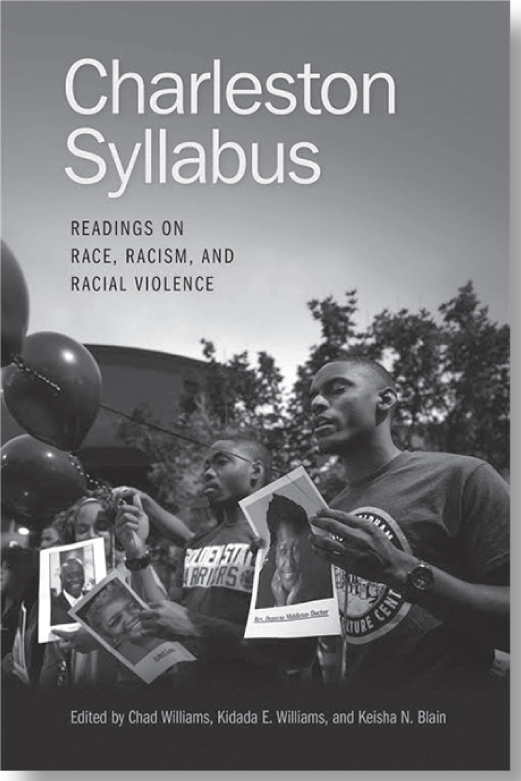
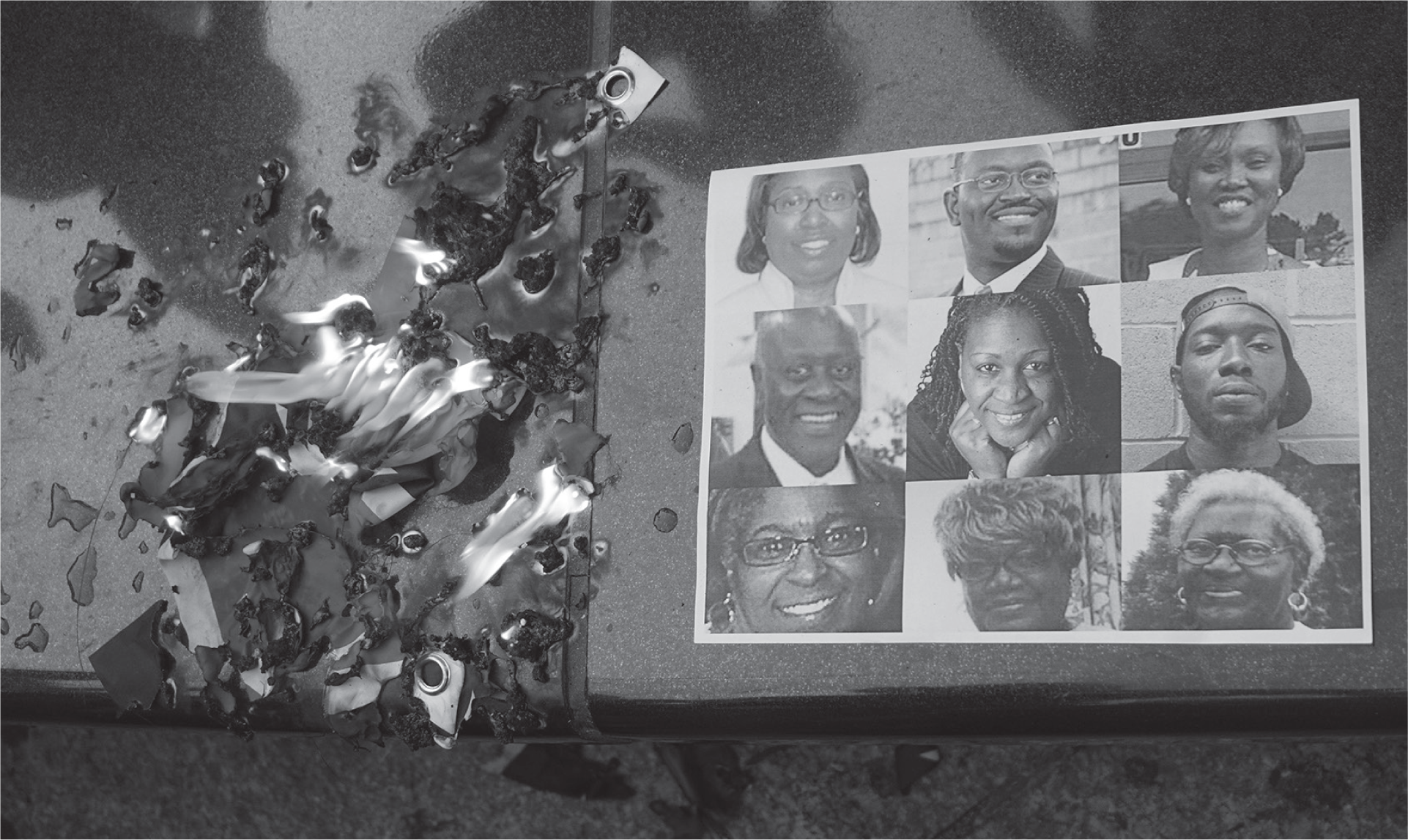
One of the earlier hashtag syllabi to surface on the internet and become popularized was the Charleston Syllabus, conceived by Professor Chad Williams and maintained by Keisha N. Blain, then a faculty member at the University of Pittsburgh. Created in 2015, the syllabus is currently hosted on the African American Historical Society’s webpage. This syllabus was compiled in response to the brutality of the events in Charleston, South Carolina, where nine Black parishioners were murdered by a white supremacist terrorist in Charleston’s Emanuel African Methodist Episcopal Church. The Charleston Syllabus includes a multitude of readings that cover the historical genealogy of white supremacy in the United States, the history of Charleston, as well as a broad overview on race and racism in the United States. This syllabus provides readers with critical historical context leading up to the events in Charleston—affirming that this country’s racist present is firmly rooted in this country’s racist past.
The Charleston Syllabus was not the first of its kind. The Ferguson Syllabus was created in 2014 by Marcia Chatelain, an assistant professor of history at Georgetown, in response to the murder of Michael Brown. It is thought to be one of the first hashtag syllabi to emerge, with Chatelain hoping to codify sources that educators could use to engage in conversations with their students about race, policing, African American history, and civil rights in the United States. Chatelain used Twitter to ask for recommendations for the Ferguson Syllabus and suggested that her academic colleagues use the syllabus on their platforms, reaching into their social networks to generate additional resources. Chatelain found that her efforts resonated with activists and educators alike as they sought materials to help them grapple with the events emotionally and intellectually.
NYC Stands With Charleston. A vigil and rally held in New York on June 22, 2015
The All-Nite Images
After the Ferguson Syllabus, digital syllabi have emerged in response to Black Lives Matter, Beyoncé’s Lemonade album, Jordan Peele’s film Get Out, the events surrounding the Dakota Access Pipeline, an Indigenous resistance (#NoDAPL), and more recently, the Black Panther film. The syllabi respond to political moments and events, cultural (re)awakenings, questions of identity and existence, and they center the voices and knowledge of people of color through solicited contributions and collective curation in the spirit of the co-construction of knowledge.
Charleston Syllabus Readings on Race, Racism, and Racial Violence
The University of Georgia Press
The Charleston Syllabus—and the many other hashtag syllabi that exist—are necessary because they provide alternative knowledge systems in a political and cultural landscape where histories and narratives are too frequently distorted and whitewashed. While some like Brittany Farr—a doctoral student in communications at the University of Southern California—have argued that these syllabi aren’t syllabi, but instead reading lists. Others, like Plath have contended that the syllabi like the Charleston Syllabus, allow “readers to gain ‘knowledge, strength, and inspiration” in the fight for racial justice and work toward more meaningful conversations about race in the United States. These hashtag syllabi can help open pathways to knowledge systems that are deemed transgressive in white spaces, and these transgressive pieces of knowledge hold immense power to shift dominant narratives.
The History of Non-Digital, Crowdsourced Knowledge
While the open-sourced hashtag syllabi may be digitally innovative, crowdsourced knowledge is not a new phenomenon, particularly in communities of color. Collective knowledge has firm roots in the Black radical tradition, and The African-American Historical Society suggests that during the last half of the 19th century, African Americans assembled in literary societies such as the American Negro Academy and the Literary Society in response to racial tensions and hostility, discrimination, and anti-black violence. Members would share Black intellectual works and engage in spaces of resistive knowledge production to challenge the racist imagery and depictions of Black identity in the white imagination.
One of the earlier hashtag syllabi to surface on the internet and become popularized was the Charleston Syllabus…The Syllabus includes a multitude of readings that cover the historical genealogy of white supremacy in the United States, the history of Charleston, as well as a broad overview on race and racism in the United States
The building of collective knowledge has not been limited to physical meetings, historically or contemporarily, though they indeed play an important role. Curating written works has been central to both communal knowledge building and the Black radical tradition in ways that predate the hashtag syllabi. During the 1980s, the National Black Feminist Organization (NBFO) worked with The Kitchen Table: Women of Color Press. The NBFO was collectively organizing for the liberation of Black women in the United States; sharing knowledge through the written word allowed Black feminist organizations to disseminate information broadly.
Contending with a publishing industry that was (and remains) dominated by white men at the time, The Kitchen Table: Women of Color Press was created by a collective of women of color in an effort to disrupt the whiteness of the publishing world. The press cooperatively produced resistive knowledge by amplifying the voices of women of color, publishing their works in the forms of short stories, poems, and other intellectual works. The press ultimately published Cherríe Moraga and Gloria Anzaldúa’s This Bridge Called My Back: Writings by Radical Women of Color in 1984. With the press, the power of the production of knowledge was tailored by and for women of color.
Around the same time, Beverly Smith, Barbara Smith, Demita Frazier (who were also involved with NBFO) co-founded the Combahee River Collective (CRC), a Black Feminist Lesbian organization, to combat the intersecting oppressions of racism, classism, and heteropatriarchy. While CRC was engaging in varying forms of activism, they also published their seminal work, A Black Feminist Statement under The Kitchen Table: Women of Color Press, which outlined intersectional Black feminist politics. While these efforts remain a testament to the politics and power of coalition building, they were also instrumental in collectively building resistive pieces of knowledge and drawing them, in the words of bell hooks, “from the margin to center.”
Moments of collective knowledge have also materialized online as well. Activists have been utilizing the internet to generate and curate alternative ways of knowing for quite some time, and activism is in the production and curation of the hashtag syllabi. For instance, public educator Candice Benbow, with the contributions of over seventy Black women, curated and openly released the #LemonadeSyllabus, which includes the work of over 250 Black feminists. The Lemonade Syllabus has a table of contents that is organized thematically and outlines sections such as fiction and literature, non-fiction and autobiography, Black Feminist studies, youth, inspirational and self-care, as well as poetry and photography.
Limitations of Hashtag Syllabi
While there are immense possibilities of the hashtag syllabi, these innovative tools are not a panacea for structural and systemic oppression. Perhaps questionably, the works contained within the hashtag syllabi are given credence by virtue of labeling the document as a “syllabus.” To some degree, at least linguistically, the syllabi are still using elitist academic conventions of majority white and male-centered knowledge production. While this may be partly attributable to some of the curators of these syllabi being formally trained academics or close to academic institutions, there are other curators who may have never stepped foot inside of a college classroom. They may or may not know what the word syllabus means, or if they do, associate it with an experience they have not had.
We must consider whether the very language of the hashtag syllabi risks alienating the medium from a broader audience and whether the deployment of that language comes at the expense of erasing the voices and knowledge contributions of people who are not college-educated. In the spirit of Audre Lorde who questioned whether the master’s tools could ever dismantle the master’s house—we must ask ourselves if institutions of higher education in the United States have a historical legacy and contemporary practice of precluding, marginalizing, and erasing People of Color, poor and working-class people, women, and people with disabilities. If so, then what does it mean to use language associated with and engendered by those very same institutions? We must explore whether it is possible to generate radical resistance using language and concepts born in institutions of racial oppression and violence.
This argument does not intend to suggest that people who do not have a college education will not be able to understand the contents of the hashtag syllabi, or that those who have not attended college lack something because they did not attend a formal institution of higher learning. As writer Sherronda Brown suggests in her piece, Elitism Sucks: Black Intellectualism Should Embrace Those Who Have Lower Levels of Education, minoritized peoples produce knowledge by their lived experiences and movements through the world, and it is problematic at least and oppressive at worst to silence and erase the voices and knowledges of people who do not have college degrees. Intellectualism is not restricted to those who have degrees from institutions of higher education. People of color, women, and poor and working-class people who do not attend college know their own experiences, produce knowledge, and must be the purveyors of their own stories. They do not need access to scholarly works to tell them about injustice because while oppression is structural, it also pervades the most intimate parts of the self.
The Possibilities of Digital Crowdsourced Syllabi
Despite the limitations of the hashtag syllabi, they still hold immense promise for the way knowledge systems are produced, curated, shared, and thought about. Their very existence challenges dominant ways of how we come to learn and know. They also push back on the notion of who gets to produce knowledge and modes of thought in the spirit of radical historical revisionism. Not learning about Black Panther and its conversations around Black liberation, Afro-Futurism, and resistance to colonialism in school? Check out the #WakandaSyllabus. Not sure how the contemporary political moment has been engendered by historical moments? Take a look at the #NoDAPL syllabus. These syllabi affirm what People of Color already know about their knowledge and histories—that they are important, that there is power in community (including digital communities), and that knowledge does not have to be created, curated, or legitimized by academic institutions.
Hashtag syllabi energize and animate the scholar within me. As a doctoral student in sociology, sometimes I’m surprised at my arrival in the academy as I am a mixed-race woman of color who grew up poor and working class. The elitist, Eurocentric, and masculinist canonical knowledges of the academy are profoundly alienating for me. I am used to sitting on the bus during my commute to graduate school burrowing into the works of Gloria Anzaldúa, Cherríe Moraga, and bell hooks. I steal time to read transgressive knowledges that are deemed not valuable enough to bring inside of classrooms because the white racial frame casts work by radical scholars of color as not “academic” enough. Or simply renders their work invisible by not incorporating it inside of classrooms. I do not want or need white institutions to legitimate those knowledges for me, but I am tired of them being silenced by white institutions. Those works and these hashtag syllabi speak to me with intimate confidence and tell me many things. They tell me that knowledge can be radical, born of collective thinking; they tell me that knowledge can change the world.