




Abstract
Fabio Rojas interviews historian and novelist Ada Palmer.
Keywords
Ada Palmer is an intellectual historian at the University of Chicago and a cutting-edge science fiction novelist. Palmer’s work as an historian examines how societies confront heretical ideas. Her work as a premiere sci-fi author, while historically informed, asks readers to imagine new political and social identities. Her first novel, Too Like the Lightning, won the Compton Crook Award for the best first novel in science fiction and was a finalist for the Hugo Award, one of the genre’s highest honors; she also received the 2017 John W. Campbell Award for Best New Writer.
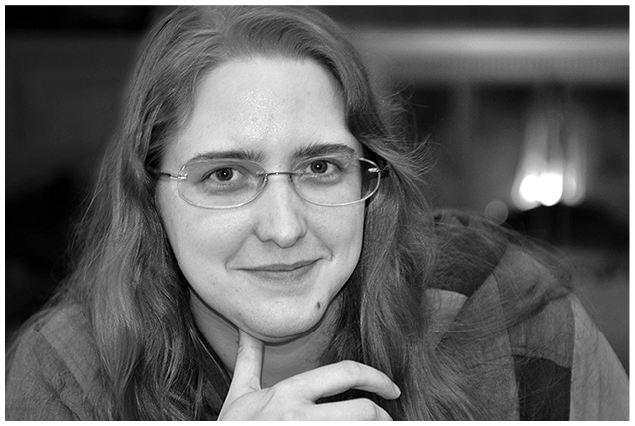
Ada Palmer
Courtesy Linda Palmer
A Historian of Heresy
How would you describe yourself as an academic professional?
So I did my PhD at Harvard, and my specialization broadly is in radical or forbidden ideas—ideas that are right on the edge of acceptability in societies—and how they move around, how they proliferate and are transmitted despite broad hostility on the part of the culture…. I study witchcraft and magic, I study homosexuality, I study atheism, I study belief in the existence of vacuum, atomism and radical physics, stoicism, epicureanism—all things that, at different times, are forbidden, not quite forbidden, or are somewhere on the edge of the sphere of acceptability. Even if largely unrelated, these ideas are transmitted through the same types of challenges and subject to the same types of tensions.
How did your dissertation engage this pseudo-acceptability of ideas?
It focused on the reception of Lucretius in the Renaissance. Lucretius’ epic poem, De Rerum Natura, is a 1st-century BCE digest of Epicurean philosophy. [This] poem talks about how the cosmos is made of atoms and vacuum, and how in the early days it was just chaos and then atoms moving randomly through space clumped together to create wads and then eventually worlds, and then life developed on those worlds, and then only the species well suited to their environment survived to the present day.
Why was it forbidden to talk about this poem in the Renaissance?
It denies the immortality of the soul, it denies the existence of an afterlife, and it gives a model of nature in which the gods had no part of creation. Lucretius says there are gods, they do exist, [but] they are one atom wide, live in deep space and they do not care about us. And so this is challenging to orthodox notions of divinity, orthodox ideas about prayer and gods listening to your prayers. And when this poem, after being absent for several centuries, is rediscovered in 1417, in Christianized Europe, it makes a splash as a radical text that has a lot in it that people are excited by. It has beautiful poetry, it has a lot of historical details about the era in which it was written. It’s the text closest to Virgil’s Aeneid, and Virgil’s Aeneid is the best thing ever to people in that time. So this new poem is exciting as a poem since it’s effectively another version of the best thing ever, but the content is a challenge since it denies the mortality of the soul and has all these other radical and uncomfortable ideas.
So, a lot of people in the Renaissance read Lucretius and a lot of people commented on it. Modern historians and others who are interested in the intellectual interiority of the Renaissance have asked, “How much were these readers questioning Christianity? How many were really atheists? How many were in it just for the poetry?”
Science Fiction or Social Science Fiction?
Let’s talk about the concepts behind your works of fiction.
They all take place in the 25th century, and there is a global system of flying cars so fast that you can get anywhere on earth from anywhere else on earth within two hours. It socially compresses the whole world into the same social relationship as a city and its suburbs, so everywhere is commuting distance to everywhere else. It’s perfectly normal to live in the Bahamas, go to work in Tokyo, have a lunch meeting in Paris. It’s perfectly normal to have your spouse live in the Bahamas with you, have a lunch meeting in Buenos Aires, and work in Antarctica—and this is a perfectly reasonable commute for everyone in a day. Once that system is in place for a couple of generations, geography begins to be divorced from identity. … When people live and work and move around the globe daily, it stops making sense to people for geography to be definitional for citizenship and for political identity.
[P]eople drift toward non-geographic ideas about nationhood and national identity. Rather than citizenship coming from birth it comes from identity: one might say “I am French, and it doesn’t matter whether I was born in Chile, I feel that I am French.”…The books imagine a 25th century in which nationhood has become fully non-geographic, since the system has been in place for 300 years. We have global nation-like organizations of governance called Hives.… [W]hen you come of age, you take the adulthood competency exam and you choose which of these political institutions you feel shares your values and has the laws you respect and would like to live by, and you sign up for it and you pay taxes to it and it is your legal protection. [This Hive] provides your social services, besides those that are local to your town, and you obey its laws. But your next-door neighbor or even your spouse may abide by a different set of laws, because that is what they have chosen.
How would you describe the plot or thematic arc of the series?
There is a who-done-it, but it’s a strange who-done-it. The entire first book is figuring out what it is that someone has done. You finally fully understand the full consequences of what was done on the last page of the book, and you don’t understand fully what’s happened at that point. Up until then you’re aware that a crime has happened and people are trying to figure it out and it’s connected to deep political stuff… but only at the end of book 1 do you fully understand the scope and scale, and then book 2 is both the solution of the mystery and, more important, its consequences. It’s one of the slowest-burn mysteries you could possibly imagine.
And what about the different types of writing you use in the book?
So, the large narrative structure is mainly in the style of the 18th-century philosophical novel, like Candide or Diderot’s Jacques le Fataliste (which is what it is based on). The narrator gives this very personal, very emotional, very analytic narration, which is also very lush and constantly interrupting: “Oh, dear reader! Doesn’t this remind you of something…”. And then it will go off on a philosophical or historical tangent for a page and a half before returning to what was happening. So much of it is that 18th-century pleasure of getting to know the author’s voice and getting to know the narrator who is describing this to us. And the relationship between the narrator and the reader, which 18th-century authors like Diderot so loved to explore.
We also learn that this future is a future where people, at least in English, don’t use gendered pronouns anymore. In fact, gendered language is ferociously taboo. Gendered differentiation is not there in daily speech, but the narrator claims that, in order to navigate this particular story, gendered pronouns must be used—so the narrator uses gendered pronouns in the narration but in the dialogue… everyone uses the neutral “they.” But the narrator isn’t using pronouns the way we normally use them either, since the narrator uses “he” and “she” based on the narrator’s assessment of the person’s personality and which of the two categories it fits, not based on the person’s body.
This combination means that the book gives you a very weird and orthogonal way to consider how we use gender. Gendering [in this series] disrupts you as a reader. … Each reader learns about your own unique relationship with gender and how you feel about it from how you react to the bizarre disruptions to gender that the narrator continues to introduce over the course of the whole series. My goal was to facilitate self-discovery, exploration of your own gender attitudes, by intentionally using gendered pronouns in a way that is comfortable for no one. I really mean that it’s comfortable for no one. If you’re progressive, it’s not comfortable. If you’re not progressive it’s not comfortable. If you’re me, it’s not comfortable. There’s no one for whom the narrator’s use of pronouns is comfortable, largely because it is disruptive and inconsistent. But, by having that uncomfortable encounter with unreliable pronouns, you the reader then get a chance to examine your own relationship with gender and pronouns and think, “Interesting, in this moment the gendered pronouns are helping it be clearer, but in this other moment the gendered pronouns are actually quite toxic and making me judge this character in a way I know I wouldn’t if this person had other pronouns.” So you learn about how you yourself engage with gender, and how the same kinds of language can be useful or toxic in different situations.
Families are different in this future world, too; how are they tied to higher education?
There’s a new family unit, and that’s the historian in me, because most people when sitting down to imagine a future for Earth start with, “Where we are now?” but instead I think like a historian, so I rewind and look at the world a few centuries ago and say, “Okay, what is in flux? What has changed over the last few centuries? What is changing now? What’s likely to keep changing?” Gender is changing now. I think we don’t know what the future of gender will be but we do know it’s unrealistic to write science fiction where gender in 100 years still works exactly the way it does now. There are a bajillion ways it could work, but it will not work the way it does now because how it works now isn’t how it worked a few decades ago.
Similarly the family unit has been changing over time, and the isolated nuclear family that is what western literature tends to see as the current standard family unit (often dwelling in suburbs) is only a few decades old and already isn’t working well with changing demographics as more women work, more families live in cities, etc., so I don’t think it’s realistic that the nuclear family unit would remain unchanged over the next century… My imagined new family unit is the bash’ (from the Japanese ibasho, the good place where something belongs), a group of adults mostly between three and 12 members. …[Y]ou share a communal house, you raise kids together, everybody has a 20-hour work week, and those hours align differently, so there’s always one or two adults around where the kids are, and domestic resources like kitchens and cooking are shared. The bash’ forms at campuses, which are large educational communities with colleges and universities but also vocational schools. The bash’ forms through the friends one makes in that coming-of-age education process, and, as you’re finishing that process, you and a group of friends form a bash’ together. Some bash’es continue over time to the next generation, the new generation will come home to the same shared home they grew up in, sharing it with the earlier generation and bringing in new friends and spouses, while other bash’es form anew with every generation, through the friends one makes in college or college-like educational experiences. Now that it’s becoming more standard for all adults to work, a couple living alone simply can’t care for kids when the adults both work, but it is tenable when it’s a group of six adults who take shifts with kids during the week, so it’s a model that aligns better with current employment and residence patterns.