



Abstract
Tristan Bridges and Jesse M. Philbin on the behavioral patterns that betray cheap sex.
In Cheap Sex: The Transformation of Men, Marriage, and Monogamy, Mark Regnerus argues that men have historically entered marital relationships with women primarily to access sex. He claims that as women have demanded less from men in exchange for sex, the institution of marriage has been undermined. Regnerus suggests that shifts in women’s sexual behavior have “cheapened” sex because straight men are no longer obliged to offer concessions such as protection, resources, attention, or fidelity to gain access to sex with women. Thus, according to Regnerus, the decline in marriage—and the nuclear family—is caused by women’s newfound willingness to be “promiscuous.” These claims represent a nostalgic plea for a time when young women were expected to wait for marriage to have sex, accept reproduction as a likely outcome of sex, and rely on the material resources of a male partner. These claims are provocative. But are they true?
For Regnerus’s argument to be supported, heterosexual sex should be happening earlier in women’s and men’s lives compared to previous generations, and cohabitation, marriages, and children should all be happening later for both women and men. If sex is so “cheap,” and if men are as averse to committed relationships as Regnerus argues, we would expect to see men delaying or forgoing such commitments to a greater degree than women, since they are no longer required to offer them in order to access sex.
Our analysis challenges Regnerus’s claims. The patterns we observe suggest that sexual practices and relationship and family formation practices are not being undone but redone.
Sexual practices and relationship and family formation practices are not being undone but redone.
We examined shifts in women’s and men’s ages at first heterosexual sex, first cohabiting union, first marriage, and first birth, as well as the sequence of these events, to better understand transformations in heterosexual women’s and men’s sexual lives and family formation practices. Our findings suggest that, while shifts in the timing and sequence of these events have taken place, these changes do not support the “cheap sex” interpretation of transformations in Americans’ sexual lives and relationships.
A Note on Data and Methods
The National Survey of Family Growth (NSFG) first began asking unmarried women about their sexual activity in 1982. So, the data for women go back to those born in 1939 (the oldest women who were part of the initial survey in 1982). It was not until 2002 that the NSFG began interviewing men, too. The oldest men to be interviewed in any NSFG round were born in 1960. Using an approach employed by Lawrence B. Finer and Jesse M. Philbin in a 2014 article on women’s ages at life events, for each birth cohort (by year), we calculated the median age at which people reported having heterosexual sex for the first time (“first sex”), moving in with a romantic partner (“first cohabitation”), entering their first marriage (“first marriage”), and experiencing the birth of their first child (“first birth”). For those who first cohabited with a partner when they married, age at first cohabitation and age at first marriage are the same. To minimize noise, the medians we report for each birth cohort reflect the experiences of people born in that year as well as the two years before and the two years after. This approach allows us to fact-check Regnerus’s narrative of shifts in heterosexual sex and relationship behavior.
Decoding Shifts in Women’s and Men’s Sexual Life Events
Consider shifts in the median ages at which men and women first had sex, first moved in together (first cohabitation), first got married, and experienced their first birth over time (see next page). The general story is one of gender convergence—the differences between women’s and men’s timing of these events have been declining over time. Simply put, over time, gaps between the median ages at which women and men first experience each of these events have shrunk (converged).
For people born in the middle of the 20th century, there was approximately a 1-year difference in women’s median age at first sex (around 17) compared to men’s (around 18). Women’s median age at first sex continued to decline through the late 1970s, when it converged with the median age for men, and then both medians slowly began to climb. Both women’s and men’s ages at first sex have risen among younger cohorts of Americans, particularly when we compare them to those who were adolescents in the early 1990s (meaning they were born in the 1970s).
Shifts in median age at first sex, cohabitation, marriage, and birth by gender
Source: Authors’ calculations, using data from the Centers for Disease Control and Prevention, National Survey of Family Growth.
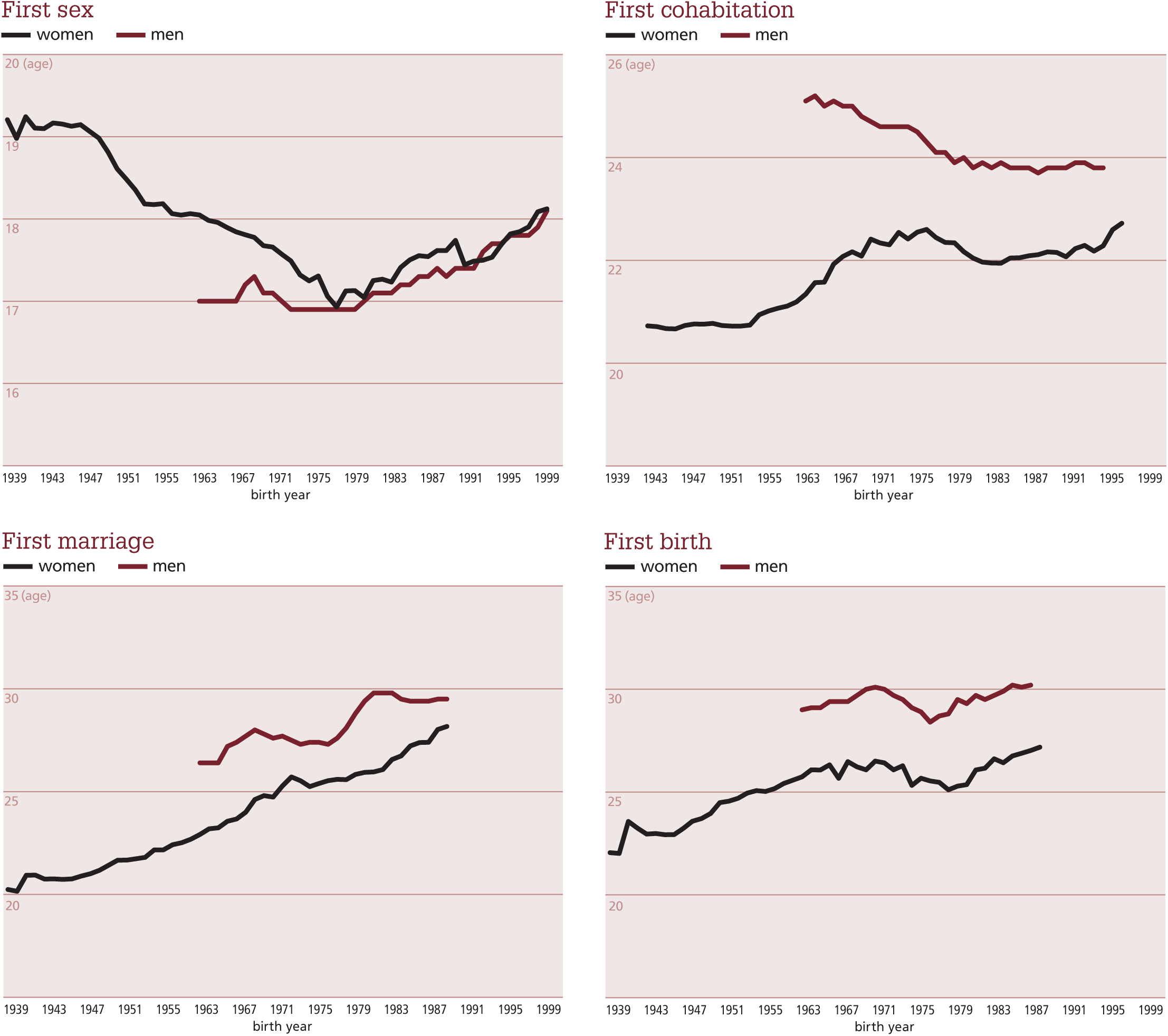
At first, the fact that the gap between the median age that women and men start having heterosexual sex has shrunk might appear consistent with Regnerus’s claim that heterosexual sex is simply “cheaper” (for men) than it used to be. However, this does not address the fact that young women and men have begun delaying sex. If sex is “cheaper” now than it was for older generations, we should expect sexual initiation to take place earlier not later.
While first marriage and first cohabitation used to be concurrent for women in heterosexual relationships, first cohabitation has now replaced marriage in the early 20s (see next page). For both women and men, the change in median age at first cohabitation is much smaller than change in median age at first marriage. As with age at first sex, we observe gender convergence—men’s median age at first cohabitation has decreased by about a year, while women’s median age has increased by a bit more than that. Entry into a committed, cohabiting relationship in young adulthood (early- to mid-20s) is normative for women and men, and has been for a long time. The main changes are that these partnerships no longer take the form of marriage and that women and men who do marry are likely to live together longer beforehand.
Shifts in median age at first cohabitation and first marriage by gender
Source: Authors’ calculations, using data from the Centers for Disease Control and Prevention, National Survey of Family Growth.
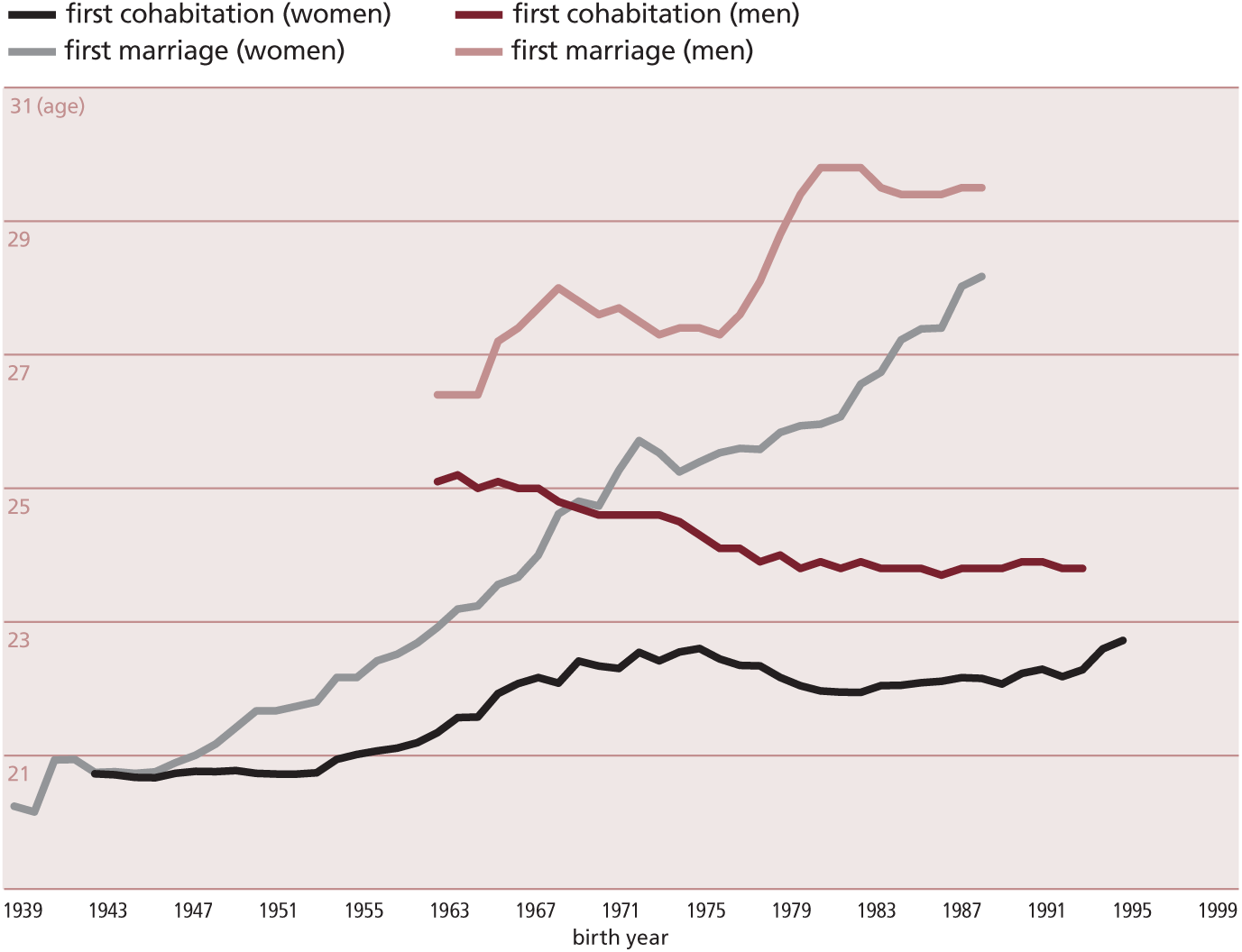
Again, the increase in age at first marriage and the longer gap between first sex and first marriage might seem to support Regnerus’s claims, but the data on first cohabitations are at odds with this story. For as far back as our data exist, men’s median age at first cohabitation has consistently declined. And though some might argue that cohabitation is a weaker type of commitment than marriage, it represents the sort of commitment that Regnerus argues is unappealing to men and should no longer be necessary in a “cheap sex” world.
Additionally, while both women’s and men’s median ages at first marriage have consistently increased, ages at first birth have been more static. Among those born in 1960, women’s and men’s median ages at first birth differed by just over 3 years—25.7 for women and 29.0 for men. The most recent birth cohorts of women and men in which at least 50% have experienced the birth of their first child show no change in this gender gap. This means the roughly three-year difference in women’s and men’s median ages at first birth has remained constant. Here again, these changes are not consistent with sex becoming “cheaper” for men. Were that true, we might expect significant delays in the timing of men’s first birth experience, as parenthood is another form of investment that men are—again, according to Regnerus— more reluctant than women to endure. However, changes in the age at first birth are modest for both men and women compared to marriage, and the gap in age difference at first birth between men and women has experienced virtually no change during the period that sex allegedly became cheaper.
The decades of evidence we present show significant shifts in heterosexual relationship practices, but they firmly reject a scenario in which women have made sex “cheaper.”
The final figure (next page) presents how timing and sequence of sex and relationship events have shifted in relation to each other and over time. It is a powerful illustration of social change, demonstrating not only that the intervals between events have changed, but also that the sequence of some of these events has shifted relatively recently. For instance, both women and men are having their first child later in the life course, and many are not married at the time.
The size of the intervals between median age at first sex and first marriage for women and men illustrates considerable change, too. While women and men are both having sex and getting married later, they are experiencing each event at increasingly similar ages to one another. For both women and men, there is now a gap of more than a decade between the median age at first sex and the median age at first marriage. When we compare the duration of these intervals for women and men, we see yet another pattern of gender convergence. Among the oldest birth cohort for which we have data for both women and men (those born in 1960), men’s gap between first sex and first marriage is about four years longer than for women; more recently, this difference has shrunk to less than two years.
Women today are having sex slightly earlier and moving in with a partner slightly later, compared with earlier generations of women. Compared to their predecessors, men today are having sex slightly later and moving in with a partner slightly earlier. While just examining women’s behavior might appear to support Regnerus’s claims, the trends for men are a more challenging fit for his theory. If women were “giving the milk away for free” with major consequences for men’s access to sex, we would expect men to be having sex earlier and postponing entry into committed partnerships; we certainly would not expect them to be delaying sex and hastening cohabitation as is the case.
Shifts in median timing and sequence of sex, cohabitation, marriage, and reproduction in U.S. women’s and men’s lives (by birth cohort and year)
Source: Authors’ calculations, using data from the Centers for Disease Control and Prevention, National Survey of Family Growth.
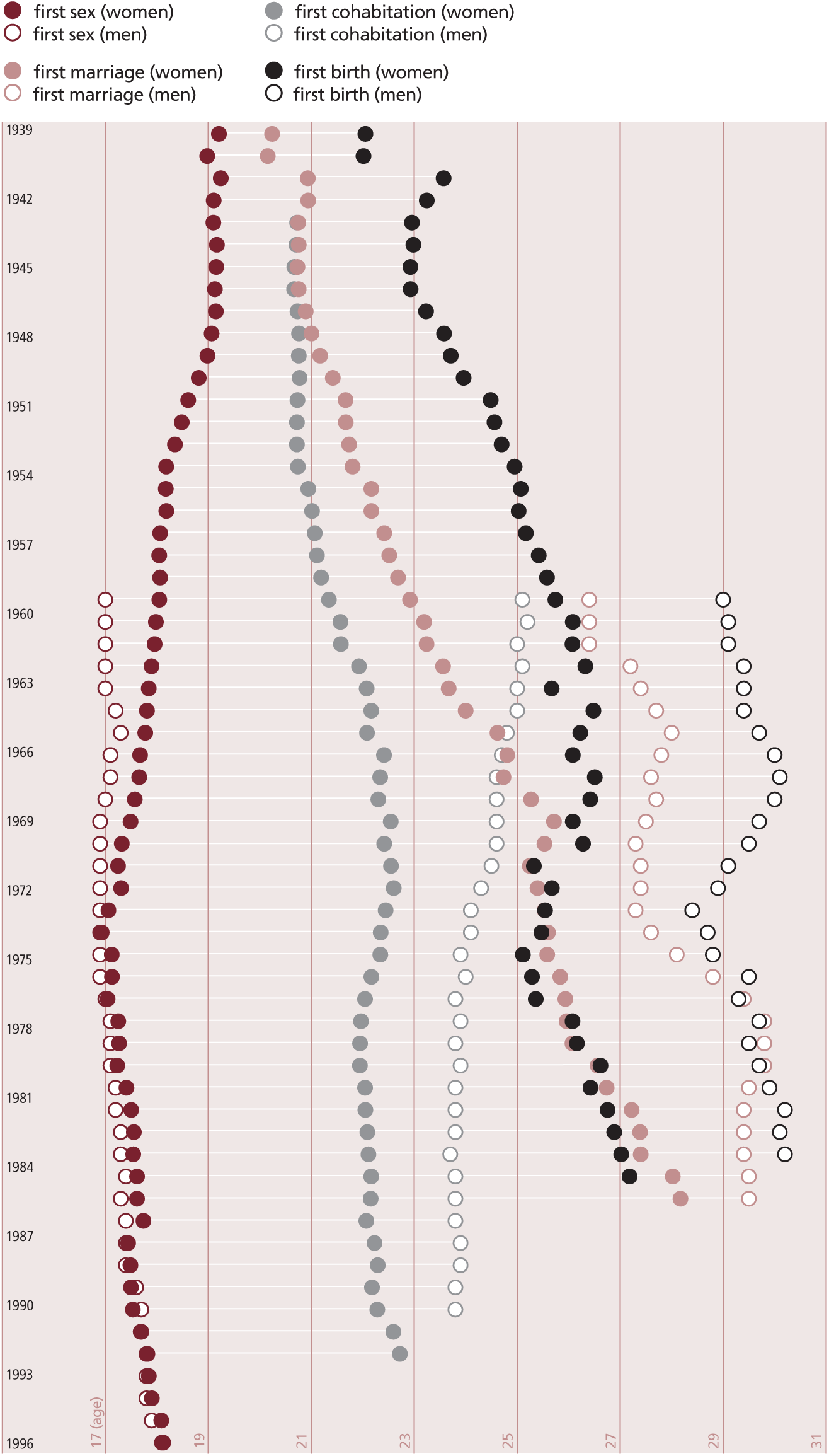
Perhaps the most interesting trend is the shift in the sequence between first marriage and first birth for women and men. The median age at first birth for women in the most recent cohorts is actually younger than women’s median age at first marriage. For men, while age at first birth (30.2) is still slightly older than age at first marriage (29.5), the trajectory resembles what we see for women. This means that in the U.S. today, first births outside of marriages are normative experiences—at least in a statistical sense.
Regnerus’s claims, if accurate, should be reflected in these historical, aggregate behavioral patterns. As we show, however, the data consistently fail to support his hypothesis and, in some cases, completely contradict it. As we argue here, the description that best fits shifts in the timing and sequence of heterosexual, relationship, and reproductive events in women’s and men’s lives is gender convergence. A more likely explanation is that sexual and relationship formation practices are increasingly dependent upon individual preferences and socioeconomic factors, and less dependent upon the gender-specific behaviors and norms or sex-specific biological impulses on which Regnerus’s explanation relies.
Regnerus problematizes women’s sexual decisions, reducing women to little more than what they can provide men as sexual partners. Yet, he also ignores men’s agency and motivations in sexual and relationship choices beyond a consideration of sexual access to women. The decades of evidence that we present show significant shifts in men’s and women’s heterosexual relationship practices—but they firmly reject a scenario in which women have made sex “cheaper” than it used to be.